



















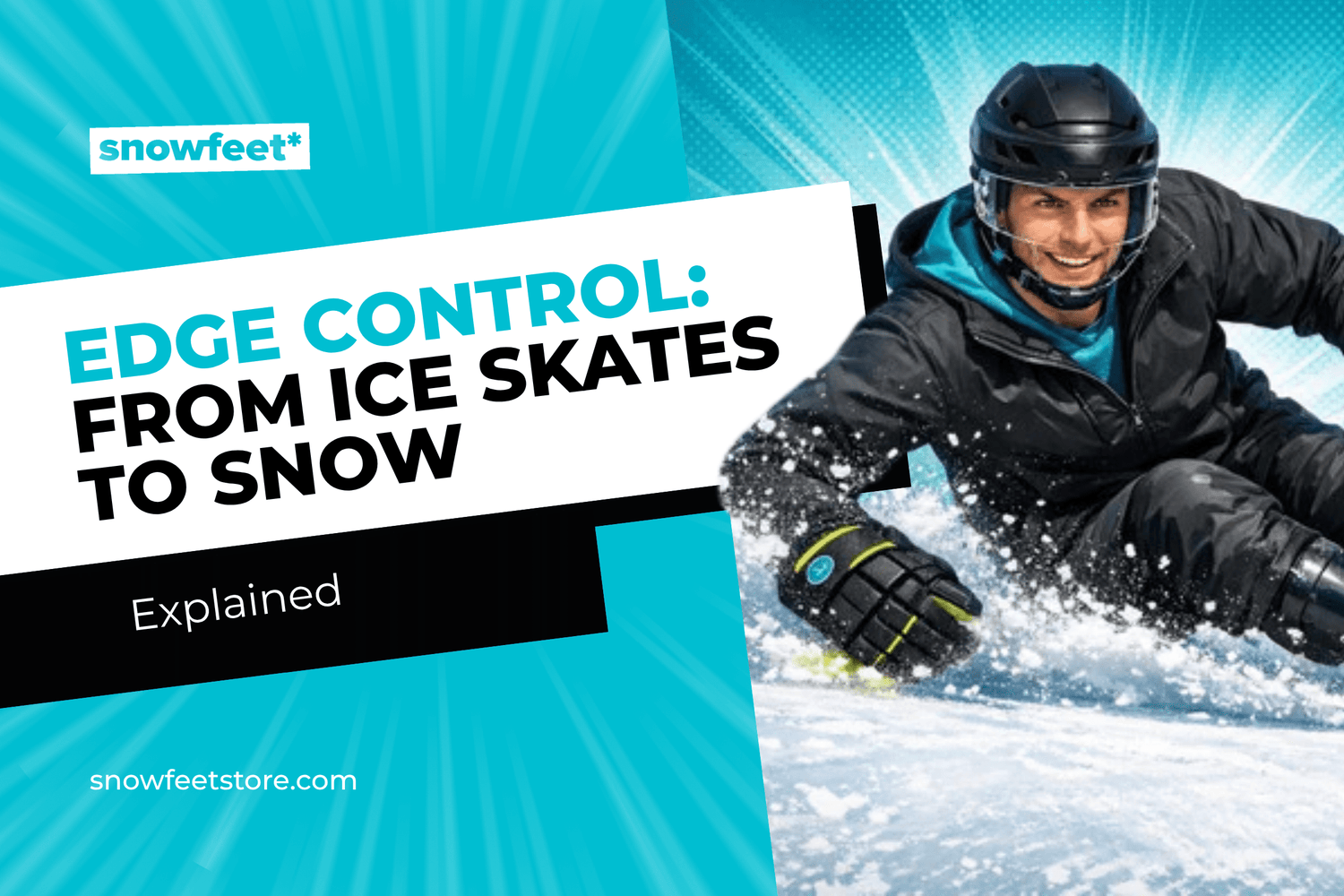
If you’re a hockey player thinking about skiing, you’re already ahead of most beginners. The balance, edge control, and quick movements you’ve mastered on the ice translate well to the slopes. But skiing isn’t the same as skating - snow is slower, and your weight shifts differently. Here’s the good news: short skis like Snowfeet Skiskates (44 cm) and Skiblades (65–120 cm) are designed to feel more like skating, making the transition smoother.
Key Takeaways:
- Hockey Skills That Help: Balance, edge control, and stopping techniques carry over to skiing.
- What’s Different: Snow adds resistance, weight shifts are bigger, and leaning back is a no-go.
- Gear to Try: Snowfeet Skiskates and Skiblades are shorter and lighter, making them easier to handle than long skis.
- Cost: Skiskates start at $575; Skiblades at $635.
If you want to skip the awkward learning phase and feel at home on the slopes, gear like Snowfeet can help you leverage your skating instincts. Let’s dive into the details.
Hockey Skills Transfer to Skiing: What Carries Over vs What Changes
THE TRANSITION FROM HOCKEY TO SKIING | Dodge Ski Boots Chairlift Chat #11
How Hockey Skating Skills Transfer to Skiing
If you've spent hours on the ice honing your hockey skills, you're already ahead of the game when it comes to skiing. All those practiced movements - turns, stops, and weight shifts - aren’t just for hockey. They lay the groundwork for skiing too. Your time on skates has given you instincts that translate naturally to the slopes, especially when it comes to edge control and balance.
Edge Control and Carving
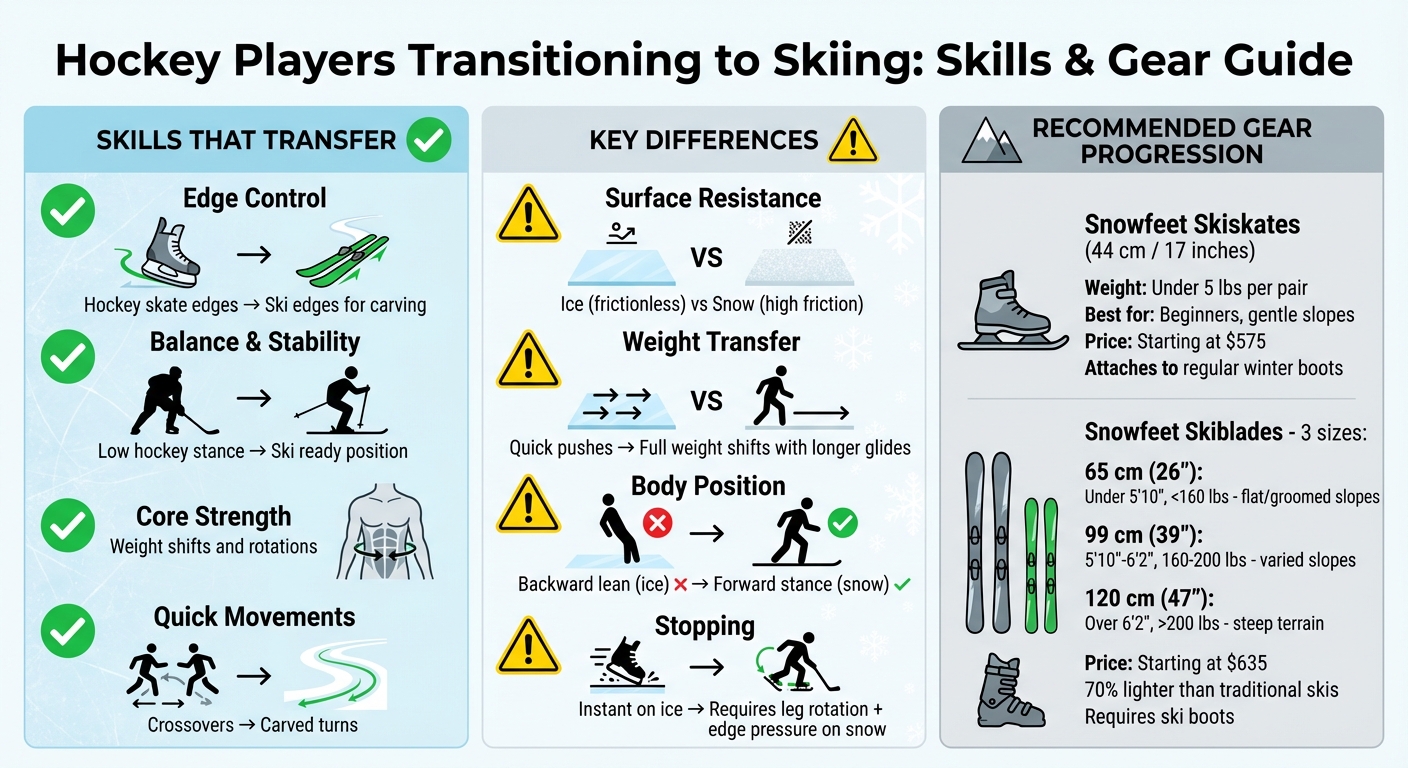
Hockey skates have two edges - inside and outside - and you've mastered how to use them for quick stops, sharp turns, and bursts of speed. That same edge awareness is a game-changer for skiing. When you carve a turn on skis, it’s all about engaging the ski's edges, just like the bite you rely on during a hockey stop. As Coach Jeremy from How To Hockey explains:
"You need to trust your edges and let them grip into the ice while you make sharp turns".
On the slopes, trusting your edges works the same way. Lean into your turns, let the edges grip, and you’ll have the control you need. Plus, all those one-legged balance drills, crossovers, and pivots from hockey? They’re perfect prep for carving on skis, where you shift your weight onto the outside (or downhill) ski. That edge control you’ve built becomes the backbone of your skiing stability.
Balance and Stability
Your hockey stance - low, stable, and ready - translates almost seamlessly to skiing. That familiar squat position you rely on during stops and turns is nearly identical to the "ready position" skiers use to maintain control and engage their edges. And your legs? They’re already conditioned for the job. Your quads, glutes, and core have been trained for those isometric holds that skiing demands.
As Joshua Cohen, a registered nurse and ski patroller, explains:
"From your core muscles to the small and large muscle groups of the lower legs, the dynamic motion that our body is going through while skiing improves balance and stability".
On top of that, the micro-adjustments you make with your ankles and lower legs to stay upright on the ice help you adjust to uneven snow conditions. And don’t underestimate your core strength - it’s key for shifting your weight and staying controlled. As Columbia Sportswear points out:
"Shifting your weight while skiing or snowboarding is essential; therefore, using your core, especially the obliques, is necessary to rotate the torso and support the lower body".
This is why products like Snowfeet*, which align with your natural movements, make transitioning to skiing even smoother. Your time on the ice has already set you up for success on the slopes. All you have to do is trust your skills and enjoy the ride!
What's Different Between Skating and Skiing
Your hockey skills might give you a solid foundation, but skiing is a whole different ballgame. Snow behaves nothing like ice - it’s softer, slower, and demands a new set of techniques. From handling friction to adjusting your body movements, understanding these differences can save you from common rookie mistakes on the slopes. Let’s break it down. If you're looking to learn skiing on your own, understanding these mechanics is the first step.
Dealing with Snow Resistance
Ice is slick and nearly frictionless, so skating relies on sharp, precise movements. Snow, on the other hand, creates way more resistance. To learn how to stop on skis, you’ll need to rotate your legs quickly and angle them aggressively to grip the edges of your skis.
As ski instructor Kevin Jordan puts it:
"To perform a hockey STOP and actually STOP quickly, you must turn your skis fast and tip your lower legs rapidly to get the edges to grip."
Stopping on ice is instant - you can halt a forward velocity of 10.1 m/s in seconds. On snow, though, it’s more about coordination. You’ll need to rotate your legs, control your upper body, and apply steady pressure along the entire ski edge to manage the friction and spray effectively.
Weight Transfer and Gliding Technique
Hockey skating is all about quick, powerful pushes with barely any glide time. Skiing flips that script, focusing on full weight shifts and longer glides that let gravity and momentum do the heavy lifting.
When skiing, you’ll need to shift your weight completely onto the downhill ski during turns. This creates the hip angulation that gives you control. At first, this forward weight transfer might feel odd, but it’s essential. Tools like Snowfeet* Skiskates, with their short and compact design, make it easier to master these quick leg rotations and smooth weight transfers.
Fixing the Backward Lean Problem
Here’s a big one for hockey players: stop leaning back! On the ice, you naturally shift your weight backward when stopping, crouching slightly and leaning away from your direction of travel. On skis, though, leaning back throws off your balance, making you lose control - or worse, sending you tumbling uphill.
Kevin Jordan explains:
"If I had focused on this pole plant reach downhill I would have fixed my balance problem and stayed upright."
A delayed pole plant can help. After engaging your edges, reach downhill with your pole to shift your weight forward. Think of it like sticking a landing in gymnastics - you want your balance to come from your feet, not your upper body.
This is where shorter equipment, like Snowfeet* Skiskates (measuring just 44 cm or about 17 inches), can be a huge help. Their compact size allows for quicker leg rotation and makes it easier to correct that backward lean. Plus, they’re less cumbersome than traditional skis, helping you adjust faster and build the right muscle memory from the start.
sbb-itb-17ade95
Best Gear for Hockey Players Starting to Ski
When hockey players trade the ice for the slopes, the right gear can make all the difference. Traditional skis come with bulky boots and a steep learning curve, which can be frustrating for someone used to the agility of skates. That’s where Snowfeet* gear comes in. Designed to complement your hockey instincts, this equipment simplifies the transition by building on the skills you already have, rather than forcing you to start from scratch.
Snowfeet* Skiskates (44 cm)
Snowfeet* Skiskates are a game-changer. These compact, skate-like devices attach directly to your regular winter boots - no need for those clunky ski boots. At just 17 inches long and weighing under 5 lbs per pair, they offer a lightweight, familiar feel for hockey players. The design encourages a forward stance and quick leg movements, much like skating, which makes them perfect for beginners tackling gentle slopes. You’ll avoid the awkwardness of long skis and focus on mastering the basics. Once you’ve got the hang of it, you can step up to Skiblades for more advanced challenges.
Snowfeet* Skiblades (65 cm, 99 cm, and 120 cm)
Snowfeet* Skiblades are all about versatility and performance, with options to suit different skill levels and terrains:
- 65 cm Skiblades (26 inches): These are ideal for beginners and work best on flat, groomed slopes. If you’re under 5'10" or weigh less than 160 lbs, this size is a great starting point.
- 99 cm Skiblades (39 inches): Designed for intermediate skiers, this size handles varied slopes with ease. It’s a solid choice for players between 5'10" and 6'2" or weighing 160–200 lbs.
- 120 cm Skiblades (47 inches): Perfect for steeper terrain or advanced skiers, these offer a smoother glide. They’re best suited for taller players over 6'2" or those weighing more than 200 lbs.
Each Skiblade model pairs with ski boots to provide a more traditional skiing experience as you progress. Despite their performance capabilities, they’re about 70% lighter than standard skis and fold down small enough to fit in a backpack.
Snowfeet* vs. Traditional Skis and Snowboards
Traditional skis and snowboards can feel like overkill for hockey players just starting out. Snowboards, for example, require a centered stance and heel-to-toe edging - techniques that can feel completely foreign to someone used to skating.
Snowfeet* products, on the other hand, are designed with portability and ease of use in mind. They align naturally with a hockey player’s parallel stance, making it easier to hit the slopes with confidence. Plus, you can skip the hassle of renting bulky equipment and dive right into learning with gear that feels like an extension of your skates. It’s a win-win for anyone looking to make a smooth transition from ice to snow.
Practice Drills for Hockey Players Learning to Ski
Beginner Drills
Start with a hockey stop - it’s a move that will feel familiar if you’ve spent time on the ice. Ski instructor Kevin Jordan explains:
"A hockey stop is when the skier turns their legs quickly, then sets their edges with firm pressure to stop. It comes from Ice Hockey where players must stop quickly and change direction to follow the puck."
To execute this on snow, quickly rotate your legs and press evenly from toe to heel to engage your ski edges.
Before heading to the slopes, try duck walking on flat terrain. Squat slightly with your knees bent and your feet turned outward. This helps build the leg strength and balance you’ll rely on while skiing. Once you’re on gentle terrain, practice monster turns - big, slow turns that let you control speed and direction while staying stable. Another great drill is the falling leaf. Slide diagonally across the slope, flatten your skis, and then apply pressure to the inside edge to change direction. This drill is excellent for improving edge control and lateral balance, skills you’ve likely already developed from quick transitions on the ice.
To sharpen your stopping skills, pick a specific spot on the snow - like a track mark or a small pile - and practice stopping right on it. For an extra challenge, try stopping within a narrow corridor, about as wide as a cat track. This forces quicker leg movements and strengthens your core, building the muscle memory you’ll need for consistent edge control.
Once these drills feel natural, you’re ready to move on to advanced exercises that focus on carving and precision.
Advanced Carving and Control Drills
After nailing the basics, step up your game with exercises like figure eights and carved turns. These drills mimic the tight crossovers you’re used to on the ice, but they also emphasize hip angulation - creating an angle between your upper and lower body to transfer more weight to your downhill ski.
To enhance your stability off the slopes, try single-leg drills. Start by balancing on one leg for 30 seconds and repeat this four times. Once you’ve got that down, add an unstable surface like a balance board or even a couch cushion to make it more challenging. Want to take it up a notch? Incorporate directional stickhandling while balancing. Moving a puck from front to side forces your core to work harder and mimics the weight shifts needed for smooth, controlled carving.
Physical therapist Steve Chmielewski highlights the importance of energy transfer:
"Power from each stride will be reduced as the player transfers his/her kinetic energy through the trunk, hips and knees into the ice effecting both the player's speed and agility."
This concept applies to skiing too - efficient energy transfer makes every turn feel smoother and more controlled.
Conclusion
Your edge control, balance, and muscle memory from hockey give you a solid head start when transitioning to the slopes. While you'll need to adjust to things like snow resistance, weight transfer, and avoiding a backward lean, your core skills are your biggest advantage.
Snowfeet* Skiskates (44 cm) and Skiblades (65 cm, 99 cm, and 120 cm) are designed to make this transition easier. Unlike traditional skis and skiblades - which require you to relearn turning techniques and can feel awkward in tight spaces - Snowfeet* lets you lean into your hockey skills. The shorter length allows for sharper turns, better control in crowded areas, and the precision you're already comfortable with on the ice. This alignment with your balance and edge control is why Snowfeet* gear works so well for hockey players.
Traditional skis and snowboards often demand you adapt to their design, but Snowfeet* is built to match your existing abilities. Whether you're practicing hockey stops, working through figure eights, or even balancing drills off the slopes, you're reinforcing your strengths while fine-tuning your snow control. Choosing the right Snowfeet* gear can make all the difference in your progression.
Start with the 44 cm Skiskates for maximum agility and an ice-like feel. Once you're confident, you can compare skiskates and skiblades to move up to the 99 cm or 120 cm models for more speed and stability on open runs. With equipment designed to complement your skills, you'll find the transition to snow smoother and more intuitive.
Trust your edges and let your hockey instincts guide you. The slopes may feel different, but with the right tools, you're already set up for success. Your hockey background has laid the groundwork - now it's time to take on the mountains.
FAQs
Can I ski without taking lessons if I play hockey?
Hockey players usually discover that they can pick up skiing or skiskating pretty quickly, even without formal lessons. That’s because the skills you develop on the ice - like edge control, balance, and agility - translate naturally to the slopes. While lessons can speed up the learning process and ensure you’re practicing safely, your hockey experience gives you a solid foundation to adapt to skiing or skiskating with just a bit of practice.
Should I start with Skiskates or Skiblades?
For hockey players venturing into skiing, Snowfeet Skiskates (44 cm) are an ideal starting point. These are designed to feel similar to skating, which makes the transition smoother and helps build confidence on the slopes. On the other hand, Skiblades (65 cm, 99 cm, 120 cm) are great for mastering advanced turns and picking up speed, but they’re better suited for those with a bit more experience. If you’re just starting out, stick with Skiskates to make the most of your skating background before stepping up to Skiblades as your skills improve.
What’s the fastest way to stop leaning back on skis?
To stop leaning back on your skis quickly, try a hockey stop. This move involves sharply turning your skis and tipping them onto their edges while shifting your weight forward. By doing this, you'll engage the edges of your skis and regain balance. Practicing hockey stops not only helps you stay centered but also boosts your control and stability, making it easier to avoid leaning back.











Leave a comment
This site is protected by hCaptcha and the hCaptcha Privacy Policy and Terms of Service apply.