



















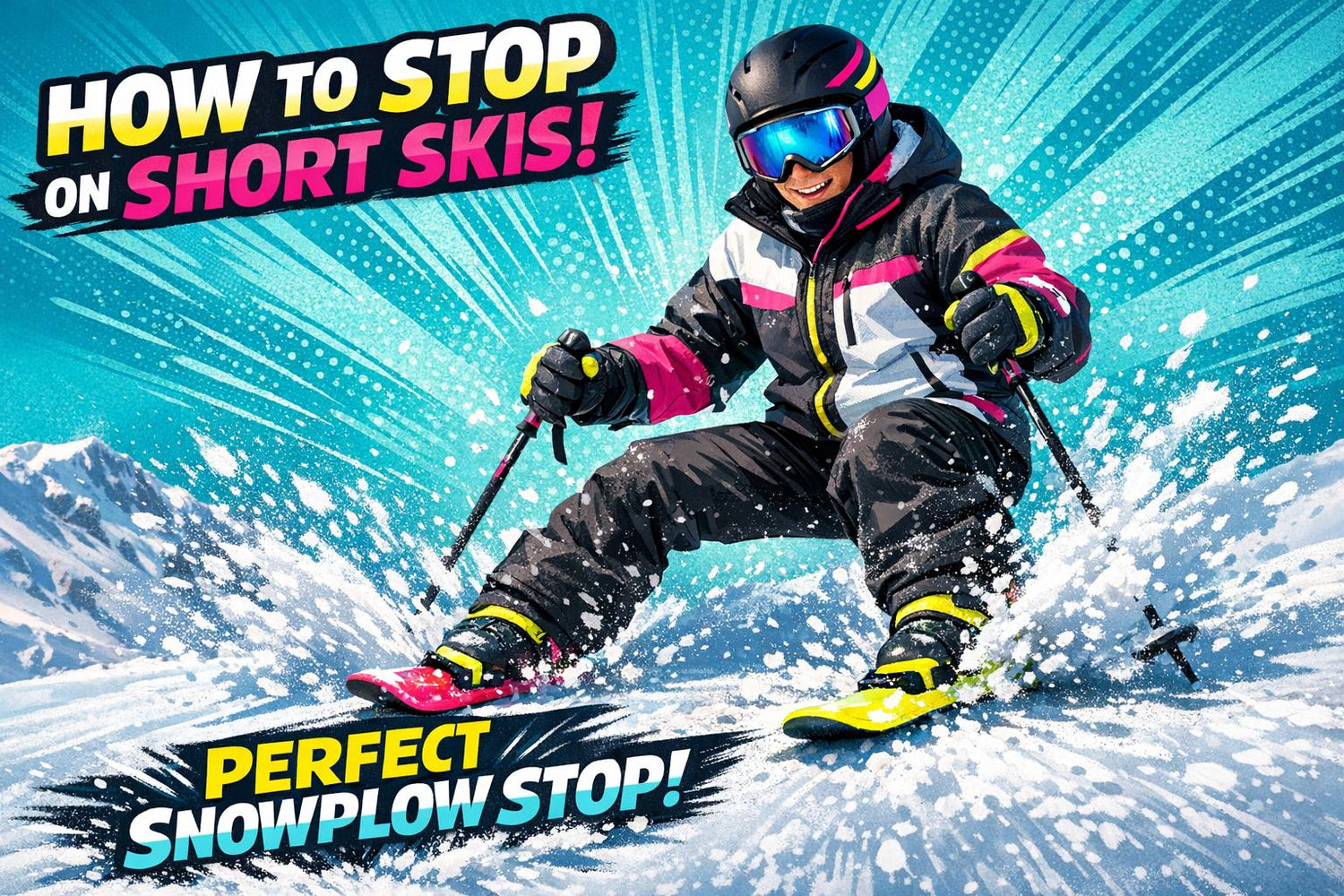
Learning to stop on short skis, like Snowfeet, is much easier than you think. Why? Short skis are lightweight, easier to control, and less intimidating than longer skis. Whether you're using the classic snowplow method or trying out a hockey stop, these compact skis make it simple to stay in control and avoid spills.
Key Takeaways:
- Snowplow Stop: Form a wedge with your skis to slow down. Great for beginners!
- Side-Slipping: Perfect for steeper slopes - turn your skis sideways and use the edges to control speed.
- Hockey Stop: For advanced skiers - quickly pivot skis 90° and dig in the edges to stop.
- Why Short Skis Help: They're lighter, easier to maneuver, and often include features like heel brakes for added control.
Start on gentle slopes, keep your weight centered, and practice these techniques step-by-step. With short skis, stopping feels natural - even for first-timers. Ready to hit the slopes? Let’s dive into the details.
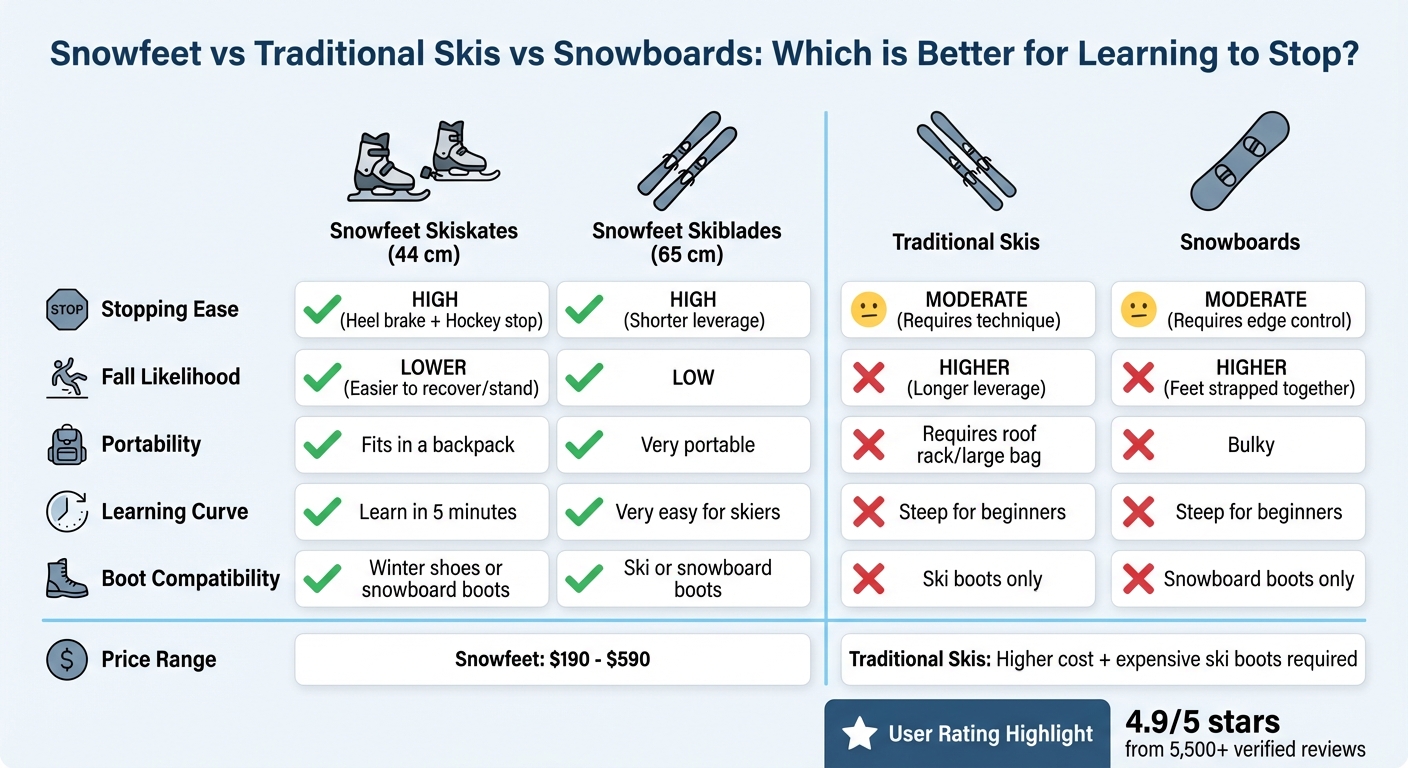
Snowfeet vs Traditional Skis vs Snowboards: Stopping Ease and Features Comparison
5 ways to stop on skis FOR BEGINNERS
Snowplow Stop: The Easiest Method for Beginners
The snowplow stop - often called the "pizza" stop - is a beginner's go-to for slowing down safely. It involves forming a wedge shape with your skis to create friction against the snow. Thanks to Snowfeet*'s compact size (44–120 cm), this maneuver becomes a breeze compared to using traditional skis.
"The snowplow stop works by forming a wedge with your skis, by pushing out your ankles. This wedge creates a large surface area and friction which pushes on the snow and slows down your speed", explains James Apfel, an experienced skier.
How to Do a Snowplow Stop: Step-by-Step
- Start on a gentle slope.
- Push the heels of your Snowfeet* outward while angling the tips inward to form a triangular wedge.
- Keep your shoulders apart, bend your knees slightly, and shift your weight inward to press the inner edges into the snow. This helps you center your weight over the middle and back of your feet.
- The wider you make the wedge, the quicker you'll stop.
A key tip: ski poles are for balance only. Don’t rely on them to slow down or stop.
Once you’ve nailed this simple technique, you’ll have a solid base to move on to more advanced skills.
Why Snowfeet* Makes the Snowplow Stop Easier
Snowfeet*'s compact design makes forming the wedge position much simpler than with traditional skis. Because they’re shorter and lighter, they require less physical effort to control. Plus, their responsive nature lets you adjust your stopping angle quickly, without the awkward leverage of longer skis. The metal edges on Snowfeet* also grip the snow effectively, making stopping feel natural and effortless.
"Short skis provide more fun and freedom of movement, they are playful, responsive, lightweight on your feet, [and] easier to stop", says the Snowfeet Team.
With over 5,500 verified reviews and a stellar 4.9/5 star rating, users frequently mention how easy Snowfeet* are to control compared to regular skis. For many beginners, mastering the snowplow stop happens in their very first session, giving them a confidence boost as they hit the slopes.
Side-Slipping Stop: Controlling Your Speed on Slopes
Once you've got the hang of the snowplow, it's time to step up your game with side-slipping. This technique is a go-to for intermediate skiers, especially on steeper slopes or icy patches where the wedge stop might not cut it. Instead of pointing your skis downhill, you turn them sideways and use your metal edges to control the slide. It’s a solid way to handle tricky terrain.
"Side-slipping... has become my secret weapon for managing terrain that feels a bit too challenging." – Luca Signorelli, SkiTutor
One of the perks of Snowfeet* is how quickly they let you pivot into a side-slipping position. Their compact design gives you faster edge control compared to traditional skis.
How to Side-Slip: Step-by-Step
- Start Perpendicular: Position your Snowfeet* parallel to each other and perpendicular to the slope.
- Flatten the Edges: Shift your weight slightly downhill and flatten your Snowfeet* to release the metal edges, allowing you to slide sideways.
- Control the Slide: Bend your knees and keep your weight centered, with your shoulders aligned over your feet for balance .
- Stop with Edges: To stop, shift your weight uphill and roll your ankles to dig the uphill edges into the snow.
A great way to practice is with the "start-stop" drill. On a moderate slope, slide sideways for a few feet, then engage your edges to stop. Repeat this until it feels natural. This drill helps you build muscle memory fast. Compared to traditional skis or snowboards, Snowfeet* make this process feel more fluid and precise, which we’ll dive into next.
Side-Slipping on Snowfeet* vs. Long Skis and Snowboards
Snowfeet* bring something unique to the table with independent leg movement and easy pivoting. Traditional skis, on the other hand, are heavier and take more effort to maneuver into a side-slip. Snowboarders face a different challenge with their fixed stance, making adjustments less flexible. Snowfeet*’s design feels more intuitive, especially for those with ice skating or hockey experience.
"Use sideslipping to scrub speed on steeper pitches. This versatile stop is great for tackling different inclines and conditions." – Stio
Thanks to their metal edges, Snowfeet* offer excellent grip on icy slopes. With over 5,500 verified reviews and an impressive 4.9 out of 5-star average, users love how the compact design makes edge control feel natural and responsive.
From Snowplow to Hockey Stop: Learning Advanced Techniques
Once you've nailed the basics like the snowplow and side-slipping, it's time to step up your game with the hockey stop. Thanks to Snowfeet*'s compact design, this progression feels more natural compared to traditional skis. Mastering these advanced moves not only gives you better control but also sets you up for tackling more demanding slopes with confidence.
Moving to Parallel Skis from the Snowplow
To transition from the snowplow to parallel skiing, start with wedged turns. Shift your weight onto one ski while in the snowplow position and guide yourself into a turn across the slope. As you become more comfortable, gradually narrow the wedge until your skis align parallel during the turn.
Snowfeet* makes this shift easier than traditional skis. With lengths ranging from just 44 cm to 120 cm, they’re far more agile and forgiving than the longer, less maneuverable options you’d find with regular skis.
"Don't lean forward like you would do with skis... instead, stand up straight and place your weight over the middle and back of your feet." – Snowfeet Team
For stability, keep your legs about shoulder-width apart. Unlike skiing, where you often shift weight to your downhill ski, Snowfeet* requires an even weight distribution across both feet. This balanced stance lays the groundwork for mastering the hockey stop.
How to Do a Hockey Stop on Snowfeet*: Step-by-Step
The hockey stop is all about precision and edge control. Here’s how to pull it off:
- Start by gliding straight down a gentle slope with your Snowfeet* parallel.
- Bend your knees slightly to unweight yourself.
- Quickly rotate your body and Snowfeet* 90° so they’re perpendicular to the slope.
- As you turn, press your heels into the snow to engage the metal edges, creating a controlled spray as you come to a stop.
"A hockey stop is another effective way to stop on skiboards. To perform a hockey stop, turn your skiboards perpendicular to the slope and apply pressure to your edges while simultaneously twisting your body." – Snowfeet Team
Snowfeet*’s skating-inspired design makes this movement feel intuitive, even for those new to the technique. The sharp metal edges provide excellent grip, giving you confidence as you practice. Start on gentle slopes, and work on stopping in both directions to build versatility.
If you’re still getting the hang of it, take advantage of the heel brake feature on your Snowfeet*. This handy tool helps you control your speed while refining your hockey stop. With an average rating of 4.9 out of 5 stars from over 5,500 verified reviews, users consistently rave about how Snowfeet*’s lightweight and responsive design make learning advanced techniques easier.
sbb-itb-17ade95
Common Stopping Mistakes and How to Fix Them
Even with solid technique, beginners often stumble on a few common stopping mistakes. The good news? Recognizing and correcting these issues can boost your confidence on Snowfeet*. Let’s break down the most frequent errors and how to steer clear of them.
Mistakes to Avoid: Leaning Back, Narrow Stance, and Hesitation
One of the biggest rookie mistakes is leaning backward. When nerves kick in, it’s tempting to lean back, but this shifts your weight off the front of your skis, making control a lot harder. Matt Appleford, Founder of The Adventure Project, puts it like this:
"The most common flaw with a beginner student's basic position is what we call 'back and inside,' that is too much weight back on the heels and back of the skis."
This backward lean can make both steering and stopping feel like an uphill battle. Instead, aim to keep your weight centered over the middle of your feet, with your knees slightly bent in a relaxed, athletic stance.
Another common misstep is staring down at your Snowfeet*. While it might feel natural to look at your feet, it actually stiffens your body and limits your ability to react to what’s ahead. Instead, focus 10–15 feet in front of you to spot obstacles and plan your moves.
Your stance can also trip you up. If your legs are too far apart or squeezed too close together, your balance takes a hit. Shoot for a shoulder-width stance. If you’re still feeling a bit shaky, try a staggered stance with one foot slightly ahead of the other for better stability.
Lastly, don’t lock your knees. Rigid knees make it tough to adjust to changes in terrain. Keep them soft and slightly flexed to maintain control and react quickly.
Now, let’s see how Snowfeet* is designed to help you sidestep these beginner blunders.
How Snowfeet* Helps You Avoid Beginner Mistakes
Snowfeet* are built with features that naturally correct many of these common errors, making the learning process smoother. For starters, their compact size (44–120 cm) makes adjusting your stance easier, without the bulk of traditional skis.
The design also encourages a staggered stance. Unlike long skis that lock you into a parallel position, Snowfeet* let you comfortably place one foot slightly ahead of the other. This helps improve your front-to-back balance and reduces the urge to lean backward.
Another perk? Snowfeet* promote a balanced weight distribution. You don’t need to lean aggressively forward; instead, standing upright with your weight centered over your midfoot and heels works best. This setup minimizes over-corrections and keeps you steady.
Snowfeet* also come with an integrated heel brake, giving you an added layer of control as you learn to manage your speed.
With over 5,500 verified reviews averaging 4.9 out of 5 stars, users often highlight how Snowfeet* make stopping easier and falls less intimidating. Plus, their shorter length means less strain on your limbs if you do take a tumble, lowering the risk of injury compared to traditional skis.
Why Snowfeet* Is Better for Learning to Stop
Let’s talk about why Snowfeet* gear makes stopping on the slopes easier and more intuitive, especially for beginners. These short skis offer a level of control and simplicity that traditional skis and snowboards just can’t match.
Snowfeet* Features That Make Stopping Easier
Snowfeet* are designed with a compact length, ranging from 44 to 120 cm, which gives you incredible maneuverability. This smaller size makes it easier to come to a controlled stop without the effort or technical skill required by longer skis or snowboards. Plus, their lightweight build reduces leg fatigue, so you can stay steady and stop more comfortably.
Some Snowfeet* models even include an integrated heel brake. Unlike traditional gear, this feature lets you slow down by simply leaning back on your heels. It’s a game-changer for beginners who are still building confidence with more advanced stopping techniques.
Another standout feature? All Snowfeet* models come with high-quality metal edges. These provide the grip you need for techniques like hockey stops or snowplowing. If you’re just starting out, the Carbon Fiber edition is worth considering - it’s designed for a slower, more stable ride, making it perfect for learning.
As Andrew B. shared: "These skiblades are so much fun and easy to control. Never going back to regular skis."
Comparison: Snowfeet* vs. Traditional Skis and Snowboards
Here’s how Snowfeet* stack up against traditional skis and snowboards when it comes to stopping, portability, and ease of use:
| Feature | Snowfeet* Skiskates (44 cm) | Snowfeet* Skiblades (65 cm) | Traditional Skis | Snowboards |
|---|---|---|---|---|
| Stopping Ease | High (Heel brake + Hockey stop) | High (Shorter leverage) | Moderate (Requires technique) | Moderate (Requires edge control) |
| Fall Likelihood | Lower (Easier to recover/stand) | Low | Higher (Longer leverage) | Higher (Feet strapped together) |
| Portability | Fits in a backpack | Very portable | Requires roof rack/large bag | Bulky |
| Learning Curve | Learn in 5 minutes | Very easy for skiers | Steep for beginners | Steep for beginners |
| Boot Compatibility | Winter shoes or snowboard boots | Ski or snowboard boots | Ski boots only | Snowboard boots only |
Traditional skis can feel cumbersome for beginners, as their longer length creates leverage that makes falls harder to recover from. Snowboards, on the other hand, lock your feet together, increasing the risk of catching an edge and limiting your ability to recover quickly. Snowfeet* solve these issues by allowing for natural movement and offering multiple ways to stop, making them a great choice for anyone learning the ropes.
Another big plus is portability. While traditional skis require a roof rack or a large bag, Snowfeet* Skiskates fit right into a backpack. This means you can take them anywhere - whether it’s a groomed slope or a hiking trail - and practice stopping in different environments. More practice means faster progress.
As Daniel Siouffi put it: "Going fast I was in complete control of every move, turns, and stops."
And here’s the kicker: Snowfeet* are affordable. With prices starting at $190 for the Mini Ski Skates and going up to $590 for the 99 cm Skiblades, they’re a budget-friendly alternative to traditional ski setups. Plus, you won’t need to shell out for costly ski boots, making them even more accessible for winter sports enthusiasts.
Conclusion: Learning to Stop on Snowfeet* Short Skis
Getting the hang of stopping on Snowfeet* short skis is easier than you might think. Start with the snowplow for slower speeds, use side-slipping when tackling steeper sections, and try the hockey stop for those faster, adrenaline-filled runs.
Snowfeet* short skis are designed to keep you in control. With over 5,500 verified reviews and a stellar 4.9/5 star rating, it’s clear users love the lightweight, compact design that offers precise handling on the slopes.
To build confidence, begin on gentle slopes. Keep your weight balanced over both feet, stand with your feet about shoulder-width apart, and practice each stopping technique until it feels like second nature. Once you're comfortable, you can gradually take on steeper and more challenging terrain.
Whether you opt for the ultra-portable 44 cm Skiskates or the 99 cm Skiblades for a more classic skiing vibe, Snowfeet* gear is built to make stopping safe and easy. Some models even come with a heel brake, giving you a stopping option that traditional skis just don’t have. Master these techniques, and you'll be ready to enjoy every winter adventure with confidence and control.
FAQs
How does learning to use Snowfeet compare to traditional skis?
Snowfeet’s compact and lightweight design makes picking up the basics a breeze compared to traditional skis. With lengths as short as 17 inches (44 cm) or 26 inches (65 cm), beginners can quickly gain control and learn essential moves like turning and stopping in just a few runs. Traditional skis, on the other hand, are much longer and require more time to build balance and master edge control - sometimes taking days or even weeks to feel confident.
Since Snowfeet work more like skates than full-length skis, stopping techniques such as the snowplow, edge turn, or hockey stop feel more natural and take less effort to learn. This means most first-timers can go from wobbling to cruising comfortably in just one session. In comparison, getting to that same level with traditional skis usually takes several days of practice.
What makes Snowfeet a great choice for beginners?
Snowfeet* are a fantastic option for beginners, thanks to their short and lightweight design that makes learning snow sports way less intimidating than using traditional skis or snowboards. With lengths ranging from just 44 cm to 99 cm, they’re much easier to control. You can stop and turn with simple techniques like the snowplow or side-slipping - no need to wrestle with the tricky edge work that long skis demand.
One of the best parts? Snowfeet* are compatible with your regular ski or snowboard boots, so there’s no need to splurge on specialized gear. Their compact size and lightweight wood-core design make them super easy to carry around - even kids can handle them with ease. Plus, their short turning radius and natural feel help beginners build confidence quickly, stay balanced, and enjoy the slopes without the bulk or steep learning curve of traditional equipment. With over 5,500 glowing reviews, Snowfeet* have earned their spot as a trusted choice for anyone stepping into the world of snow sports.
How can I switch from a snowplow stop to a hockey stop on Snowfeet?
Transitioning from a snowplow stop to a hockey stop on Snowfeet is pretty straightforward, thanks to their lightweight and compact build. Begin by forming a snowplow position - think of the classic "pizza" shape - with the tips of your Snowfeet close together and the tails angled outward. Gently shift your weight onto the inside edge of your downhill foot to start turning and slowing down. As your speed drops, bring the tails together so your Snowfeet are parallel, keeping your legs about shoulder-width apart for balance.
From there, rotate your hips and shoulders to face downhill while swinging the Snowfeet into a perpendicular position relative to the slope. Press the edges firmly into the snow and flex your ankles to engage them, creating a controlled skid that brings you to a smooth stop. Thanks to their short length and responsive edges, Snowfeet make this transition feel quicker and easier than it would on traditional skis or snowboards, giving you better control and more confidence on the slopes.













Leave a comment
This site is protected by hCaptcha and the hCaptcha Privacy Policy and Terms of Service apply.