



















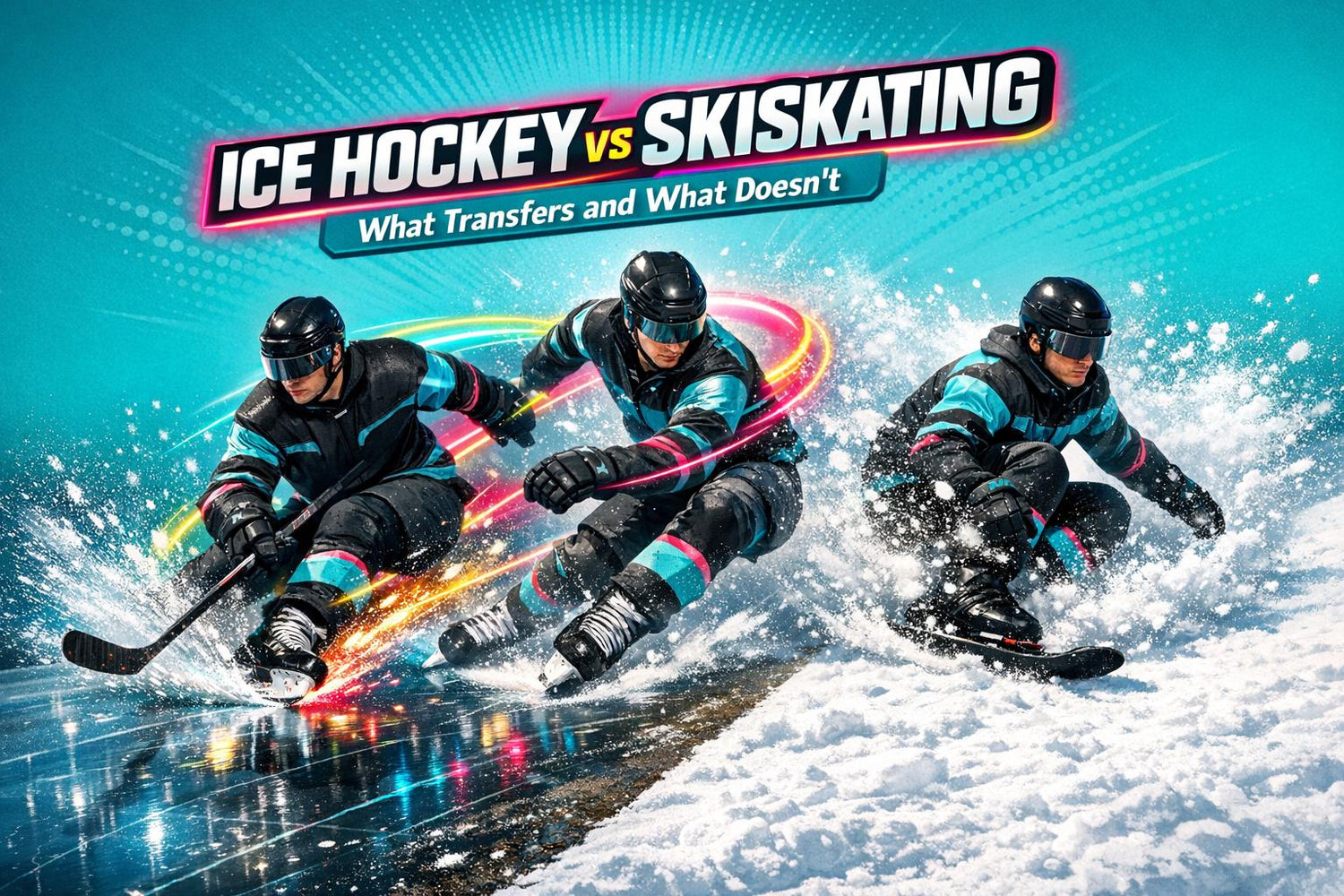
If you're a hockey player, transitioning to skiskating with Snowfeet* is surprisingly smooth. Your ice skating skills - like balance, edge control, and quick stops - carry over almost directly. Skiskating feels natural because it builds on the techniques you’ve already mastered on the ice. But snow isn’t as predictable as an ice rink. It’s softer, uneven, and changes depending on the conditions, so you’ll need to tweak how you use your edges and manage your weight.
Snowfeet* Skiskates make the switch easier. They’re lightweight, portable, and designed to mimic the feel of hockey skates. Their short length allows for agility, quick turns, and even hockey-style stops. Unlike regular skis or snowboards, these are easy to learn, fit in a backpack, and work on various snow terrains. Whether you’re carving on groomed trails or tackling backyard hills, Snowfeet* let you bring your hockey skills to the slopes without bulky gear.
Quick Takeaways:
- What Transfers: Balance, edge control, quick turns, and stops.
- What’s Different: Snow is less consistent than ice, requiring minor adjustments in technique.
- Why Snowfeet* Work: They’re compact, easy to carry, and feel familiar to hockey players.
Skiskating is a fun, straightforward way for hockey players to enjoy the snow without starting from scratch.
Ice Hockey Skills That Work for Skiskating
Balance and Edge Control
If you’ve mastered single-leg stability in hockey, you’re already ahead when it comes to Snowfeet* Skiskates. Those precise weight shifts and edge control you’ve honed on the ice? They’re exactly what you need to tackle the 44 cm (17.3 inches) base of Snowfeet* Skiskates. The short, curved blades you’re used to in hockey perfectly prepare you for the quick adjustments required on snow.
Think of it this way: trust your edges on snow just like you do on ice. Roll your ankles inward to grip the snow, much like the "V" position you’d use to climb uphill on skates. Keep your knees bent and stay in that low hockey stance - it gives you maximum control over the shorter surface. The metal edges on Snowfeet* work just like your hockey blades, biting into the snow with the same ankle pressure and lean. This familiarity extends naturally to stopping techniques, where balance is key.
Hockey Stop Techniques
The hockey stop? It’s a perfect match for skiskating. Just turn both skiskates perpendicular to your direction, dig the metal edges into the snow, and slide to a stop. Snow, being less dense than ice, offers less resistance, so the slide might feel a bit smoother.
Ease into it by starting with gentler edge angles until you get a feel for how the snow reacts. Groomed trails are your best bet for practice - they’re like the freshly resurfaced ice of the snow world. Once you’ve nailed your stops, you’ll be ready to tackle sharper, more advanced maneuvers.
Agility and Quick Turns
Your hockey agility training gives you a major edge with Snowfeet* Skiskates. Their compact length is similar to your hockey blades, so your quick-turning reflexes transfer effortlessly. You can even perform crossovers on snow to keep up speed through tight corners - something that’s almost impossible with traditional skis, which demand wide, sweeping arcs.
Your ability to shift weight quickly from edge to edge makes tight carving and sharp maneuvers feel second nature. Plus, the low center of gravity and wide stance you’ve built in hockey make handling the responsiveness of short skiskates a breeze. Whether it’s skating backward, jumping, or pulling off tricks, the skills you’ve perfected on the rink translate seamlessly to the slopes. This is why Snowfeet* Skiskates are a natural fit for hockey players - they let you bring your ice skills straight to the snow.
What Ice Hockey Players Need to Adjust for Skiskating
Snow vs Ice: Different Surface Conditions
Ice rinks offer a consistent, hard surface every time you lace up. Snow, on the other hand, is all over the map - it can be hard-packed, icy, soft, or even powdery. This variety means you'll need to tweak how you use your edges.
Hockey skates rely on a "hollow" grind that digs aggressively into the ice. But Snowfeet* Skiskates have flat metal edges, which call for a different approach. If you apply too much force in soft snow, the edges can sink instead of carving smoothly. Snow also creates variable resistance - wet snow feels sticky, while deep powder can make you sink, requiring more precise weight shifts than the nearly frictionless glide you're used to on ice.
To ease into it, start on groomed or packed snow to get the hang of it before venturing into deeper powder. Keep your weight centered in a hockey-style stance. Leaning too far forward can cause the tips to dive into softer snow. When turning, practice "feathering" your edges - snow responds better to gradual movements rather than the sharp digs you might use on ice.
But it's not just the surface that takes getting used to - your equipment plays a big role too.
Getting Used to Shorter Equipment
Switching from ice to snow also means adjusting to different gear. Hockey skate blades are around 11–12.5 inches (28–32 cm) long, while Snowfeet* Skiskates measure 17.3 inches (44 cm). They’re longer than your blades but much shorter than traditional skis, which usually exceed 59 inches. This unique design gives Snowfeet* their agility, making them a fun middle ground between skates and skis.
The good news? The balance point feels familiar. Just like on your hockey skates, you'll need to stay centered, engaging your core to keep that "sweet spot" steady. Thanks to their shorter length, Snowfeet* are super responsive to changes in snow conditions. Whether you're carving on packed trails or tackling uneven terrain, you'll find them quick to react. Plus, their compact design lets you pull off tight crossovers, skate backward, and even spin 360 degrees - moves that would be nearly impossible with long skis.
Hockey Player Tries Snowfeet* Skiskates | See What He Thinks | Skiboards | Short Ski | Mini Ski

sbb-itb-17ade95
Why Snowfeet* Skiskates Beat Traditional Skis and Snowboards
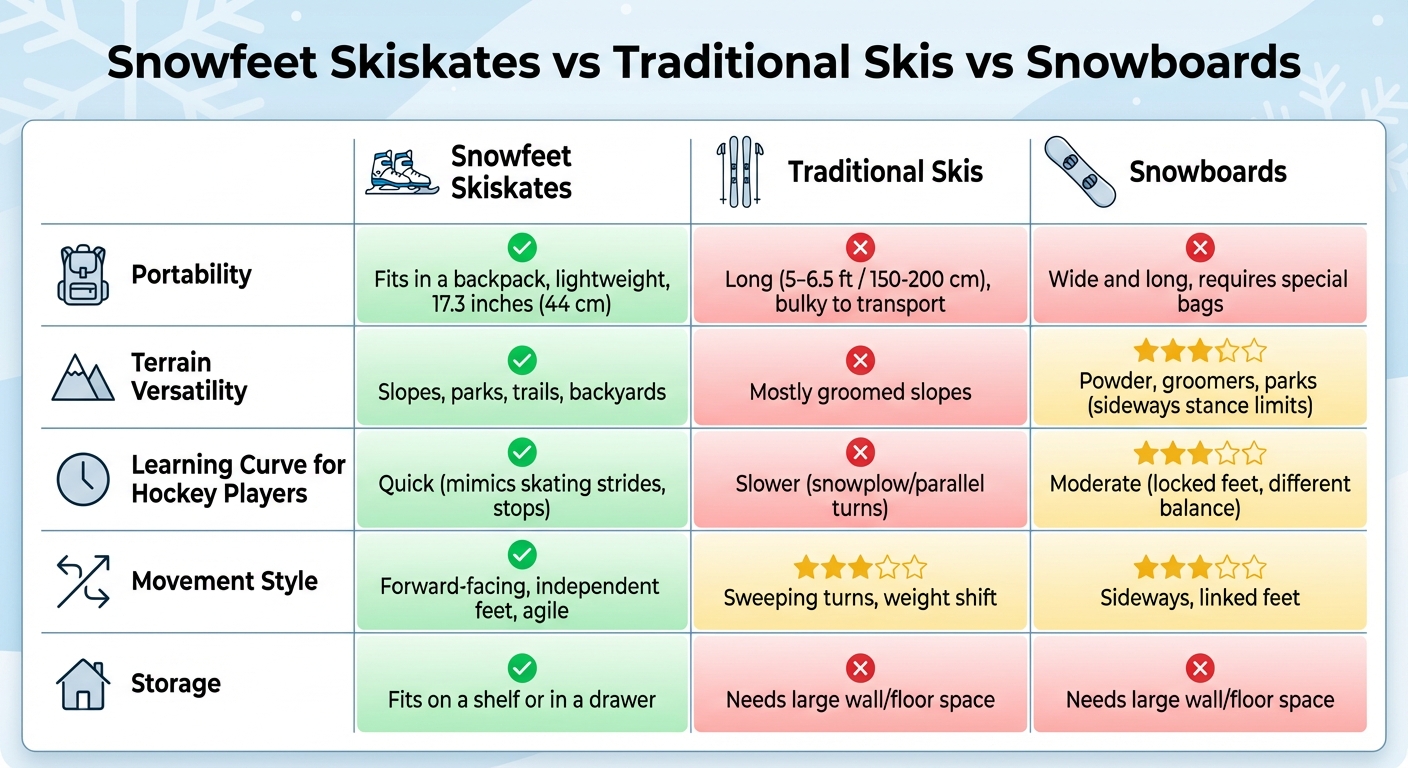
Snowfeet Skiskates vs Traditional Skis and Snowboards Comparison Chart
Let’s dive into why Snowfeet* Skiskates are a standout alternative to traditional skis and snowboards.
Easy to Carry and Store
Traditional skis are massive - measuring 5 to 6.5 feet (150–200 cm). They need roof racks, oversized bags, or even extra luggage fees when traveling. Snowboards aren’t much better, taking up serious trunk space and being awkward to lug around. Snowfeet* Skiskates? At just 17.3 inches (44 cm), they fit neatly into a standard backpack. You can toss them in your car trunk, bring them on a hike, or even take them as carry-on luggage. No bulky gear. Just grab them and go.
Storing them is just as simple. Unlike skis and snowboards that demand wall racks or dedicated closet space, Snowfeet* can sit on a shelf or in a drawer. For hockey players used to managing large gear bags, this compact setup is a breath of fresh air. Plus, upkeep is quick and easy - basic waxing and cleaning replace the time and money spent on professional ski and snowboard tuning.
Works on Any Snow Terrain
Traditional skis shine on groomed slopes but can struggle in tighter or uneven spaces. Snowboards, with their fixed sideways stance, can feel limiting in terms of movement. Snowfeet* Skiskates, on the other hand, are built for versatility. They perform on ski slopes, snow parks, forest trails, and even that hill in your backyard. Their short length makes navigating tight spaces a breeze, and the forward-facing stance with independent foot movement feels natural - especially for hockey players.
Want to glide across a flat trail? Easy. Ready to carve down a groomed run? They’ve got you covered. Feel like tackling a small hill after a snowstorm? No problem. Snowfeet* adapt to wherever you want to go.
Faster to Learn
If you’re a hockey player, you can skip the ski school. Learning to ski involves mastering snowplow techniques and parallel turns, which can take days (or weeks). Snowboarding demands even more adjustment with its sideways stance and locked feet. But with Snowfeet* Skiskates, you can use your existing skating skills from the start. Your hockey stop? It works. Edge control? Already there. Balance? Feels just like your skates.
For anyone who’s spent years perfecting their skating technique, the ability to hit the snow with confidence right away is a game-changer.
Snowfeet* Skiskates vs Traditional Skis and Snowboards
Here’s a quick comparison to sum it up:
| Feature | Snowfeet* Skiskates | Traditional Skis | Snowboards |
|---|---|---|---|
| Portability | Fits in a backpack, lightweight | Long (5–6.5 ft), bulky to transport | Wide and long, requires special bags |
| Terrain | Slopes, parks, trails, backyards | Mostly groomed slopes | Powder, groomers, parks (sideways stance limits) |
| Hockey Players' Learning Curve | Quick (mimics skating strides, stops) | Slower (snowplow/parallel turns) | Moderate (locked feet, different balance) |
| Movement Style | Forward-facing, independent feet, agile | Sweeping turns, weight shift | Sideways, linked feet |
| Storage | Fits on a shelf or in a drawer | Needs large wall/floor space | Needs large wall/floor space |
Snowfeet* Skiskates offer a lightweight, versatile, and easy-to-learn option for snow enthusiasts, making them a practical and fun alternative to traditional snow gear.
Tips for Hockey Players Starting with Skiskating
Starting with skiskating? These tips will help you fine-tune your transition from the rink to the snow.
Practice Your Edge Work
Take your hockey edge control skills and adapt them to snow by focusing on carving and balance. Start with smooth carving arcs: roll your ankles inward as you push off, transferring your weight fully to the gliding leg for maximum power. Keep your nose, knee, and ski tip aligned during each stride for better control. Practice lateral movements and hockey-style stops: flatten your Snowfeet* to release the edges, pivot 90°, and then re-engage the edges to regain control.
As Coach Jeremy from How To Hockey points out, “proper knee bends are essential for generating power.”
At first, focus on your legs and balance. Your core strength from hockey will naturally kick in to support these movements. Once you’re confident with edge work, try experimenting in different snow conditions to build versatility.
Try Different Snow Surfaces
Start on groomed corduroy runs where edge control is easier and more predictable. Once you’re comfortable there, move on to slush or light powder to test how the 44 cm (17.3 inches) Snowfeet* handle varying snow textures. These skiskates are great for snow parks, forest trails, or even the local hill after a fresh snowfall.
Different snow surfaces will challenge your adaptability. Hard-packed snow feels more like ice, requiring precision, while softer snow demands stronger weight shifts to maintain control.
How to Maintain Your Skiskates
To keep your Snowfeet* in top shape, regular maintenance is a must. Apply liquid or paste wax to the base to prevent snow from sticking and to ensure a smooth glide. Reapply the wax every few sessions for the best performance.
After each use, dry the metal edges with a cloth to prevent rust and keep them sharp for better grip on icy surfaces. Check the straps and bindings regularly for wear, and make sure the ratchets are free of debris so your boots stay securely attached during quick maneuvers.
Lastly, always dry your Snowfeet* thoroughly after each session to avoid moisture damage. A little care goes a long way in keeping your skiskates ready for action!
Conclusion
Hockey players can easily bring their balance, edge control, and quick stops from the rink to the slopes with skiskates. The athletic stance and sharp maneuvers you’ve honed on ice translate smoothly to skiskating - you just need to adjust to the softer, less predictable surface of snow compared to the hard, consistent ice of a rink.
Snow requires a slightly different approach, like keeping your weight more centered and fine-tuning edge pressure depending on the conditions. That’s where Snowfeet* Skiskates shine - they work with your natural skating stride, making these adjustments feel intuitive rather than overwhelming.
Unlike traditional skis or snowboards, Snowfeet* Skiskates are lightweight, portable, and easy to learn. Forget about hauling bulky gear - these fit into a backpack and can handle anything from groomed slopes to forest trails. Plus, most hockey players pick them up in no time, often within a single day.
Your hockey skills - like quick pivots, crossovers, and defensive footwork - give you a head start. With Snowfeet* Skiskates, you’re not learning from scratch; you’re building on what you already know. It’s a natural extension of your abilities, letting you enjoy the snow in a whole new way.
FAQs
What boots do Snowfeet* Skiskates work with?
Snowfeet* Skiskates work seamlessly with your regular winter boots, making them incredibly easy to use. Unlike traditional skis or snowboards that need special boots, these skiskates let you stick with the footwear you already own. This means you can switch from ice skating to snow activities without any hassle. Plus, they keep snow sports simple, portable, and open to everyone.
Are Snowfeet* Skiskates safe for beginners on steeper runs?
Snowfeet* Skiskates are beginner-friendly, even on steeper slopes, thanks to their emphasis on stability, edge control, and user-friendly design. If you’ve got experience with ice hockey or skating, you’re already ahead of the game - those balance and edge control skills transfer over seamlessly, making the learning process faster. Compared to traditional skis or snowboards, Snowfeet* stand out for their portability, adaptability, and ease of use. This combination makes them a solid choice for anyone looking to confidently take on steeper terrain.
Do I need ski lessons if I already play hockey?
For hockey players, ski lessons are usually not needed. The skills you’ve developed on the ice - like balance, agility, and edge control - translate naturally to skiing and skiskating. Sure, there might be minor technique tweaks for certain snow movements, but Snowfeet skiskates are built to feel like ice skating, making the adjustment super simple. Most hockey players find themselves comfortable on skiskates or skis almost immediately.











Leave a comment
This site is protected by hCaptcha and the hCaptcha Privacy Policy and Terms of Service apply.