



















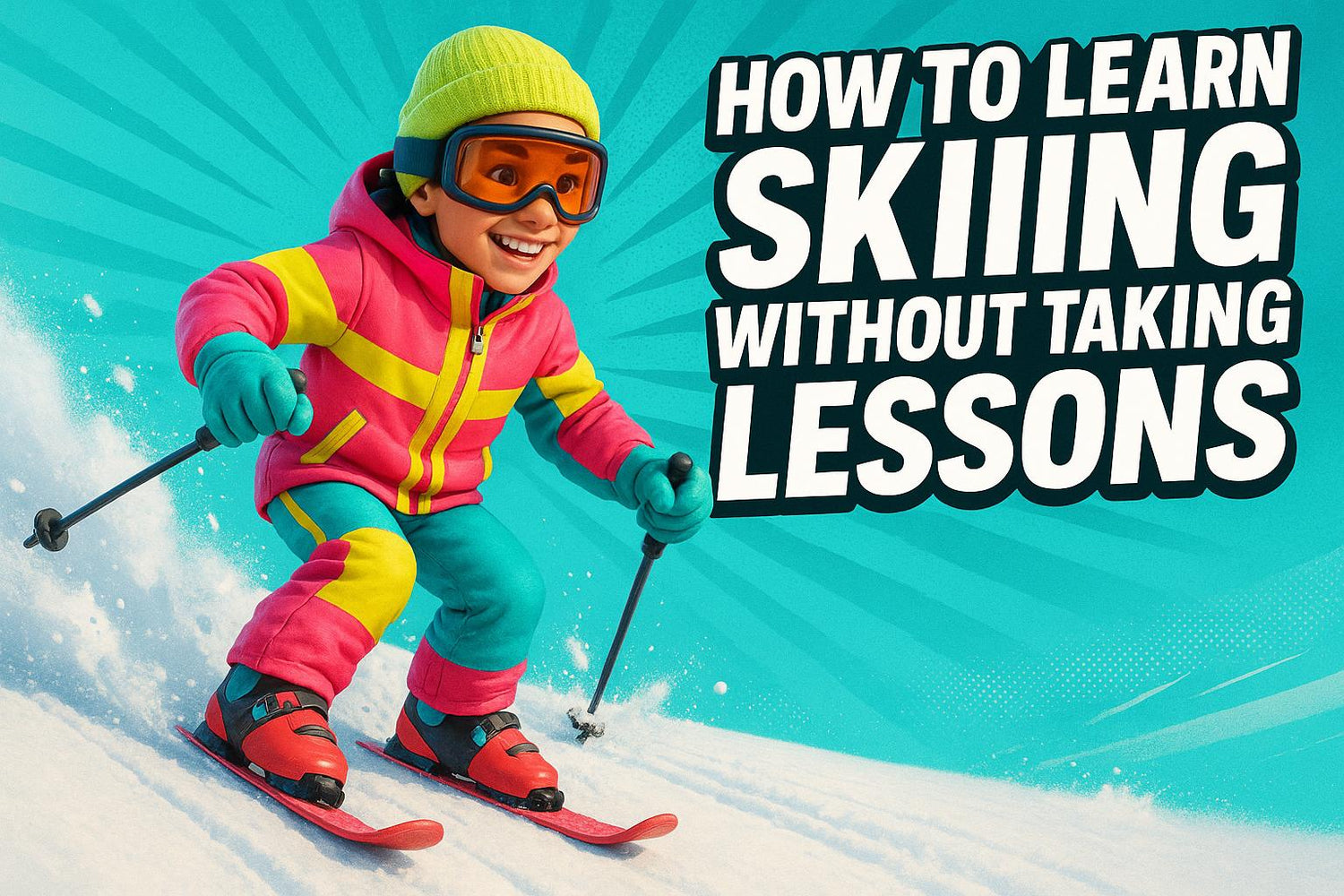
Learning to ski without lessons is easier than you think, especially with the right gear. Short skis, like Snowfeet's skiblades or skiskates, are lightweight, compact, and beginner-friendly. They help you balance, turn, and stop more easily than longer skis, making self-teaching less intimidating and more fun. Plus, they’re portable and work with regular winter boots for added convenience.
Here’s how to get started:
- Pick the right gear: Snowfeet offers options like Mini Ski Skates (15 inches) for easy control or Skiblades (up to 39 inches) for more stability. Prices range from $250 to $775.
- Stay safe: Always wear a helmet, follow resort rules, and stick to beginner slopes.
- Practice the basics: Learn balance, stopping, and turning with Snowfeet's free online tutorials.
- Warm up: Simple exercises like squats and lunges will prepare your muscles for the slopes.
- Choose beginner-friendly slopes: Look for green circle trails with gentle gradients (6-10%).
With Snowfeet gear, you can skip pricey lessons and learn at your own speed while enjoying the slopes. Ready to start? Grab your gear, hit a beginner slope, and let the adventure begin!
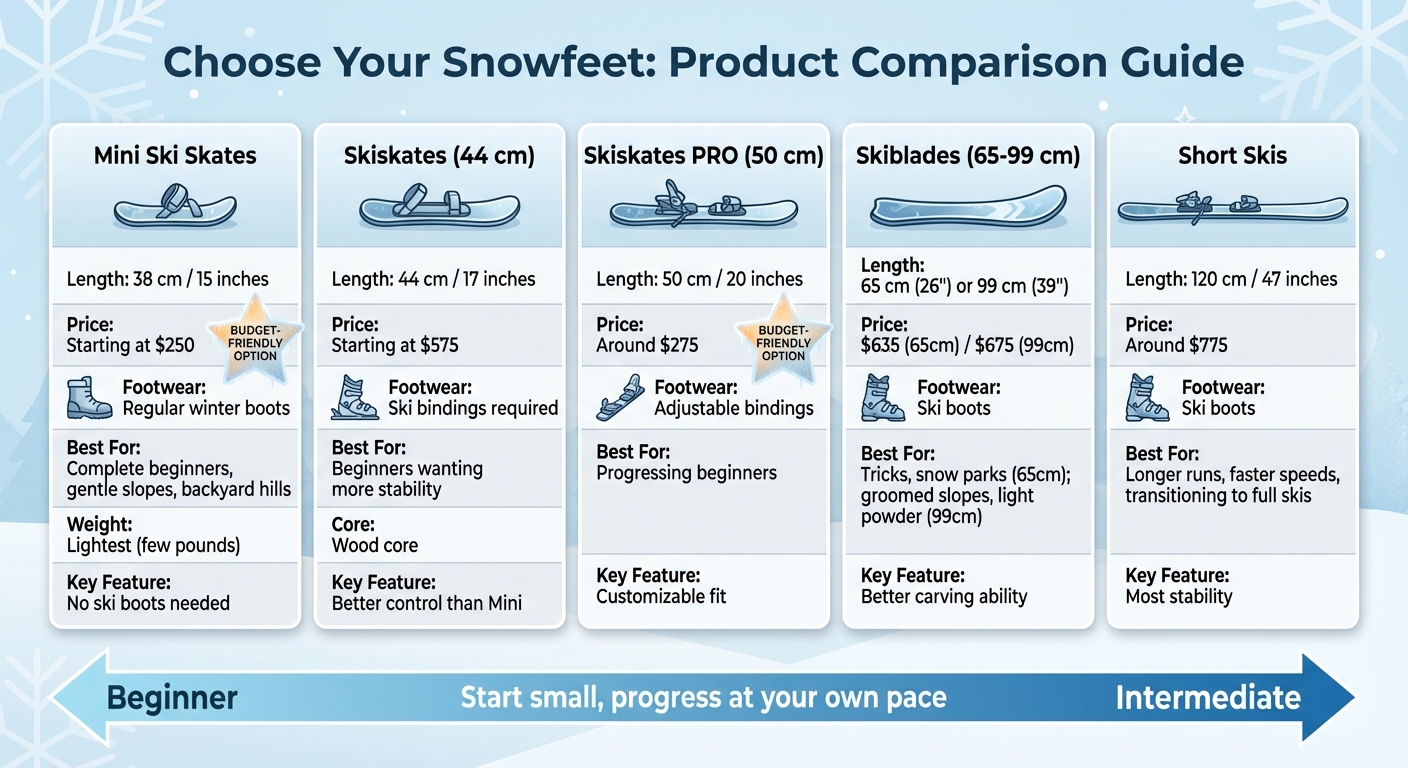
Snowfeet Product Comparison Guide: Sizes, Prices, and Best Uses for Beginners
Picking Your First Snowfeet* Gear
Why Short Skis Are Great for Self-Taught Skiers
Short skis, like the ones from Snowfeet*, are a game-changer if you're teaching yourself to ski. With lengths ranging from 15 to 47 inches, they make turning feel effortless - something that’s super helpful when you’re figuring things out on your own. Compare that to traditional skis, which can stretch up to 6 feet, adding extra weight and making them harder to handle. Snowfeet* gear keeps things light and agile, so you can focus on sliding and less on recovering from mistakes.
The shorter design also makes it easier to control your speed and stop quickly, which helps minimize common beginner issues like catching an edge or crossing your ski tips. This means fewer falls, faster progress, and more confidence to keep practicing solo. Plus, they’re small enough to fit in a backpack, saving you from the hassle of ski racks or those annoying oversized luggage fees when flying to spots like Colorado or Vermont. Now, let’s dive into the Snowfeet* lineup to see which gear fits your needs.
Snowfeet* Product Lineup
Snowfeet* has a range of products designed for different skill levels and terrains. Here’s a quick breakdown:
-
Snowfeet Mini Ski Skates (38 cm / 15 inches)
These attach directly to your winter boots - no need for ski boots. They’re lightweight, just a few pounds, and work great on gentle slopes or even backyard hills. Starting at $250, they’re a fun and low-commitment way to try skiing without lugging around bulky gear. -
Snowfeet Skiskates (44–50 cm / 17–20 inches)
If you want a bit more stability but still prefer short skis, these are a solid choice. The 44 cm version has a wood core and ski bindings, starting at about $575. For a more customized fit, the PRO model (50 cm) comes with adjustable bindings and costs around $275. -
Snowfeet Skiblades (65–99 cm / 26–39 inches)
These are a step closer to traditional skis, offering better carving ability. The 65 cm version, priced at about $635, is perfect for tricks and snow parks. The 99 cm model, available for roughly $675, provides more freedom on groomed slopes and light powder, with added edge control for smoother rides. -
Snowfeet Short Skis (120 cm / 47 inches)
The longest option in the Snowfeet* family, these are built for longer runs and faster speeds but still shorter than regular skis. At around $775, they’re a great choice if you’re thinking about transitioning to full-length skis down the road.
Matching the Right Snowfeet* Product to Your Needs
If you’re just starting out, Mini Ski Skates or the 44 cm Skiskates are excellent for maintaining control while using your regular winter boots. Have some experience with inline or ice skating? The 65 cm Skiblades could help you progress faster. These options are perfect for self-learners looking to build confidence and skills quickly.
Your terrain matters too. For smaller hills or bunny slopes, the Mini Ski Skates or Skiskates offer an ideal mix of control and ease. If you’re heading to larger ski resorts with longer green or blue runs, the Skiblades (65 or 99 cm) or Short Skis (120 cm) will give you the extra stability you need.
Footwear is another key factor. If you want to skip the hassle of ski boots, stick with the Mini Ski Skates or Skiskates, which work with your regular winter boots. But if you’re ready to invest in ski boots, the Skiblades and Short Skis will give you better performance and sharper turns. Think about your goals too - whether it’s casual fun on weekend trips or building skills for traditional skiing, there’s a Snowfeet* product that fits the bill.
Getting Ready for Your First Day
Safety Equipment and Ski Resort Rules
Before you even think about hitting the slopes, grab a helmet. In the U.S., most ski resorts strongly recommend them, and many require helmets for anyone under 18. Snowfeet* gear is designed with safety in mind, often leading to gentler falls compared to traditional skis or snowboards.
Double-check your bindings. Some Snowfeet* models come with non-release ski boot bindings and include safety leashes. Make sure these are securely attached. Once you're at the resort, take a moment to learn the basic rules: always stay in control, give the right of way to skiers downhill, and stop only in spots where you're visible from above. Most resorts treat Snowfeet* gear just like skis, but it’s always a good idea to confirm with the resort ahead of time to avoid any last-minute surprises.
Now that your gear and safety are covered, it’s time to get your body ready.
Quick Warm-Up Exercises
Your muscles need a little wake-up call before you start sliding around. A quick warm-up can make all the difference. Here’s a simple routine:
- Bodyweight squats: Do 20 reps to activate your legs.
- Reverse lunges: Complete 10 reps per leg.
- Side lunges: Try 8–12 reps per side to loosen up your hips.
This takes just five minutes and can easily be done in the parking lot or lodge.
Next, get your blood flowing. March in place for 20–30 seconds. Follow that with straight-leg swings - stand on one leg, use your poles for balance, and swing the other leg front to back. Wrap it up with arm circles in both directions to loosen up your shoulders. These moves will help you feel more agile and less stiff when you start your first run.
Finding the Right Slopes for Beginners
Once you’re warmed up, pick a slope that matches your energy and skill level. Green circle trails are your best bet - they’re wide, smooth, and perfect for learning. Aim for slopes with a gentle gradient of 6 to 10 percent. This gives you enough speed to enjoy the ride without feeling like you’re losing control. Snowfeet* perform best on groomed snow, so check if your resort posts a daily grooming list to find the freshest, smoothest runs.
Steer clear of crowded areas, bumpy moguls, and deep powder (anything over 4 inches) when you’re just starting out. Look for slopes with a flat, open run-out area where you can stop easily.
"For first timers, 6 to 10 percent. For novices building their abilities, 10 to 16 percent. Terrain that has some character, that rolls and bucks, as opposed to a smooth open slope, will best help beginners progress".
Start with the basics and gradually challenge yourself as you gain confidence with your Snowfeet* gear.
Learning to Ski: Step-by-Step Guide
Finding Your Balance and First Slides
Start by standing with your feet shoulder-width apart and your knees slightly bent - this gives you better stability. Keep your weight centered over the middle or back of your feet. Trust me, leaning forward onto your toes is a surefire way to end up on the ground.
Position one foot slightly ahead of the other and lean forward just a bit. This stance helps you stay balanced as you start sliding. To get moving, push off alternately with each foot, much like you would if you were ice skating or rollerblading. If you’ve done either of those before, this will feel pretty natural. That’s one of the reasons Snowfeet* is such a friendly option for beginners.
Snowfeet* Mini Ski Skates make adjusting your balance easier. One user, Danielle D., mentioned how quickly she improved her balance and had fun doing it, while Chan Saelee was carving smooth "S" turns in no time.
Stick to groomed slopes or bunny hills when you're just starting out. Falling is part of the learning process, but with Snowfeet*, it’s usually less intimidating than with traditional skis or snowboards.
Once you’ve got the hang of balancing and sliding, it’s time to learn how to control your speed.
Slowing Down and Stopping
To slow down, use the wedge stop. Push the backs of your Snowfeet* outward to form a triangle, with the tips pointing inward. Then press down on the inner edges. The wider you spread your heels, the more you’ll slow down.
Keep your knees bent and your weight evenly distributed over both feet. This athletic stance gives you better control. And here’s a tip: look where you want to stop, not down at your feet.
Once you’ve nailed the wedge stop, try the hockey stop. Turn your Snowfeet* so they’re perpendicular to the slope, apply edge pressure, and twist your body to kick up a little burst of snow as you come to a quick stop. If your Snowfeet* have a heel brake, you can use it for gentler speed control. Practice these moves on easy slopes until you feel confident. Thanks to their lightweight design, stopping with Snowfeet* is a lot easier than with traditional skis.
Now that you’ve got stopping down, let’s move on to making smooth, controlled turns.
Making Your First Turns
Turning builds on the balance and stopping skills you’ve already learned. Snowfeet* are designed to make turning simple. Their shorter length and lighter weight mean they respond quickly to your movements.
To turn, shift your weight to one side while keeping your knees bent. This taps into Snowfeet*’s natural ability to maneuver. With these Mini Ski Skates, you can even create a "drifting" motion around corners - similar to traditional skis but with more flexibility. Pro skater Logan (@xskyskaterx) loves Snowfeet* for their "speed, agility, convenience, and lightness", especially when drifting through turns.
Keep your upper body slightly forward and your weight centered over the middle or back of your feet. Want tighter turns? Just apply more pressure to your edges. Many beginners have carved "S" turns on their first day with the Snowfeet Pro 50cm models.
While you’re still learning, avoid steep slopes and deep powder. Stick to groomed trails, snow parks, or easy runs where Snowfeet* perform at their best. As you gain confidence, you’ll appreciate how their compact, lightweight design makes turning less tiring compared to traditional skis.
Using Ski Lifts and Getting Around the Resort
Once you’ve mastered sliding, stopping, and turning, you’re ready to explore the resort. Chairlifts are much easier with Snowfeet* than with long, clunky skis. Chan Saelee, a lifelong snowboarder who tried Snowfeet* for the first time, described using chairlifts as "seamless" and "stress-free - way easier than snowboarding or skiing".
When approaching a chairlift, keep your Snowfeet* parallel and pointed forward. As the chair comes up behind you, sit back and, if there’s a footrest, place your Snowfeet* on it. When it’s time to exit, stand up smoothly and let gravity do the work. Their lightweight design makes this process a breeze.
If you’re using magic carpets or conveyor belts, just step on and ride. Snowfeet* are light enough to keep you balanced. Most resorts treat Snowfeet* like regular ski gear, but if you’re using the 38cm Mini Ski Skates with winter boots instead of ski boots, it’s a good idea to check with the lift operators before your first ride.
The compact design of Snowfeet* also makes it easy to move between runs without feeling weighed down.
sbb-itb-17ade95
Using Snowfeet* Online Videos to Learn
Following Snowfeet* Video Tutorials
Snowfeet's YouTube channel is packed with free tutorials that make learning both the basics and advanced tricks a breeze - no need to shell out for expensive ski lessons. These videos break down essentials like how to distribute your weight, start and stop safely, and even navigate ski lifts with Snowfeet* gear. If you're ready to push your limits, they’ve got tutorials on backward skiing, jumps (like 180s, 360s, and front flips), and creative footwork techniques.
Start with the basics: stand with your feet shoulder-width apart, keep your knees bent, and center your weight. This stance is the secret to Snowfeet*'s excellent control. For beginners, skating like a hockey player is highly recommended, especially on flat terrain. Or, as the Snowfeet team says:
"The best way to start your ride is to skate like a hockey player."
Take your time with each tutorial - watch, pause, and practice. Once you’ve nailed the fundamentals, moving on to advanced techniques will feel much smoother.
Recording Your Progress and Self-Coaching
Moving Up to Advanced Snowfeet* Products
After mastering the basics with the Mini Ski Skates (38 cm), you might feel ready to step up your game. That’s where advanced Snowfeet* products come in. For better performance and stability at higher speeds, try the Snowfeet PRO (50 cm). If you're craving a more professional feel on groomed slopes, the 44 cm Skiskates are a great choice. For those tackling varied terrain or snow parks, Skiblades (65 cm or 99 cm) offer extra length while keeping the agility that makes Snowfeet* so fun to use.
Don’t hesitate to experiment. The tutorials include advanced moves like one-leg skiing, crossovers, spirals, and even aerial tricks. As you explore the video library, you’ll naturally figure out which Snowfeet* product fits your growing skills and personal style - all without spending a dime on formal instruction.
5 ways to stop on skis FOR BEGINNERS
Conclusion
Learning to ski on your own is totally doable if you’ve got the right gear and a solid plan. Start by picking the Snowfeet* product that matches your skill level. For beginners, the 38 cm Mini Ski Skates are a great starting point. As you improve, you can move up to the 50 cm Snowfeet PRO or the 65 cm Skiblades. These shorter, lighter, and wider options are much easier to handle than traditional skis, making it simpler to nail down the basics like balance, turning, and stopping.
Take it one step at a time: get comfortable with your stance, stick to beginner-friendly slopes, and let Snowfeet's free YouTube tutorials guide you. Unlike traditional ski gear that usually requires expensive lessons, Snowfeet* gear is super convenient. It’s compact enough to fit in a backpack and works with regular winter boots or snowboard boots you might already own. This makes it easier to focus on learning and having fun rather than worrying about complicated setups or hefty expenses.
Snowfeet* gives you a smoother learning experience. Its forgiving flex helps reduce the risk of catching an edge and taking a tumble, while the extra maneuverability helps you build confidence quickly. From finding your balance to carving sharp turns, it’s all about enjoying your time on the slopes without the steep learning curve (or price tag) of traditional skiing.
So, grab your Snowfeet* gear and start your adventure. With a design tailored for beginners, it’s never been simpler - or more affordable - to dive into winter sports on your own terms.
FAQs
What makes Snowfeet better than traditional skis for beginners?
Snowfeet are a fantastic option for beginners because they’re smaller, lighter, and much easier to manage than traditional skis. Their compact and lightweight design means you can focus on mastering the basics without feeling like you're wrestling with heavy gear. Plus, the intuitive control they offer helps you build confidence on the slopes more quickly.
Another huge perk? Portability. Unlike traditional skis, which can be a pain to transport and often require roof racks or special carriers, Snowfeet are so small they can fit right into a backpack. This makes traveling and storing them a breeze. If you're new to skiing and want a fun, hassle-free way to dive in, Snowfeet are a no-brainer.
What safety tips should I follow when using Snowfeet gear?
To have a blast while staying safe with your Snowfeet gear, don’t skip the basics. Always gear up with essentials like a helmet, goggles, waterproof gloves, and solid winter boots that offer good ankle support. Start out on easy, gentle slopes to get the hang of things, take your time, and warm up those muscles before diving in.
Stick to the slope rules - stay visible, practice proper stopping techniques, and keep an eye out for others. Before you head out, give your gear a quick check to spot any issues. Also, be sure to respect lift etiquette and stick to terrain that matches your skill level. Following these tips will keep the fun going while keeping you safe on the snow!
Can I use Snowfeet gear on different types of slopes?
Snowfeet gear is built to handle all kinds of slopes, making it a fantastic choice for beginners and those teaching themselves. Whether you're cruising down mellow hills, sticking to groomed trails, hitting the terrain park, or just playing around in your backyard snow, Snowfeet offers great control and flexibility.
Thanks to their compact design and simplicity, they’re an awesome alternative to traditional skis and snowboards. Perfect for anyone seeking a more approachable and fun way to enjoy the slopes!












1 comment
Sam
Please can you send me the pdf
Leave a comment
This site is protected by hCaptcha and the hCaptcha Privacy Policy and Terms of Service apply.