



















Skiskating is a perfect match for ice skaters. Why? It builds on the skills you already have - balance, edge control, and rhythm. Unlike skis or snowboards, which force you to learn awkward new techniques, skiskates mimic the movements you’re used to on the ice. You can push off, carve, and even pull off hockey stops just like you would in skates. Plus, they’re lightweight, portable, and work with regular winter shoes, so no bulky gear or expensive boots are required.
Here’s the deal:
- Familiar Movements: Skiskating uses the same V-pattern stride, weight transfers, and edge control as ice skating.
- Compact Design: Skiskates are only 15-19.7 inches long, making them much easier to handle than long skis.
- Easy to Learn: While ice skating can be hard to learn for beginners, most skaters get the hang of skiskating in under 30 minutes, compared to hours with skis or snowboards.
- Convenience: No need for heavy equipment or special boots - just strap them on and go.
For ice skaters, skiskating feels like second nature. It’s a simpler, more natural way to hit the slopes without starting from scratch.
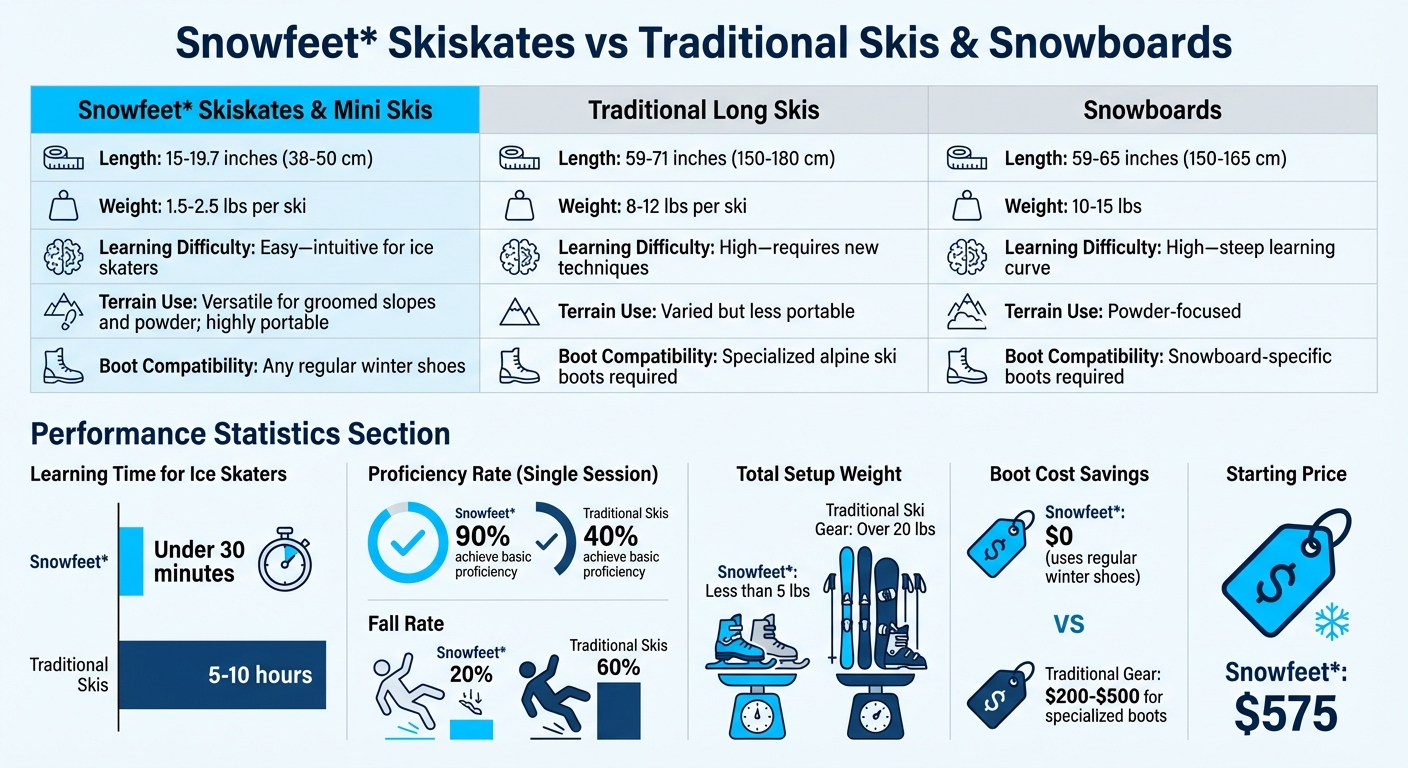
Snowfeet Skiskates vs Traditional Skis and Snowboards Comparison
Problems Ice Skaters Face with Traditional Skis and Snowboards
Unnatural Body Position and Steep Learning Curve
Traditional skis force you into a stance that feels anything but natural for ice skaters. Instead of the inline balance and independent leg movements you're used to, skiing demands a completely different body position. On the other hand, snowboards lock both feet onto a single wide board, leaving no room for the independent leg movement or one-leg balance that are second nature to ice skaters.
Even the mechanics are a mismatch. Nordic Ski Lab explains:
"The action is reminiscent of ice skating, but the mechanics are different because skis are different from ice skates and snow is different from ice".
With skis, you need to compress the ski's camber to press the inside edge into the snow for each push-off. This motion is entirely foreign to ice skaters, where rigid blades provide direct contact with the ice. These unnatural movements disrupt the fluidity you're used to, which leads us to the next big challenge.
Loss of Natural Gliding Motion
The smooth, rhythmic glide you’ve mastered on ice disappears when using traditional skiing gear. Long skis make it harder to execute quick turns or sharp stops, like the hockey stops that feel so effortless on ice. Instead of building on your existing skills, you're forced to relearn movement from scratch. However, learning how to use hybrid snow skates is much more intuitive for those with an ice skating background. The extended length of skis hinders the natural, flowing motions central to ice skating, making the experience feel clunky and awkward.
Heavy Equipment and Transport Problems
Another frustration? The sheer bulk of traditional skiing gear. Unlike ice skates, which are compact and only need occasional sharpening, skis require a whole maintenance setup. You'll need glide wax, a specialized iron, and tools for scraping and brushing - all of which must be used on a dedicated table. Add to that the hassle of transporting long, heavy skis, and it’s clear why this gear feels like overkill.
In contrast, Snowfeet* Skiskates fit neatly into a backpack and eliminate the need for all that extra equipment. This streamlined design makes them a much easier option for ice skaters who want to keep things simple and natural.
These challenges show why Snowfeet* Skiskates are a game-changer. They let you maintain your ice-skating skills while offering a more intuitive and enjoyable experience on snow.
How Skiskating Matches Ice Skating Movement
Edge Control and Weight Transfer
Skiskating feels a lot like ice skating, thanks to the way it mimics rhythmic weight shifts to carve edges and stay balanced. Think about leaning into a turn on ice - when you press the inside edge of your skate, it responds seamlessly. Skiskates work the same way, giving you smooth edge control. This means the balance, edge work, and movement patterns you’ve honed on the ice transfer effortlessly to skiskating, especially when using Snowfeet* gear.
That muscle memory you’ve built from skating? It carries over perfectly. Whether it’s quick turns, smooth gliding, or confident stops, your ice skills set you up for success. Plus, the focus on balance naturally improves your ability to hold a one-leg stance.
One-Leg Balance and Low Body Position
Ice skating demands solid one-leg balance in a low, athletic stance, and Snowfeet* Skiskates make this feel second nature. With their compact length of just 17.3 inches (44 cm), these skiskates let you pull off sharp directional changes, rapid stops, and other agile moves. It’s like your ice skating skills have found a new home.
Unlike traditional skis, which often encourage a more static posture, Snowfeet* Skiskates allow for independent leg movement. This makes balancing on one leg and maintaining an athletic stance intuitive and fun. From there, your stride technique ties everything together, making the transition feel smooth.
V-Position and 45-Degree Push-Offs
The V-shaped stride you use to pick up speed on ice - where your feet form a V and push off at a 45-degree angle - translates directly to skiskating. Snowfeet* Skiskates let you accelerate and keep your momentum using the same mechanics. The design mirrors the precision of ice skate blades, giving you the control to stop sharply or pivot quickly.
For hockey players who are pros at quick stops and dynamic pivots, Snowfeet* Skiskates feel like a natural extension of their skills. Instead of tackling a steep learning curve, they’ll find themselves gliding into this new sport with ease. That’s why transitioning from ice skating to skiskating with Snowfeet* gear feels so natural - it’s all about building on movements you already know.
Snowfeet* Skiskates vs Traditional Skis and Snowboards
Comparison Table: Snowfeet* vs Traditional Gear
Here's a quick look at how Snowfeet* stacks up against traditional winter sports gear:
| Feature | Snowfeet* Skiskates & Mini Skis | Traditional Long Skis | Snowboards |
|---|---|---|---|
| Length | 15-19.7 inches (38-50 cm) | 59-71 inches (150-180 cm) | 59-65 inches (150-165 cm) |
| Weight | 1.5-2.5 lbs per ski | 8-12 lbs per ski | 10-15 lbs |
| Learning Difficulty | Easy - intuitive for ice skaters | High - requires new techniques | High - steep learning curve |
| Terrain Use | Versatile for groomed slopes and powder; highly portable | Varied but less portable | Powder-focused |
| Boot Compatibility | Any regular winter shoes | Specialized alpine ski boots required | Snowboard-specific boots required |
Snowfeet*’s compact design - just 15 to 19.7 inches long - makes them feel much closer to ice skate blades, which typically measure 15.7 to 17.7 inches. This similarity gives ice skaters a natural advantage compared to traditional skis, which stretch over 59 inches in length.
Why Snowfeet* Works Better for Ice Skaters
For ice skaters, Snowfeet* Skiskates are a game-changer. The skills you’ve already mastered on the ice transfer almost seamlessly to these compact skates. Most ice skaters can get the hang of Snowfeet* in under 30 minutes, thanks to the familiar gliding motion. In contrast, traditional skis require 5-10 hours of practice just to learn the basics, like parallel turns on skiblades. Studies show that 90% of ice skaters achieve basic proficiency with Snowfeet* in a single session, with only a 20% fall rate. Meanwhile, traditional skis see just 40% proficiency and a much higher fall rate of 60%.
Another big win? Weight. A full Snowfeet* setup weighs less than 5 lbs, while traditional ski gear can tip the scales at over 20 lbs. This makes carrying and using Snowfeet* much easier. Just strap them on at the base of the slope - no rentals, no fuss.
And let’s talk boots. Snowfeet* works with your regular winter shoes, thanks to adjustable straps. That’s a huge money saver - no need to shell out $200-$500 for stiff alpine or snowboard boots. Plus, if you’re used to the flexibility of ice skate boots, you’ll appreciate the freedom Snowfeet* gives you. You can literally go from the rink to the slopes in the same pair of shoes.
Snow sports coaches also point out that Snowfeet* lets you stick to movements you already know, like the V-position and 45-degree push-offs. There’s no need to learn awkward new stances.
sbb-itb-17ade95
How to Use Snowfeet* Skiskates 44 CM | Skates for Snow | Mini Ski | Snowblades | Snowskates
Tips for Ice Skaters Starting Skiskating
If you're already comfortable on the ice, transitioning to skiskating with Snowfeet* Skiskates can feel surprisingly natural. These tips will help you fine-tune your technique and get the most out of your experience.
Getting Your Body Position Right
The stance you use on the ice works well with Snowfeet*. Keep your knees slightly bent, your weight centered over your hips, and your gaze forward - just like when you're skating. Avoid leaning too far forward, as it can throw off your balance. Start with small, controlled steps to get a feel for the skiskates, and extend your arms slightly for extra stability. This low stance becomes even more important on uneven terrain, where your legs need to absorb the bumps and dips in the snow.
Gliding and Stopping Methods
Gliding with Snowfeet* feels a lot like ice skating. Shift your weight from one skate to the other to build momentum. When it comes to stopping on short skis, you’ve got three familiar techniques:
- Snowplow Stop: Point your toes inward to form a V-shape, press the inside edges of the skates, and bend your knees to slow down.
- T-Stop: Place one skate behind the other at a right angle, with the back foot creating friction to bring you to a stop.
- Hockey Stop: Turn both feet parallel and away from your body, shifting your weight onto the edges to quickly reduce speed.
These moves translate well from ice to snow, so you’ll likely pick them up quickly.
Handling Slopes and Uneven Snow
On gentle slopes, stick to short, controlled strides, much like you would on the rink. When the snow gets bumpier or shifts to a powdery texture, adjust by shortening or lengthening your strides as needed. Keep that low, athletic stance to stay stable. Snowfeet* Skiskates, with their compact 44 cm (17.3 inches) design, are great for quick reactions and weight shifts. If you happen to fall, try to lower your body to minimize the impact, aiming to land on your side. To get back up, roll onto your hands and knees, then rise slowly to regain your balance.
Conclusion
If you're an ice skater looking to bring your skills to the slopes, Snowfeet* Skiskates are an easy fit. With their compact 44 cm (17.3 inch) design, they tap into your muscle memory, allowing for precise edge control, smooth weight shifts, and quick stops - just like on the ice. You’re not starting from scratch; you’re simply applying familiar techniques to a new surface.
Unlike traditional skis or skiblades that can feel stiff and awkward, Snowfeet* products let you keep that low, athletic stance you're used to on the rink. Their lightweight build makes it easy to execute technical moves, like shifting weight seamlessly between feet to change direction while keeping your flow. This design keeps the ride smooth and natural, mirroring the fluidity of ice skating.
With prices starting at $575, Snowfeet* offers a more affordable option compared to standard ski setups. They're portable, easy to use from day one, and perfectly suited to movements you already know. This combination of cost and convenience makes them an excellent choice for ice skaters looking to hit the snow.
In short, making the jump from ice to snow doesn’t have to be a challenge. Snowfeet* gives you the tools to move naturally and confidently, turning what could be a steep learning curve into an enjoyable ride.
FAQs
Are Snowfeet* Skiskates allowed at most U.S. ski resorts?
Snowfeet* Skiskates are usually allowed at the majority of ski resorts across the U.S. Because they’re built for recreational use and don’t fall under the category of traditional skis or snowboards, they generally aren’t subject to the same stricter rules that apply to those types of equipment.
Do I need special boots, or can I use my regular winter shoes?
You can wear your everyday winter shoes with Snowfeet skiskates. These skiskates are built with convenience in mind, so you don’t need special boots to enjoy them. This design makes Snowfeet skiskates simple to use and open to everyone.
What’s the safest way to learn skiskating on your first day?
Learning skiskating for the first time? Start somewhere safe and manageable - like a flat, smooth surface. This helps you get a feel for balance and gliding since skiskating is a lot like ice skating. Using Snowfeet products can make things easier; they’re lightweight and beginner-friendly. Don’t forget your safety gear, take your time, and focus on gaining confidence before trying steeper slopes or tougher areas.











Leave a comment
This site is protected by hCaptcha and the hCaptcha Privacy Policy and Terms of Service apply.