




















If you're a hockey player, good news: your skills on the ice give you a big head start on the slopes. Balance, edge control, and weight transfer - core elements of hockey - translate seamlessly to skiing. The transition becomes even smoother with shorter ski gear like Snowfeet Skiskates or Skiblades, designed to mimic the agility and quick stops you're used to on skates.
Here’s why hockey players excel at skiing:
- Edge Control: Leaning into turns on skis feels similar to carving on hockey skates.
- Low Stance: Your bent-knee posture on the ice is perfect for skiing.
- Quick Stops: Hockey stops work well with shorter skis, making speed control easier.
Snowfeet products, including Skiskates (44 cm) and Skiblades (65–120 cm), are ideal for hockey players. They’re compact, responsive, and easy to store. Prices range from $575 to $775, and they work with regular winter boots. If you want to bring your hockey moves to the snow, these are a great choice.
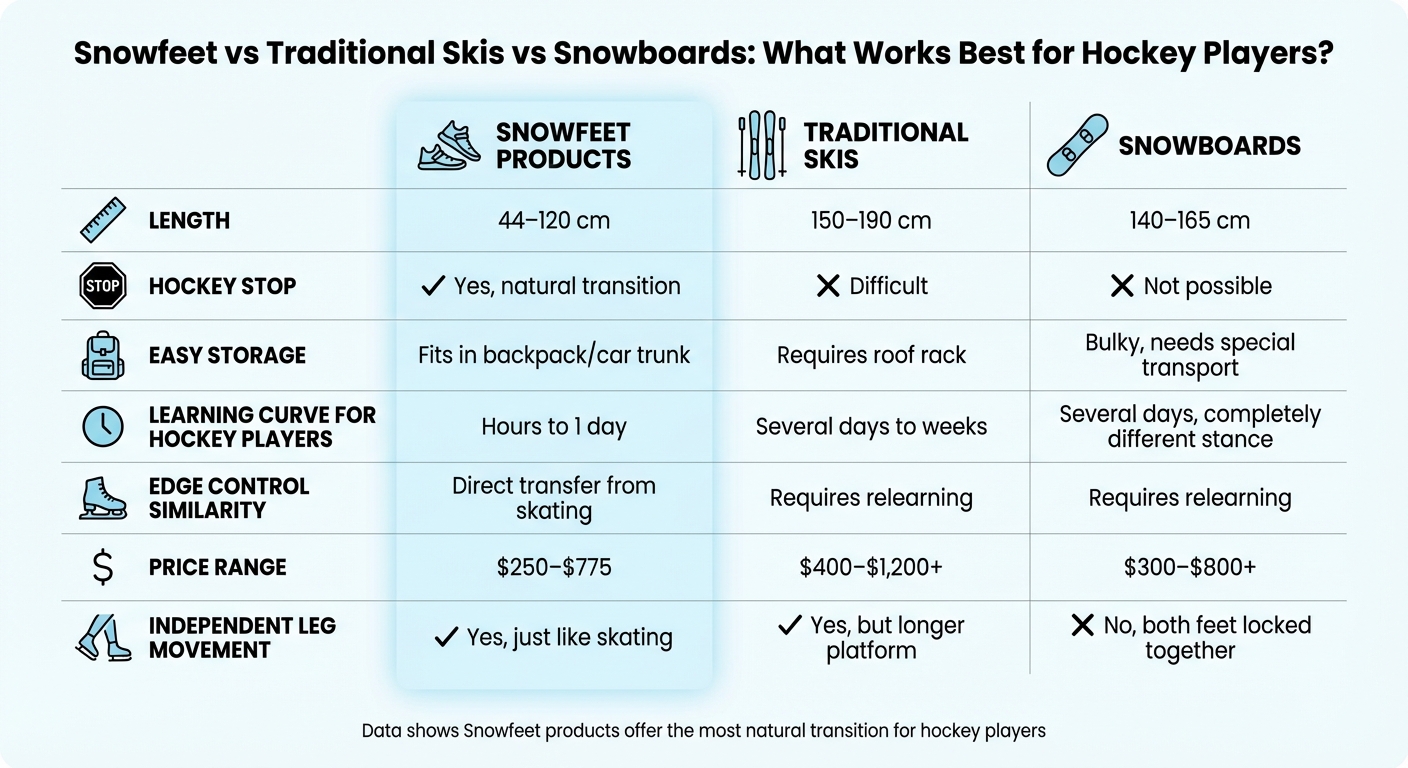
Snowfeet vs Traditional Skis vs Snowboards Comparison for Hockey Players
Hockey Player Tries Snowfeet* Skiskates | See What He Thinks | Skiboards | Short Ski | Mini Ski
How Hockey Skills Transfer to Skiing
If you’re a hockey player, you already have a head start when it comes to skiing. The skills you’ve honed on the ice - like balance, edge control, and weight transfer - can easily be applied to the slopes. Your body mechanics and muscle memory are already wired for success; you just need to adjust to the different surface. And with gear like Snowfeet*, the transition feels even more natural. Let’s break down how your hockey skills translate directly into skiing techniques.
Edge Control and Weight Transfer
Think about how you lean into turns on the ice, tilting your blade to grip and carve. The same logic applies to skiing. When you tilt your ski onto its edge, you create clean, controlled turns instead of skidding. Your natural ability to shift weight on the ice also works perfectly for initiating ski turns. Plus, modern shaped skis make this process even easier, as they naturally follow an arced path when you engage the edges.
Low Stance and Balance
Hockey players are already pros at maintaining a low, stable stance. That bent-knee posture with your weight centered over your feet? It’s exactly what skiing requires. This low center of gravity gives you better control and makes quick direction changes a breeze. Since you’re used to this position, you won’t have to learn a new stance - just apply what you already know. Once you’re dialed in, everything from carving turns to stopping becomes second nature.
Push-Off Movements and Stops
The lateral push-offs you use to build speed on the ice are perfect for engaging ski edges and gaining momentum. And that famous hockey stop? It transitions beautifully to skiing, especially with shorter skis that are designed for agility. The combination of weight distribution, edge angles, and quick rotations in a hockey stop mirrors the techniques you’ll use to control speed and stop effectively on the slopes.
Why Snowfeet* Products Work Well for Hockey Players
If you're a hockey player, you know the importance of quick turns, sharp stops, and precise control. Snowfeet* products are designed to bring those same skills to the slopes. Their shorter design mimics the agility and responsiveness you're used to on the ice, making the transition from skating to skiing feel natural. Unlike traditional long skis, which require learning new techniques, Snowfeet* products let you use your skating skills right away. Balance and edge control stay almost identical, giving you the confidence to carve and stop like you do on ice. It's like taking your hockey game to the snow.
Snowfeet* Skiskates (44 cm): Perfect for Hockey Players
The Snowfeet* Skiskates, measuring just 44 cm, are like hockey skates for snow. Their compact size delivers the same quick reactions you rely on for sharp cuts and stops on the ice. You can pull off hockey-style maneuvers and tight turns without the hassle of bulky equipment. Built with a wood core, they offer excellent edge grip for precise carving compared to all-mountain skis, while their small size makes them incredibly portable - just throw them in a backpack and you're ready to go. At $575, they provide all the performance you need without the bulk of traditional skis.
Snowfeet* Skiblades (65, 99, 120 cm): Something for Everyone
Need a bit more stability or surface area? Snowfeet* Skiblades come in three sizes to match your skill level and the terrain you want to conquer.
- 65 cm Skiblades: Starting at $635, these keep the skate-like feel but add a little extra surface area for better handling in varied snow conditions.
- 99 cm Skiblades: Priced at $675, these are ideal for advanced terrain or higher speeds, offering a balance of control and maneuverability.
- 120 cm Short Skis: At $775, these are your go-to for all-mountain versatility. They deliver great performance while keeping that hockey-inspired responsiveness.
No matter which model you choose, you're getting equipment that builds on your skating instincts.
Snowfeet* vs. Traditional Skis and Snowboards
Traditional skis and snowboards require you to learn completely new techniques. Long skis (usually 150–190 cm) force you into wide, sweeping turns, while snowboards lock your feet together, making independent leg movement impossible. Snowfeet* products, on the other hand, preserve the quick stops and sharp maneuvers you're already comfortable with. Their shorter length makes hockey stops and tight turns feel natural - something that's nearly impossible on traditional skis. Plus, they're super portable, fitting easily in a car trunk or backpack. And the learning curve? You'll be up and running in hours, not days or weeks.
| Feature | Snowfeet* Products | Traditional Skis | Snowboards |
|---|---|---|---|
| Length | 44–120 cm | 150–190 cm | 140–165 cm |
| Hockey Stop | Yes, natural transition | Difficult | Not possible |
| Easy Storage | Fits in backpack/car trunk | Requires roof rack | Bulky, needs special transport |
| Learning Curve for Hockey Players | Hours to 1 day | Several days to weeks | Several days, completely different stance |
| Edge Control Similarity | Direct transfer from skating | Requires relearning | Requires relearning |
| Price Range | $250–$775 | $400–$1,200+ | $300–$800+ |
| Independent Leg Movement | Yes, just like skating | Yes, but longer platform | No, both feet locked together |
sbb-itb-17ade95
Drills for Hockey Players to Learn Ski Carving
If you're a hockey player looking to bring your edge control and balance from the rink to the slopes, you're in luck. Adapting your hockey stop technique is a great way to translate those skills into ski carving. These ski drills to improve edge control are designed to help you make the most of your skating instincts while refining your control on snow.
Hockey Stop Adaptation for Snow
Your hockey stop is already a solid foundation for skiing, but it needs a few tweaks to work on snow. Ski instructor Kevin Jordan explains, "To perform a hockey STOP and actually STOP quickly, you must turn your skis fast and tip your lower legs rapidly to get the edges to grip". This means quick movements and precise edge control - skills you likely already have from hockey.
Start with the "Gymnast" landing drill. The goal here is to stop on a marked spot 25 times per side, focusing on a stable, non-sliding landing. Jordan also advises focusing on even pressure distribution: "I feel that I apply pressure evenly from the big toe to the heel. This makes the ski grip from tip to tail". This even pressure helps you maintain control and ensures your skis grip the snow effectively.
Lastly, practice hockey stops in a narrow corridor. This drill sharpens your leg rotation and control, which are key for quick edge changes. If you're using something like Snowfeet* Skiskates, their compact design can make these drills even more effective.
Conclusion
Hockey players already have the skills needed to feel at home on skis - balance, edge control, quick stops, and sharp turns. These abilities translate naturally to short skis, making the switch feel like second nature rather than starting from scratch.
Snowfeet* products are designed to let you bring your hockey moves to the slopes. The Snowfeet* Skiskates (44 cm/17 inches) are perfect for pulling off hockey stops and tight turns, giving you the same control and agility you’re used to on the ice. If you’re looking for more options, the Snowfeet* Skiblades come in sizes like 65 cm/26 inches, 99 cm/39 inches, and 120 cm/47 inches, so you can pick what suits your skill level and favorite terrain. Unlike traditional long skis, these let you build on your existing edge control and quick maneuvers without needing to relearn everything.
Plus, they’re super convenient. Snowfeet* products are small enough to fit in a backpack and work with your regular winter or snowboard boots - no need to splurge on pricey ski boots. Whether you’re heading to the mountains, trekking through fresh snow in your backyard, or tossing them in your car for a quick trip, they’re easy to take anywhere.
This winter, take your hockey skills to the slopes with Snowfeet* Skiskates or Skiblades. You’ve already mastered the ice - now it’s time to dominate the snow. Your instincts are ready; all you need is the right gear.
FAQs
Are Snowfeet* easier than long skis for hockey players?
Snowfeet* products are often a smoother transition for hockey players moving to snow sports. Their shorter lengths - 44 cm for Skiskates and 65, 99, or 120 cm for Skiblades - closely align with the mechanics of hockey skating. Skills like edge control and maintaining balance feel more familiar, making it easier to adapt. On the other hand, traditional long skis demand learning new techniques, which can feel less intuitive for those accustomed to quick, precise movements.
Which Snowfeet* length should I choose to start carving?
Snowfeet* provides a range of options for snow enthusiasts, including Skiskates (44 cm) and Skiblades (65 cm, 99 cm, and 120 cm). If you're a hockey player looking to transition to snow sports, these are designed to feel natural. For beginners, the 65 cm Skiblades are a great pick. They offer just the right mix of stability and control, making it easier to carve and apply your hockey skills on the slopes without feeling overwhelmed.
Can I use my regular winter boots with Snowfeet*?
Snowfeet* are made to pair perfectly with standard winter boots. Just strap them on over your regular boots, and you're ready to hit the snow. They provide a smooth, natural feel, making your time on the slopes both easy and fun.











Leave a comment
This site is protected by hCaptcha and the hCaptcha Privacy Policy and Terms of Service apply.