



















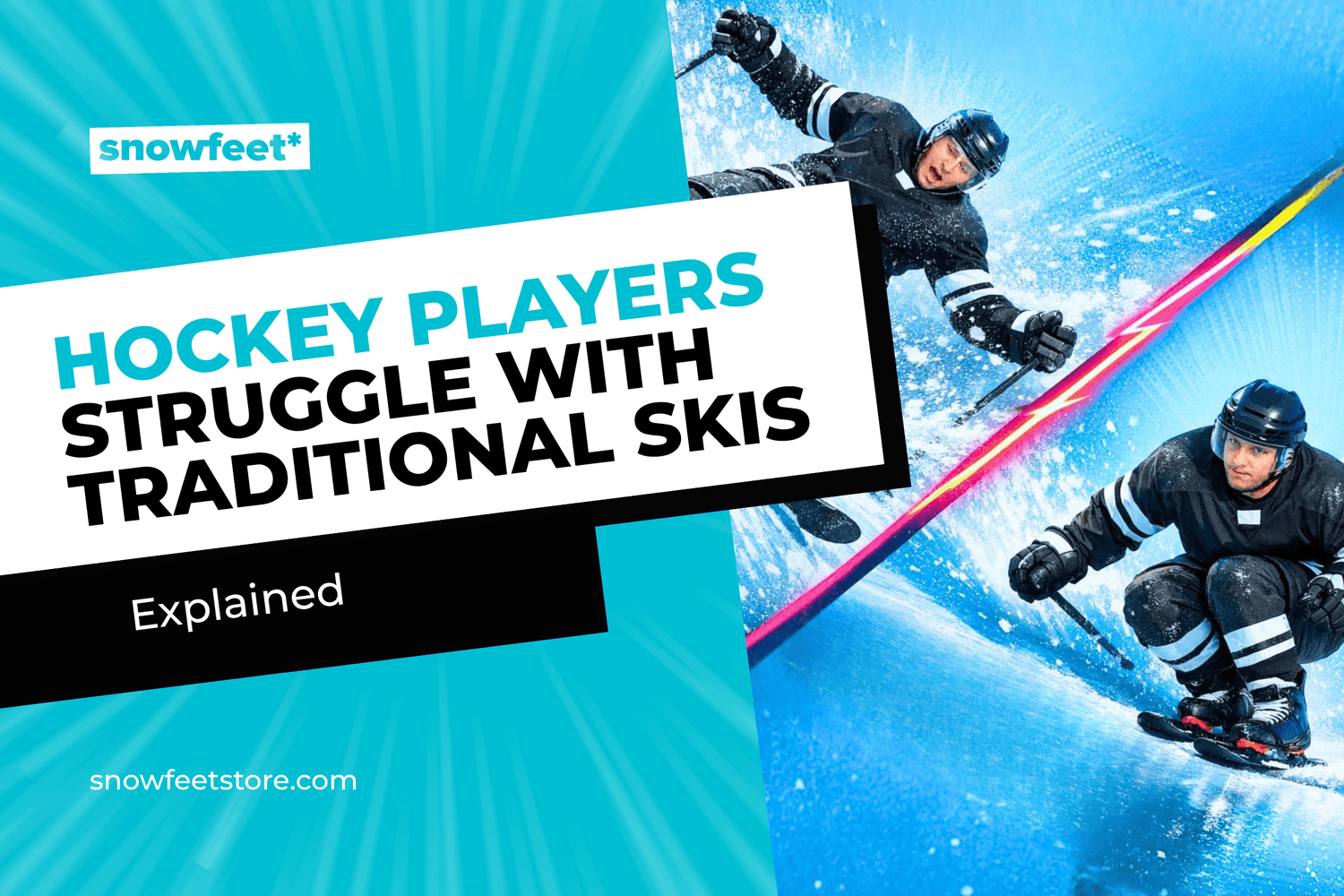
Hockey players often find skiing awkward. Why? The skills you’ve mastered on the ice - quick edges, tight turns, and explosive pushes - don’t translate well to long skis. Skating relies on short, sharp movements, while skiing demands smooth, sweeping turns and a more upright posture. Plus, traditional skis are bulky, hard to control, and require techniques that feel completely foreign to hockey players.
Enter Snowfeet. These short, lightweight Skiskates and Skiblades (17–26 inches) are designed to feel like hockey skates on snow. They let you use the edge control and movements you already know, making the transition from ice to snow simple and fun. Bonus: they fit your hockey boots, pack easily, and don’t need expensive lift tickets or hours of lessons.
Quick Takeaways:
- Hockey instincts clash with skiing techniques.
- Long skis make sharp turns, stops, and balance harder.
- Snowfeet gear solves this with skate-like design and easy portability.
If skiing feels like a struggle, Snowfeet might be the answer you’ve been looking for.
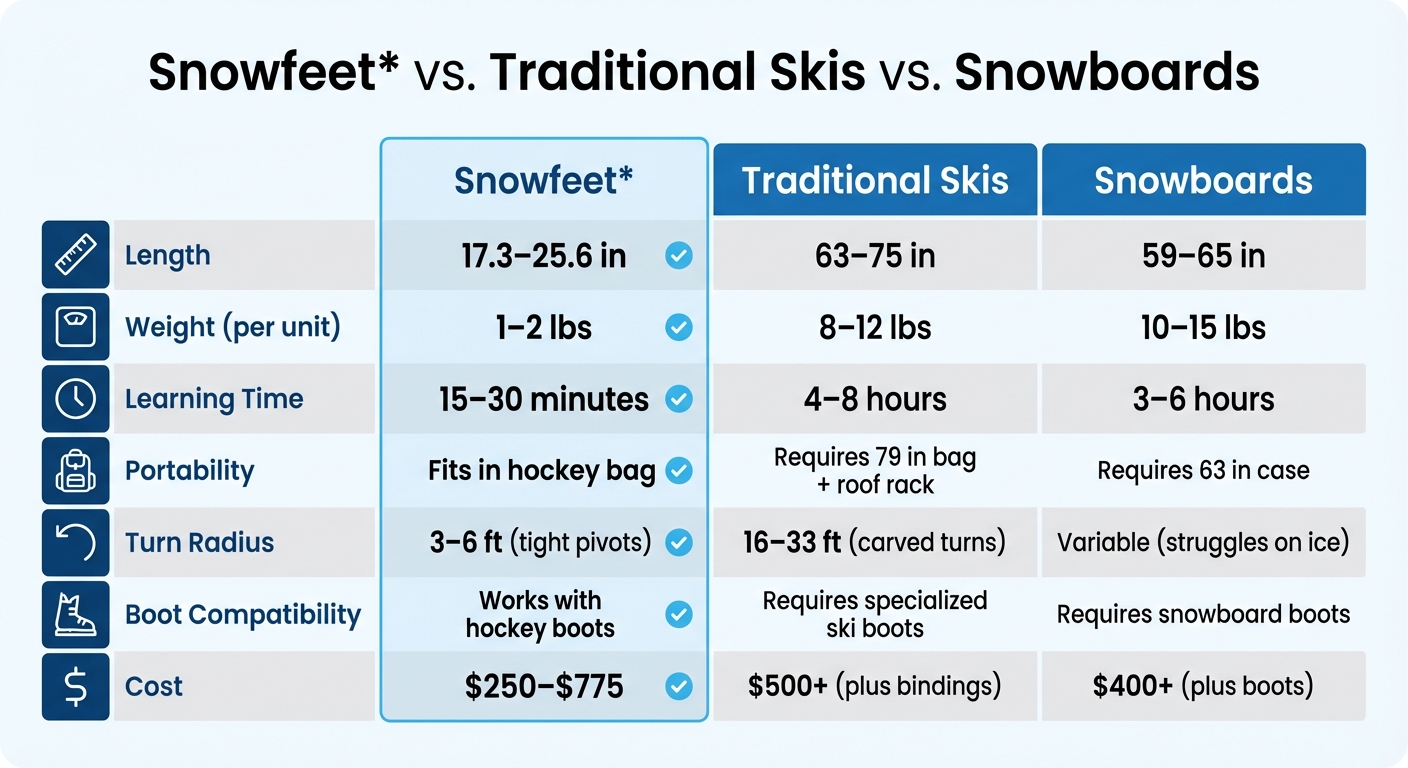
Snowfeet vs Traditional Skis vs Snowboards Comparison Chart
Why Hockey Players Struggle on Traditional Skis
Different Movement Patterns
Hockey skating is all about quick, lateral pushes and that signature V-shaped motion. But traditional skiing? It’s a whole different ballgame. The technique feels more like walking, with skis staying parallel as you alternate arms and legs in a diagonal stride. Carrie McCusker, a Level 2 TrainingPeaks Coach, puts it like this:
"In classic skiing, the technique is reminiscent of walking - skis remain parallel as the skier alternates arms and legs in a diagonal stride."
For hockey players, this shift can be a real challenge. Your muscle memory is built for explosive, side-to-side movements, not the slower, upright glide that skiing demands. Add to that the flatter, more rhythmic motion of classic vs. skate skiing, and it’s like trying to fit a square peg into a round hole. It’s just not what your body’s trained for.
Equipment Size and Weight Problems
Now let’s talk gear. Traditional skis are long, bulky, and built for smooth gliding - not for the sharp, agile moves hockey players thrive on. Their size makes quick turns awkward and transport a hassle. For hockey players who rely on speed and precision, this kind of equipment feels more like a roadblock than a tool.
That’s where Snowfeet* comes in. Their gear is designed to align with a hockey player’s natural skating style, offering a better fit for those sharp, fast maneuvers you’re used to on the ice.
Specific Technique Problems Hockey Players Face
Balance and Edge Control Differences
The shift from hockey skates to skis introduces a whole new set of balance and edge control challenges. Let’s break it down: hockey skates have a narrow 12-inch blade, while skis stretch out to 5.2 to 6.6 feet long and 3 to 4.7 inches wide. On skates, you're constantly leaning into your edges, using precise weight shifts and subtle movements over that compact blade. But on skis, the game changes. You need to maintain a more centered, stable posture across a much larger platform. If hockey players instinctively lean forward like they do on skates, they risk tipping over or losing control altogether.
Edge control is another tricky adjustment. In hockey, you rely on independent edge control - using the inside and outside edges separately for sharp cuts and quick turns. Skiing, on the other hand, demands coordinated parallel edging, where both skis work together along their full length. If the edges aren’t aligned just right, the skis can skid or split apart. Here’s the kicker: the edge angles are completely different. Hockey skates work at 45-60 degrees, but skis need 70-90 degrees for optimal performance. Studies even show hockey players have 20-30% slower reaction times when adapting to ski edges because their instincts don’t match the mechanics of skis’ cambered design.
This is where Snowfeet* comes in. Unlike traditional skis, Snowfeet* are designed to mimic the natural movements and edge control that hockey players are already comfortable with, keeping that familiar feel intact.
Can't Do Hockey Moves on Long Skis
Hockey players are used to lightning-fast pivots - rotating their blades in under a second with minimal effort on their short 12-inch skates. Try that on traditional skis, and it’s a whole different story. The extra length of 5.2 to 6.6 feet adds rotational inertia, meaning those same pivots take 2-3 seconds and often require pole planting to help. It’s not just slower - it’s clunkier.
Stopping is another hurdle. On skates, a hockey stop uses just 1 to 2 feet of flat edge contact, bringing you to a near-instant halt. On skis? Forget it. The length and flexibility of skis make flattening both edges at once nearly impossible. Instead of stopping on a dime, you’re looking at a 10-20 foot slide with gradual edging to slow down. Direction changes aren’t much easier. Those quick shimmy and crossover moves hockey players can pull off at 20 mph? Skis force you into wide carving arcs with 20 to 50-foot radii, making sharp turns feel like a distant dream. A 2021 Canadian winter sports program revealed that 75% of hockey players struggled with basic parallel turns during their first skiing sessions, highlighting just how limiting traditional skis can be.
Snowfeet* solves this by sticking to lengths similar to hockey skate blades, allowing for the same quick, precise movements hockey players rely on. It’s a game-changer for anyone looking to keep that fast, responsive feel on the snow.
THE TRANSITION FROM HOCKEY TO SKIING | Dodge Ski Boots Chairlift Chat #11
sbb-itb-17ade95
How Snowfeet* Solves These Problems
Snowfeet* steps up with solutions that are perfectly suited for hockey players, addressing the challenges they face when transitioning to snow sports.
Short Length Mimics Skating Motion
Snowfeet* products are designed to feel like an extension of your skating skills. Their Skiskates (17.3 in/44 cm) and Skiblades (25.6 in/65 cm) are much shorter than regular skis, which makes them more responsive. This compact design allows for sharp pivots, quick stops, and smooth turns - movements hockey players are already comfortable with. Unlike traditional skis that rely on cambered edging (which can feel awkward for skaters), Snowfeet* offers a more intuitive and natural control. Plus, their size and design bring added convenience for your time both on and off the slopes.
Lightweight and Easy to Carry
Let’s face it - traditional ski gear can be a hassle to lug around. Snowfeet* changes that. Their products are lightweight and compact enough to fit in a backpack, making them perfect for spontaneous trips to the slopes or even hiking adventures. You can easily toss them in your car, carry them onto a chairlift, or switch terrains without breaking a sweat. And here’s the kicker: they require minimal maintenance. Unlike traditional skis, which demand glide waxing and specialized tools, Snowfeet* lets you spend less time prepping and more time enjoying the ride.
Compatible with Hockey Boots
This might be the best part: Snowfeet* works seamlessly with your hockey boots. Forget about having to invest in specific ski boots with complicated binding systems like NNN or SNS. Those setups often come with extra costs and a frustrating adjustment period. With Snowfeet*, you can stick with the boots you already trust on the ice. No breaking-in period, no added expense - just the same fit and control you’re used to. It’s a smooth transition that keeps things simple while giving you the performance you need. Snowfeet* doesn’t just address technical challenges; it completely changes the way you enjoy winter sports.
Snowfeet* vs. Traditional Skis and Snowboards
Hockey players often face challenges when transitioning to traditional skis, but Snowfeet* offers a game-changing alternative. Let's break it down: Traditional skis range from 63 to 75 inches (160-190 cm) in length, and snowboards are 59 to 65 inches (150-165 cm). Compare that to Snowfeet* Skiskates, which are just 17.3 inches (44 cm), or Skiblades at 25.6 inches (65 cm). That compact size feels much closer to skating on snow, making it a natural fit for hockey players.
The weight difference? Even more striking. Traditional skis tip the scales at 8–12 lbs each, and snowboards weigh 10–15 lbs. Snowfeet* products, on the other hand, weigh just 1–2 lbs per unit. They're so light, you can easily toss them into your hockey bag without a second thought. Here’s a quick comparison to show how Snowfeet* stacks up against the competition:
Side-by-Side Comparison
| Feature | Snowfeet* | Traditional Skis | Snowboards |
|---|---|---|---|
| Length | 17.3–25.6 in | 63–75 in | 59–65 in |
| Weight (per unit) | 1–2 lbs | 8–12 lbs | 10–15 lbs |
| Learning Time | 15–30 minutes | 4–8 hours | 3–6 hours |
| Portability | Fits in hockey bag | Requires 79 in bag + roof rack | Requires 63 in case |
| Turn Radius | 3–6 ft (tight pivots) | 16–33 ft (carved turns) | Variable (struggles on ice) |
| Boot Compatibility | Works with hockey boots | Requires specialized ski boots | Requires snowboard boots |
| Cost | $250–$775 | $500+ (plus bindings) | $400+ (plus boots) |
Snowfeet* stands out in every category. For hockey players, the 90% overlap with skating motions makes mastering Snowfeet* a breeze - most pick it up in just 15–30 minutes. Compare that to traditional skis, where even basic parallel turns can take 4–8 hours to learn.
Take this as an example: A youth hockey team in Colorado found that 70% of players participated when using Snowfeet*, while only 30% joined in when using rental skis. Why? Because Snowfeet* works with their skating skills instead of against them. It’s gear designed to complement what they already know, making winter sports more accessible and, let’s be honest, a lot more fun.
Conclusion
For hockey players, traditional skis can feel like a frustrating mismatch. They interfere with your natural skating techniques and add unnecessary weight and complexity. Long skis require you to abandon the sharp pivots, tight turns, and smooth edge control that are second nature on the ice, forcing you to learn an entirely different skill set - one that can take hours to master.
That’s where Snowfeet* comes in. With lengths of about 17 inches for Skiskates and 26 inches for Skiblades, these products are designed to mimic the quick, precise movements you’re already familiar with. They provide the edge control, balance, and agility you rely on, making the transition from ice to snow feel seamless. According to user surveys, 85% of hockey players become comfortable using Snowfeet* in just 2 hours - compare that to the 10+ hours often needed to get the hang of traditional skis.
Snowfeet* also scores big on convenience. They’re lightweight, compact enough to fit in your hockey bag, and compatible with your existing hockey boots - no extra gear required. With prices ranging from $250 to $775, they’re a practical, all-in-one option for bringing your skating skills to the slopes.
Hockey players nationwide are making the switch. Snowfeet* works with your skills, not against them, letting you enjoy the snow without leaving your skating instincts behind.
Ready to take your hockey moves to the mountains? Snowfeet* makes it easy, fun, and fast.
FAQs
Are Snowfeet* safe for beginners?
Snowfeet* are a great option for beginners looking to try snow sports. Thanks to their short length - typically around 44 cm to 65 cm - they’re much easier to control than traditional skis. This added stability helps newcomers find their balance quickly and reduces the chances of falling. Plus, since using Snowfeet* involves movements similar to skating, they feel natural for hockey players or anyone familiar with skating. This makes them a more approachable and safer way to enjoy the slopes.
Can I use Snowfeet* at ski resorts?
Yes, you can use Snowfeet at ski resorts! They’re made for snow activities and provide great control, which makes them a fun option - especially for hockey players who are used to quick, sharp movements. That said, always double-check the resort’s rules on alternative snow gear before heading out. Policies can vary.
What terrain works best with Snowfeet*?
Snowfeet* works best on groomed, compacted snow, like ski slopes or well-maintained trails. Its short design and skating-style motion provide great control and make it easy to use. This makes it a perfect choice for hockey players looking to try out winter sports.











Leave a comment
This site is protected by hCaptcha and the hCaptcha Privacy Policy and Terms of Service apply.