



















Most U.S. shops won’t list “ski skates” by that name. If I wanted to find them fast, I’d search “snowblades near me,” “skiblades rental,” or “short ski rentals” and then call 2–3 local resorts or specialty shops before driving over.
Here’s the short version:
- Use the right search words: snowblades, skiblades, short skis, mini skis
- Expect rental prices around $13–$40 a day at smaller shops, and often $40–$80/day at resorts with boots
- Know your boot type first: some models need ski boots, while some Snowfeet* options work with winter boots or snowboard boots
- If you ride 3–5 days or more, buying can cost less than renting again and again
- Local hills, terrain parks, ski swaps, and demo days are often better bets than standard rental counters
If I were helping a friend shop today, I’d keep it simple:
pick the gear based on your boots, where you’ll ride, and how easy you want it to be to carry. That’s the whole game.
The Most Affordable Ski Skate Gear?
Quick Comparison
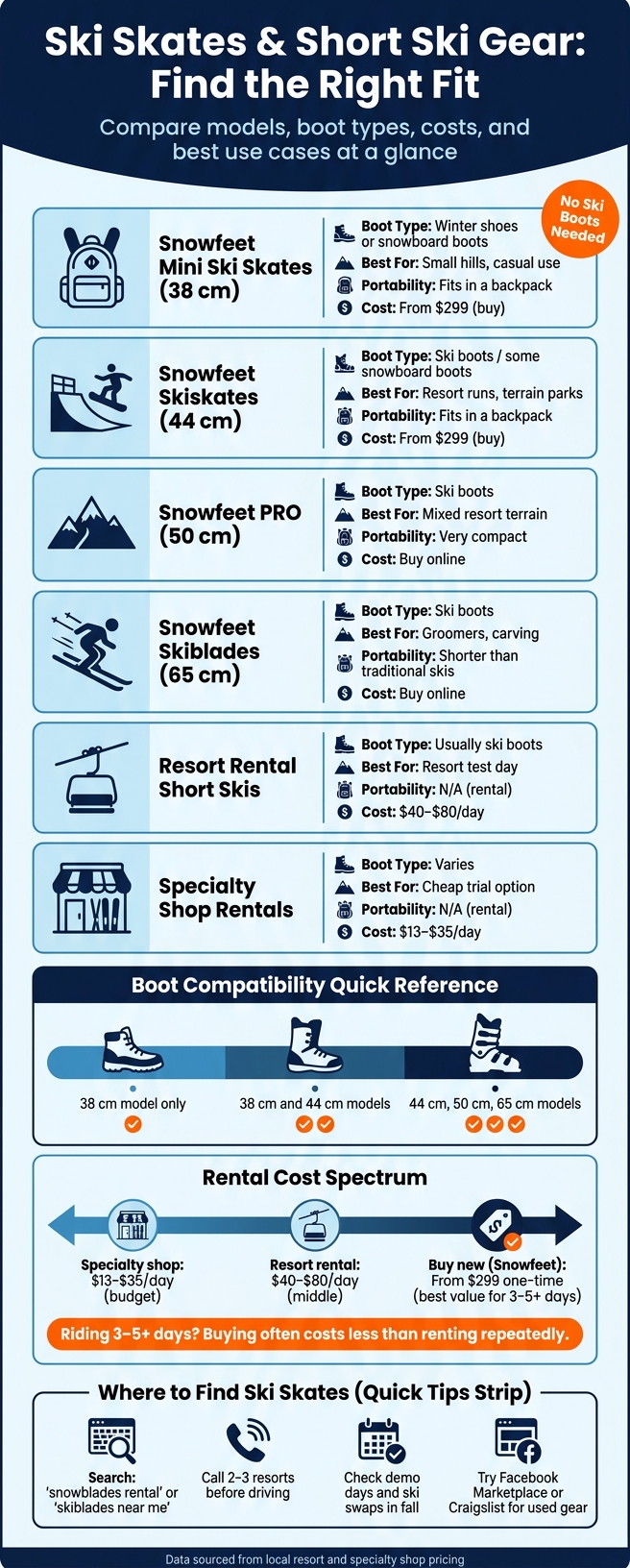
Ski Skates & Short Ski Gear Comparison Guide
| Option | Best Search Term | Boot Type | Best Use | Typical Cost |
|---|---|---|---|---|
| Snowfeet* 38 cm | mini ski skates | Winter boots / snowboard boots | Small hills, casual use | Buy from $299 |
| Snowfeet* Skiskates 44 cm | ski skates / skiskates | Ski boots, some snowboard boot setups | Resort runs, parks | Buy from $299 |
| Snowfeet* PRO 50 cm | short skis | Ski boots | Mixed terrain | Buy online |
| Snowfeet* Skiblades 65 cm | snowblades / skiblades | Ski boots | Groomers, carving | Buy online |
| Resort rental short skis | snowblades rental | Usually ski boots | Resort test day | $40–$80/day |
| Specialty shop rentals | skiblades rental | Varies | Cheap trial option | $13–$35/day |
A few things stand out from the article:
- Shops often don’t stock short skis front and center
- Resort rules can matter, since some places want metal edges and a retention device
- Snowfeet* gear is often easier to buy online and bring with you than to hunt down in person
- The 44 cm Skiskates give the most skate-like feel, while the 65 cm Skiblades feel closer to normal downhill skis
So, if you’re searching “ski skates near me,” the best move is not just to search harder. It’s to search smarter, call ahead, and match the setup to your boots and local terrain. That saves time, gas, and that awkward rental-counter stare when you say “ski skates” and get a blank look :)
Know What Type of Short Ski Gear You Are Looking For
Before you call shops, know the product type. “Ski skates” can mean a few very different things.
Snowfeet* Models and Where Each One Fits
These four Snowfeet* options cover most local-use needs. In most cases, the right pick comes down to your boots, your terrain, and how easy you want the gear to carry.
Think of this as a translation guide. A shop might list “snowblades,” “skiblades,” or “short skis,” and those labels don’t always mean the same thing. This helps you match what a rental desk has with the Snowfeet* size you want.
| Model | Length | Boot Type | Best For | Portability |
|---|---|---|---|---|
| Snowfeet* Mini Ski Skates | 38 cm (~15 in) | Winter shoes or snowboard boots | Local hills, packed snow, casual use | Fits in a backpack |
| Snowfeet* Skiskates | 44 cm (~17 in) | Ski boots (some versions also work with snowboard boots) | Playful resort runs, terrain parks | Fits in a backpack |
| Snowfeet* PRO 50 cm | 50 cm (~20 in) | Ski boots | More stability, mixed resort terrain | Very compact |
| Snowfeet* Skiblades | 65 cm (~26 in) | Ski boots | Carving, resort runs, more downhill feel | Still much shorter than traditional skis |
The 38 cm model works with winter shoes or snowboard boots, so you don’t need ski boots. It fits shoe sizes 6–13 US (38–47 EU).
The 44 cm Skiskates are built more like a ski, with a wood core. They weigh about 1.6 kg (3.5 lb) per pair and fit ski boot sizes 4.5–14.5 US (36–49 EU). If you want the most skate-like feel, this is the one people usually mean.
The PRO 50 cm sits right between the 44 cm and 65 cm options. You get more stability than the shortest models, but it’s still small enough to toss in a bag. Nice middle ground if you want more control without jumping to a longer ski.
The Skiblades 65 cm feel closest to a standard ski in the Snowfeet* lineup. They give you more stability and a more familiar downhill ride. If you already ski and want something that feels less like a toy and more like a short ski, start here.
How Snowfeet* Compares to Long Skis and Other Short-Ski Brands
Let’s be plain about it: long skis are better for some jobs. If you’re heading out for a full day on a big mountain, skiing powder, or going fast, standard skis in the 150–200+ cm range give you more stability and float than any short-ski setup. That’s just physics.
But for casual riders, the math changes. On a local hill, at a smaller resort, or in a terrain park, short ski gear is easier to carry, easier to stash in a car, and easier to learn. That’s a pretty sweet trade if you’re not trying to bomb a huge face at 40 mph :)
You may also see other names in this space. Salomon Snowblades are a well-known reference point and still pop up in used gear shops or older resort rental fleets. Bigfoot-style mini skis are another label worth knowing. Those names matter because a local shop may stock short skis under those terms.
Still, those products are mostly shortened versions of standard skis. They’re not built around the same carry-it-anywhere style or the same boot flexibility.
Snowfeet* takes a different path. The big standout is boot compatibility. The 38 cm model works with regular winter shoes, which most older short-ski brands don’t offer. That can save you from renting ski boots just to mess around on a small local hill.
| Category | Length | Boot Compatibility | Best Terrain | Portability | Learning Curve |
|---|---|---|---|---|---|
| Traditional long skis | 150–200+ cm | Alpine ski boots | Full mountain, powder, high speed | Low | Moderate to steep |
| Salomon Snowblades / legacy skiblades | 65–120 cm | Alpine ski boots | Groomed resort runs | Moderate | Moderate |
| Bigfoot / Kneissl mini skis | 60–80 cm | Alpine ski boots | Groomed runs, novelty use | Moderate | Easy to moderate |
| Snowfeet* Skiblades 65 cm | 65 cm | Alpine ski boots | Groomed runs, carving | High | Easy |
| Snowfeet* PRO 50 cm | 50 cm | Alpine ski boots | Mixed resort terrain | Very high | Easy |
| Snowfeet* Skiskates 44 cm | 44 cm | Ski or snowboard boots | Terrain parks, resort runs | Very high | Easy |
| Snowfeet* Mini Ski Skates 38 cm | 38 cm | Winter shoes or snowboard boots | Local hills, packed snow | Highest | Easiest |
If local shops don’t carry the right model, the next move is to check nearby resorts, rental desks, and demo programs.
sbb-itb-17ade95
Check Nearby Resorts, Rental Shops, and Recreation Programs
Start with the resort’s Rentals or Winter Services page. Then call the shop if the listing feels thin or vague.
How to Search Resort Rental Pages and Call the Shop
Go to the resort’s website and check the rentals section for terms like “snowblades,” “skiblades,” “ski boards,” “short skis,” or “twin-tip skis.” Don’t search only for “Snowfeet” by name. Resorts use all kinds of labels, and that can throw you off.
If the page includes a downloadable PDF price sheet, use Ctrl+F on Windows or Command+F on Mac. Search for words like “short,” “blade,” “twin tip,” or “Snowfeet.” It’s a small step, but it can save you a long phone call.
If the site doesn’t show every item, call the rental shop directly. Before you make the drive, ask these four things:
- What do you rent? “Do you rent short skis such as Snowfeet, skiblades, ski boards, or twin-tip skis? What lengths do you carry?”
- Lift and terrain park access: “Are short skis allowed on all chairlifts, and are there any restrictions in your terrain parks?”
- Boot requirements: “Do these short skis use standard ski boots, or can I use my own winter boots or snowboard boots?”
- Pricing: “What’s the full-day and half-day rate in U.S. dollars? Are boots and a helmet included?”
Also ask if you need a reservation, mainly for weekends. Specialty gear tends to disappear fast.
Winter Park Resort in Colorado openly allows snowblades under its equipment policy, which says sliding devices must have metal edges and retention devices. That’s why policy pages matter. They often spell out lift access and terrain park rules for short skis.
Where Else to Look if the Resort Says No
If the resort says no, don’t pack it in yet. Three other places are worth a look: specialty winter sports shops, university outdoor programs, and military base recreation offices.
Specialty shops near mountain towns, especially in Colorado, Utah, Vermont, and the Pacific Northwest, are more likely to carry niche gear. They serve people who are deep into the sport, not just weekend visitors. Some independent shops rent snowblade or skiboard packages for as little as $13 per day. You usually pick up the gear in town and bring it to the mountain, so check first that the resort allows your exact setup.
University outdoor programs near campuses with a winter sports scene can be a smart backup too. These programs often subsidize gear, which can mean lower day rates. In some cases, they also carry stuff a standard rental desk won’t bother stocking.
Army MWR and base Outdoor Recreation offices near mountain areas can also be worth a call. They often rent ski packages for $25–$35 per day, which is well below many resort rates. Some also carry compact skis that are easier to store in a car trunk and haul around.
Here’s the fast side-by-side view:
| Option | Typical Day Rate | Gear Availability | Key Trade-Off |
|---|---|---|---|
| Resort rental shop | $40–$80/day with boots | Inconsistent; call ahead | Convenient on-mountain, but short skis often aren’t stocked |
| Local specialty shop / recreation program | About $13–$35/day | Varies; more experimental gear possible | You pick up the gear in town and bring it to the hill; confirm the resort allows it |
| Buy Snowfeet* | One-time purchase | No rental uncertainty | Higher upfront cost, but you own portable gear that works with regular winter boots, snowboard boots, or ski boots |
If you still want to test before buying, the next spots to check are demo days, ski swaps, and local marketplaces.
Try Them at Terrain Parks, Small Hills, Demo Days, or Used-Gear Sources
Terrain Parks and Small Local Hills Where Short Skis Work Well
If resort rentals strike out, terrain parks and small local hills are usually your next best bet.
Short skis turn fast and feel easier to spin. That makes them a strong match for rails, boxes, and small jumps. If you just want a quick test close to home, local demo days and ski swaps are often the next place to look.
Before you go, check the resort or hill’s approved devices or safety page for terms like “snowblades” or “short skis.” Some places ask for a retention device or leash. City-run hills may have simpler rules, but they can still ban nonstandard gear. It’s smart to confirm helmet rules and operating hours before you head out.
| Terrain Type | Best Snowfeet* Model | What to Confirm First |
|---|---|---|
| Terrain park (resort) | Skiskates 44 cm or Skiblades 65 cm | Park rules, boot/binding policy, helmet requirement |
| Small local ski hill | Snowfeet 38 cm or PRO 50 cm | Allowed gear, lift type, grooming schedule |
| Municipal sledding hill | Snowfeet 38 cm or PRO 50 cm | Whether sliding devices are permitted, operating hours |
| Small walk-up hill | Snowfeet 38 cm or PRO 50 cm | Terrain safety, access, and whether any restrictions apply |
Demo Days, Ski Swaps, and Local Marketplaces
If you want to test before you buy, start with demo days. They’re the fastest way to get a feel for the gear without making a full commitment.
Resorts usually post demo days on their events or calendar pages. Local shops tend to share them through email newsletters and social media early in the season. Not every event includes compact gear, so ask ahead if they’ll have short skis or Snowfeet* models. Bring your own boots and helmet. Then ask a few simple things before you click in:
- Which runs do they suggest for a first try?
- How long can you keep the gear?
- Are there any setup notes you should know first?
Ski swaps are also worth a look, especially if you’re open to used gear. These usually happen in the fall and are often put on by ski clubs, schools, or local shops. Show up early if you can. That’s when the good stuff tends to go first.
When you spot a short ski or snowblade, give it a close look. Check the edges and base for heavy rust or deep damage. Make sure the bindings release smoothly. And confirm the boot size range works for you. A cheap setup that doesn’t fit is just garage art, right?
Online listings like Facebook Marketplace and Craigslist can help widen the search. Just be a little careful. Ask for clear photos of the base, edges, and binding hardware before you buy.
If you want the easiest long-term path, new Snowfeet* cuts out a lot of the guesswork that comes with used gear. New Snowfeet* gear includes a warranty and current bindings, which can matter more than saving a bit of money on gear with an unknown past.
| Channel | Typical Cost | Pros | Watch Out For |
|---|---|---|---|
| Demo day (resort or shop) | Varies | Try before you buy, expert guidance on-site | Short skis may not be available; check in advance |
| Ski swap (in-person) | Varies | Lower cost, inspect gear yourself | Condition varies; no warranty or return policy |
| Online secondhand (Facebook Marketplace, Craigslist) | Varies | Wide selection | Can't inspect in person; boot compatibility risk |
| New Snowfeet* | From $299 | Warranty, current design, boot flexibility | Higher upfront cost than used gear |
Choose the Right Snowfeet* Model When Local Options Are Limited
Pick Based on Your Boots, Terrain, and Portability Needs
If nearby rentals, demo days, and swaps don’t have much, don’t overthink it. A good Snowfeet* pick usually comes down to three simple things:
- the boots you already own
- the terrain you’ll ride most
- how you get to the hill
Use this table as a quick shortcut.
| Model | Boots | Terrain | Travel |
|---|---|---|---|
| Snowfeet 38 cm | Winter/snowboard boots | Small hills, terrain parks | Backpack-friendly |
| Snowfeet PRO 50 cm | Winter/snowboard boots | Mixed terrain, local hills | Easy to pack |
| Skiskates 44 cm | Ski or snowboard boots | Resort groomers, parks | Easy to pack |
| Skiblades 65 cm | Ski or snowboard boots | All-mountain, varied snow | Shorter than standard skis |
Here’s the plain-English version: if you take rideshare, public transit, or just like throwing your gear in a backpack and heading out, portability matters a lot. The 38 cm model fits in a standard backpack. The other options are still much easier to carry than regular skis, which, let’s be honest, can feel like hauling fence posts through a parking lot.
Conclusion: The Fastest Path to Getting on Ski Skates
Search for "snowblades rental", "ski skates demo," or "short skis near me," then call 2–3 nearby resorts right away. Ask about boot and binding policies before you make the drive.
If you find a demo day or ski swap with something close to what you want, go test it.
If local choices still look thin, do a quick cost check. In the U.S., specialty rentals usually cost $30–$60 per day. If you think you’ll spend 3–5+ days on snow, buying will often cost less than renting again and again.
Match the model to your boots, terrain, and travel setup, and you can get on snow fast.
FAQs
Can beginners use ski skates?
Yes. Ski skates are a good pick for beginners.
Compared with long skis, Snowfeet ski skates are easier to control. A lot of first-time users can learn basic turning and stopping in as little as 5 to 30 minutes. That’s a pretty nice start, especially if long skis have ever felt awkward or, well, like too much at once.
Another plus: they attach to regular winter boots or snowboard boots. So you don’t need stiff ski boots to get going.
The 50 cm PRO model is especially good for beginners because the extra length adds more stability and control.
Do I need ski boots for Snowfeet*?
No. You don’t need specialized ski boots for most Snowfeet* products.
Models like the 38 cm and 50 cm versions work with regular waterproof winter boots or snowboard boots. So for a lot of people, that’s the easy route. Just strap in and go.
You can also use ski boots if you want more aggressive carving or extra stability, but they’re optional. That kind of flexibility can save you the cost and hassle of renting or buying rigid ski gear.
Are ski skates allowed at every resort?
Not always. Snowfeet products like Skiskates, Skiblades, and mini skis are usually allowed at most U.S. ski resorts because they have metal edges, which meet standard safety rules.
That said, each resort can make its own call. So it’s smart to check with the resort before you go. And since Snowfeet gear is portable, you can often bring your own instead of depending on a rental shop.











Leave a comment
This site is protected by hCaptcha and the hCaptcha Privacy Policy and Terms of Service apply.