



















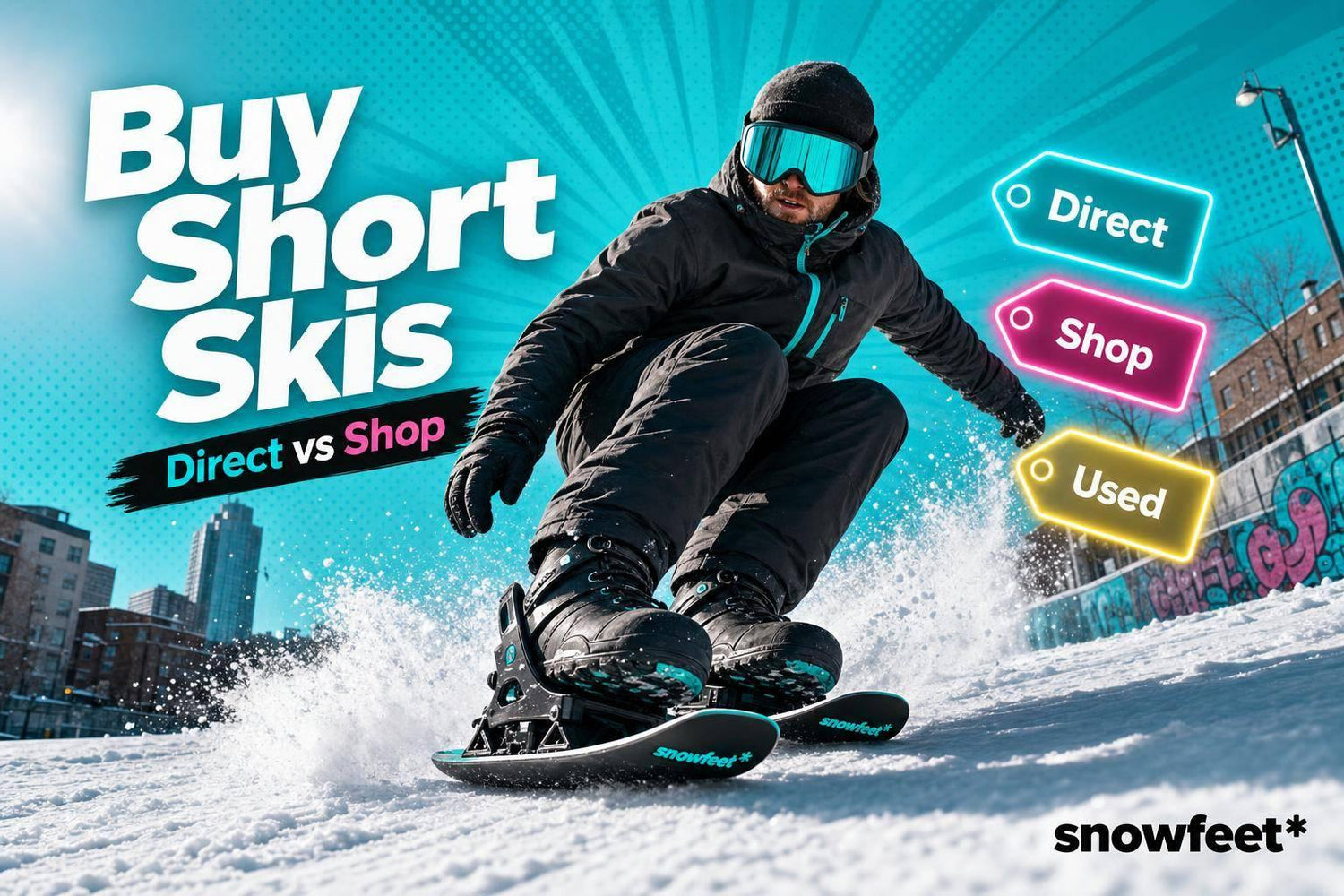
If I wanted the safest place to buy short skis today, I’d start with the Snowfeet* direct store. It has the full adult lineup, clear boot info, and a 30-day return policy on unused, unmounted gear.
Here’s the short version:
- Buy direct from Snowfeet* if you want the easiest path and official warranty help
- Use specialty ski shops if you want to compare brands and chase sale prices
- Go to a local ski shop if boot fit and binding setup are your top concern
- Check secondhand sites if saving 30%–60% matters more than warranty or shop support
For adults, the main short-ski options here run from 44 cm to 120 cm and start at about $460 and go up to $950. The right pick depends on three things:
- your boot type
- your skill level
- how you plan to ride
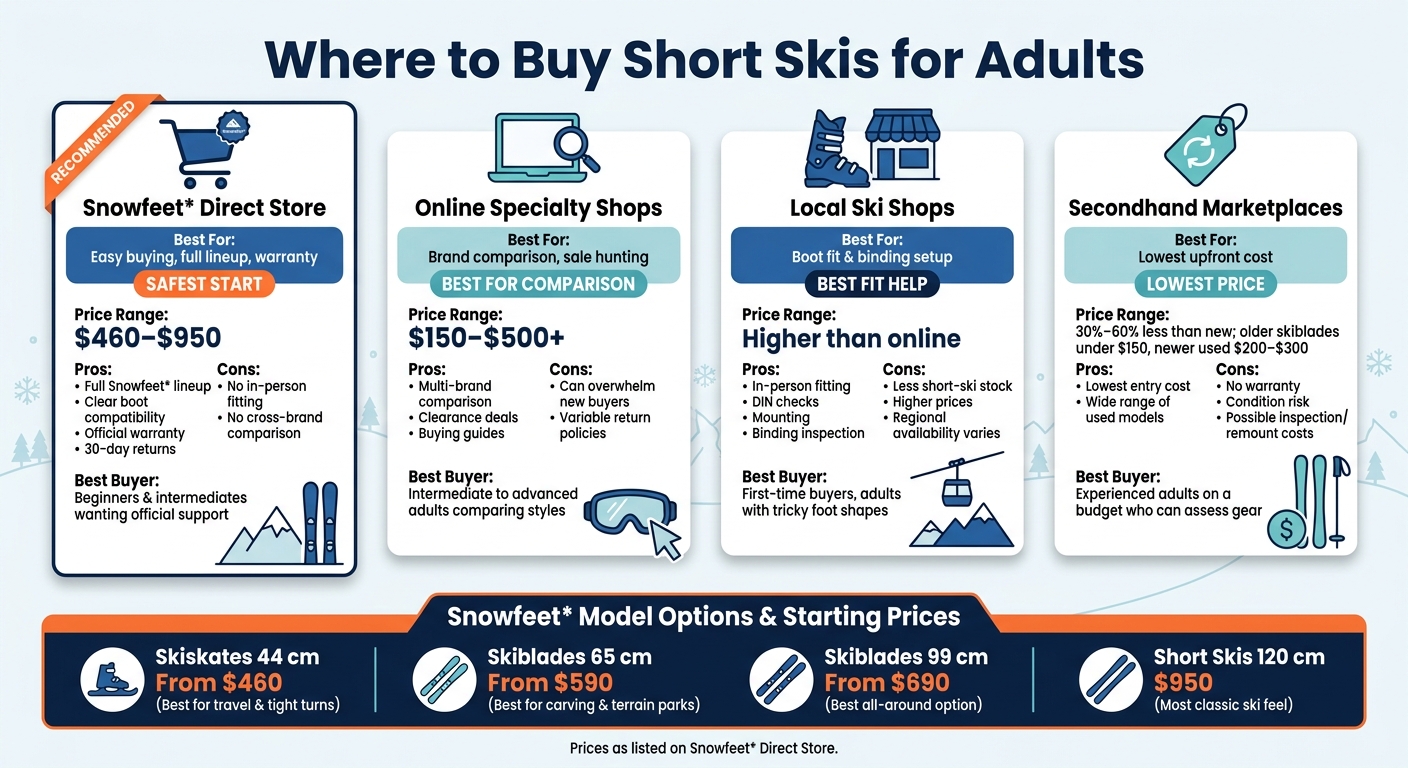
Where to Buy Short Skis for Adults: Buying Channel Comparison
Snowboarder tries Snowfeet* | Which Snowfeet* Short Ski is the Best? | Snowblades 44, 65, 99 Review
Quick Comparison
| Where I’d Buy | Best For | Main Tradeoff |
|---|---|---|
| Snowfeet* Direct Store | Easy buying, full lineup, warranty | No in-person fitting |
| Online Specialty Shops | Brand comparison, sale hunting | Can get confusing fast |
| Local Ski Shops | Boot and binding help | Less short-ski stock, higher prices |
| Secondhand Marketplaces | Lowest upfront cost | No warranty, more risk |
So, if you want the plain answer: most casual adult riders should start direct, then use a local shop for fit help if needed. If you know gear well and don’t mind doing homework, specialty or used routes can save money.
A couple of helpful videos before you buy:
That’s the whole game, minus the ski-shop mumbling and coffee stains :)
1. Snowfeet* Direct Store
The direct store at snowfeetstore.com is the safest place to start if you're an adult and want to cut down on fit mistakes before you buy. That matters most when boot fit is the make-or-break part of the decision.
Selection
The direct store keeps the full Snowfeet* adult lineup in one spot. So you can compare the 44 cm, 65 cm, 99 cm, and 120 cm models without bouncing between a bunch of retail sites.
Boot Compatibility
Snowfeet* product pages show compatibility for ski boots and snowboard boots. You also get size guidance if your boot size runs unusually small or large, which can save you from a bad pick.
Price
| Model | Direct Store Price |
|---|---|
| Skiskates 44 cm | From $460 |
| Skiblades 65 cm | From $590 |
| Skiblades 99 cm | From $690 |
| Short Skis 120 cm | $950 |
The direct store offers 30-day returns on unused and unmounted products. Return shipping is the buyer’s responsibility.
Best Use Case
This option makes the most sense for adults who want the simplest buying path. It’s a good fit for beginners picking 65 cm Skiblades, and for travelers or park riders who want 44 cm Skiskates.
If you want more retailer choices or want to check local stock, the next stop is online specialty ski shops.
2. Online Specialty Ski Shops
Online specialty ski retailers like Skiboards.com and VerticalExtreme usually have a much better mix of short skis than your average local shop. Instead of digging through page after page of full-length alpine skis, you’ll often see compact gear grouped into clear categories like Skiboards, Snowblades, Short Carvers, and Compact Skis. That makes the search a lot less annoying.
These shops also tend to carry Snowfeet*-style lengths, which is handy if you’re an adult trying to compare a few compact setups side by side. If you want to stack Snowfeet* up against other short skis before you buy, this is a smart next step.
Selection
The big win here is brand-by-brand comparison.
You can line up Snowfeet*-style compact skis - like the Skiskates 44 cm or Skiblades in 65, 99, and 120 cm - next to other skiboard brands and short carvers. That makes it easier to compare stuff like length, waist width, flex, and binding type in one spot instead of bouncing between ten browser tabs like a maniac.
Many shops also let you filter by:
- Skill level
- Use case
- Flex
That helps a lot if you’re trying to sort out whether you need a beginner setup, a park setup, an all-mountain option, or something easy to pack for travel. Most of these stores also include buying guides, comparison charts, and customer reviews, which can save you from guessing your way through the short-ski rabbit hole.
Boot Compatibility
Specialty retailers usually do a solid job of spelling out binding type, boot match, and binding settings for ski-boot setups.
For short skis similar to Snowfeet* Skiskates, product pages will often say if the setup uses strap-on or universal bindings for winter boots, or standard ski bindings for ski boots. That matters more than people think. A ski can look perfect, then boom - your boots don’t work with it.
Many shops label boot and binding compatibility clearly and offer chat support before checkout. Before you order, check your boot sole length and any size limits listed on the page.
Price
Entry-level short skis and skiboards at specialty shops usually cost about $150–$300. Midrange setups with bindings are often around $300–$500. Premium models can climb past $500.
You may also spot:
- Clearance pricing on last-season models
- Free shipping minimums
- Off-season sales
Those can trim the total cost a bit, which never hurts :) For in-person fit checks and faster answers, local ski shops come next.
Best Use Case
This option makes the most sense for adults who want to compare brands, hunt for clearance deals, or find a very specific short-ski setup for park riding, travel, or softer snow.
If you already know you want a Snowfeet* bundle with warranty support, the direct store is the simpler buy.
If you want to handle the skis before buying, local ski shops are next.
sbb-itb-17ade95
3. Local Ski Shops in the U.S.
A local ski shop gives you something online buying can’t: in-person fit advice. If you want to check fit before you buy, this is the place to do it. A lot of adults go this route even with less choice, because confidence in the boot and binding setup matters more than ease or endless options.
Selection
Most local ski shops carry only a small number of short skis. Their floor space usually goes to standard alpine gear. So, if you want a very specific model, like Snowfeet* Skiblades 99 cm or Snowfeet* Skiskates 44 cm, there’s a good chance the shop won’t have it sitting on the rack.
That’s why the main reason to visit a local shop usually isn’t product range. It’s the boot and binding setup.
Boot Compatibility
This is where local shops shine. A good boot-fitter can check shell fit and comfort in person, which matters a lot. On shorter platforms, precise boot setup matters even more than it does on standard skis. Small fit issues can feel a lot bigger once you’re on snow.
Local shops can usually help with:
- DIN checks
- Mounting
- Fit checks
That said, service policies vary from shop to shop. Some include more help in the sale price. Others charge for each part of the setup. Either way, that extra service can be a big help, but it also pushes up the total cost.
Price
Local shops usually cost more than buying direct online. You’re not just paying for the gear. You’re paying for setup know-how, hands-on help, and the peace of mind that comes from having someone check everything before you head out.
Best Use Case
Local shops make the most sense for first-time buyers, adults with tricky foot shapes, and anyone who wants in-person boot and binding checks. If saving money matters more and you’re fine skipping in-person service, secondhand listings are the next place to look.
4. Secondhand Marketplaces
If price comes first, secondhand is usually the cheapest way in. You give up in-person fit help, but you can save a good chunk of money. Common places to look include eBay, Facebook Marketplace, Craigslist, and Geartrade. Gear resale shops like Out&Back Outdoor and local ski swaps can also have solid finds. Snowfeet* models don’t pop up as often, so you may need to set alerts and wait a bit.
Selection
Older skiblades show up more often for a simple reason: they’ve been around longer. Snowfeet* Skiskates (44 cm) and Skiblades (65, 99, and 120 cm) are newer and more niche, so used listings are less common.
If you’re flexible on size or model, secondhand can work well. If you want one exact Snowfeet* setup, buying new is the safer bet.
Boot Compatibility
This part matters a lot. With traditional bindings, make sure the binding is still accepted by ski shops and that it matches your boot sole length. A lot of older bindings don’t pass that test, and that’s a serious safety issue.
For Snowfeet* models with straps or adjustable bindings, inspect the small stuff:
- Straps
- Ratchets
- Buckles
- Cracks
- Stretching
- Loose hardware
For traditional bindings, have a qualified technician do a binding release test before you ski. For strap-on systems, check that your boot feels locked in and that the hardware still looks sound. A cheap setup stops being cheap fast if it fails on snow.
Price
Used short skis often sell for 30% to 60% less than new. Sounds great, right? Well, there’s a catch. You may still need a tune and a binding inspection.
Older skiblades with bindings can sell for under $150, while lightly used newer models may still cost $200–$300. So yes, the savings can be real. But tuning and inspection costs eat into the deal. In plain English: the lower price only matters if the bindings and overall condition are good.
Best Use Case
Secondhand makes the most sense for intermediate buyers who know how to inspect gear, or who don’t mind having a shop look it over. It’s also a smart way to try short skis without paying full price.
If you’re a complete beginner, or you want warranty support and sure-fire boot compatibility, buying new is the better move - ideally direct from Snowfeet*.
Pros and Cons by Buying Channel
Boot fit and support are the big tradeoffs here. That’s the part that can make your day smooth and fun… or kind of a mess.
| Buying Channel | Pros | Cons | Best Adult Buyer Profile |
|---|---|---|---|
| Snowfeet* Direct Store | Full Snowfeet* lineup, clear boot compatibility, official warranty | Online only, no in-person fitting, limited cross-brand comparison | Beginners and intermediates who want official support and travel-friendly specs |
| Online Specialty Shops | Multi-brand comparison and occasional sales | Can overwhelm new buyers, variable return policies, shipping can match or exceed direct-store costs | Intermediate to advanced adults comparing short-ski styles or park-specific setups |
| Local Ski Shops | In-person fitting and binding checks | Narrower short-ski inventory, higher prices, regional availability varies | Beginners and cautious intermediates who need hands-on boot and binding guidance |
| Secondhand Marketplaces | Lowest upfront cost, wide range of used models | No warranty, condition risk, possible inspection or remount costs | Experienced adults on a budget who can assess gear condition independently |
Use this comparison to narrow your pick by support, price, and boot fit.
If you want the simplest path, Snowfeet* Direct Store makes things easy. You get the full lineup, clear info on which boots work, and the official warranty. The catch? You can’t try anything on in person, and you won’t get much side-by-side comparison with other brands.
Online specialty shops are a better fit if you like to compare options before you buy. That can help a lot when you’re looking at different short-ski styles or park setups. But for newer buyers, too many choices can feel like walking into a gear wall and hearing ten people talk at once.
Local ski shops shine when boot fit is your main concern. Getting in-person help with fittings and binding checks can save you from buying the wrong setup. The downside is simple: many shops carry fewer short-ski options, and prices may be higher.
If price comes first, secondhand marketplaces usually have the lowest entry cost. That said, used gear can be a bit of a gamble. No warranty, wear-and-tear issues, and possible inspection or remount costs can eat into the deal fast.
So, narrow your pick based on what matters most:
- Want official support and easy compatibility info? Go with Snowfeet* Direct Store.
- Want to compare brands and hunt for deals? Check online specialty shops.
- Want hands-on help with boots and bindings? Visit local ski shops.
- Want the lowest upfront price and know how to inspect gear? Try secondhand marketplaces.
Next, the conclusion narrows which channel fits most adult buyers best.
Conclusion
After looking at fit, price, and support, the best place to buy comes down to what matters most to you.
Go with Snowfeet* Direct Store if you want the full lineup, clear boot compatibility, and warranty help. Specialty shops make sense if you want to compare brands side by side. Local shops are a good pick for in-person fitting. And secondhand? That’s the budget route if your main goal is the lowest upfront cost.
Once you’ve picked where to buy, the next step is simple: choose the length that fits your boots, skill level, and how you plan to ride.
- Skiskates 44 cm - Best for travel and tight turns. From $460.
- Skiblades 65 cm - Best for quick carving and terrain parks. From $590.
- Skiblades 99 cm - Best all-around option. From $690.
- Short Skis 120 cm - Best for riders who want the most classic ski feel. $950.
For most casual adult riders, Snowfeet* Direct Store is the safest default pick: current models, easy compatibility checks, and a setup made for portability and quick turns. If you want hands-on fitting help, stop by a local shop before you buy.
FAQs
Which short ski length is best for me?
The best length comes down to three things: your skill level, where you ride, and what you want to do on the snow.
_Snowfeet PRO (50 cm)_* works best for absolute beginners. They’re short, simple to handle, and less intimidating when you’re just getting started.
65 cm Skiblades are a great fit for park riders and trick-focused skiers. They feel playful and easy to whip around.
For all-mountain use, 99 cm Skiblades hit the sweet spot between stability and easy turning. If you want one option that can handle a bit of everything, this is often the go-to pick.
For advanced riders, 120 cm Short Skis give you carving performance and stability that feels closer to standard skis.
The general rule is pretty simple:
- Shorter skis are easier to turn
- Longer skis give you more control at higher speeds
Do I need ski boots or can I use winter boots?
No - Snowfeet* gear does not require specialized ski boots. Most models work with regular winter boots or snowboard boots.
Snowboard boots are often the top pick because they give you a nice mix of support and comfort. If you're just riding casually or messing around in the backyard, waterproof winter boots with a stiff or semi-stiff sole and good ankle coverage can work just fine too. Traditional ski boots are optional.
Should I buy new or used short skis?
For most riders, buying new Snowfeet short skis is the better move.
When you buy from the Snowfeet store, you know you're getting the real thing. That means good build quality, durable bindings, metal ski edges, and backing from the maker with support and warranty coverage. That peace of mind matters, especially when you're out on snow and want your gear to just work.
Used options are out there, sure. But they often come with no support and no warranty. And if something feels off, you're pretty much on your own.
The big point? Snowfeet gear like the 44 cm Skiskates and 120 cm Short Skis is already priced in a way that makes buying new make a lot more sense. They're also easy to pack and travel with, which adds even more value.
So if you want the best mix of value, performance, and safety, new is the way to go.











Leave a comment
This site is protected by hCaptcha and the hCaptcha Privacy Policy and Terms of Service apply.