



















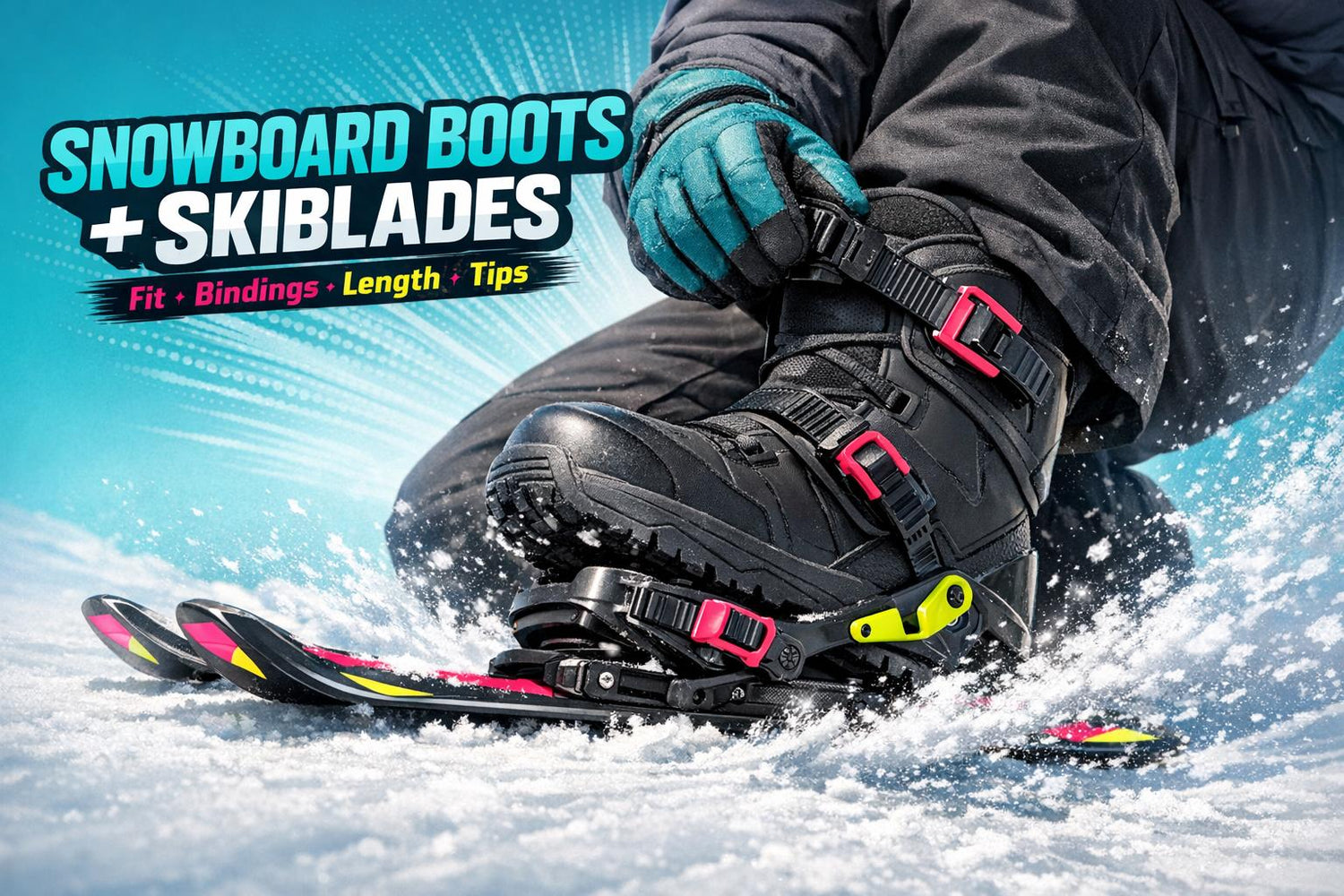
If you’re tired of clunky ski boots and long skis, here’s some good news: you can pair your snowboard boots with skiblades for a more comfortable and fun experience on the slopes. This combo is gaining popularity because it’s easier to learn, lighter to carry, and way more comfortable.
Here’s the gist:
- Comfort: Snowboard boots are softer and easier to walk in compared to stiff ski boots.
- Skiblades: Shorter than skis, they’re great for quick turns and easy control - perfect for beginners or casual riders.
- Compatibility: Snowfeet skiblades work with most snowboard boots using adjustable bindings.
- Setup: It’s simple - strap in, adjust your stance, and you’re good to go.
Snowfeet offers three skiblade options:
- 65 cm: Agile and playful, great for beginners and tight spaces.
- 99 cm: Balanced for mixed terrain and moderate speeds.
- 120 cm: More stable, ideal for carving and higher speeds.
If you’re looking for a portable, easy-to-use setup for groomed runs or snow parks, this might be your best bet. Let’s break it all down.
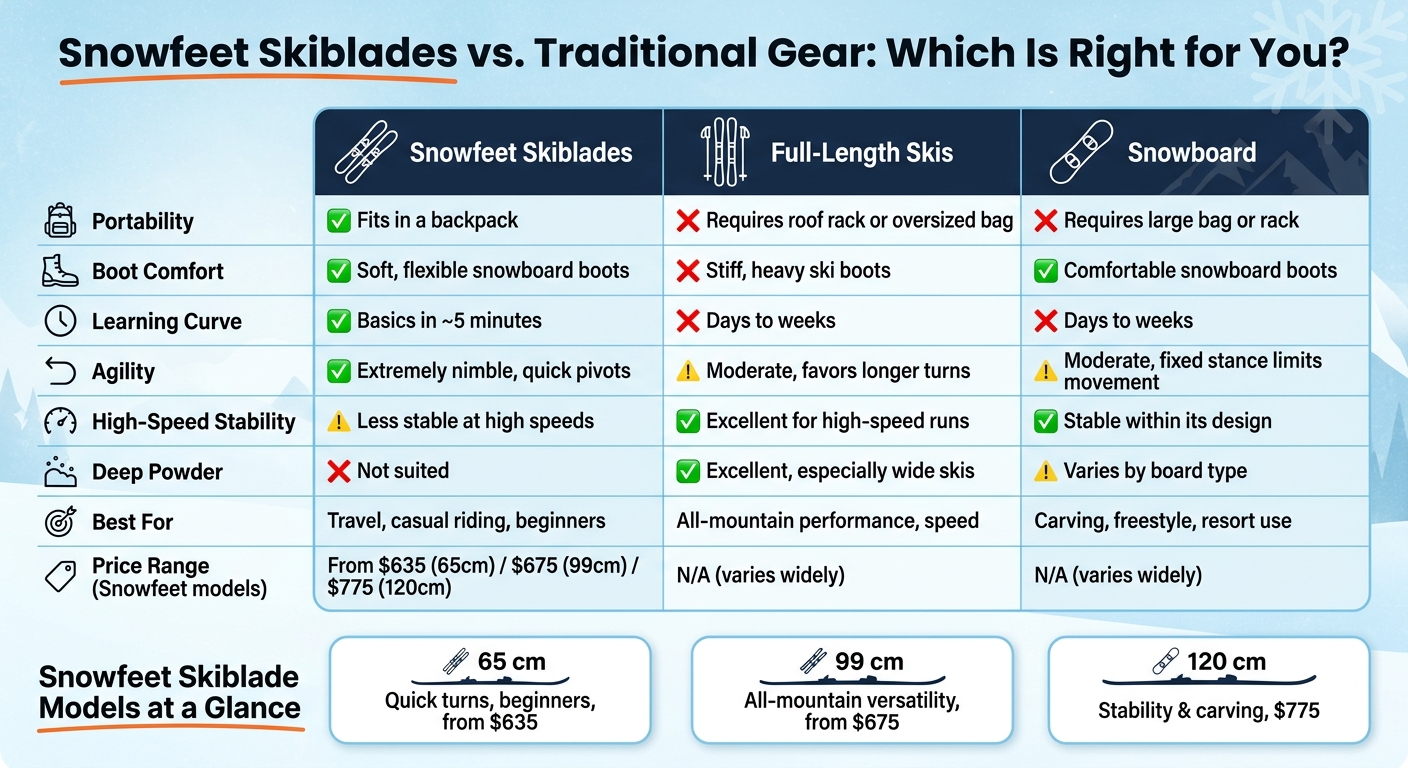
Snowfeet Skiblades vs. Traditional Ski & Snowboard Gear: Full Comparison
Snowfeet & Skiskates Maintenance - Adjusting Bindings | Tuning Metal Edges | Waxing
sbb-itb-17ade95
Snowboard Boot and Skiblade Compatibility: What You Need to Know
Here’s a breakdown of how snowboard boots and skiblades work together.
Key Factors That Affect Compatibility
When it comes to pairing snowboard boots with skiblades, four main factors come into play: sole shape, boot size, binding style, and stance options.
Sole shape is a big deal. A flat, firm rubber outsole ensures solid power transfer to the skiblade edges, which makes carving smoother and turns more precise. On the flip side, boots with rockered soles or chunky treads can create gaps between the boot and binding platform. This can reduce edge control and make your ride feel less predictable. Most snowboard boots designed for resort use have the flat soles that work best with skiblades.
Boot size is another key consideration. Snowfeet* snowboard bindings are designed to fit a wide range of sizes - U.S. sizes 6–14.5 (EU 38–49). To avoid surprises, it’s a good idea to physically test your boots in the bindings to ensure there’s no heel or toe overhang that could snag in the snow.
Now, let’s talk binding style. Unlike alpine ski bindings, which require ISO-certified ski boots, Snowfeet* bindings are different. They use adjustable ratchet strap bindings that clamp directly onto the boot sole. This makes them compatible with most snowboard boots without needing any extra hardware. Keep in mind, though, these are non-release bindings. Unlike alpine bindings, they don’t pop off during a fall, so always use the included safety leash - most U.S. resorts require it.
These factors highlight how Snowfeet* has tailored their bindings to work seamlessly with snowboard boots.
How Snowfeet* Skiblades Are Built for Snowboard Boots
Snowfeet* has taken these compatibility needs into account when designing their skiblades. They offer a Snowboard Binding variant for both their 65 cm and 99 cm models, specifically crafted to handle the wider shape and softer flex of snowboard boots. The bindings are tool-free and adjustable, so you can even tweak them while wearing gloves, making regular maintenance and adjustments simple.
The binding platform is equipped with an anti-slip surface that grips the boot sole, preventing unwanted movement. Wide, padded ratchet straps secure the instep and ankle, reducing boot roll during edge-to-edge transitions. This setup gives snowboard boots an edge over traditional ski bindings, which aren’t built to handle their softer flex.
Snowfeet* also carefully centers the bindings on the skiblades, aligning them with the sidecut and contact points for optimal performance. On the 65 cm model, this setup prioritizes quick, playful turns, while the 99 cm model focuses on stability and edge hold for carving on groomed runs. The 65 cm skiblades, with their 13-foot (4-meter) turning radius and narrow 3.7-inch (9.5 cm) waist, make even softer snowboard boots feel responsive and agile.
One thing to note: the snowboard binding setup does add some extra weight. The 65 cm model with snowboard bindings weighs 5.89 lbs (2,638 g) per pair, compared to 3.79 lbs (1,720 g) with ski bindings.
Benefits of Using Snowboard Boots With Skiblades
Snowboard boots bring a whole new level of comfort and flexibility to skiblading, making the experience enjoyable for both beginners and seasoned riders.
More Comfort and Flexibility on the Slopes
Let’s face it - traditional ski boots can feel like wearing a stiff, plastic shell. They’re built for high-speed carving but don’t exactly scream "comfort." Snowboard boots, on the other hand, are designed for natural movement, offering all-day comfort without the rigidity. Their soft, flexible design allows your foot and ankle to move more freely, which means less fatigue during those long sessions on the slopes. Plus, that added flexibility makes it easier to pull off tricks, jumps, and spins in the snow park since your ankles aren’t locked in place. This freedom of movement also improves your balance, giving you better control overall.
Better Balance and Control
One big advantage of using snowboard boots with skiblades is how they enhance leg independence. Unlike snowboarding, where your feet are locked into a single position, skiblades let each leg move freely. This reduces muscle fatigue, as noted by a satisfied customer, Sunshine Straiges:
"I had no muscle soreness after using these because I can change my leg position, unlike the snowboard which is set."
The natural flex of snowboard boots also helps you adapt to different terrains more intuitively. Combine that with Snowfeet*'s adjustable, tool-free bindings - specifically designed for snowboard boots - and you get responsive handling without sacrificing performance.
Easy to Carry and Simple to Use
If you’ve ever lugged around a pair of traditional skis, you know how bulky and inconvenient they can be. Snowfeet* skiblades paired with snowboard boots are a game-changer in terms of portability. Their compact design, especially the 65 cm model, can fit into a backpack or even checked luggage, making travel a breeze. As one happy customer, heyjerz, put it:
"I got the snowboard binding version, so super comfortable in my snowboard boots. A lot easier to haul around the hills & on vacation than traditional skis!"
And here’s the kicker: this setup is super easy to learn. Most users get the hang of it in just a few minutes to a day, which is way quicker compared to mastering full-length skis.
Best Snowfeet* Skiblades to Use With Snowboard Boots
If you're ready to pair snowboard boots with skiblades, choosing between short skis vs long skis is key. Snowfeet* offers three standout models, each tailored to different riding styles. Whether you prioritize agility or crave stability, there's a perfect match for you.
Snowfeet* Skiblades 65 cm
The 65 cm skiblades are all about agility. With a tight 4-meter turning radius, they're perfect for weaving through crowded slopes, navigating snowparks, or even darting between trees. As Jan from Snowfeet* puts it:
"65 cm is the sweet spot - quick to learn, fast on groomers and super agile even between trees."
These skiblades have earned a stellar 4.96/5 star rating from 77 reviews. Riders love their playful, skate-like feel, making them a go-to for beginners and snowboarders transitioning to skiblades. The shorter length also helps build confidence quickly by making it easier to recover from slips or mistakes.
Snowfeet* Skiblades 99 cm
Looking for a balance between agility and stability? The 99 cm model delivers. Its longer edge contact compared to the 65 cm version means better grip on hard-packed snow, cleaner carves, and greater stability at higher speeds. It's versatile enough for groomed runs, light off-piste adventures, and mixed terrain.
This model suits a wide range of riders - confident beginners ready to level up, intermediates seeking an all-around setup, and advanced snowboarders who value precise edging. Starting at $675, it's a solid choice for those who want a bit of everything.
Snowfeet* Short Skis 120 cm
For a more traditional ski experience with added stability, the 120 cm short skis are the way to go. Their extended edges provide smooth, rail-like carves and hold steady at higher speeds and on steeper slopes. Priced at $775, this premium model is ideal for intermediate to advanced riders looking for ski-like performance while keeping the comfort of snowboard boots.
Quick Comparison of Snowfeet* Models
Here's a handy breakdown to help you decide:
| Model | Best For | Speed Comfort | Price |
|---|---|---|---|
| 65 cm Skiblades | Quick turns, beginners | Low–moderate speeds | From $635 |
| 99 cm Skiblades | Mixed terrain, all-purpose | Moderate–higher speeds | From $675 |
| 120 cm Short Skis | Stability, ski-like feel | Higher speeds | $775 |
Each model brings something unique to the table. Whether you're chasing agility, versatility, or a more traditional ski vibe, Snowfeet* has you covered.
How to Set Up Snowboard Boots With Skiblades
Getting your setup dialed in can make a huge difference in how your skiblades perform. A proper setup not only enhances comfort but also ensures you get the most out of the control and agility that Snowfeet* skiblades are known for. Spending a few minutes adjusting things before you hit the slopes can save you a ton of hassle later.
Choosing the Right Binding Fit
First, double-check that your snowboard boots fall within the recommended size range for your skiblades. Both the 65 cm and 99 cm Skiblades come with bindings designed to work with snowboard boots. However, the 120 cm Short Skis are only compatible with pro ski boot bindings at the moment.
Once you’ve confirmed the right model, follow these steps to set up your bindings:
- Lay the skiblade flat and loosen all the straps completely.
- Step in, positioning the ball of your foot near the center of the blade from front to back.
- Adjust the heel cup so it fits snugly against the back of your boot with as little gap as possible.
- Tighten the toe/instep strap first, followed by the ankle strap to lock your heel securely in place.
- Test your setup by flexing forward. Your heel should stay firmly in place without any lift.
After a few runs, double-check the straps to account for any settling in the webbing.
"I was nervous about the boots not being stiff enough for skis, but it was not an issue at all. SUPER comfortable, easy to control, very agile, easy on the knees and ankles because they are so light."
Once your bindings are set, focus on adjusting your stance for optimal performance.
Adjusting Your Stance and Settings
Start with a shoulder-width stance, but consider narrowing it by 1–2 inches compared to your snowboard stance. The shorter length of skiblades makes edge-to-edge transitions quicker, and a slightly narrower stance can help you take full advantage of that.
Your stance angles depend on how you plan to ride:
- All-mountain: Set your front foot to +12° to +15° and your rear foot to 0° to −6°.
- Freestyle/park (65 cm): Go for a symmetrical duck stance, like +12° / −12°, for easier switch riding and quick turns. This setup is ideal for practicing switch skiing on shorter blades.
- Carving (99 cm or 120 cm): Use a more directional setup, such as +15° to +21° on the front foot and +3° to +9° on the rear, to align your knees with your direction of travel and improve edge grip.
Fine-tuning your boot’s position is also key. Make sure the mid-sole of your boot lines up with the center of the skiblade. On the 65 cm model, even small adjustments forward or backward can significantly change how the blade handles.
Skiblade Length Comparison Table
| Model | Ride Feel | Best Use | Stance Style | Recommended Boot Flex |
|---|---|---|---|---|
| 65 cm Skiblades | Skate-like, ultra-agile, quick pivots | Snow parks, tight terrain, beginners | Narrower, duck stance (+12° / −12°) | Medium |
| 99 cm Skiblades | Balanced, stable at speed, versatile | Groomers, mixed terrain, all-mountain | Shoulder-width, mild duck or directional | Medium to stiff |
| 120 cm Short Skis | Ski-like, smooth carves, high-speed hold | Groomed runs, steeper slopes, carving | Slightly wider, directional angles | Stiff |
This table gives a quick snapshot of how skiblades vs. skiskates feel and perform, helping you choose the right one for your riding style.
Snowfeet* Skiblades vs. Standard Ski and Snowboard Gear
Wondering how the skiblade-and-snowboard-boot combo stacks up against traditional ski and snowboard setups? Full-length skis shine when it comes to high-speed stability and carving on steep slopes, while snowboards offer a smooth, surf-like ride across diverse terrain. But both come with some baggage - literally. They’re bulky to transport, require specialized boots, and demand a steep learning curve. That’s where Snowfeet* skiblades change the game. They fit in a regular backpack and work with the snowboard boots you probably already own. Talk about convenience!
"A lot easier to haul around the hills & on vacation than traditional skis!" - heyjerz, Verified User
While Snowfeet* skiblades score major points for portability and ease of use, they’re not designed for everything. If you’re aiming to charge down steep slopes at top speed or float through deep powder, traditional skis will still have the edge. But for groomed trails, snow parks, or casual laps at the resort? Skiblades are a super convenient and fun option.
Side-by-Side Comparison: Snowfeet* vs. Standard Gear
Here’s a quick breakdown to show how Snowfeet* compares to traditional options:
| Feature | Snowfeet* Skiblades | Full-Length Skis | Snowboard |
|---|---|---|---|
| Portability | Fits in a backpack | Requires a roof rack or oversized bag | Requires a large bag or rack |
| Boot Comfort | Soft, flexible snowboard boots | Stiff, heavy ski boots | Comfortable snowboard boots |
| Learning Curve | Basics in about 5 minutes | Takes days to weeks | Often takes days to weeks |
| Agility | Extremely nimble for quick pivots | Moderate agility, favors longer turns | Moderate; fixed stance limits movement |
| High-Speed Stability | Less stable at high speeds | Excellent for high-speed runs | Stable within its design |
| Deep Powder | Not suited | Excellent, especially with wide skis | Varies by board type |
| Best For | Travel, casual riding, beginners | All-mountain performance, speed | Carving, freestyle, resort use |
So, what’s the takeaway? If you’re all about easy transport, a quick learning curve, and playful handling, Snowfeet* skiblades are a fantastic pick. But if speed, powder days, or aggressive carving are your thing, sticking with traditional skis or a snowboard might be the way to go.
Conclusion: Picking the Right Skiblade Setup for You
Think about it: What kind of rider are you? The 65 cm Skiblades (starting at $635) are perfect if you’re after quick turns and playful rides on groomed trails. For those looking for a more versatile option, the 99 cm Skiblades (from $675) offer a balanced experience, handling most resort terrain with ease. And if you’re craving something closer to traditional skiing, the 120 cm Short Skis ($775) provide better edge grip and stability at higher speeds. Once you’ve nailed down the model that fits your riding style, don’t overlook the importance of a solid binding setup.
Bindings that fit snugly are key to performance. Pair them with a snowboard boot that minimizes heel lift, and you’ll get optimal power transfer and control - crucial for making the most of your skiblades, no matter the model.
"Only trade-off is at higher speeds, where longer skis still feel more stable - but for overall fun and maneuverability, these are hard to beat."
FAQs
Are non-release bindings safe for resorts?
Non-release bindings aren’t the best choice for resort skiing. Why? They don’t have a quick-release mechanism, which means your boots won’t pop out during a fall. This increases the risk of injury, especially when skiing at high speeds or tackling the tricky terrain you often find at resorts.
Which skiblade length should I choose for my riding style?
The right skiblade length hinges on your skill level, the terrain you prefer, and the kind of experience you’re after. Shorter skiblades - like Snowfeet’s 65 cm models - are ideal for beginners, pulling off tricks, or making quick, sharp turns. If you’re looking for better stability, especially at higher speeds, longer options like the 99 cm or 120 cm models are the way to go. Snowfeet skiblades are lightweight, easy to handle, and designed to suit a range of riding styles, all while being super portable.
Will my snowboard boots work, or do I need a specific sole?
Your snowboard boots can be used with Snowfeet skiblades, as long as they fall within the compatible size range: US 6–14.5 or EU 38–49. To ensure both safety and performance, Snowfeet suggests using skiblades that are specifically designed for these sizes. Before heading to the slopes, double-check that your boots' soles are compatible.











Leave a comment
This site is protected by hCaptcha and the hCaptcha Privacy Policy and Terms of Service apply.