




















Skiblades (short skis) are all about fun, agility, and control. But the right bindings? They’re the game-changer. Whether you’re carving down slopes, hitting the park, or just cruising, bindings connect your boots to your skiblades, impacting safety, performance, and ease of use. Here’s the deal:
- Alpine Ski Bindings: Great for precision and power. Perfect for fast carving and steep runs. Requires ski boots.
- Strap Bindings: Easy, flexible, and lightweight. Works with winter boots. Best for casual or park riding.
- Release Bindings: Focused on safety with automatic release during falls. Ideal for challenging terrains. Needs alpine or touring boots.
Quick Tip: Match your bindings to your riding style. Beginners might prefer strap bindings for simplicity, while advanced riders tackling tough slopes will appreciate the safety of release bindings.
Ready to find your perfect setup? Let’s dive in.
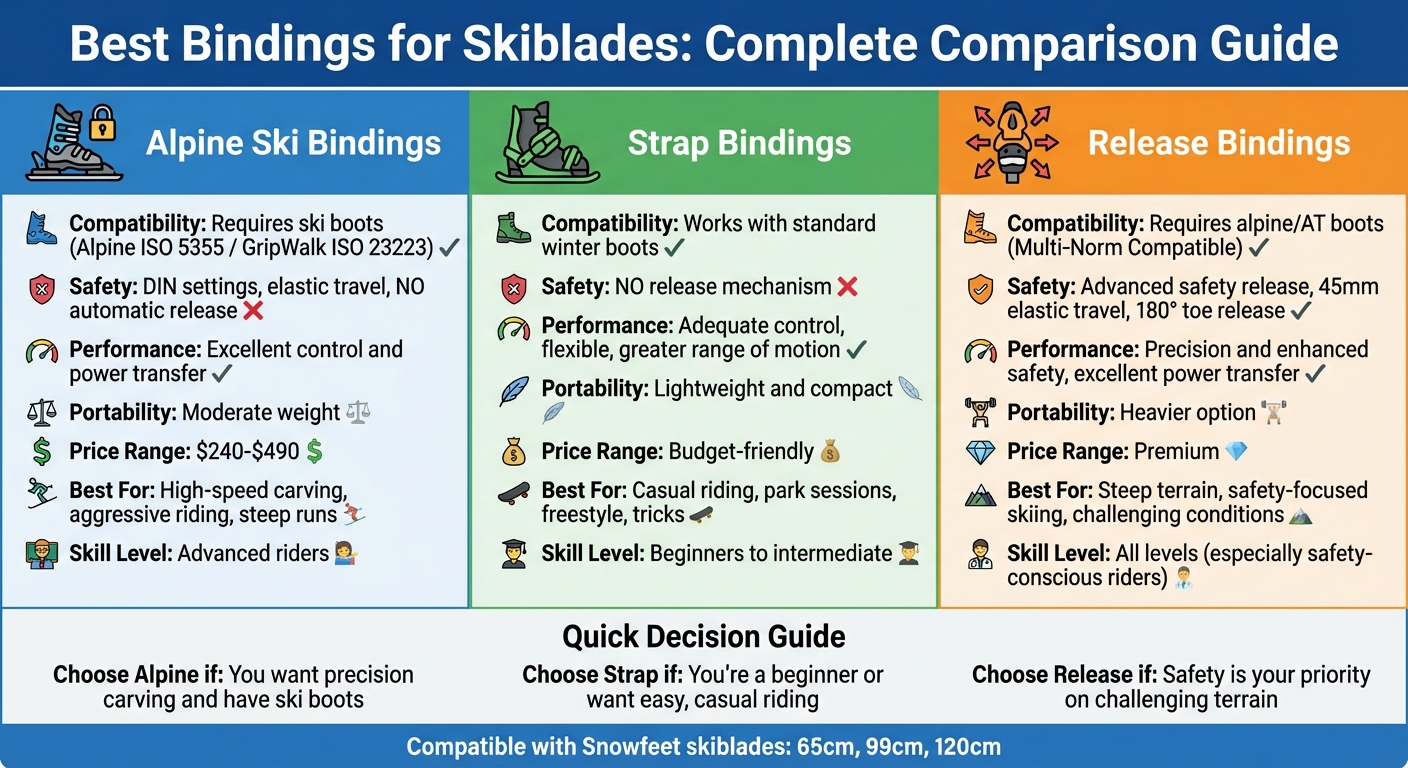
Skiblade Bindings Comparison: Alpine vs Strap vs Release Bindings
Snowfeet Snowblade / Skiboard Review! Short Skis with SNOWBOARD BINDINGS!
1. Alpine Ski Bindings
Alpine ski bindings bring the precision of traditional downhill skiing to skiblades. They provide a solid connection between your boots and skis, ensuring confident edge control and efficient power transfer. This setup delivers a more responsive feel compared to the heavier systems found on full-length skis.
Compatibility with Short Skis
When choosing bindings, make sure they match your boot sole type. Standard alpine bindings are designed to work with Alpine (ISO 5355) and GripWalk (ISO 23223) soles. If you’re using Alpine Touring (ISO 9523) boots, look for multi-norm compatible (MNC) bindings to ensure proper fit. Snowfeet* skiblades are built to align with these standards, but double-check your boots for compatibility to get the best performance from your setup.
Safety and Release Features
Alpine bindings come with DIN settings, which are adjusted based on your weight, height, age, and skill level. These settings help ensure the bindings release properly in case of a fall. Many models also feature elastic travel, allowing for slight boot movement to prevent accidental releases. Brands like Salomon and Marker offer bindings with these features, typically priced between $240 and $490. Snowfeet* takes it a step further by combining easy adjustments with excellent integration, giving you both safety and performance for dynamic skiing.
Performance and Riding Style
If you’re into aggressive carving or hitting the park, alpine bindings are a great choice. Their low stand height keeps you closer to the snow, improving power transfer and control during quick edge changes. This secure connection is key for fast transitions, and Snowfeet* bindings are designed to strike the perfect balance between responsiveness and stability.
Portability and Adjustability
Skiblades are naturally lighter and easier to carry, and the adjustability of DIN settings lets you tweak the release tension as your skills improve or snow conditions shift. Just make sure the binding’s brake width is within 15mm of your skiblade’s waist width for optimal performance. Snowfeet* bindings excel here too, offering a mix of convenience and top-notch performance for skiblade enthusiasts.
2. Strap Bindings (Snowboard-Style)
Strap bindings bring a snowboard-inspired twist to skiblades, offering a more adjustable and flexible alternative to traditional alpine bindings. Instead of locking boots in place with a rigid mechanism, these bindings use straps to secure your footwear, making them compatible with a wide variety of boots.
Compatibility with Snowfeet Models
Strap bindings on Snowfeet* skiblades are all about flexibility and ease of use. They work with softer, more casual boots - like snowboard boots or even regular winter boots - that wouldn’t typically pair well with alpine systems. Thanks to features like adjustable toe ramps, heel cups, and highbacks, you can tweak the fit to match your boots perfectly. This makes Snowfeet* strap bindings a great option for beginners or anyone looking for a more relaxed, user-friendly setup.
Performance and Riding Style
If you’re into freestyle or playful riding, strap bindings are your go-to. Their flexible design allows for a greater range of motion, which is perfect for tricks, spins, and park-style riding. While they might not deliver the precision needed for aggressive carving or high-speed runs, they shine when it comes to jibbing, buttering, and creative moves. Snowfeet* has fine-tuned their strap systems to match the unique demands of skiblades, striking a balance between control and a fun, forgiving ride.
Portability and Adjustability
One of the standout features of strap bindings is how easy they are to adjust. With tool-free tweaks for the highbacks, ankle straps, and toe straps, you can quickly dial in your setup right on the slopes. They’re also lightweight, so they don’t add much bulk to your already compact skiblades. Snowfeet* takes it a step further by designing their bindings for quick entry and exit - perfect for when you need to make fast adjustments mid-run. All in all, Snowfeet* strap bindings are a versatile and convenient choice for skiblade enthusiasts.
sbb-itb-17ade95
3. Release Bindings
Release bindings are designed to reduce the risk of injury by automatically releasing your boot during a fall. They use multi-directional release mechanisms and adjustable DIN settings (Deutsches Institut für Normung), which are calibrated based on your height, weight, age, and skill level. One standout feature is elastic travel - the amount of boot movement allowed before the binding releases. Take the Look Pivot 2.0, for example: it offers 45 mm of elastic travel and a 180-degree toe release that works independently of the heel. This setup absorbs the impact from jumps or rough terrain, preventing premature release while still ensuring reliable ejection during a fall. This thoughtful safety design pairs perfectly with Snowfeet* skiblades, enhancing both protection and performance.
Compatibility with Snowfeet Models
Snowfeet* skiblades are built to work seamlessly with standard release bindings, ensuring precision and safety. Available in 65 cm, 99 cm, and 120 cm lengths, these skiblades are compatible with Multi-Norm Compatible (MNC) release bindings. These bindings are versatile, accommodating alpine boots, GripWalk boots, and alpine touring (AT) boots. To keep your skiblades from sliding away when detached, make sure the binding's brake width matches the skiblade's waist width, or is no more than 15 mm wider. Snowfeet* simplifies the process by allowing you to mount trusted bindings, like the Salomon Strive or Tyrolia Attack LYT, directly onto your skiblades.
Performance and Riding Style
When it comes to performance, release bindings shine in high-speed runs, aggressive carving, and mountain riding. They ensure excellent power transfer from your boots to your skiblades, giving you the precision and responsiveness of traditional skis in a smaller, more compact package. Whether you're navigating steep slopes, weaving through moguls, or executing sharp carves, release bindings provide the retention and control you need for confident riding. Paired with Snowfeet* skiblades, they deliver impressive agility and control, making them perfect for quick transitions and tight downhill runs - all without the bulk of longer skis.
Pros and Cons
Understanding the strengths and limitations of each binding option can help you make the best choice for your skiblade setup. Here’s a breakdown of the main types of bindings and what they bring to the table:
- Alpine Ski Bindings: These are all about precision and control, making them a great pick for aggressive carving or high-speed runs. They transfer power efficiently but require ski boots and add some extra weight to your setup.
- Strap Bindings: If portability and ease are your priorities, strap bindings are a solid choice. They work with standard winter boots and are perfect for casual riding or park sessions. However, they don’t include a safety release mechanism, which might be a concern for some.
- Release Bindings: Safety takes center stage here, thanks to their advanced release mechanism, which is especially useful on steep terrain. They’re compatible with Snowfeet* skiblades in 65 cm, 99 cm, and 120 cm lengths. The trade-off? They’re heavier and require specific alpine or AT boots.
In the U.S., ski bindings must meet strict testing standards to ensure consistent release. Multi-Norm Compatible (MNC) bindings solve compatibility headaches by working with various boot sole types, offering flexibility while maintaining safety.
| Feature | Alpine Ski Bindings | Strap Bindings | Release Bindings |
|---|---|---|---|
| Compatibility | Requires ski boots | Works with standard winter boots | Requires alpine/AT boots |
| Safety | No release mechanism | No release mechanism | Advanced safety release |
| Performance | Excellent control and power | Adequate control | Precision and enhanced safety |
| Portability | Moderate weight | Lightweight and compact | Heavier option |
| Ideal For | High-speed carving | Casual riding, park sessions | Steep terrain, safety-focused skiing |
Snowfeet* skiblades are compatible with all three binding types, giving you the flexibility to match your setup to your riding style. For example, if you’re tackling steep slopes and need extra security, release bindings paired with 99 cm or 120 cm Snowfeet* skiblades offer a reliable, responsive experience. On the other hand, strap bindings with 65 cm skiblades are a lightweight, portable option for relaxed runs or quick laps in the park. No matter your choice, Snowfeet* ensures performance and safety across all binding styles.
Conclusion
When picking bindings, think about your riding style and the terrain you’ll be tackling. Matching the right bindings to your setup can make all the difference in performance and safety.
Alpine ski bindings are built for precision and power. They’re a great choice for aggressive carving and high-speed runs, especially when paired with longer Snowfeet* skiblades (99/120 cm). While they require ski boots and add some weight, their ability to transfer power precisely makes them a favorite for experienced riders craving control.
Strap bindings are all about convenience and portability. These work with regular winter boots, making them perfect for casual rides or park laps with 65 cm Snowfeet* skiblades. They’re lightweight and easy to carry around, but they don’t include a safety release, so keep that in mind.
For those tackling steep or challenging slopes, release bindings are your go-to for safety. They feature a reliable release mechanism to protect you during falls. These require alpine or AT boots and are ideal for riders who want extra security on tough terrain.
Snowfeet* makes it easy to grow with your gear, no matter your skill level. If you’re a beginner, start with 65 cm Snowfeet* skiblades and strap bindings for a smooth learning curve. As you improve, alpine or release bindings can help you take on more advanced challenges. Intermediate riders might find alpine bindings with moderate DIN settings (3–11) a good middle ground, while advanced skiers will appreciate the confidence that high-DIN alpine or release bindings provide for steep and aggressive runs.
The compact design of Snowfeet* skiblades makes them incredibly versatile and portable compared to traditional skis. Pairing them with the right bindings only amplifies these advantages. Snowfeet* continues to push the boundaries, offering compatibility and performance that stand out in the world of skiing and snowboarding.
FAQs
What’s the difference between alpine, strap, and release bindings for skiblades?
Alpine bindings provide a solid, locked-in connection, perfect for delivering top-notch downhill performance and precise control. Strap bindings, on the other hand, focus on comfort and adaptability, with adjustable straps that ensure a snug, user-friendly fit. Then there are release bindings, which put safety first by detaching during falls to help minimize injury risks.
While each type has its perks, Snowfeet bindings bring something fresh to the table. Their design blends performance, comfort, and safety in a way that stands apart from what traditional ski and snowboard brands offer.
What type of bindings should I choose based on my skill level and riding style?
Choosing the right bindings for your skiblades comes down to your skill level and how you plan to ride. If you're a beginner or intermediate, Snowfeet bindings are a fantastic option. They're super lightweight, easy to handle, and focus on comfort and safety - just what you need when you're learning or cruising casually. Plus, they’re versatile enough for all-mountain or backcountry adventures and pair perfectly with Snowfeet skiblades in various lengths.
For more advanced or aggressive skiers who crave high-speed runs or technical terrain, traditional alpine or hybrid bindings from brands like Marker or Salomon might deliver better power and stability. That said, Snowfeet bindings bring a fresh design to the table, making them a fun and accessible choice for skiblade fans at any level.
Are Snowfeet skiblades compatible with the bindings discussed in the article?
Snowfeet skiblades work best with snowboard-style bindings and release bindings, which are crafted to boost both performance and safety. Although ski or alpine touring bindings might come up in discussions, they’re not typically a great match for Snowfeet skiblades.
To get the most out of your skiblades, stick with bindings designed specifically for them. These ensure a snug fit and give you better control when you're carving down the slopes.













Leave a comment
This site is protected by hCaptcha and the hCaptcha Privacy Policy and Terms of Service apply.