




















Snowblades are short skis (15–47 inches) designed for agility, quick turns, and easy control. They’re lighter, easier to carry, and simpler to use than regular skis or snowboards, making them great for beginners or anyone looking for a fun, less tiring way to enjoy the slopes. Snowfeet* offers models for various skill levels and terrains, from ultra-compact Mini Ski Skates to 120 cm Short Skis for carving and powder.
Why consider snowblades?
- Super portable: No roof racks needed - fits in a backpack.
- Beginner-friendly: Easier to learn than skis or snowboards.
- Agile and fun: Perfect for tight turns, tricks, and playful riding.
- Compatible with regular boots: No need for special ski boots.
Limitations:
- Not ideal for high speeds or deep powder.
- Less stable on steep, icy slopes.
Snowfeet* leads the pack with durable, easy-to-use options starting at $250. Whether you’re cruising groomed runs, tackling moguls, or just having backyard fun, snowblades offer a fresh way to hit the snow.
How to choose Snowfeet* Snowblades | Skiblades | Skiboards | Short Ski
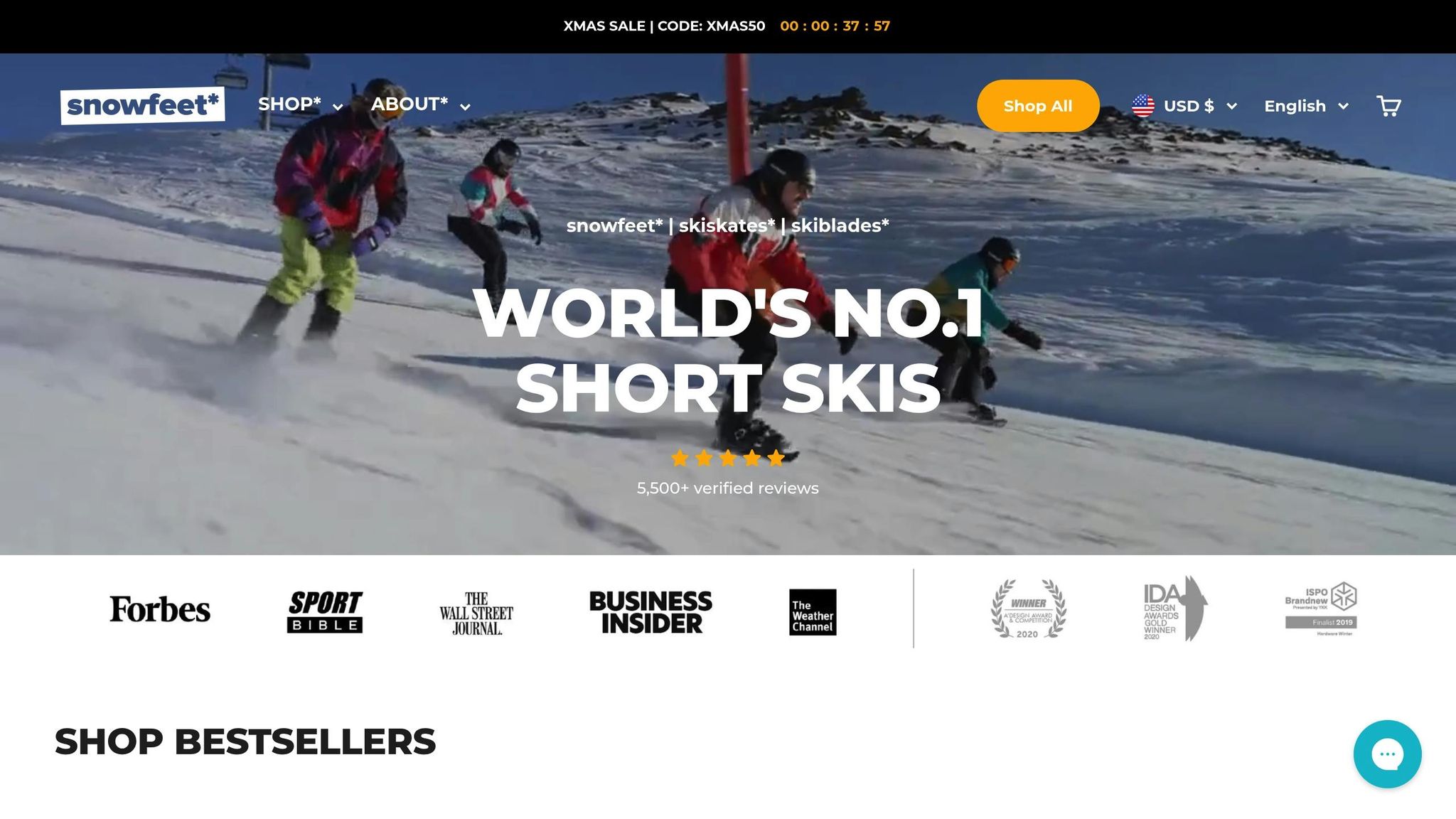
How Snowblades Compare to Traditional Skis and Snowboards
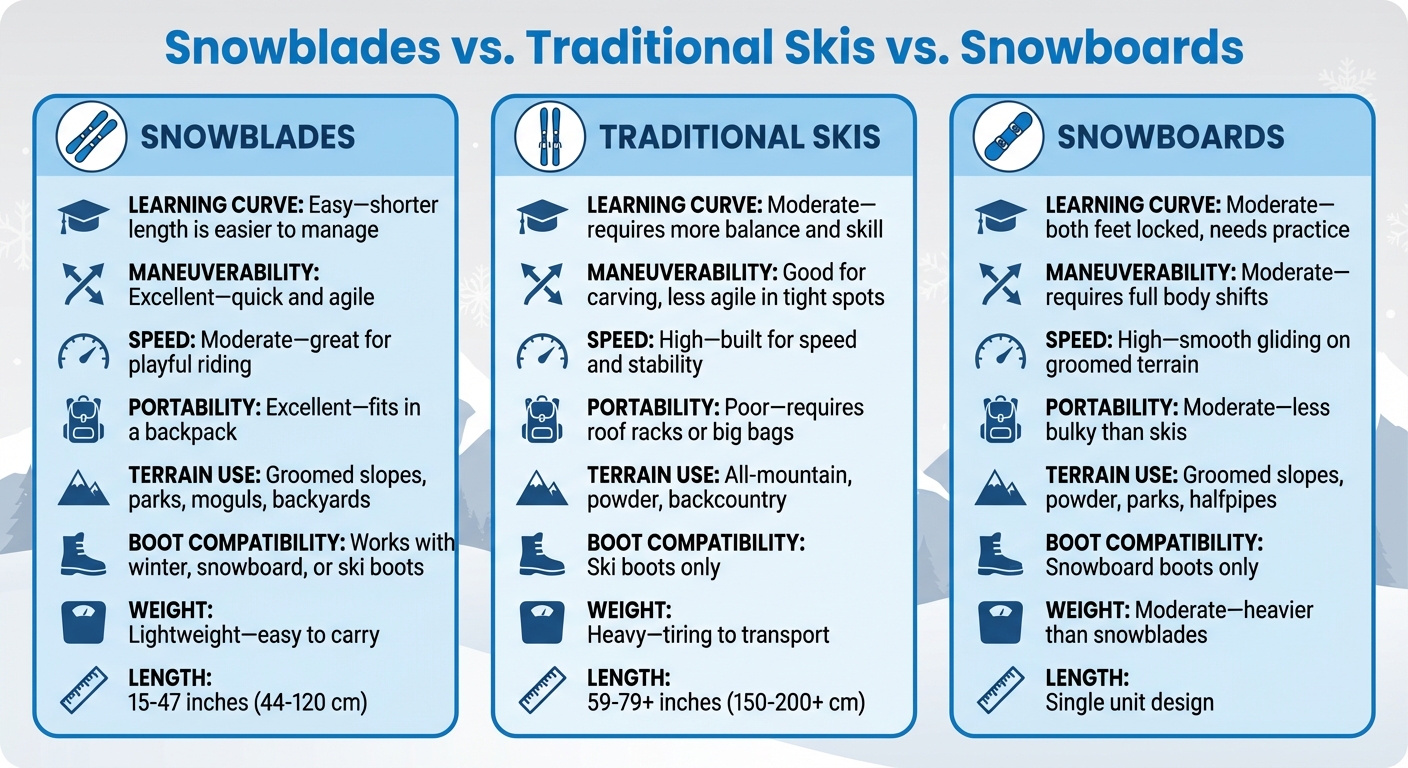
Snowblades vs Traditional Skis vs Snowboards Comparison Chart
Snowblades bring a whole new vibe to the slopes compared to traditional skis or snowboards. They’re not just shorter - they’re built differently, feel different, and even ride differently. Whether you’re a seasoned skier or a curious beginner, snowblades offer a fresh take on winter sports.
Snowblade Construction and Design
The most obvious difference? Length. Snowblades are much shorter, ranging from 17 to 47 inches (44 cm to 120 cm), while traditional skis usually start around 59 inches (150 cm) and can go beyond 79 inches (200+ cm). Snowboards don’t have a direct comparison since they’re a single unit, but their size and riding style are entirely different from both skis and snowblades.
Width and shape also set snowblades apart. They’re often wider than skis and have a parabolic or hourglass shape, similar to snowboards. The wider tips and tails make them stable, while twin tips let you switch directions easily. Skis, on the other hand, have a pronounced sidecut designed for long, sweeping turns at high speeds.
Materials matter, too. Snowfeet* Skiblades, for example, use high-quality wood cores, metal edges, and cap construction in their 65 cm, 99 cm, and 120 cm models - similar to traditional skis. Meanwhile, their ultra-compact Mini Ski Skates (15 inches) are made from lightweight, durable plastic, making them easy to carry around. Traditional skis and snowboards also use wood cores and metal edges but are built for entirely different performance goals.
Bindings on snowblades are more versatile. Snowfeet* models can be used with regular winter boots, snowboard boots, or ski boots, depending on the size and type. Traditional skis require specialized release bindings and ski boots, while snowboards need their own bindings and boots. For safety, longer snowblades (over 39 inches or 100 cm) often come with release bindings, while shorter ones use non-release bindings.
These design differences aren’t just for show - they completely change how you ride. Let’s dive into that next.
Riding Technique: Snowblades vs. Skis and Snowboards
Snowblades bring agility and quick turns to the table. Thanks to their compact size, they’re easier to control and feel almost like skating or rollerblading on snow. You’ll be shifting your weight and making adjustments constantly, which makes them great for playful, dynamic riding. Traditional skis, however, focus on stability and speed, favoring long, deliberate turns. Snowboards? They require you to shift your entire body since both feet are locked in, making sharp turns more challenging.
Turning is where snowblades really shine. They can pivot almost instantly, letting you weave through tight spaces, tackle moguls, or recover from mistakes without breaking a sweat. Skis need more room to carve their turns, especially at higher speeds. Snowboards, while smooth and fluid, demand more effort to navigate tight spots.
Easier to learn? Absolutely. Snowblades are beginner-friendly. Their shorter length makes them less intimidating, and they feel more intuitive to control. You’re not wrestling with long skis that want to cross or drift apart. Even experienced skiers often enjoy snowblades as a fun break from their usual gear.
Comparison Table: Snowblades vs. Skis vs. Snowboards
| Feature | Snowblades | Traditional Skis | Snowboards |
|---|---|---|---|
| Learning Curve | Easy - shorter length is easier to manage | Moderate - requires more balance and skill | Moderate - both feet locked, needs practice |
| Maneuverability | Excellent - quick and agile | Good for carving, less agile in tight spots | Moderate - requires full body shifts |
| Speed | Moderate - great for playful riding | High - built for speed and stability | High - smooth gliding on groomed terrain |
| Portability | Excellent - fits in a backpack | Poor - requires roof racks or big bags | Moderate - less bulky than skis |
| Terrain Use | Groomed slopes, parks, moguls, backyards | All-mountain, powder, backcountry | Groomed slopes, powder, parks, halfpipes |
| Boot Compatibility | Works with winter, snowboard, or ski boots | Ski boots only | Snowboard boots only |
| Weight | Lightweight - easy to carry | Heavy - tiring to transport | Moderate - heavier than snowblades |
Snowfeet* models bring these features to life with different options. The 65 cm Skiblades are ideal for tricks and tight turns. The 99 cm models (including the POWDER variant) offer more stability without losing their playful edge. The 120 cm Short Skis give you a taste of traditional skiing but with far more maneuverability. Plus, all of them are lightweight and easy to carry - no roof rack required!
Benefits and Limitations of Snowblades
Key Benefits of Snowblades
Snowblades are easy to pick up. Compared to traditional skis, they're much simpler to learn, making them a great choice for beginners. In fact, they can even act as a stepping stone for those planning to transition to longer skis later on. Their shorter length makes them less intimidating, helping new riders build confidence right away.
They're super portable. Forget about roof racks or bulky ski bags - Snowfeet* models are lightweight and compact enough to carry without hassle. No special transportation needed.
Their design makes them incredibly nimble. Thanks to their compact size, snowblades allow for quick pivots, tight turns, and fast recoveries. Whether you're darting through moguls, navigating tree runs, or cruising groomed trails, they respond instantly to your movements. The 65 cm Snowfeet* Skiblades are great for tricks and sharp turns, while the 99 cm models strike a balance between playfulness and stability, making them ideal for carving and picking up speed.
They're versatile across different terrains. Snowblades work well on groomed slopes, in terrain parks, on moguls, and even in your backyard. Plus, they’re compatible with regular boots, so you don’t need special footwear to enjoy them.
Of course, these perks come with a few tradeoffs.
Limitations and Tradeoffs
While snowblades offer plenty of fun, there are some limitations to keep in mind.
Speed and stability aren't their strongest points. Snowblades tend to be slower than traditional skis, and they can feel less stable at higher speeds. If you're aiming for top speeds or tackling steep, icy slopes, longer skis still provide better control and confidence.
Deep powder can be tricky. In powder deeper than 6 inches, the smaller surface area of snowblades can cause them to sink more easily. However, Snowfeet* offers wider and longer models to address this. The 99 cm POWDER variant is designed specifically for soft snow, and the 120 cm Short Skis provide extra support for powder and carving.
They're not ideal for extreme conditions. Snowblades struggle in big mountain scenarios, steep slopes, or backcountry terrain. Advanced skiers looking to carve aggressively on icy slopes or handle challenging conditions may prefer traditional long skis. Snowblades are best suited for groomed runs, parks, and moderate terrain.
Shorter models can be tough for absolute beginners. The ultra-short Snowfeet* models, while fun, can feel unstable for those brand new to winter sports due to their narrow base and brief length. However, they’re perfect for people with existing balance and edge control skills, like rollerbladers or hockey players. For true beginners, starting with the 65 cm, 99 cm, or 120 cm models offers a more forgiving experience.
There's a perception hurdle. Some traditional skiers might not take snowblades seriously, but if your goal is to have fun and try something different, this shouldn’t deter you.
Choosing the right Snowfeet* model can help minimize these limitations while maximizing your enjoyment on the slopes.
Comparison Table: Snowfeet* Models vs. Traditional Winter Gear
| Feature | Snowfeet* 65 cm | Snowfeet* 99 cm | Snowfeet* 120 cm | Traditional Skis | Snowboards |
|---|---|---|---|---|---|
| Control & Agility | Excellent – great for tricks and quick turns | Great – balanced maneuverability | Good – stable but less agile | Moderate – requires more space for turns | Moderate – relies on full body shifts |
| Stability at Speed | Moderate – may chatter at high speeds | Good – handles faster rides well | Better – more stable than shorter models | Excellent – built for speed | Good – smooth on groomed runs |
| Powder Performance | Limited – struggles in deep powder | Decent – wider models improve performance | Good – better flotation than shorter models | Excellent – large surface area | Good – floats reasonably well |
| Terrain Compatibility | Best for parks, groomed runs, and moguls | Suited for all-mountain and moderate powder | Ideal for groomed runs, powder, and carving | Versatile – handles all-mountain, backcountry, and steep slopes | Versatile – works on groomed runs, parks, powder, and halfpipes |
| Portability | Excellent – fits in a backpack | Excellent – lightweight and easy to carry | Very good – still portable | Poor – requires roof racks or large bags | Moderate – less bulky than skis |
| Price (USD) | From $635 | From $675 | $775 | $400–$1,200+ | $300–$1,000+ |
| Customer Rating | 5.0 | 5.0 | Not listed | Varies | Varies |
Snowfeet* models offer something for every type of rider. The 65 cm Skiblades are perfect for tricks and quick turns, the 99 cm models balance fun and performance, and the 120 cm Short Skis bring extra support for powder and carving. Plus, they’re far easier to transport than traditional skis or snowboards, making them a convenient and exciting choice for winter sports enthusiasts.
sbb-itb-17ade95
Choosing the Right Snowfeet* Snowblades for You
Snowfeet* Product Lineup
Snowfeet* has two main categories in their lineup: Skiskates (38, 44, 50 cm) and Skiblades/Short Skis (65, 99, 120 cm).
The Skiskates range includes:
- Mini Ski Skates (38 cm): Starting at $250, these are lightweight and portable, fitting easily into a backpack. They’re compatible with winter or snowboard boots.
- Professional Skiskates (44 cm): Priced from $575, these offer a design similar to regular skis, with a wood core and cap construction.
- Snowfeet* PRO (50 cm): At $275, this model is perfect for skiskating on groomed snow and works well with regular winter boots.
For more traditional short ski options, the Skiblades/Short Skis collection includes:
- 65 cm Skiblades: Starting at $635, these are great for tricks and terrain parks.
- 99 cm Skiblades: Priced from $675, they balance agility and stability, with a POWDER variant designed specifically for soft snow.
- 120 cm Short Skis: At $775, these are built for carving and powder, offering more support and stability.
Your choice should depend on your riding style, skill level, and the type of terrain you plan to explore.
Factors to Consider When Choosing Snowblades
With so many options, it’s important to pick a model that matches your ability, footwear, and performance needs. Snowfeet* designs tackle common challenges associated with traditional skis and snowboards, making them a versatile choice.
Here are some key factors to weigh:
- Skill Level: Beginners might prefer the Snowfeet* PRO (50 cm), which offers a slower, more controlled ride. The wider base on Skiblades (65 cm, 99 cm, and 120 cm) also provides extra stability, making them beginner-friendly. For seasoned riders, the Professional Skiskates (44 cm) deliver speed and precision.
- Terrain: If you’re sticking to groomed slopes at resorts like Vail or Park City, the Snowfeet* PRO (50 cm) is a solid pick. For tricks or terrain parks, go for the 65 cm, 99 cm, or 120 cm Skiblades. Shorter models excel in tight spaces like moguls or forest paths, thanks to their quick turning ability. However, deep powder (over 6 inches) isn’t ideal for any Snowfeet* model due to their smaller surface area.
- Footwear Compatibility: Most Snowfeet* models work with regular winter or snowboard boots, making them convenient and easy to use.
Matching your choice to your riding style and terrain ensures you’ll get the most out of your Snowfeet* experience.
Decision Table: Which Snowfeet* Model Suits You
| Rider Profile | Best Snowfeet* Model | Length | Price | Why It Works |
|---|---|---|---|---|
| Complete Beginner | Snowfeet* PRO | 50 cm | $275 | Slower ride for better control; works with regular winter shoes |
| Beginner to Intermediate | Skiblades | 65 cm or 99 cm | $635–$675 | Wider base for added stability; easy to maneuver |
| Park Rider & Trick Enthusiast | Skiblades | 65 cm | From $635 | Highly agile; twin tips make riding backwards a breeze |
| All-Mountain Rider | Skiblades | 99 cm | From $675 | Combines agility and stability for varied conditions |
| Powder Chaser | Snowfeet* POWDER | 99 cm | From $675 | Designed specifically for soft snow |
| Carving & Speed Lover | Short Skis | 120 cm | $775 | Offers great stability and flotation at higher speeds |
| Groomed Slope Cruiser | Professional Skiskates | 44 cm | From $575 | Faster performance, wood core construction, ideal for ski slopes |
| Backyard & Casual Fun | Mini Ski Skates | 38 cm | From $250 | Ultra-portable, versatile, and fits in a backpack; compatible with any shoes |
Shorter models are perfect for tight spaces and tricks, while longer options provide better stability and versatility for a range of conditions. Take your time to assess your preferences and pick the Snowfeet* model that best suits your adventure goals.
Buying and Maintenance Tips for US Riders
US riders can get the most out of their Snowfeet* gear with easy-to-follow pricing insights, quick setup steps, and simple maintenance routines.
Snowfeet* Pricing and Value Comparison
Snowfeet* products are priced between $155 and $790, offering a much more affordable option compared to traditional ski packages, which typically cost between $800 and $1,500 or more. For instance, Mini Ski Skates start at $155 (sale price; regular $170), while the 120 cm Short Skis are priced at $790. By comparison, a traditional ski package - including skis, bindings, boots, and poles - can easily exceed $1,500, not to mention additional costs like lift tickets and rentals.
For most riders, the sweet spot is between $440 and $590. The 44 cm Skiskates start at $440, the popular 65 cm Skiblades are priced at $499, and the versatile 99 cm models come in at $540. Even the premium POWDER model, priced at $590, is still significantly cheaper than entry-level traditional ski gear. To top it off, Snowfeet* offers free priority shipping to the US, typically delivering in about three business days [8].
Snowboard setups aren’t much cheaper either. A decent snowboard with bindings and boots starts around $600 and can go well over $1,200. Snowfeet*’s affordability, combined with its compatibility with regular boots, makes it a smart and cost-effective upgrade from traditional snow gear.
Setup and Compatibility Considerations
Setting up your Snowfeet* is a breeze - it only takes a few minutes and a screwdriver. For Mini Ski Skates (38–50 cm), the Pro X binding offers a tool-free, universal fit for most boots, while the Standard model includes an extra strap to accommodate larger sizes.
For non-release bindings, simply release the safety buttons, adjust the brackets to fit your boot length, and lock them in place. Make sure the front toe clip is snug, and always attach the safety leash to secure your gear.
If you’re using models with release bindings (99 cm and longer), you’ll need to check the DIN setting to ensure it matches your weight and skill level. Not sure how to adjust it? A local ski shop can calibrate it for you - often for free or less than $20. Snowboard boot bindings are even quicker to adjust: tighten the ankle strap first, followed by the toe strap until it’s snug.
Once everything is set up, you’re ready to hit the slopes. But don’t forget to care for your gear to keep it running smoothly.
Care and Maintenance Tips
To keep your Snowfeet* in top shape, wax the base daily. This prevents snow buildup and improves speed. Just apply a thin layer of regular ski wax, let it cool, then scrape and buff. It’s a quick routine that makes a big difference in performance.
"We recommend keeping your edges sharp for maximum control." – Snowfeet Team
Sharp edges are key for handling icy conditions and carving. Use a simple sharpening stone or a handheld edge tuner (available for $15–30 at most ski shops) to keep the edges clean and smooth. Focus on removing small burrs and nicks rather than over-sharpening. If you’re not comfortable doing it yourself, ski shops can handle edge tuning for about $10–20.
After each use, dry the metal edges thoroughly to avoid rust. For off-season storage, wipe the edges with a light coat of oil and store your Snowfeet* in a cool, dry spot away from direct sunlight. These steps help extend the life of your gear. Since Snowfeet* edges are the same as those on traditional skis and snowboards, the maintenance process is familiar and straightforward.
Conclusion: Why Snowblades Are the Future of Winter Sports
Snowblades are shaking up the winter sports world with their quick learning curve and confidence-boosting design. From the moment you strap them on, they make the slopes feel more approachable and fun. Whether you're new to snow sports or a seasoned skier craving something different, snowblades offer a fresh way to enjoy the mountain. They're easier to control, less tiring, and just plain fun.
Their lightweight and compact build, paired with incredible maneuverability, let you pull off sharp, quick turns that traditional skis can't match. As we've covered, snowblades bring a level of agility and convenience that larger, bulkier gear simply doesn't. And they open up a whole new world of possibilities - whether it's skiskating, cross-country adventures, or nailing tricks in the park, snowblades take versatility on snow to the next level.
Snowfeet* is leading the charge with designs that work with regular winter and snowboard boots. And let’s talk price - most models range from $635 to $775, which is a steal compared to traditional ski setups that can easily top $1,500. Snowfeet* is making winter sports more accessible without cutting corners on performance or quality.
The buzz around snowblades is growing as more riders discover their rollerblade-like feel and the sheer fun they bring to the slopes. This isn’t just a passing trend - it’s a game-changer. With evolving designs and a growing community of enthusiasts, snowblades are proving they’re here to stay. They’re not just reshaping how we ride - they’re shaping the future of winter sports.
Ready to see what all the excitement is about? Check out the full Snowfeet* lineup for the 2026 season and join the movement.
FAQs
What makes snowblades a better choice than traditional skis or snowboards?
Snowblades are a go-to choice for anyone seeking a mix of fun, ease, and practicality on the slopes. Their lightweight and compact design makes them incredibly simple to handle, whether you’re a first-timer or a seasoned snow enthusiast looking to switch things up. With snowblades, you can pull off quick, sharp turns effortlessly, making them ideal for weaving through tight spots or hitting the terrain park. They also don’t demand the same level of strength or experience as traditional skis or snowboards, offering a ride that feels more like gliding on rollerblades - but on snow.
Snowfeet* snowblades take this concept up a notch. Built with durable materials, enhanced safety features, and compatibility with regular winter boots, they’re designed to be both accessible and convenient. Whether you’re after something easy to carry, beginner-friendly, or just plain exciting, snowblades provide a fresh and playful alternative to traditional winter gear.
How do I pick the best Snowfeet model for my skill level and favorite terrain?
Choosing the right Snowfeet model comes down to your skill level and the terrain you prefer. If you're a beginner or plan to stick to mellow, easy slopes, shorter options like the Mini Ski Skates (15 inches) or Short Skis (38–120 cm) are a great fit. They're lightweight, easy to handle, and super portable - perfect for learning the ropes and just having fun out there.
For those with more experience or aiming to tackle intermediate to advanced runs, the 65 cm or 99 cm Snowfeet Skiblades are a better pick. These models deliver more stability, speed, and performance, while staying compact and versatile compared to traditional skis or snowboards. Plus, all Snowfeet models are designed to work with regular winter boots, making them a convenient and practical choice for anyone who loves hitting the snow.
Can snowblades handle deep powder or high-speed skiing?
Snowblades are a blast to use, but they’re not ideal for every situation. Their short length and smaller surface area can make floating in deep powder tricky, and they don’t offer the stability you need for high-speed runs. If you’re planning to tackle deep snow or go full throttle, traditional skis or snowboards are a better fit.
That being said, snowblades shine on groomed trails and packed snow. They’re super lightweight, incredibly easy to maneuver, and perfect for playful, freestyle riding. If you’re after a fun, unique way to enjoy the slopes, snowblades might just be your new favorite gear.












Leave a comment
This site is protected by hCaptcha and the hCaptcha Privacy Policy and Terms of Service apply.