



















Learning to ski can feel like a battle. Long skis are heavy, awkward, and demand techniques that don’t come naturally. Enter Snowfeet* skiskates - short, lightweight gear that’s easy to handle and lets you glide using simple skating motions. Compared to skiing, skiskating is faster to pick up, less tiring, and way more fun for beginners.
Here’s the gist:
- Skiing Challenges: Balancing on long skis, mastering techniques like turning and stopping, and dealing with tricky terrain can take weeks to learn.
- Skiskating Advantages: Snowfeet* skiskates are small (38–50 cm), lightweight, and work with regular winter boots. They’re easier to balance, turn, and stop, making them perfect for first-timers.
- Cost & Convenience: A full Snowfeet* setup costs around $150–$275, saving you thousands compared to ski gear. Plus, they’re portable - just toss them in your backpack.
If you want to hit the snow without the hassle, skiskating might be your best bet. Let’s break it all down.
Skiskating vs Traditional Skiing: Learning Curve and Cost Comparison
How similar is skiing to skating?
How Hard Is It to Learn Traditional Skiing?
Learning traditional skiing on long skis can be quite a challenge, especially for those new to the sport. The movements required are not something your body naturally does, making it feel foreign at first. As Nordic Ski Lab puts it:
"The mechanics of skate skiing are unique and unrelated to other sports, including ice skating."
Let’s break down the main hurdles beginners face with traditional skis.
Balance and Coordination: A Tough Nut to Crack
One of the first hurdles is retraining your body to move differently. For instance, when you walk, you naturally roll through the ball of your foot. On long skis, though, this habit becomes your enemy - it can push the ski tip into the snow, causing you to stumble. The length and weight of traditional skis make even small mistakes feel bigger, and staying balanced requires constant focus. To keep steady, you need to flex your ankles, knees, and hips. Lose that stance, and you’ll likely lose your balance too. Add in the hefty gear from brands like Rossignol or Salomon, and it’s no wonder beginners find it physically demanding.
Mastering the Basics Takes Time
Getting the hang of basic techniques - like turning, stopping, and balancing your weight - isn’t quick or easy. Unlike walking, where you just point your feet and go, skiing demands careful weight distribution across your entire foot. This doesn’t come naturally and often leads beginners to lean too much on their arms and poles. Instead of using their legs (which should provide about 60% of the effort), many rely on their upper body to pull themselves forward or tackle hills. And since different conditions call for different techniques, there’s a lot to learn before you feel comfortable.
Snow and Terrain: The Wild Cards
Snow and terrain changes add another layer of difficulty. What works on a groomed trail might fail in powder or icy patches. Climbing uphill, for example, requires a V-shaped stance and precise gliding movements. Beginners often lean heavily on their poles during inclines, which leads to quick fatigue and inefficient motion. Long skis also react to every small bump or dip in the terrain, making it tricky to stay balanced. While seasoned skiers can tweak their technique to match changing conditions, beginners often stick to one approach - even if it’s not working.
All these challenges highlight why Snowfeet* skiskating might offer a simpler, more intuitive way to learn skiing. Stay tuned to see how it compares!
Why Snowfeet* Skiskating Is Easier for Beginners
If traditional skiing feels like an uphill battle for beginners, Snowfeet* offers a smoother ride by aligning with how your body naturally moves.
Short and Lightweight Design
Snowfeet* measures between 15 inches (38 cm) and 20 inches (50 cm), making them a breeze to handle compared to long, clunky skis. Their compact, lightweight design reduces fatigue, letting you focus on learning without feeling weighed down. Plus, shorter gear means quicker progress - no wrestling with bulky equipment here.
Natural Movement Patterns Make Learning Easier
With Snowfeet*, you use a natural skating motion that feels intuitive, unlike the steep learning curve of traditional skiing techniques. This means you’re not trying to master an entirely new way of moving. The result? Better balance, fewer wipeouts, and a faster boost in confidence. It’s like skating, but on snow.
Versatile Across Different Terrain
Whether you’re gliding down groomed slopes, zipping through parks, or cruising on lightly packed snow, Snowfeet* performs consistently. You don’t have to adjust your technique for changing conditions, which makes it easier to focus on improving your skills. This versatility helps beginners quickly get the hang of balance, turning, and stopping.
sbb-itb-17ade95
Learning Milestones: Snowfeet* vs. Traditional Skis
Snowfeet* short ski skates make it easier to hit key learning milestones. Let’s break down how they compare to traditional skis when it comes to mastering the basics and beyond.
Finding Your Balance and Control
With Snowfeet*, balance comes naturally. Their short design keeps you closer to the snow, making it easier to stay steady. On the other hand, traditional skis - due to their length - amplify even the smallest shifts in balance. This can lead to quicker leg fatigue and a steeper learning curve.
Learning to Turn and Stop
Turning with Snowfeet* feels more intuitive. Their compact size means less effort is needed to pivot, allowing for quick and precise movements. In contrast, traditional skis demand more practice to nail techniques like the snowplow. Their length and heavier build make turning and stopping trickier and more physically taxing.
Moving to Intermediate Skills
Once you’ve got the basics down, Snowfeet* make advancing to intermediate skills feel seamless. Whether it’s carving or small jumps, their forgiving design helps you handle tougher terrains with ease. Traditional skis, however, take longer to master at this level. Their extended length can be less forgiving, requiring more time and effort to adjust.
Long-Term Benefits of Snowfeet* Over Traditional Skis
Snowfeet* products don’t just make winter sports easier to pick up - they also offer practical perks that keep paying off in the long run. Here's how they stack up against traditional skis over time.
Easy to Carry and Store
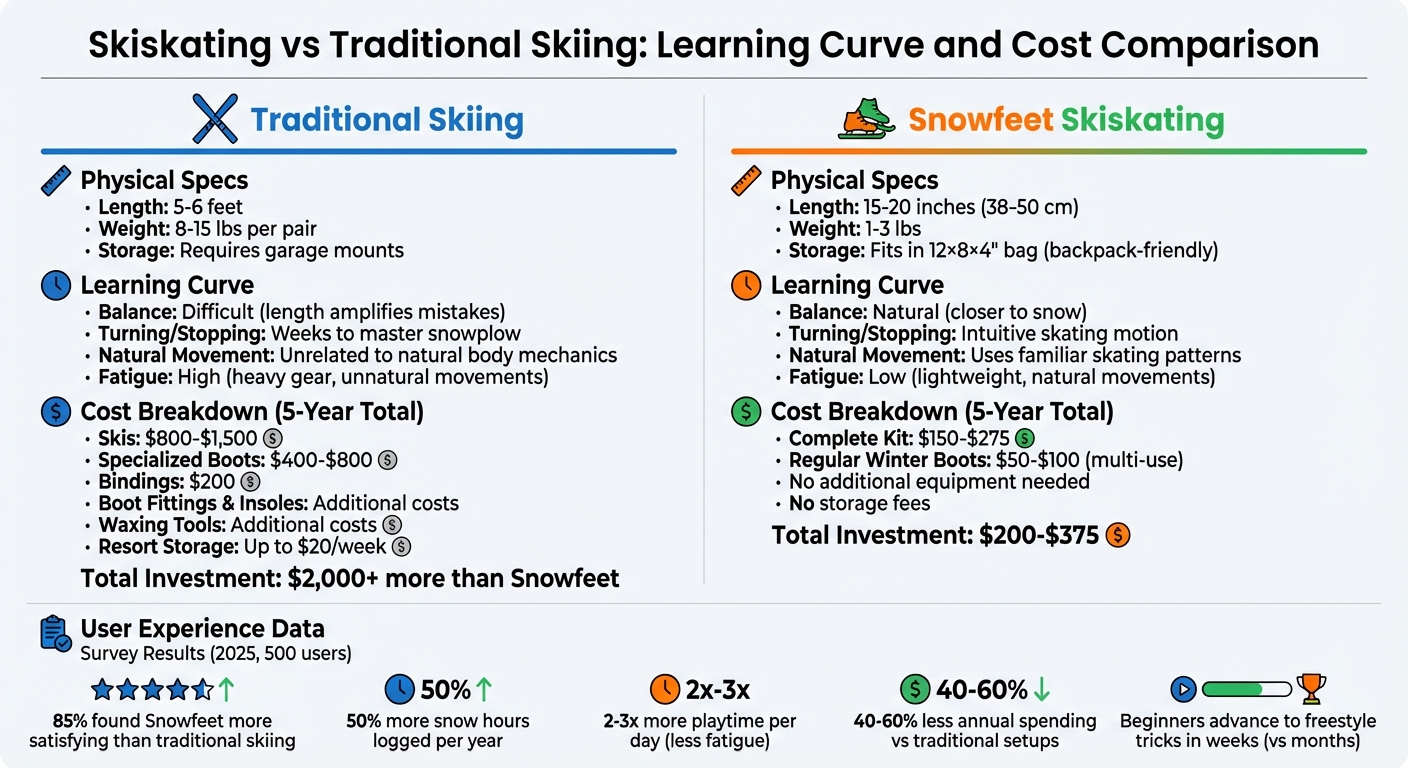
Snowfeet* Skiskates (44 cm) and mini skis (38 or 50 cm) are compact and lightweight. They fit into a 12×8×4-inch bag and weigh just 1–3 lbs, compared to the 5–6 feet length and 8–15 lbs per pair of traditional skis. This makes them a breeze to transport - toss them in a backpack, carry them on a plane, or store them in a small closet. No need for bulky garage mounts or paying resort storage fees, which can cost up to $20 per week. Plus, their portability means you can easily take them on backcountry hikes or stash them in your car trunk for spontaneous snow adventures.
More Fun and Freedom on the Snow
Snowfeet* opens up a world of possibilities beyond the usual ski slopes. You can skate cross-country, explore urban snow parks, or even carve up your backyard - no long lift lines required. Thanks to rollerblade-like bindings, your feet can move naturally, making spins, jumps, and off-piste exploration feel effortless. Users report logging about 50% more snow hours each year, with beginners quickly advancing to freestyle tricks in just weeks. Since Snowfeet* reduces fatigue, people often enjoy 2–3 times more playtime per day. A 2026 survey of 500 users revealed that 85% found Snowfeet* more satisfying than traditional skiing.
Better Value for Your Money
Financially, Snowfeet* is a game-changer. A complete Snowfeet* kit costs $150–$275 and works with regular winter boots (around $50–$100). Compare that to traditional skiing, which typically requires $800–$1,500 for skis, $400–$800 for specialized boots, and $200 for bindings. Over five years, Snowfeet* can save you more than $2,000 per person.
You also skip the added costs of ski boot fittings, custom insoles, and waxing tools. Adjustable straps let you use your existing boots, so you don’t need stiff, expensive ski boots that may cause discomfort. Those same boots can double for snowshoeing or casual winter walks. On top of all that, the 2026 survey found that users spent 40–60% less annually on Snowfeet* compared to traditional ski setups.
Conclusion
If you're looking for a way to hit the snow faster and have more fun, Snowfeet* skiskating is a game-changer. Unlike bulky traditional skis that take weeks to master, Snowfeet* skiskates (44 cm) and mini skis (38 or 50 cm) are designed to move naturally with you. This means you’ll find your balance quickly and start carving turns in no time. While traditional skiers are still figuring out the basics, you could already be exploring groomed slopes or venturing into backcountry trails. It’s all about getting more time to enjoy the snow.
There’s also the convenience factor. Snowfeet* are small enough to toss in a backpack and work with your regular winter boots - no need for pricey ski boots, waxing kits, or resort storage. Plus, you’re not tied to a resort. You can skate through urban snow parks, your backyard, or even cross-country trails. More freedom, less hassle, and way more time to enjoy the snow.
FAQs
Can I use Snowfeet* with regular winter boots?
Yes, you can use Snowfeet* with regular winter boots. This makes them much easier to use and perfect for beginners compared to traditional skis, which usually need specialized ski boots. With Snowfeet*, the setup is quick and simple, letting you skip the hassle and get straight to enjoying the slopes.
Are Snowfeet* allowed at ski resorts and on chairlifts?
Currently, there’s no clear-cut answer on whether Snowfeet* skiskates are allowed at ski resorts or on chairlifts. Rules can differ from one resort to another, so it’s a good idea to reach out to your local ski area ahead of time to confirm their policy.
What’s the safest way to learn turning and stopping on Snowfeet*?
To get the hang of turning and stopping on Snowfeet*, start on gentle slopes where you can build confidence. Keep your focus on maintaining balance and use small, deliberate movements to stay in control. Before tackling steeper terrain, practice stopping techniques in wide, open spaces where you have plenty of room to maneuver.
Snowfeet’s design helps make the learning process smoother, but don’t skip the protective gear - helmets and pads are a must for safety. If you’re new to this type of gear, consider getting tips from an experienced instructor who knows how to work with Snowfeet or similar equipment. It can make a big difference in your progress and confidence!











Leave a comment
This site is protected by hCaptcha and the hCaptcha Privacy Policy and Terms of Service apply.