



















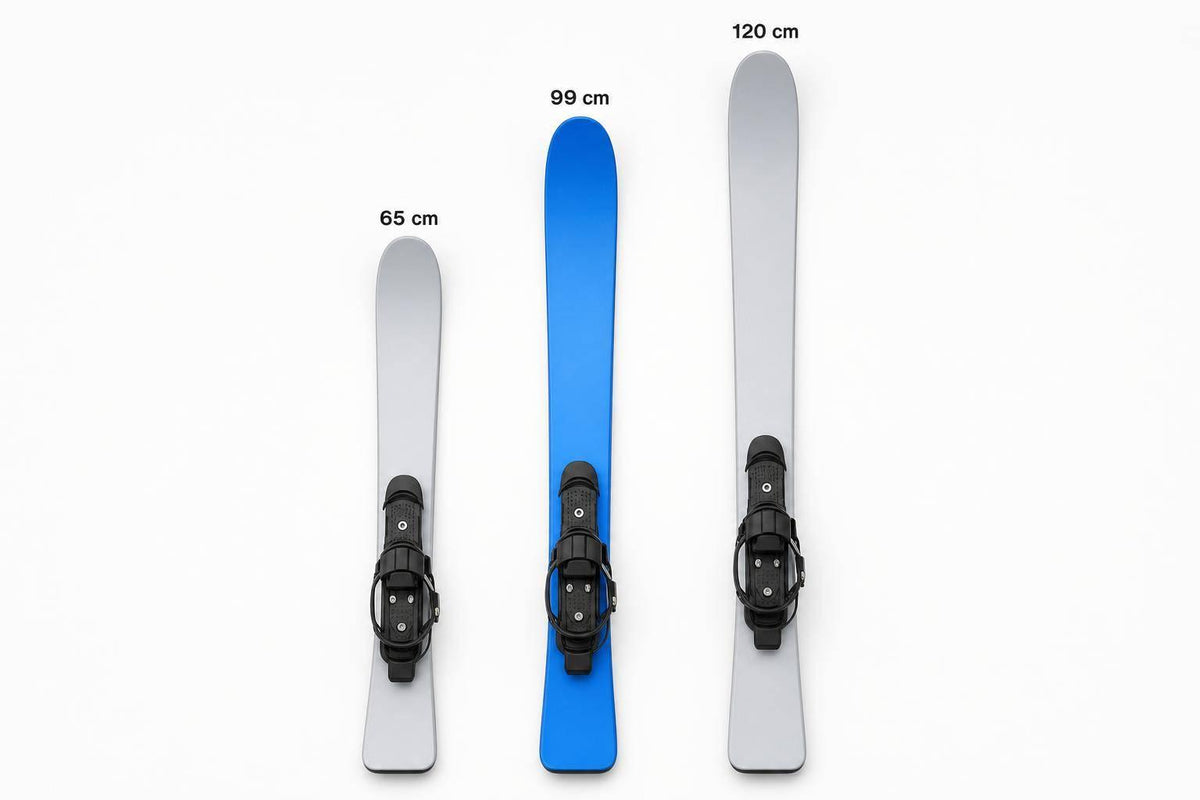
If you want the short answer: I’d pick 99 cm for most adults. It starts at $690, sits between the 65 cm at $590 and the 120 cm at $950, and gives the best mix of control, speed, and day-long comfort.
Here’s the whole thing in plain English:
- 65 cm: lowest price, easiest to learn, best for mellow runs and family days
- 99 cm: best pick for most resort riders, more stable than 65 cm, still easy to turn
- 120 cm: highest price, best for people who ski faster and want a more ski-like feel
That price gap is $360 from shortest to longest. And no, you’re not just paying for more centimeters. You’re paying for more edge on snow, a calmer ride at speed, and smoother turns.
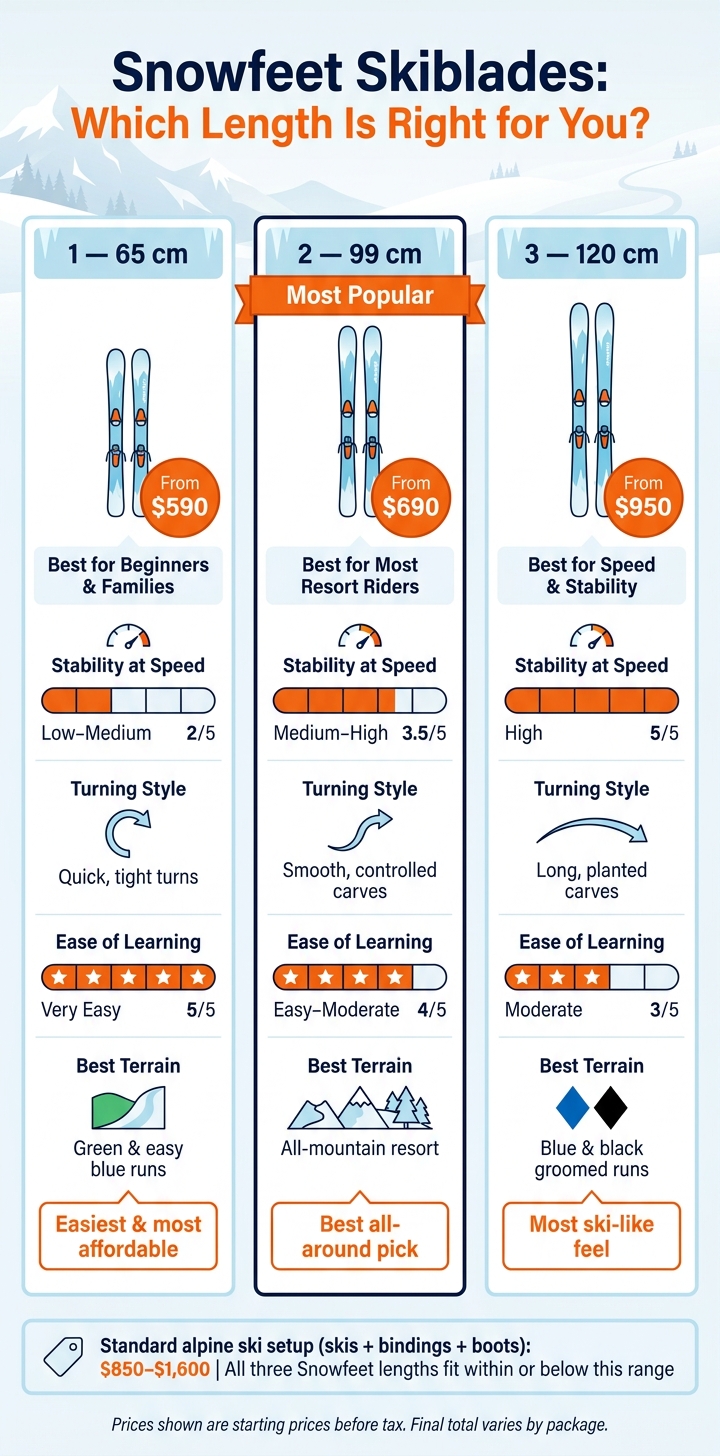
Skiblades Size Comparison: 65 vs 99 vs 120 cm Price, Performance & Best Use
Snowboarder tries Snowfeet* | Which Snowfeet* Short Ski is the Best? | Snowblades 44, 65, 99 Review
Quick Comparison
| Length | Starting Price | Best For | Feel on Snow |
|---|---|---|---|
| 65 cm | $590 | Beginners, families, casual laps | Light, playful, easy to swing around |
| 99 cm | $690 | Most resort riders | Balanced, steady, easy to trust |
| 120 cm | $950 | Faster skiers, stronger riders | More planted, smoother in longer turns |
A few fast takeaways:
- 65 cm costs about 14.5% less than 99 cm
- 120 cm costs about 37.7% more than 99 cm
- Standard ski setups in the U.S. often run $850 to $1,600, so all three sit in or under that range
So, if you’re stuck, here’s my shop-floor answer:
Go 65 cm for easy fun. Go 99 cm for the safest all-around pick. Go 120 cm only if you know you want more speed and calm underfoot.
If you want to see how short skis ride in the real world, these videos can help:
Let’s get into the buying call without the fluff :)
Snowfeet* Price Comparison: 65 cm vs 99 cm vs 120 cm
Here’s the price breakdown.
| Length | Starting Price (USD) | Main Value |
|---|---|---|
| 65 cm | About $590 | Easiest handling |
| 99 cm | About $690 | Best all-around balance |
| 120 cm | About $950 | Most stability and smoother turns |
These price differences aren’t just about size. They also reflect what each model adds on snow: more stability, better edge hold, and more range across terrain.
Starting prices are before tax. Your final checkout total will vary based on tax and the package you pick.
What Each Price Includes
As you move up in length, you’re paying for a steadier and more versatile ride.
The 65 cm model starts at about $590. It’s the lightest and most playful option, and binding packages can shift the total by about $50 to $100. The 99 cm model starts at about $690 and gives you more stability for mixed terrain. Step up to the 120 cm model, starting at about $950, and you get the most planted feel at speed.
How Snowfeet* Prices Compare to Standard Ski Costs
In the U.S., a new mid-range alpine ski setup - skis, bindings, and boots - usually costs $850 to $1,600. Even a budget beginner package can still come in around $700 before tax.
Snowfeet* keeps it simpler. The blades and bindings come in one purchase, and if you already own boots, you don’t need anything else. That can make the math a lot easier, especially if you’re not trying to build a full ski setup from scratch.
Long skis still make sense for aggressive carving and deep backcountry days. But for most resort riders, Snowfeet* costs less, is easier to carry, and fits more casual use.
That makes the price gap easier to judge based on how you like to ride, which is what the next section gets into.
Next: how the 65 cm, 99 cm, and 120 cm models differ on snow.
sbb-itb-17ade95
65 cm vs 99 cm vs 120 cm: What Each Length Gets You
Now let’s match each price to the kind of ride you get.
| Length | Best For | Stability at Speed | Turning Style | Ease of Learning |
|---|---|---|---|---|
| 65 cm (26 in) | Beginners, park, casual fun | Low–Medium | Quick, tight turns | Very Easy |
| 99 cm (39 in) | Most resort riders, all-mountain | Medium–High | Smooth, controlled carves | Easy–Moderate |
| 120 cm (47 in) | Confident intermediates and advanced riders, speed | High | Long, planted carves | Moderate |
65 cm: Easiest to Handle
The 65 cm is the lightest and most forgiving pick. It flips from edge to edge fast and makes tight turns with little effort. Snowfeet* calls this its most playful, easiest-turning option, and that checks out on snow.
That makes it a smart fit for first-timers, families, and anyone who wants laid-back fun on green and easy blue runs. It’s the one that feels the least intimidating. You can hop on and start messing around without feeling like the gear is bossing you around.
The downside shows up when the pace picks up. On steeper runs or at higher speeds, the shorter length has less edge contact and less stability than the 99 cm or 120 cm. If you want a bit more calm under your feet without losing much maneuverability, the 99 cm is the next move.
99 cm: Broadest Use Case
For most riders, the 99 cm hits the sweet spot. It carves more naturally than the 65 cm but still feels quick and under control. It also handles mixed resort terrain with more confidence, which is a big deal if your day includes a little of everything.
This is the best all-around choice for most resort terrain. If you started on 65 cm and want more range without jumping all the way to full-length skis, the 99 cm feels like a natural step. Not too twitchy. Not too demanding. Just a nice middle ground.
If your main goal is more calm at speed, though, the 120 cm is where you’d look next.
120 cm: Most Stability and Smoother Turns
The 120 cm gets closest to the feel of standard skis. More edge contact means better stability at speed, less chatter on rough snow, and a better grip for longer, wider carves on groomed runs. The shorter lengths just can’t match that in the same way.
If you spend a lot of time on blue and black runs at moderate to high speeds, and you want something that feels more like a short ski than a playful blade, this is the size that earns its higher price.
There is a trade-off, of course. It’s less nimble in tight spaces and takes up more room than the 65 cm or 99 cm. So, don’t buy it just because “longer sounds better.” Pick it if you’ll use that extra stability and those longer carves.
Which Length Gives You the Best Value for Your Riding Style
Now that the prices are clear, let’s match each Snowfeet* length to how you’ll use it most.
| Length | Price | Best Fit |
|---|---|---|
| 65 cm (26 in) | From $590 | Beginners, families, casual riders |
| 99 cm (39 in) | From $690 | All-around resort riders |
| 120 cm (47 in) | From $950 | Speed-focused intermediates and advanced riders |
Use the breakdown below to turn price into a buying decision.
Best for Beginners and Families: 65 cm
If you’re planning a few weekend trips to a local hill with the family, the 65 cm is the easiest yes. It’s the lowest-cost way into Snowfeet* for casual riders and first-timers. On groomed green and blue runs, it works well for learning and low-stress family days.
That lower price helps, too. If one or two people in the family are just starting out, you’re not paying for extra performance that may not matter yet. Simple, fun, and less of a hit to the wallet.
If you want more range but still want easy control, the 99 cm is the next move.
Best Overall Value for Most Riders: 99 cm
For the biggest group of U.S. resort riders, 99 cm gives you the most performance for the money. You get enough edge length for steady carving on blue and easy black runs, enough maneuverability for mixed terrain, and enough stability to stay comfortable through a full day of changing snow.
Pick this if you want one setup that can handle most resort days without feeling like a compromise. It’s also a smart choice for adults getting back into snow sports after time away. It feels familiar, but it still keeps that short-ski fun factor.
If speed and stability matter more than agility, go up to 120 cm.
Best for Riders Who Want More Stability: 120 cm
The 120 cm is the right call when stability comes first. This length makes the most sense for riders who like to carry speed on groomed black runs or spend time at bigger resorts where edge hold on hardpack and icy sections matters.
If you’re coming from full-length skis and want something shorter without losing that planted feel, the 120 cm does that better than the other sizes. The extra edge contact helps you make longer, smoother carves on fast, firm snow.
Buy it only if you want that extra stability.
Conclusion: Choosing the Right Snowfeet* Length by Budget and Performance
After looking at price, stability, and how easy each option feels to ride, the takeaway is pretty simple: 65 cm is the easiest and cheapest, 99 cm gives you the best all-around value, and 120 cm feels the most stable at speed.
Long skis still have their place. If you care most about powder days and hard charging at high speed, they can still be the better pick. But for most casual resort riders, Snowfeet* gives you more for your money and is a lot easier to travel with and stash away than full-length skis.
And here’s a nice little bonus: all three lengths fit in a car trunk or closet. That makes resort trips, packing, and storage way less of a hassle.
Final Picks by Buyer Type
Choose the length that fits how you ride most of the time, not the one that just sounds cool on paper.
- Go 65 cm if you're new to snow sports or want the easiest, lowest-cost pick.
- Go 99 cm if you want one setup for most resort days and the best all-around value.
- Go 120 cm if you already ski well and want the most stable, ski-like feel in a small package.
If you're stuck between 65 cm and 99 cm as an adult, default to 99 cm. It gives you better long-term value.
If you're deciding between 99 cm and 120 cm, be honest with yourself: do you ski fast on firm snow or steeper runs? If yes, go with 120 cm. If most of your days are more about moderate-speed cruising, stick with 99 cm.
If you want the safest default, choose 99 cm.
FAQs
Should most adults choose 99 cm?
For most adults, Snowfeet 99 cm Skiblades* hit the sweet spot.
They give you a nice mix of agility and stability, which makes them a strong pick for groomed slopes and mixed conditions. They sit right in the middle of the range: 65 cm leans more toward tricks and tight, playful moves, while 120 cm gives you more speed, more stability, and better support when the snow gets deeper.
At about $590–$675, the 99 cm length gives you more range without pushing you into the higher price of the 120 cm version.
Is 120 cm worth the higher price?
Yes - if you’re an advanced skier or you want a more old-school skiing feel. The 120 cm model gives you better stability at higher speeds, better flotation in deeper snow, and more support when you’re laying into hard carves.
What you’re paying for, mostly, is more range on the mountain. You still get a compact ski that’s easier to carry and transport than standard 150–200 cm skis, but with more support when conditions get rough or your skiing gets more aggressive.
Can beginners start on 99 cm?
Yes. Beginners can start on 99 cm Snowfeet Skiblades.
Mini Ski Skates often get the nod for total first-timers. But the 99 cm Skiblades give you a bit more ski underfoot, which can help a lot when you're learning. You get a wider base for extra stability, plus a nice mix of agility and control.
That’s why they’re a solid pick for beginners who want something a little longer and more all-around without feeling hard to handle.












Leave a comment
This site is protected by hCaptcha and the hCaptcha Privacy Policy and Terms of Service apply.