



















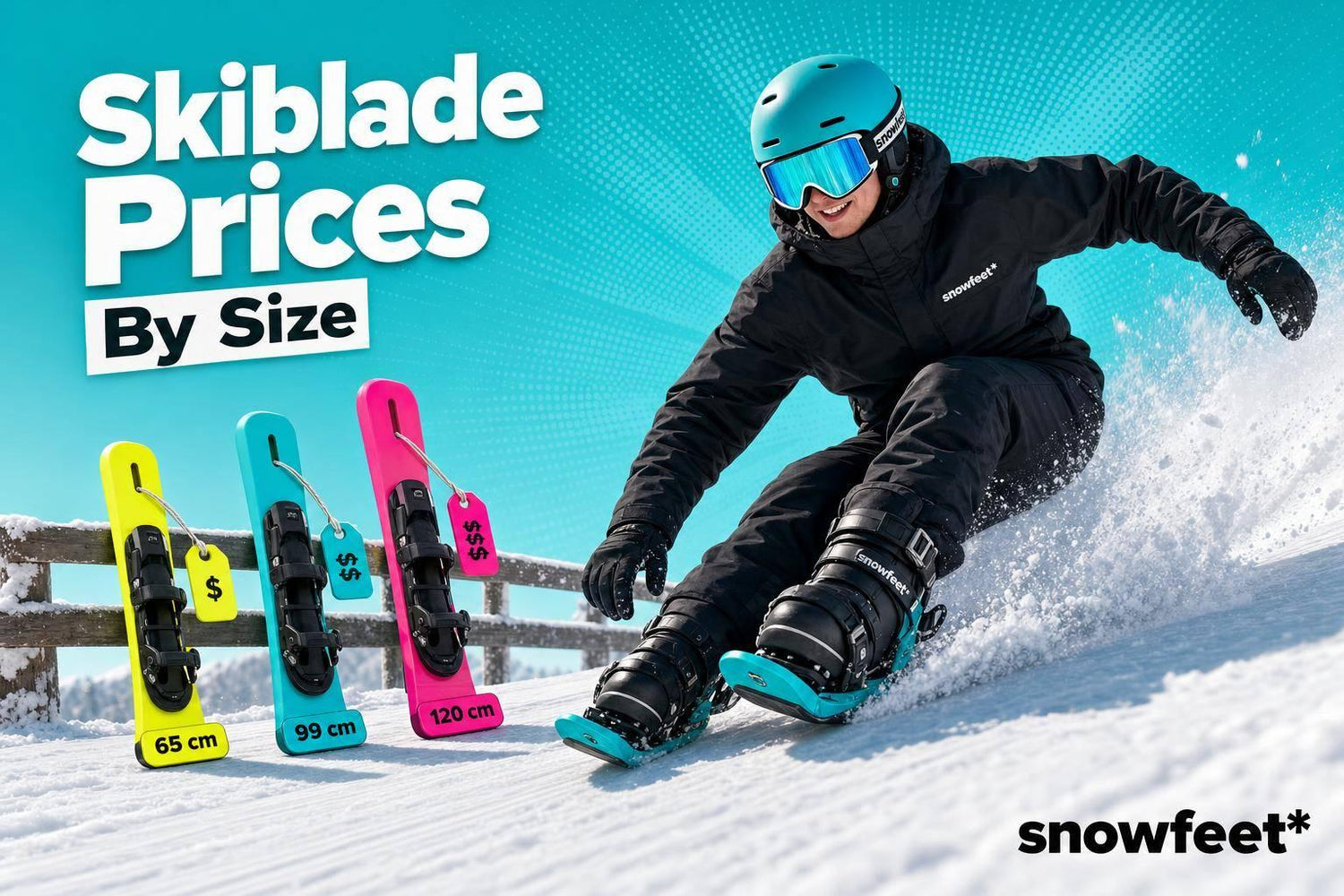
If you want the short answer: skiblades usually cost about $300 to $700+ per pair, and Snowfeet* models run from $590 to $950. So, your pick mostly comes down to one thing: how much stability you want for your money.
Here’s the simple breakdown:
- 65 cm ($590+): best if you want the lowest price in this lineup, easy packing, and tight turns
- 99 cm ($690+): the middle ground for most riders
- 99 cm POWDER ($690+): same starting price, but built for soft snow
- 120 cm ($950): costs the most, gives you the calmest ride
In other words: shorter usually means less money and more playfulness. Longer usually means more cost and more control.
If I were giving quick shop-floor advice, I’d say:
- Pick 65 cm if you want something small, fun, and easy to carry
- Pick 99 cm if you want the safest all-around bet
- Pick 99 cm POWDER if you ride soft snow a lot
- Pick 120 cm if you want the most planted feel and don’t mind paying full-ski money
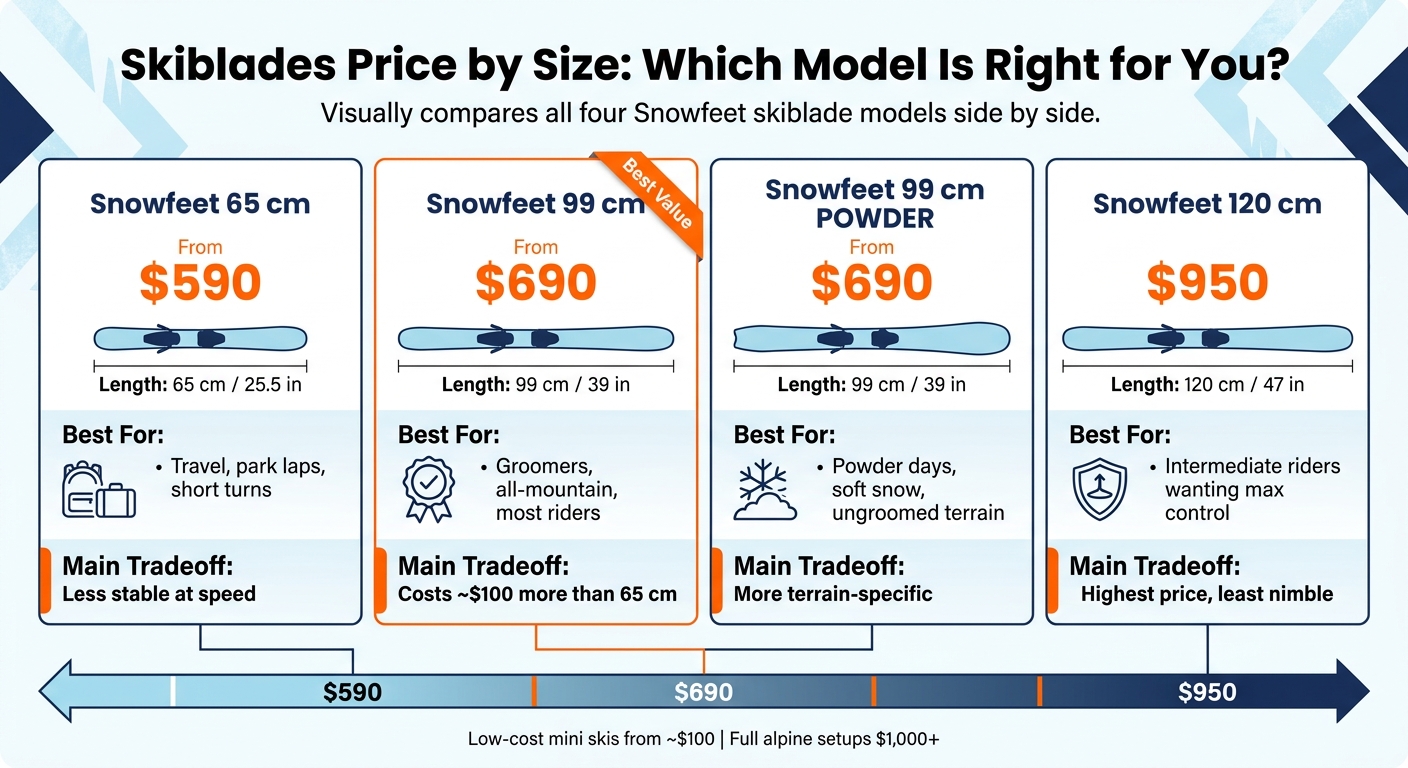
Skiblades Price by Size: Which Model Is Right for You?
How to choose Snowfeet* Snowblades | Skiblades | Skiboards | Short Ski
Quick Comparison
| Model | Starting Price | Length | Best For | Main Tradeoff |
|---|---|---|---|---|
| Snowfeet* 65 cm | $590 | 25.5 in / 65 cm | Travel, park, short turns | Less stable at speed |
| Snowfeet* 99 cm | $690 | 39 in / 99 cm | Groomers, mixed resort riding | Costs more than 65 cm |
| Snowfeet* 99 cm POWDER | $690 | 39 in / 99 cm | Soft snow, powder days | More terrain-specific |
| Snowfeet* 120 cm | $950 | 47 in / 120 cm | Riders who want more control | Highest price, less nimble |
A useful stat here: the jump from 65 cm to 99 cm is about $100, but the jump from 99 cm to 120 cm is about $260. So, for a lot of riders, 99 cm hits the sweet spot on cost vs. ride feel.
And one more thing: low-cost mini skis can start near $100, while full alpine setups can push past $1,000. So Snowfeet* sits in that middle lane - not bargain-bin cheap, not full ski-rack wallet pain either :)
If you’re shopping by value, I’d keep it simple: 65 cm for portability, 99 cm for most people, and 120 cm only if you know you want more stability.
For a quick visual rundown, you can also check skiblade videos on YouTube:
Snowfeet* Skiblades 65 cm: price and who they suit
65 cm price and what you get for it
Snowfeet* 65 cm skiblades start at $590 in the U.S., and most versions land between $550 and $710, based on the binding type and edition.
That puts them at the lowest price point in the Snowfeet* skiblade lineup. And that’s a big reason this model clicks with riders who care most about portability and quick, snappy handling.
At 65 cm, or about 25.5 inches, they’re short enough to carry without a fuss, pack into tight spaces, and stash at home without playing storage Tetris. For travelers and casual riders, that matters a lot.
Best for park laps, short turns, and travel
The 65 cm size is a strong match for terrain park laps and short turns. Since the ski is so short, turning feels fast and easy. You don’t have as much ski to manage, which helps beginners and occasional riders get used to them with less hassle.
The trade-off shows up when speed picks up. On open runs or at higher speeds, the 65 cm won’t feel as planted as the 99 cm or 120 cm models. So if you like the short-ski feel but want more control under you, the 99 cm is the next size to look at.
sbb-itb-17ade95
Snowfeet* Skiblades 99 cm and 99 cm POWDER: price by use case
Both 99 cm models start at $690, while the 65 cm starts at $590. That extra cost comes from the longer platform and the added stability that comes with it. But here’s the key point: these two 99 cm models are not the same tool with a different graphic. They’re made for different kinds of riding.
If you want more stability but don’t want to jump all the way to a full ski, 99 cm is the next step up.
99 cm skiblades: more length for all-mountain use
At about 39 inches (99 cm), the 99 cm skiblade works well for resort riders who want the quick feel of short skis with a bit more calm underfoot. Compared with the 65 cm, the added length gives you a more planted ride at speed, less twitchiness, and better performance on groomers.
That makes it a strong fit for riders who spend most of their time on groomed resort runs but still want that short-ski feel.
99 cm POWDER: same price, different purpose
The 99 cm POWDER starts at the same price, but it’s built with a different job in mind. It’s wider underfoot, which helps it float better and turn more easily in soft snow, powder, and ungroomed terrain.
So, if your local mountain gets steady snowfall and you like chasing soft-snow days, this is the one to look at.
Comparison table: Snowfeet* 99 cm vs other short-ski options
| Option | Length | U.S. Price | Terrain Focus | Boot Compatibility |
|---|---|---|---|---|
| Snowfeet* 99 cm Skiblades | 99 cm (~39 in) | From $690 | Groomed runs, mixed all-mountain | Ski or snowboard boots |
| Snowfeet* 99 cm POWDER | 99 cm (~39 in) | From $690 | Powder, soft snow, ungroomed terrain | Ski or snowboard boots |
| Used Salomon snowblades | 90–99 cm | ~$75–$180 (resale) | Groomers, park features | Alpine ski boots only |
| Other used/budget skiboards | 75–100 cm | ~$150–$600 | Park, casual resort use | Ski or snowboard boots, limited adjustability |
Used Salomon snowblades can get you in for less money up front. But there’s a catch: they lock you into alpine ski boots only and come with older construction. Snowfeet* 99 cm models cost more at the start, but they give riders a more modern build and broader boot compatibility.
That makes them a simpler pick for people who want fewer gear headaches and more freedom in how they set up. For riders who want more stability, the 120 cm size is the next step up.
Snowfeet* Short Skis 120 cm: top price, most stability
If the 99 cm still feels a bit too short, the 120 cm is the next move. At $950, it’s the most expensive Snowfeet* option in this group. That price isn’t just paying for extra length. You’re paying for more stability, plain and simple.
This model fits riders who want the steadiest feel short skis can give without jumping all the way to a full-length setup. It’s still in the short-ski camp, but it leans much closer to the feel of a standard ski.
120 cm price vs full-length skis
At $950, the 120 cm lands right in full-ski territory, where complete resort setups often cost about $700 to $1,200+. So yes, this is short-ski money with a full-ski price tag.
That said, there’s a reason for it. The wood-core build and standard ski-boot bindings help explain the higher cost. You’re getting a setup that feels more serious and more planted underfoot.
Traditional long skis still have the edge on fast, open terrain. No surprise there. But the 120 cm gives some of that high-speed calm back while staying easier to handle. It’s a bit like taking a sports wagon instead of a full-size truck - you give up some straight-line power, but daily control feels a lot less work.
Best for intermediate riders who want more control
The 120 cm works best for riders who are past the beginner stage but don’t want the full commitment of traditional long skis. Think riders who are comfortable on blue runs, dip onto easier black runs now and then, and want a ski that can hold a clean edge on hardpack.
Compared with the 65 cm, it feels calmer at speed. Turns are more predictable. Stopping feels easier. On firm groomers, it tracks in a steady, confident way.
It’s still shorter than a standard adult ski, which makes it easier to handle than full-length skis. At the same time, it gives more control than the 99 cm. For riders who want the most control in Snowfeet*’s short-ski range, this is the best-value upgrade.
How to pick the right size for your budget
After you compare prices, the next step is pretty simple: match your budget to the way you ride.
If you want the short version, here it is. 65 cm works best if you care most about portability and park laps. 99 cm is the safest bet for most people because it gives you the best mix of price, stability, and all-around use. 99 cm POWDER makes sense if you spend most of your time in soft snow. 120 cm is the pick if stability matters most and you're fine paying more.
Size and price summary table
| Model | Starting Price | Best Terrain | Ideal Rider | Tradeoff |
|---|---|---|---|---|
| Skiblades 65 cm | $590 | Park, groomed runs | Travelers, park riders | Most maneuverable, least stable at speed |
| Skiblades 99 cm | $690 | All-mountain, groomed runs | Casual riders | Best all-around balance of agility and stability |
| Skiblades 99 cm POWDER | $690 | Powder, soft snow | Powder-focused riders | More specialized for soft snow, less versatile on firm runs |
| Short Skis 120 cm | $950 | Groomed runs | Intermediate riders | Most stable, least nimble |
Which size fits beginners, casual riders, travelers, and park riders
Go with 65 cm if easy packing and park use matter more than stability when you pick up speed. It’s the easy-to-carry, quick-turn option.
Pick 99 cm if you want the best mix of price, stability, and range. For a beginner who wants a bit more support underfoot, this is often the best place to start. It’s the “can’t-go-wrong” size for a lot of riders.
Choose 99 cm POWDER only if soft snow is your main terrain. If you ride groomed runs most of the time, the regular 99 cm gives you more range.
Choose 120 cm only if you want the most stability and don’t mind the highest price tag. You’ll get a calmer ride, but you’ll give up some quickness.
Conclusion: which skiblade size offers the best value
Best value for most riders: 65 cm for portability and park use, or 99 cm for the best all-around balance.
FAQs
Are bindings included in the price?
Yes - bindings are included in the price for all Snowfeet* Skiblades.
That’s one of the big perks here. With many ski setups, bindings are a separate cost. With Snowfeet*, they’re already built in and included with every pair.
They also work with:
- regular winter shoes
- snowboard boots
- ski boots
That helps keep the full setup more budget-friendly and a lot simpler. No extra binding purchase. No piecing parts together. Just a more straightforward package.
Which skiblade size is easiest for beginners?
If you're new to this, the best place to start comes down to the kind of ride you want.
A lot of beginners lean toward Snowfeet* because the shorter design feels easier to control. They’re light, quick, and less awkward than long skis, which can make the learning curve feel less steep.
For total beginners, the 38 cm or 50 cm Mini Ski Skates are often the easiest entry point.
If you want something that feels a bit closer to skiing or riding in the park, the 65 cm Skiblades are the best beginner pick.
Is the 120 cm worth the extra cost?
Yes - if you want a more classic skiing feel but still want the Snowfeet perks. At $690, the 120 cm Short Skis give you the most stability and support for higher speeds, clean carving, and mixed terrain.
They hit a nice middle ground for beginners stepping up from shorter skiblades, or for riders who want more performance and better flotation without the size or price tag of full skis.











Leave a comment
This site is protected by hCaptcha and the hCaptcha Privacy Policy and Terms of Service apply.