



















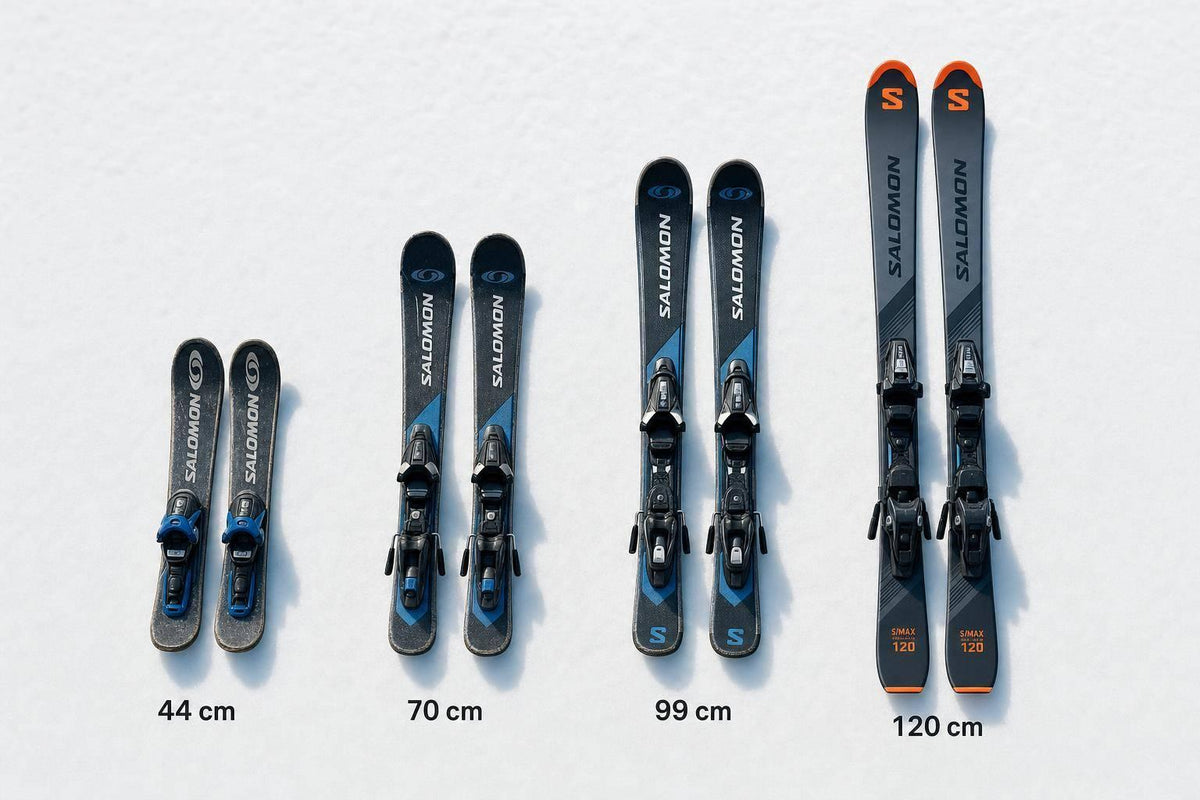
Short answer: Salomon Snowblades are gone, but short skis are not. If I wanted the closest match today, I’d look at Snowfeet* 99 cm Skiblades first, then pick 65 cm, 120 cm, or 44 cm Skiskates based on how I ride.
Here’s the whole story in plain English:
- Salomon stopped making Snowblades after short skis lost ground to park skis and all-mountain skis.
- Old Snowblades were usually 75 to 99 cm, with some later models at 120 cm.
- People liked them because they were easy to learn, easy to turn, and fun for tricks.
- Their weak spots were plain: less stable at about 25 to 30 mph, poor float in deep snow, and some older pairs had fixed, non-release bindings.
- Today, the closest picks are:
- 44 cm Skiskates for spins, butters, and a skate-like feel
- 65 cm Skiblades for kids, families, and playful resort laps
- 99 cm Skiblades for the closest old Snowblade feel
- 120 cm Short Skis for more support when speed climbs
If you’re a former Snowblade rider, I’d keep it simple: start with 99 cm. It’s the best all-around match for groomers, easy carving, and fun days on the hill. If you want more stability, go 120 cm. If you want more tricks and less ski, go 65 cm or 44 cm.
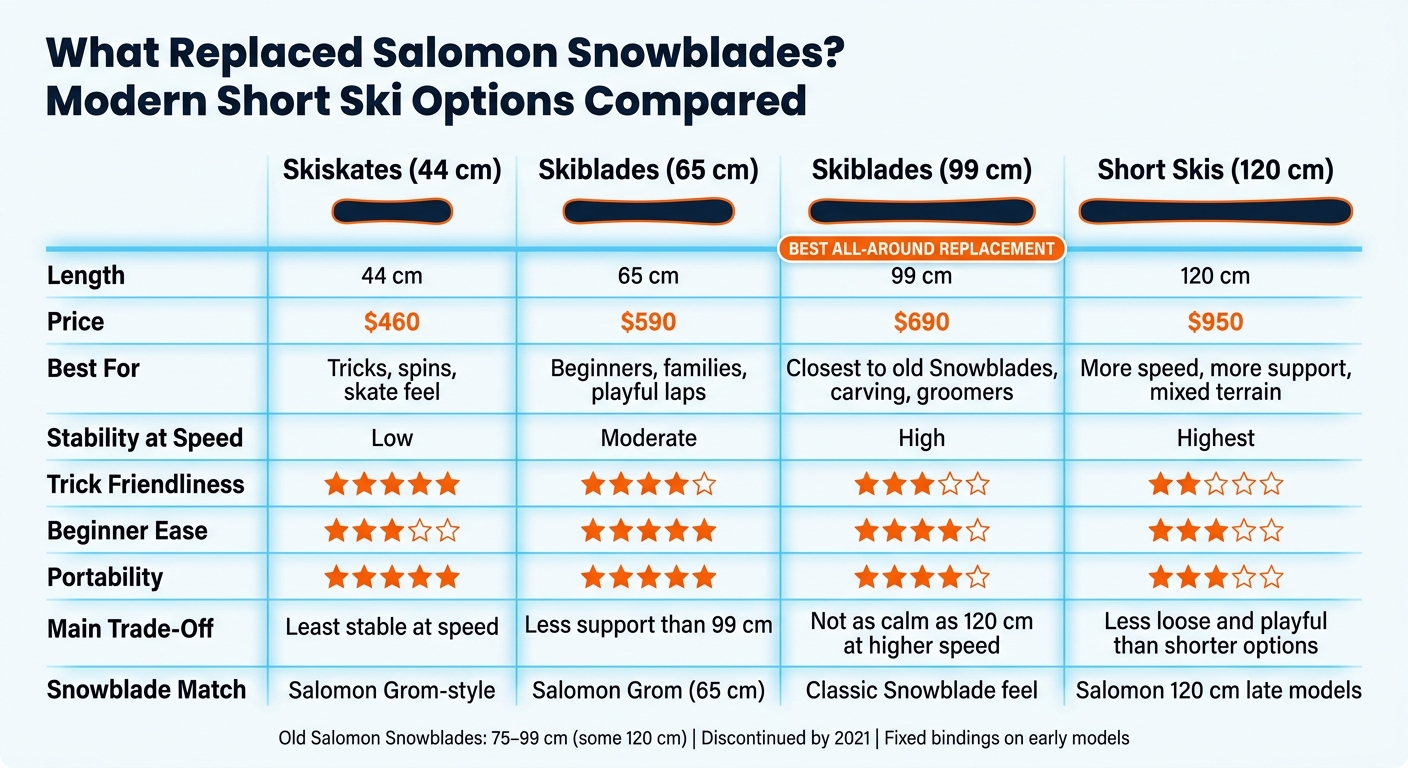
Salomon Snowblades vs Modern Short Ski Replacements: Full Comparison
Snowboarder tries Snowfeet* | Which Snowfeet* Short Ski is the Best? | Snowblades 44, 65, 99 Review
Quick Comparison
| Model | Length | Best For | Main Trade-Off | Price |
|---|---|---|---|---|
| Skiskates | 44 cm | Tricks, spins, skate feel | Least stable at speed | $460 |
| Skiblades | 65 cm | Beginners, families, playful laps | Less support than 99 cm | $590 |
| Skiblades | 99 cm | Closest to old Snowblades, carving, groomers | Not as calm as 120 cm at higher speed | $690 |
| Short Skis | 120 cm | More speed, more support, mixed terrain | Less loose and playful than shorter options | $950 |
A couple of helpful watch-first options if you want to see short skis in action:
So, if you’ve been asking, “What replaced Salomon Snowblades?” - that’s the answer up front. The format lived on. The badge changed.
Salomon Snowblades: what they were and why riders liked them
Snowblade was Salomon's name for short skis. People also called them skiboards, skiblades, mini skis, or Bigfoot-style skis. Salomon helped push this format into the spotlight in the early 2000s. And that makes sense. They were fun, simple, and easy to pick up. That mix is a big part of why Snowblades took off before riders ran into their limits and the market started to shift.
Classic Salomon Snowblades were usually 75 to 99 cm long, with some later models stretching to 120 cm.
The classic Snowblade feel: quick turns, tricks, and easy resort fun
The big draw was the feel. Snowblades felt quick, light, and easy to move around. Because they were so short, it took less effort to start a turn. Edge-to-edge moves felt fast and natural. On groomers, new riders could often link turns pretty fast, much sooner than they could on full-length skis.
That short length also made them a blast for freestyle. The low swing weight helped with spins and switch riding, especially on smaller park features and side hits. In plain English: less ski to throw around, more room to mess about. They were also easy to carry, toss in a car, or stash in a closet.
Where old Snowblades fell short
Of course, the same thing that made Snowblades fun also held them back. Their short length cut into stability. Once speeds climbed past about 25 to 30 mph, they could start to chatter. In deep snow, they sank fast.
Early models also came with non-release bindings, which meant the ski did not come off in a hard fall or rough landing. Salomon later added release bindings on the 99 cm and 120 cm versions, but by then the fixed-binding image had already stuck.
So, yeah, Snowblades were a ton of fun. But they were also easy to outgrow once riders wanted more speed, better float, or a setup that felt safer and more capable across the whole mountain.
Those limits helped open the door to newer short-ski designs with better stability, safety, and range.
Why Salomon Snowblades left the market
Snowblades didn’t vanish overnight. They slowly slipped out as skiing changed, and Salomon changed with it.
Shifting ski trends and brand priorities
In the late 1990s and early 2000s, twin-tip park skis and all-mountain skis started to take over. Brands put more of their focus on freestyle shapes and skis that could handle a mix of resort conditions. That made sense. Most skiers wanted gear that could do more than one thing.
Short skis still had a loyal crowd. But they were always a niche pick, not the go-to choice for the average skier. As the market moved, that niche was left more and more to smaller brands.
By 2021, Salomon was no longer making skiboards. It wasn’t some big public shutdown. More like a quiet fade-out.
Safety concerns didn’t help either. Resort limits and old worries around short skis hurt their image with everyday skiers. Once that label sticks, it’s hard to shake. And that pushed Snowblades even farther from the center of the market.
Why short skis did not disappear entirely
Even so, the core idea never died.
When big brands backed away, smaller specialty makers kept working on short skis. They improved the build quality, used wood cores, and added modern release bindings. That matters a lot. Better gear changes the whole feel on snow.
So, today’s short skis fill much the same role, but with stronger construction and better binding setups. That opened the door for the new wave of options, led by Snowfeet*.
sbb-itb-17ade95
What replaced Snowblades: Snowfeet* models compared by use case
Snowfeet* didn’t try to swap Salomon Snowblades with one single product. Smart move. The whole point of the lineup is that different riders want different things. Some want clean carving on groomers. Some want tricks. Some just want fun, easy resort laps with the family.
That split matters because Snowblades struggled as a one-size-fits-all idea. With Snowfeet*, the better move is to match the model to how you ride.
Best for carving and groomer laps: Snowfeet* Skiblades 99 cm and Short Skis 120 cm
The Snowfeet* Skiblades 99 cm are the closest match to the old Snowblade style. They feel quick, playful, and more dialed in on groomers, with better edge hold for carving.
If you want more support underfoot and feel better when speed picks up, go with the Short Skis 120 cm. They follow the same general idea as Salomon’s later 120 cm format, but with better modern stability. You still get a compact ski that’s easier to carry than full-length skis, but with more confidence on mixed terrain.
So the choice here is pretty simple:
- 99 cm if you want that classic Snowblade feel
- 120 cm if you want more speed and more stability
Best for tricks and the old Snowblade playfulness: Snowfeet* Skiskates 44 cm and Skiblades 65 cm
If old Snowblades won you over because they were playful and fun for messing around at the resort, the modern matches are the Skiblades 65 cm and Skiskates 44 cm.
The 65 cm Skiblades line up as the successor to the Salomon Grom models, which were also 65 cm. They’re a good fit for beginners and families because they’re easy to turn, forgiving, and more stable than the 44 cm option.
The 44 cm Skiskates lean hard into agility. They’re built for spins, butters, quick moves, and that skating-like feel. If your goal is max agility, this is the one.
Best for beginners and families: Snowfeet* Skiblades 65 cm or 99 cm
For beginners and families, the 65 cm Skiblades are the easiest to handle. They feel simple, light, and less intimidating. The 99 cm version gives adults more balance, and you still don’t need poles.
Here’s the quick match-up:
| Snowfeet* Model | Length | Best For | From |
|---|---|---|---|
| Skiskates | 44 cm | Tricks, spins, skating feel | $460 |
| Skiblades | 65 cm | Playfulness, beginners, families | $590 |
| Skiblades | 99 cm | Carving, groomers, all-mountain | $690 |
| Short Skis | 120 cm | High-speed stability, varied terrain | $950 |
Snowfeet* vs old Snowblades, other short skis, and full-length skis
Now let’s stack that old Snowblade feel up against the best newer picks.
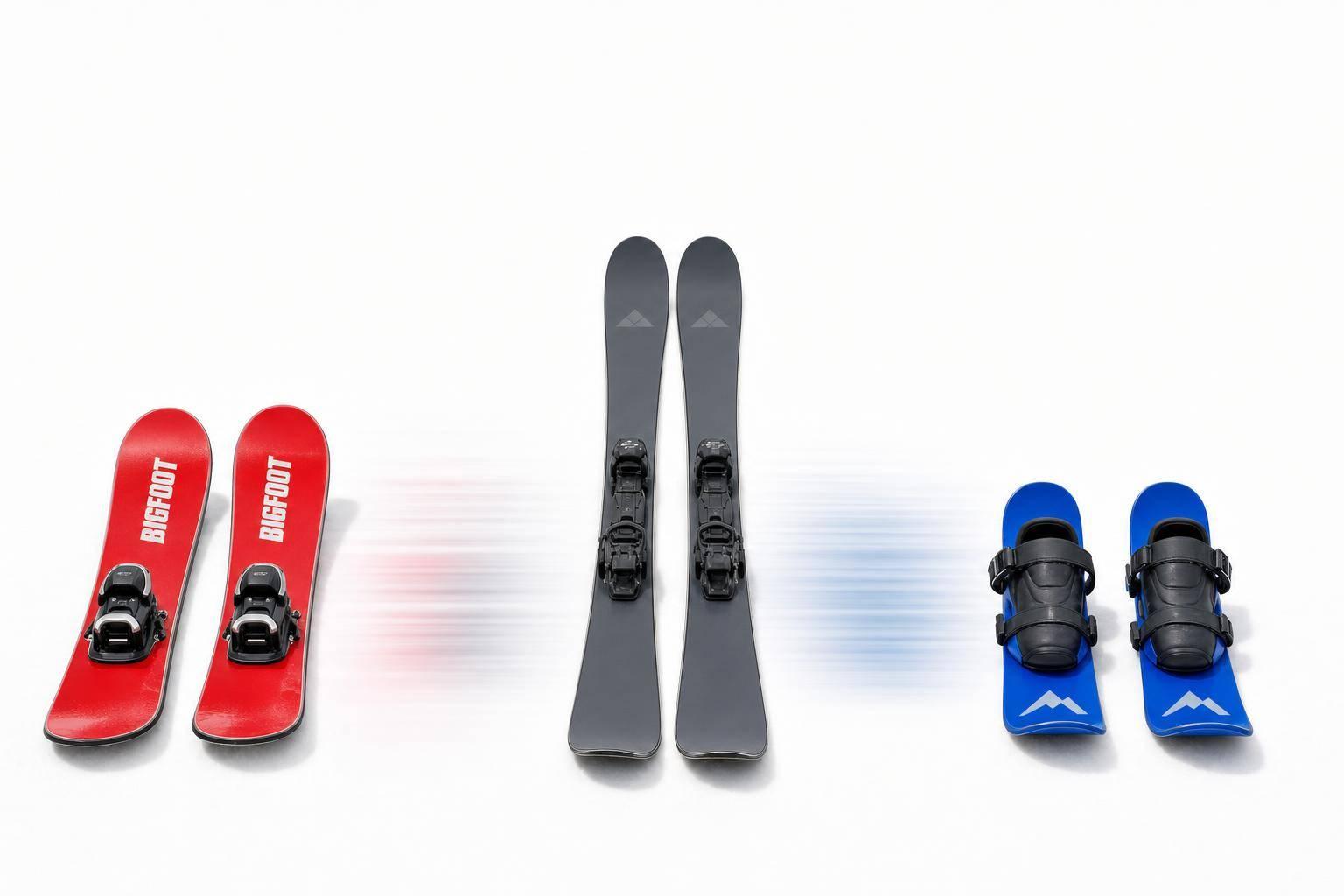
Snowfeet* vs Salomon Snowblades and Bigfoot-style short skis
Old Snowblades were small, playful, and easy to mess around on. Snowfeet* keeps that same spirit, but gives you more model options and makes the whole setup easier to carry. If you want the closest modern match to classic Snowblade carving, the 99 cm Skiblades are it.
For most resort riders today, Snowfeet* makes more sense. It covers that same short-ski lane, but with more choice. And on the shorter end, the ride feels a bit more like skating with a freestyle twist. That’s a fun combo.
So, if you want the nearest thing to the old-school Snowblade feel, the 99 cm Snowfeet* model is the closest direct replacement.
| Feature | Salomon Snowblades / Bigfoot-style short skis | Snowfeet* Skiblades (99 cm) |
|---|---|---|
| Stability | Moderate; highest in the 99 cm versions | High; best for carving and speed |
| Portability | Good | Excellent; easy to carry or store |
| Trick-friendliness | High | Moderate; better for jumps |
| Beginner ease | High | Very high |
| Boot compatibility | Integrated bindings for regular ski boots | Standard ski boots |
| Closest feel to classic Snowblades | Original design | 99 cm Skiblades |
Snowfeet* vs ODR-style short skis and similar mini-ski brands
ODR-style mini skis go after the same casual groomer rider. The catch? They tend to stay mostly on groomed runs. Snowfeet*, on the other hand, gives you more lengths and more ways to ride.
That makes Snowfeet* the broader pick. You can use it for tricks, first-timer days, groomers, and even more stable all-mountain short-ski setups. If you're chasing that old playful short-ski vibe, Snowfeet* feels like the more flexible next step.
If you want one short-ski setup that does more than cruise groomers, Snowfeet* has the stronger range.
| Feature | ODR-style / mini-ski brands | Snowfeet* lineup |
|---|---|---|
| Terrain range | Mostly groomed runs | Groomers, parks, and varied terrain |
| Boot flexibility | Varies by brand | Standard ski boots on Skiskates and Skiblades |
| Beginner ease | High | Very high |
| Use case breadth | Narrow | Wide; multiple models for different goals |
Snowfeet* vs full-length skis and snowboards
This one’s pretty simple. Long skis still win when speed gets high and the snow gets deep. Snowfeet* wins when you care more about convenience and ease.
Full-length skis and snowboards are still better for high-speed stability, deep powder, and any situation where a longer edge helps. But for most casual resort riders, Snowfeet* is easier to learn, easier to carry, and easier on the knees and legs. That matters a lot after a full day on the hill. Your legs will probably send a thank-you note :)
| Feature | Full-length skis / snowboards | Snowfeet* short skis |
|---|---|---|
| High-speed stability | Best | Lower, especially in shorter models |
| Deep powder performance | Best | Limited |
| Learning curve | Steeper | Faster and easier |
| Portability | Poor | Excellent |
| Physical strain | Higher torque on knees and legs | Gentler on knees and legs |
| Groomed run fun | Good | Very good |
The conclusion below turns these comparisons into a simple buy-now choice.
Conclusion: the best modern replacement for former Snowblade riders
Snowblades slipped out of the spotlight as ski trends shifted to shapes that could do more on the mountain. But for riders who still want that short, playful, easy-to-control feel, the answer today is pretty clear: Snowfeet*.
Snowfeet* picks up right where Snowblades left off. You’ve got 99 cm Skiblades for the closest match to the old Snowblade feel, 65 cm Skiblades for a light, playful ride, 120 cm Short Skis for more control at higher speed, and 44 cm Skiskates for the most skate-like ride on snow.
Here’s the quick breakdown:
- 99 cm Skiblades: best all-around replacement
- 65 cm Skiblades: easiest playful option
- 120 cm Short Skis: best for speed and stability
- 44 cm Skiskates: best for tricks and agility
For most riders, this is the easy pick. Former Snowblade riders should start with the 99 cm Skiblades. They’re the closest modern match and the best all-around choice for smooth carving and fun laps at the resort.
FAQs
Are Snowfeet* safer than old Snowblades?
Yes. Modern Snowfeet* gear is usually safer than old Salomon Snowblades.
Here’s the plain truth: used snowblades can come with aged materials, hidden cracks, and worn bindings. And that last part matters a lot. If bindings don’t release the way they should, the risk of injury goes up fast.
Snowfeet* Skiblades, on the other hand, use modern materials and precision-engineered bindings. The 99 cm and 120 cm models also come with standard release bindings, which can give you better safety, more control, and a lot more peace of mind on the snow.
It’s a bit like choosing between an old bike that’s been sitting in a garage for years and a new one that’s built, tuned, and ready to ride. Both might roll. But one is far more likely to work the way you expect when it counts.
Which Snowfeet* length should I choose?
Choose based on your experience and how you like to ride. If you want the closest feel to the original Salomon Snowblades, the 99 cm Skiblades are the best all-around pick for most resort riders.
If you like quick turns, park laps, and messing around with tricks, go with the 65 cm Skiblades or 44 cm Skiskates. If you want more stability, more speed, or a smoother move from long skis, the 120 cm Short Skis make more sense. For beginners, the 65 cm and 99 cm models are usually the easiest place to start.
Can beginners use Snowfeet* without poles?
Yes - beginners can absolutely use Snowfeet* without poles.
Their short, easy-to-turn design helps you stand in a natural, upright position. So you don’t need poles for balance or to begin turning.
That makes the learning curve feel less scary and a lot more natural than with skis. Most beginners can get the hang of it within a few hours by focusing on balance and smooth, quick movements.











Leave a comment
This site is protected by hCaptcha and the hCaptcha Privacy Policy and Terms of Service apply.