



















NHL players are always looking for ways to stay sharp in the off-season, and skiskates might just be the next big thing. These compact, snow-friendly tools mimic ice skating movements, making them a great option when rinks aren’t available. Unlike inline skates or skatemills, skiskates let players practice edge control, quick turns, and balance on snowy terrain. They’re lightweight, portable, and easy to use with regular winter boots, offering a low-impact way to train key hockey skills like agility and weight transfer.
Key Takeaways:
- What They Are: Skiskates are short blades (about 17 inches) that attach to winter boots, allowing you to glide on snow.
- Why They’re Useful: They replicate hockey-specific movements like sharp turns, edge control, and balance shifts.
- Who Benefits: NHL players and anyone looking to maintain skating skills off the ice.
- Cost: Around $575 for a pair of Snowfeet skiskates.
For hockey players, skiskates could fill a gap left by other off-ice training tools. They’re simple, effective, and could help keep your skills sharp year-round.
Snowfeet Skiskates vs Long Skis vs Snowboards Comparison for Hockey Training
Off-Ice Training Problems for NHL Players
For NHL players, the off-season brings a unique challenge: maintaining skating skills without constant access to ice rinks. It’s a tricky task since most off-ice training tools don’t fully capture the feel or mechanics of skating on ice. Let’s look at why popular methods like slide boards, inline skates, and skatemills fall short.
Slide boards are often used to mimic skating strides by gliding on special booties. While they help with basic movement, they limit stride length and keep everything in a linear, back-and-forth motion. This makes it nearly impossible to practice critical game movements like pivots and crossovers, which require multi-directional agility.
Inline skating can build power and endurance, but it has its own set of issues. The wheels create more rolling resistance compared to ice blades, and they don’t offer the same "bite" needed for sharp turns or sudden stops. This difference forces players to use compensatory movements that don’t translate well to on-ice performance. As TrainingPeaks coach Carrie McCusker points out, the single-leg stability and core strength gained from skating strides on ice are tough to replicate without the precise edge control and glide that only ice provides.
Then there’s dryland training and skatemills. These tools are great for general fitness and allow players to work on their stride without needing rink time. Skatemills, in particular, help with endurance and smoother skating. However, they confine movement to forward strides only, which means players miss out on practicing lateral cuts, quick stops, and balance adjustments. That lack of versatility makes it hard to match the dynamic, low-friction glide and rapid weight transfers that are essential for hockey.
Snowfeet* skiskates aim to tackle these gaps by offering a snow-based training option that brings players closer to the real dynamics of on-ice performance.
How Snowfeet* Skiskates Solve NHL Training Problems
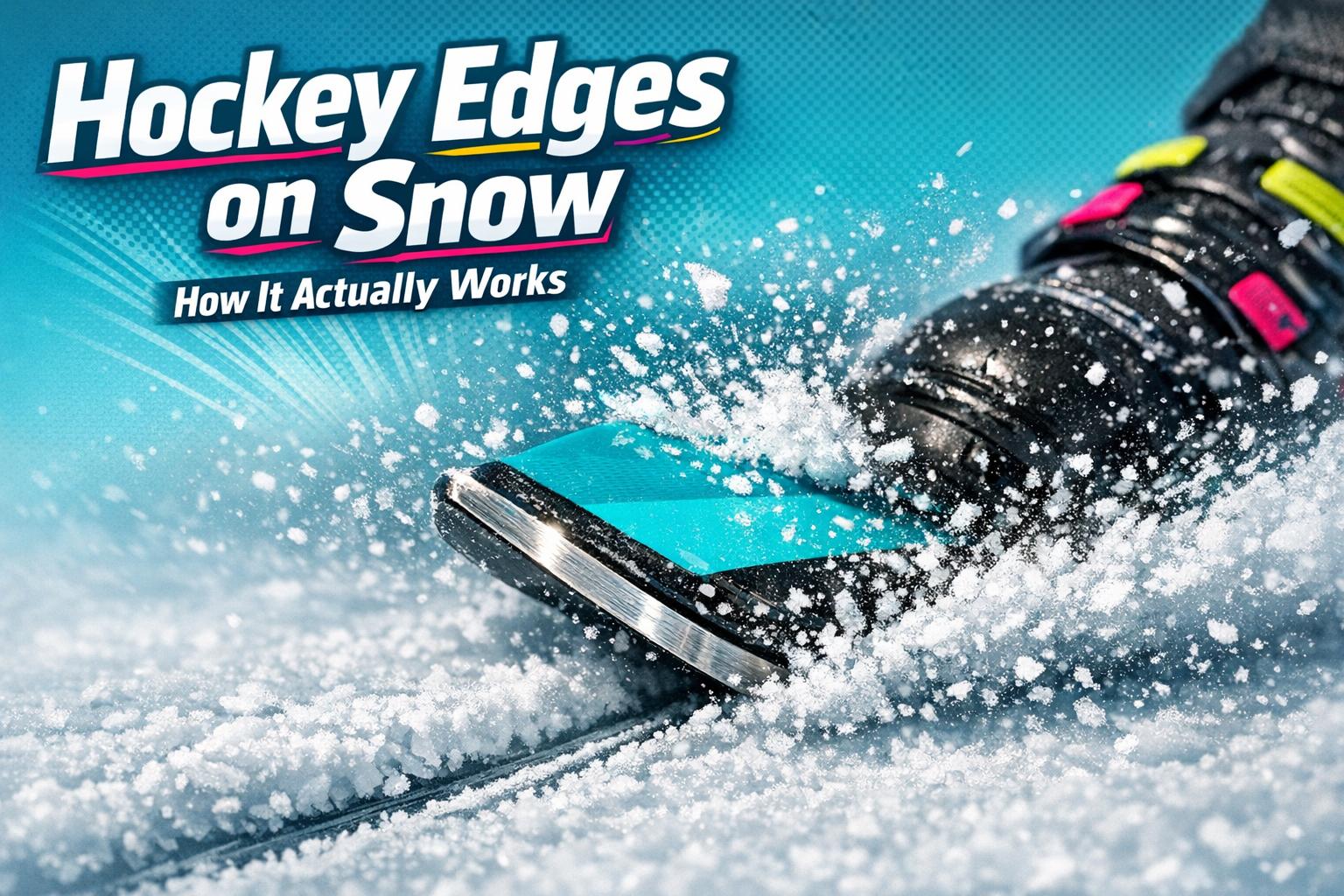
Snowfeet* Skiskates give NHL players a training edge by closely simulating on-ice movements, unlike traditional dryland methods. With their 44 cm blades designed to mimic the short, curved profile of hockey skates, they target the same muscles and movement patterns players rely on during games. These skates attach directly to winter shoes, making it easy for athletes to train on any snowy surface without the need for a rink.
The design encourages players to practice essential skills like inside and outside edge control, "V" push-offs that replicate herringbone strides, and balancing on a single blade over uneven snow. These movements are strikingly similar to what’s required on the ice. As Coach Jeremy from How To Hockey explains, the edge pressure and weight transfer with Snowfeet* are “identical to ice skating.” This means athletes can build the exact muscle memory they need for peak performance on the rink.
Hockey players already focus on plyometrics, core strength, and agility during their training. Snowfeet* builds on this foundation by offering a low-impact alternative that reduces stress on joints. This approach not only protects against wear and tear but also reinforces the precise muscle coordination needed for explosive skating. Athletes can maintain their power and agility without the repetitive strain of concrete drills or high-impact exercises.
Another key advantage? Portability. At $575 for the 44 cm model, these skates fit easily into a backpack, making them a year-round training tool. Players can practice edge control, balance, and quick maneuvers anytime, anywhere - no ice time or bulky equipment required.
Edge Control and Weight Transfer
Mastering edge control is crucial for elite hockey players, and Snowfeet* Skiskates are designed to make this skill second nature. Their compact size forces players to rely on their edges, rolling their ankles inward for grip and smoothly transferring weight between feet. This constant engagement strengthens the muscles around the ankles, knees, and hips, while also developing the neuromuscular coordination needed for sharp cuts and rapid direction changes. The design encourages precise knee bends and core activation, mirroring the mechanics of on-ice strides and improving stride efficiency for game situations.
Balance and Agility Improvement
The compact design of Snowfeet* Skiskates also challenges balance and agility in ways longer equipment can’t. Athletes must continuously engage their core to maintain stability, much like they do during quick turns or physical battles on the ice. Training on uneven snow surfaces forces players to make subtle adjustments, sharpening their nervous system’s ability to react to unexpected shifts - skills that directly translate to better on-ice performance. At the same time, skiskating builds lower body strength and flexibility, helping players maintain explosive power while reducing the risk of injury during the off-season.
Quick Turns and Stops
Quick direction changes are a hallmark of hockey, and Snowfeet* Skiskates are perfect for refining these maneuvers. Their short length allows players to pivot rapidly, practicing hip rotations and edge transitions similar to crossovers and tight turns on ice. Unlike long skis, which require wide arcs, the 44 cm skates enable hockey-specific cutting movements that match real game scenarios. Stopping techniques are also closely replicated - players dig their edges into the snow while rotating their hips, building muscle memory for controlled deceleration. Training in outdoor conditions adds an extra layer of adaptability, ensuring athletes are ready for any ice surface they encounter.
Snowfeet* Skiskates vs. Long Skis and Snowboards
Traditional skis require wide, sweeping turns, while snowboards keep your feet locked together, limiting independent leg movement. For NHL players and others aiming to replicate on-ice dynamics, Snowfeet* stands out as a better option compared to these traditional choices.
Measuring just 44 cm, Snowfeet* Skiskates encourage a natural, shoulder-width stance. This design helps hockey players build precise muscle memory with knee bends and proper hip alignment - key for mimicking hockey-specific movements. It’s this simplicity and focus on agility that sets Snowfeet* apart.
When it comes to off-ice training, Snowfeet* excels in agility and balance. Don DeBlieux, a PSIA Level 3 Nordic Instructor, points out that long skis often lead to inefficient movement patterns due to their steep learning curve. Plus, the compact design of Snowfeet* makes them far more portable than either skis or snowboards. Forget about roof racks or bulky bags - these skiskates fit right into a backpack. At $575, they’re an easy-to-carry and practical option for hockey players and winter sports enthusiasts alike.
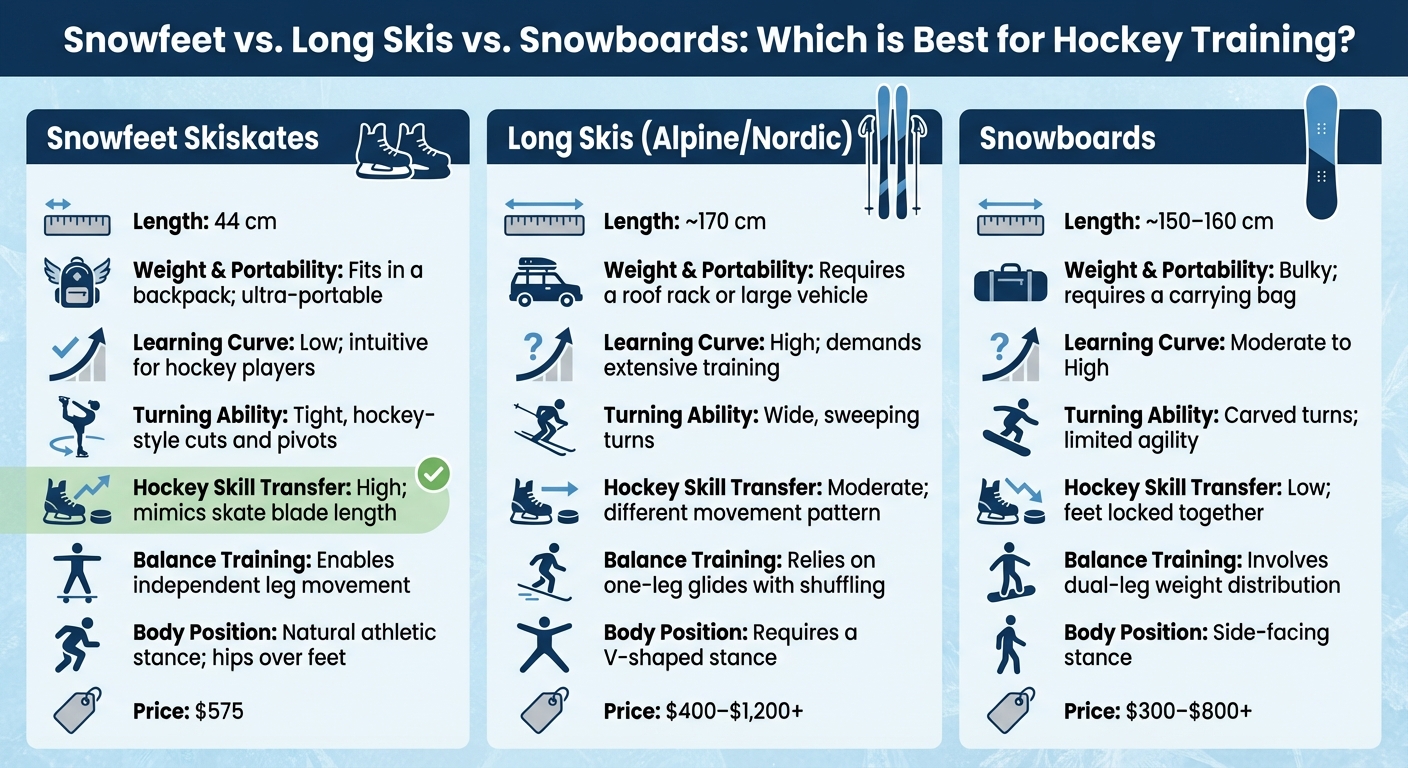
Here’s a quick breakdown of how Snowfeet* compares to long skis and snowboards:
Comparison Table: Snowfeet* vs. Long Skis and Snowboards
| Feature | Snowfeet* Skiskates | Long Skis (Alpine/Nordic) | Snowboards |
|---|---|---|---|
| Length | 44 cm | ~170 cm | ~150–160 cm |
| Weight & Portability | Fits in a backpack; ultra-portable | Requires a roof rack or large vehicle | Bulky; requires a carrying bag |
| Learning Curve | Low; intuitive for hockey players | High; demands extensive training | Moderate to High |
| Turning Ability | Tight, hockey-style cuts and pivots | Wide, sweeping turns | Carved turns; limited agility |
| Hockey Skill Transfer | High; mimics skate blade length | Moderate; different movement pattern | Low; feet locked together |
| Balance Training | Enables independent leg movement | Relies on one-leg glides with shuffling | Involves dual-leg weight distribution |
| Body Position | Natural athletic stance; hips over feet | Requires a V-shaped stance | Side-facing stance |
| Price | $575 | $400–$1,200+ | $300–$800+ |
This table highlights the advantages of Snowfeet* Skiskates, especially for those looking to blend portability, ease of learning, and hockey-specific training into their winter sports experience.
sbb-itb-17ade95
Hockey Drills You Can Do with Snowfeet* Skiskates
Snowfeet* Skiskates (44 cm) are a great tool for practicing on-ice hockey movements - only this time, in the snow. Thanks to their compact design, the skills you develop with these drills translate seamlessly to the ice. They’re perfect for sharpening your balance, edge control, and quick-turn skills.
One-Foot Glides and Balance Drills
Hockey demands strong single-leg balance, so these drills focus on improving stability and precision. Find a slight downhill slope and practice gliding on one leg while keeping your weight centered. Gradually extend the length of your glide with each attempt. This simple yet effective drill helps you build the stability needed to protect the puck and handle physical play on the ice.
"Solid technique boils down to getting comfortable with balancing on one leg. Make sure you commit completely to one ski before pushing off onto the other ski." - Don DeBlieux, PSIA Level 3 Nordic Instructor
Another great option here is the "Power Skating Edges" drill. Carve figure-8 patterns in the snow, focusing on smooth transitions between your inside and outside edges. Keep your head up and your shoulders square - just as you would during a game.
Suicide Sprints and Speed Training
Short, explosive sprints on snowy inclines are a fantastic way to build power and speed. Look for a short uphill slope and go all out for 5–10 seconds at a time. These bursts mimic the intense, anaerobic demands of a hockey shift. Plus, the snow’s resistance and the incline work together to improve your foot recovery and reaction time - think of it as overspeed training with a snowy twist.
Carving and Directional Control
To nail those quick transitions between forward and backward skating, try the "Double Pivot" and "Inside Mohawk" drills. These exercises teach you to keep your hips open and shift your weight smoothly for seamless direction changes. Mastering these drills will help you execute tight hip rotations and 360-degree spins with precision. By practicing these movements, you’ll be able to mirror the mechanics of on-ice hockey, reinforcing skills like weight transfer and sharp turns.
Snowfeet* Skiskates aren’t just a fun way to train - they’re a serious tool for taking your hockey game to the next level.
Why Snowfeet* Works Best for Professional Athletes
For NHL players juggling packed schedules, Snowfeet* offers a tool that checks all the right boxes. Its design and features make it a standout choice for professional athletes looking to stay sharp and fit.
Let’s start with portability. At just 17 inches (44 cm), Snowfeet* Skiskates are compact enough to slip into a backpack or gym bag. Unlike bulky skis or snowboards, they’re easy to carry around. For NHL players constantly traveling between games and training camps, this means no need for oversized luggage or roof racks. Just toss them in your bag, and you’re good to go.
Another big win? The learning curve. Hockey players already have the skills - edge control, weight shifts, and knee bends - that Snowfeet* require. This means they can jump right into sport-specific training without spending weeks learning a new activity, unlike traditional skiing.
The low-impact conditioning Snowfeet* provide is also a game-changer. Coach Jeremy from How To Hockey highlights how hockey techniques like edge control and weight shifts translate seamlessly to skiskates. They deliver a full-body workout that’s easy on the joints, making it perfect for athletes managing the physical toll of a long season. It’s a safer way to stay fit without adding unnecessary injury risks.
Snowfeet* also excel in movement replication. Unlike traditional skis, which favor wide, sweeping turns, or snowboards that lock your feet together, Snowfeet* mimic the explosive, quick transitions of hockey. They demand single-leg stability, fast weight transfers, and precise edge work - exactly what hockey players need to maintain their performance. For athletes with limited time between games, this sport-specific training is a huge advantage.
Lastly, there’s the ease of setup. Strap Snowfeet* onto your winter boots in seconds - no special ski boots, no fiddling with bindings, no lift tickets. Find a snowy hill nearby, and you’re ready to train. For professionals balancing games, practices, and recovery, this convenience makes it easy to fit training into even the busiest schedules.
Conclusion
Snowfeet* Skiskates might not yet be a staple for NHL players, but they’re proving to be a game-changer for hockey training. These compact tools address common off-ice challenges by improving edge control, balance, and quick weight shifts - all while being easier on the joints compared to traditional methods.
Built with hockey-specific movements in mind, they encourage the V-shaped stance and single-leg balance that are key to the sport. Plus, they allow for quick transitions that mirror on-ice maneuvers. And here’s the best part: they’re super convenient. You can use them with regular winter footwear, making it easy for busy athletes to squeeze in a solid workout without needing a ski lift or expensive gear.
On top of that, Snowfeet* Skiskates provide a full-body workout, torching 600–800 calories an hour while helping develop the muscle memory that separates good skaters from great ones. Their focus on precise weight transfers is what really makes them stand out.
FAQs
Do skiskates actually improve on-ice skating?
Skiskates are a great way to sharpen on-ice skating skills, especially for hockey players. They mimic critical movements like edge control, weight shifts, and maintaining balance, which are key to building muscle memory and coordination. Snowfeet* skiskates, in particular, offer a portable and versatile training option that focuses on agility and balance - two must-haves for hockey players. While big-name ski and snowboard brands cater to broader markets, Snowfeet* stands out by offering a tool specifically designed to boost hockey performance.
What snow conditions work best for Snowfeet* Skiskates?
Snowfeet* Skiskates work best on firm, groomed snow - think skate skiing tracks. These surfaces offer a smooth, consistent base, making it easier to practice agility, balance, and quick turns with precision.
Are Snowfeet* Skiskates safe for hockey players with knee or ankle issues?
Snowfeet* Skiskates can be a safe option for hockey players dealing with knee or ankle issues, as long as they’re used properly. They provide a low-impact workout that engages the whole body, improving balance and strength without overloading the joints. That said, it’s a smart move to check with a healthcare professional first to make sure they’re a good fit for your condition.











Leave a comment
This site is protected by hCaptcha and the hCaptcha Privacy Policy and Terms of Service apply.