



















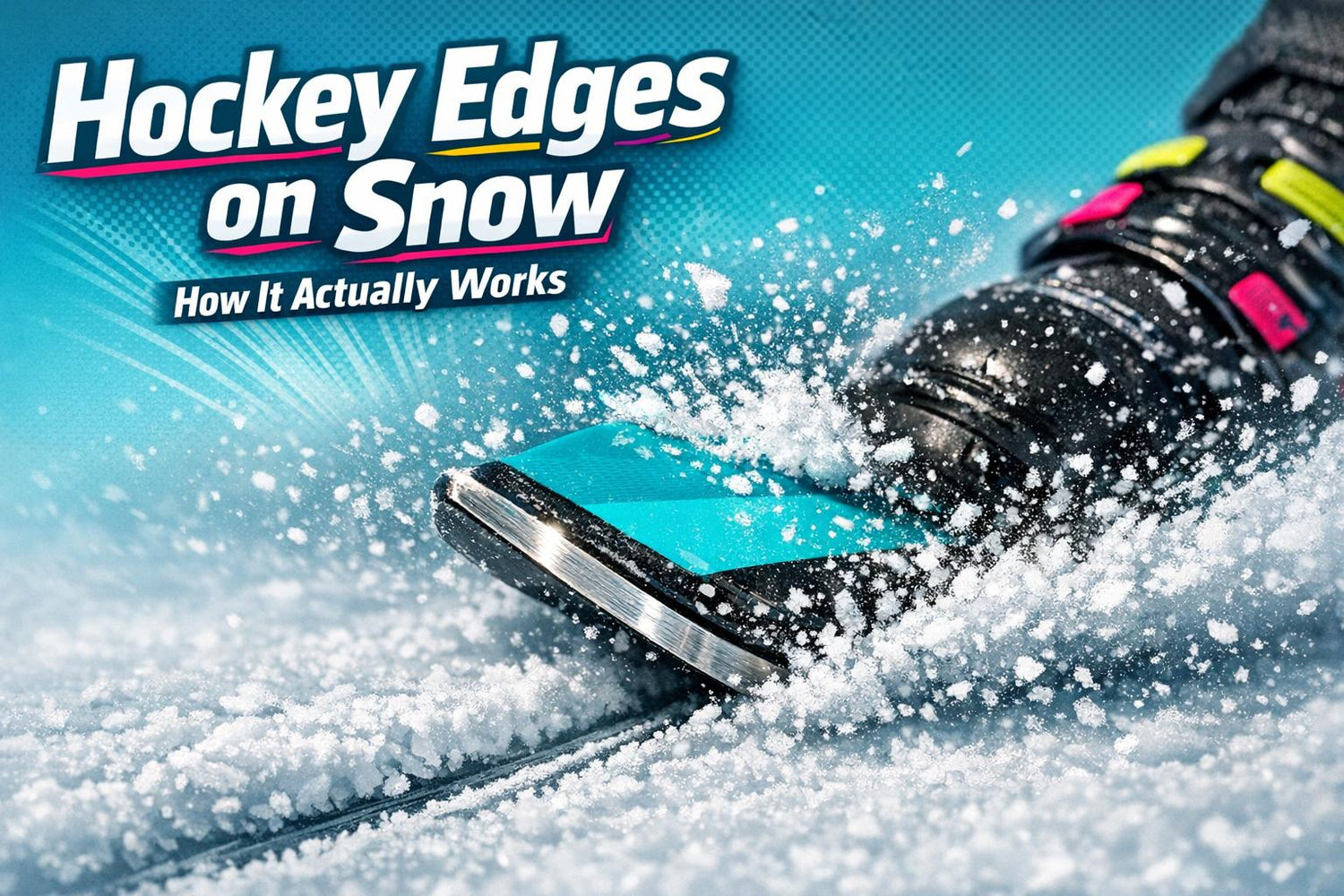
Hockey edges are the secret sauce behind quick turns, sharp stops, and smooth control in snow sports. These are the sharp parts of a skate or Snowfeet blade that dig into the snow or ice when you tilt your foot. By shifting your weight, you can grip the surface and make precise movements - perfect for carving, pivoting, or pulling off tricks.
Snowfeet products like Skiskates (44 cm) and Snowfeet PRO (50 cm) use these edges to deliver a skating-like experience on snow. They’re lightweight, compact, and attach to regular winter boots, making them easy to use and carry. The shorter length means faster turns and easier handling compared to skis or snowboards.
- Skiskates (44 cm): Great for beginners and tricks. Lightweight and quick to learn.
- Snowfeet PRO (50 cm): Better for advanced riders looking for speed and stability.
Snowfeet edges are designed for agility and control, whether you're on groomed runs, icy patches, or even your backyard. They’re a fun, portable alternative to bulky ski gear, offering a fresh way to enjoy winter sports.
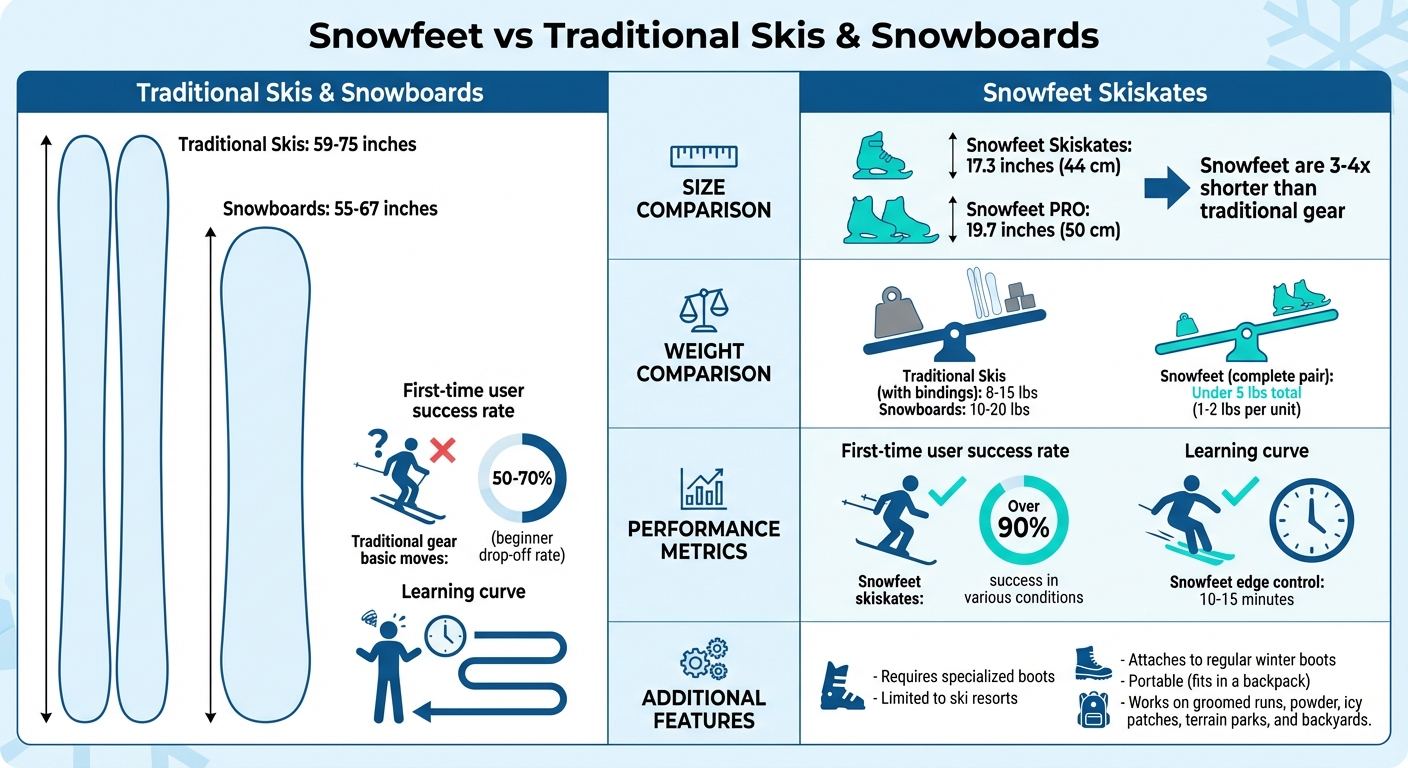
Snowfeet vs Traditional Skis and Snowboards: Size, Weight, and Performance Comparison
How Hockey Edges Work: The Mechanics Explained
The Shape and Angle of Hockey Edges
Hockey edges are designed with two edges - inside and outside - separated by a hollow groove. These edges come into play when you tilt the blade, allowing the metal to grip the snow or ice. This grip provides the traction needed for sharp turns or quick stops.
For skis, the magic happens when the angle to the slope exceeds 45 degrees. Increasing this angle, say from 40 to 60 degrees, enhances the ski’s flex and sharpens the turn. As Tom Gellie, Founder of Big Picture Skiing, puts it:
The hourglass shape allows you to bend the ski but only when it is really tipped over!
This same concept applies to Snowfeet*. Their compact size makes it easier to achieve these sharp angles without managing the length of traditional skis. This ability to control precise angles is the foundation for the traction and control discussed below.
How Hockey Edges Create Traction and Control
Proper edge engagement relies on evenly distributed pressure from toe to heel. Expert ski instructor Kevin Jordan explains:
I feel that I apply pressure evenly from the big toe to the heel. This makes the ski grip from tip to tail
This principle is key to Snowfeet* designs, allowing for sharp stops and quick turns. To achieve this, your lower legs need to tip quickly, enabling the edges to dig into the surface.
Hip angulation - how your upper and lower body align - is another important factor. Shifting your weight to the downhill edge increases its grip, especially on steep slopes. At high speeds, aggressive edging can even create a visible spray of snow, demonstrating the friction needed for rapid stopping. With Snowfeet*, the smaller surface area focuses this pressure, delivering the same grip with less effort.
What Makes Snowfeet* Edges Different

Snowfeet* take these mechanics and tailor them for precision and agility. Their shorter lengths - 44 cm (about 17 inches) for Skiskates and 50 cm (around 20 inches) for the PRO - make it easier to tip them to sharp angles quickly. This design allows for rapid edge engagement with minimal effort, responding smoothly to subtle weight shifts.
The wood core in the Skiskates adds natural flexibility, complementing the edges for tight carving on groomed runs or staying steady on tough conditions like icy, refrozen snow. This balance of flex and edge control makes Snowfeet* a versatile tool for both high-speed descents and freestyle tricks. As Coach Jeremy, a hockey instructor, points out:
You need to trust your edges and let them grip into the ice while you make sharp turns
With Snowfeet*, that trust is easier to build. Their compact design provides excellent feedback and control, making them a great choice whether you’re a beginner or a pro pushing your limits in the terrain park.
Snowfeet* vs. Traditional Skis and Snowboards
Smaller Size and Lighter Weight
Traditional skis usually measure between 59–75 inches, while snowboards are around 55–67 inches long. Compare that to Snowfeet* Skiskates, which are just 17.3 inches (44 cm) for the standard model and 19.7 inches (50 cm) for the PRO version. That’s 3–4 times shorter than the usual gear, making them incredibly easy to carry around.
Now, let’s talk weight. A pair of traditional skis with bindings comes in at 8–15 lbs, and snowboards can weigh anywhere from 10–20 lbs. Snowfeet*, on the other hand, weigh just 1–2 lbs per unit, with a complete pair staying under 5 lbs total. This lightweight design is thanks to composite materials optimized for their short, hockey-style edges rather than the long gliding surfaces of conventional skis or boards. The result? You can carry them effortlessly - whether you’re strolling through the city or hiking into the backcountry - without the shoulder ache that usually comes with traditional gear.
Another bonus? Snowfeet* attach directly to regular winter boots or snowboard boots, so there’s no need for extra-specialized equipment. Their portability and lightweight build also bring performance advantages, especially in varied snow conditions.
Performance Across Different Snow Conditions
Traditional skis shine on groomed slopes but can struggle in tight, uneven areas where their size becomes a disadvantage. Snowfeet*, however, thrive in a wide range of environments, including groomed runs, powder, icy patches, terrain parks, and even your snowy backyard. Their sharp hockey-style edges grip the snow similarly to ice skates, giving you the ability to adapt quickly to changing conditions without being weighed down by long equipment.
Here’s a fun stat: first-time users of Snowfeet* report a success rate of over 90% in various snow conditions. Compare that to the 50–70% beginner drop-off rate for traditional skis and snowboards, where the length and complexity of the gear can be intimidating. Whether you’re carving down a resort slope or just messing around in your backyard after a fresh snowfall, Snowfeet* handle terrain that might leave traditional gear struggling.
Speed, Control, and Learning Curve Comparison
Snowfeet* aren’t just versatile - they’re also beginner-friendly. Most people, especially those with hockey experience, can get the hang of them in just a few hours. Using familiar drills like one-legged glides and C-cuts, you’ll feel comfortable on Snowfeet* much faster than on traditional skis or snowboards, which often take weeks to master basic moves like parallel turns. Even Skiing Magazine editors have noted that hockey stops work well on Snowfeet*, as long as you focus on edge pressure for steering.
Drills such as garland turns or figure-8s transfer seamlessly from ice skating to Snowfeet*, and edge control can often be mastered in as little as 10–15 minutes. Thanks to their shorter length, turns are quicker and require less effort compared to managing the swing weight of full-length skis. While traditional equipment may hit higher top speeds on open groomers, Snowfeet* excel in tight spaces, offering better control for quick stops, rapid direction changes, and freestyle tricks that would be nearly impossible with longer gear.
Hockey Player Tries Snowfeet* Skiskates | See What He Thinks | Skiboards | Short Ski | Mini Ski
sbb-itb-17ade95
Which Snowfeet* Product Is Right for You
Picking the right Snowfeet* model comes down to your skill level and what kind of performance you’re after. Both models use hockey-style edges for precise control, but each is designed with specific riders in mind.
Snowfeet Skiskates (44 cm): Perfect for Beginners and Tricks
If you're just starting out or love doing tricks, the 44 cm Skiskates (17.3 inches) are a great choice. They’re super lightweight and responsive, making it easier to learn edge control quickly. Skaters will feel right at home since many skating drills translate seamlessly to these skates. For example, the garland drill - where you alternate between flat skis for speed and angled edges to slow down - helps most beginners get the hang of edge control in just 10–15 minutes.
Their lighter build makes spins, sharp turns, and playful moves a breeze. Whether you’re hitting terrain parks or practicing moves like outside edge figure 8s in your backyard, this model offers the agility and simplicity you need. But if you’re ready to tackle higher speeds and more advanced riding, take a look at the next option.
Snowfeet PRO (50 cm): Built for Advanced Riders
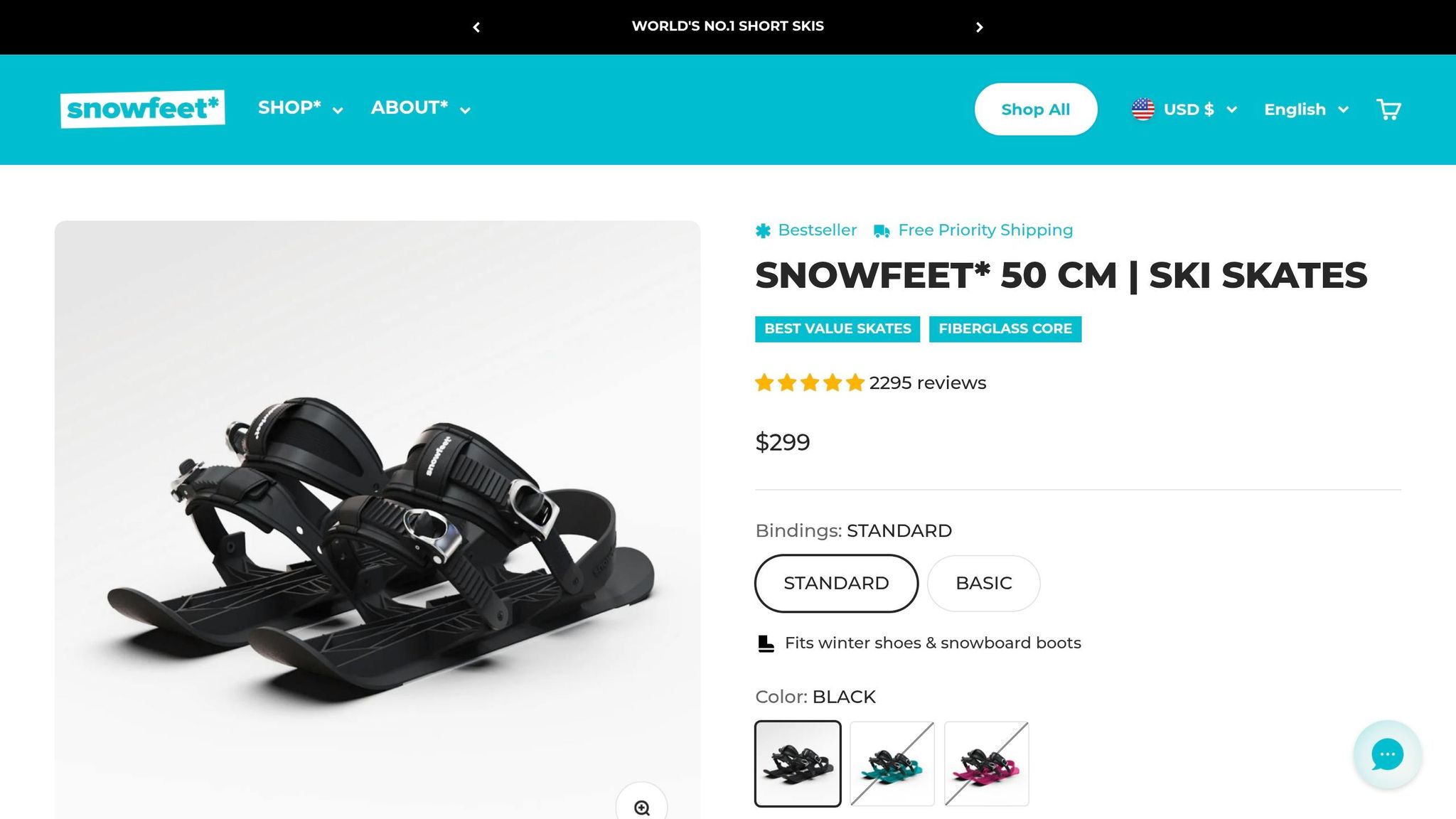
For those who’ve mastered the basics, the Snowfeet PRO (19.7 inches) delivers more stability and speed. With a longer platform, higher tip and tail, and an elevated base, this model is designed for advanced tricks and carving at higher speeds. It’s ideal for riders who are confident in deep knee bends and precise weight shifts.
The PRO fits shoe sizes 6–13 US (38–47 EU), so double-check your boot size before buying. If your feet are smaller, the Snowfeet MINI - which accommodates sizes 27–38 EU (US kids size 10 to adult size 6) - might be a better fit. Advanced riders will love how this model handles different snow conditions while maintaining the sharp edge control that Snowfeet* is known for. Plus, the extra length provides a stable base for quick direction changes without losing agility.
Comparing Snowfeet* Models
Here’s a quick breakdown of the key differences between the two models:
| Feature | Snowfeet Skiskates (44 cm) | Snowfeet PRO (50 cm) |
|---|---|---|
| Length | 17.3 inches (44 cm) | 19.7 inches (50 cm) |
| Best For | Beginners, tricks, terrain parks | Advanced riders, higher speeds, varied conditions |
| Design | Standard platform | Higher tip/tail, narrowed base, increased height |
| Weight | Lighter for quick maneuvers | Slightly heavier for stability |
| Shoe Fit | General winter boots | 6–13 US (38–47 EU) |
| Learning Curve | Edge control in 10–15 minutes | Requires mastery of fundamentals first |
If you’re new to snow sports or focused on agility for tricks, the 44 cm Skiskates are your best bet. On the other hand, if you’re an experienced rider looking for more stability and speed, the PRO model will help you take your skills to the next level.
Conclusion: Why Snowfeet* Changes Winter Sports
Key Points About Hockey Edges on Snow
Hockey edges bring sharp, angled contact points that give you immediate control over both speed and direction. With a compact design - measuring less than 20 inches - they deliver a skating-like feel that makes winter sports more approachable and fun. Coach Jeremy from How To Hockey highlights how hockey’s speed, power, and agility are mirrored in edge control. Editors at Skiing Magazine add that practicing edge drills, like garlands, helps riders fine-tune their technique quickly, making it enjoyable for beginners and pros alike.
What makes Snowfeet* stand out is how these hockey edges are fine-tuned for lightweight, responsive movement. Whether you’re gliding down groomed slopes, tackling terrain parks, hiking snowy trails, or just playing in your backyard, the design ensures precise control. From mastering the basics on the 44 cm Skiskates to pulling off advanced tricks with the 50 cm PRO, the intuitive feel of the hockey edge design makes every move seamless and natural.
How Snowfeet* Is Changing Winter Sports
Snowfeet* take the concept of edge control and turn it into a game-changer for winter sports. Traditional skis rely on length, but Snowfeet* prove that shorter can be better. Unlike conventional gear, which often limits you to ski resorts and requires bulky, specialized equipment, Snowfeet* are portable, work with standard winter boots, and fit right into a backpack.
This shift isn’t just about improving your ride - it’s about redefining your winter experience. Forget being stuck with pricey lift tickets or crowded slopes. With Snowfeet*, you can explore trails, parks, or even the hill in your neighborhood. They’re not just offering a product - they’re creating a movement, turning skiskating into a fresh way to enjoy the snow. By focusing on freedom and fun, Snowfeet* transform winter adventures into something dynamic, accessible, and completely your own.
FAQs
Do hockey-style edges work in powder?
Hockey-style edges, like those found in Snowfeet products, shine on firm snow or packed trails. They’re perfect for delivering precise control, sharp turns, and pulling off tricks. That said, they struggle a bit in deep powder, where the edges lose their grip and become harder to maneuver. While Snowfeet can handle a mix of snow conditions, they’re at their best on firmer surfaces, offering better control than traditional skis or snowboards in those settings.
What boots can I use with Snowfeet*?
Snowfeet Skiskates and Snowfeet PRO are made to pair with most standard winter boots, as long as they provide solid ankle support and a snug fit. For the best experience and safety, pick boots that work well with Snowfeet's bindings and offer good grip and stability. Unlike traditional ski or snowboard boots, Snowfeet gear can also be used with regular winter footwear, making them more convenient and versatile.
How do I sharpen and maintain Snowfeet* edges?
To keep your Snowfeet* edges in top shape, make it a habit to sharpen them regularly. You can use a ski edge sharpener or a file for this. How often? That depends on how much you ride - every few uses or whenever you notice the grip starting to fade. For frequent riders, sharpening weekly or at least once a season should do the trick.
Be careful not to overdo it, though. Remove no more than two-tenths of a millimeter during each session to avoid causing damage. Once you're done, clean off any metal filings and inspect the edges for any dull spots that might need extra attention. Properly maintained edges mean better control and precision, letting you make the most of Snowfeet's hockey-style edges for those sharp turns and cool tricks.











Leave a comment
This site is protected by hCaptcha and the hCaptcha Privacy Policy and Terms of Service apply.