



















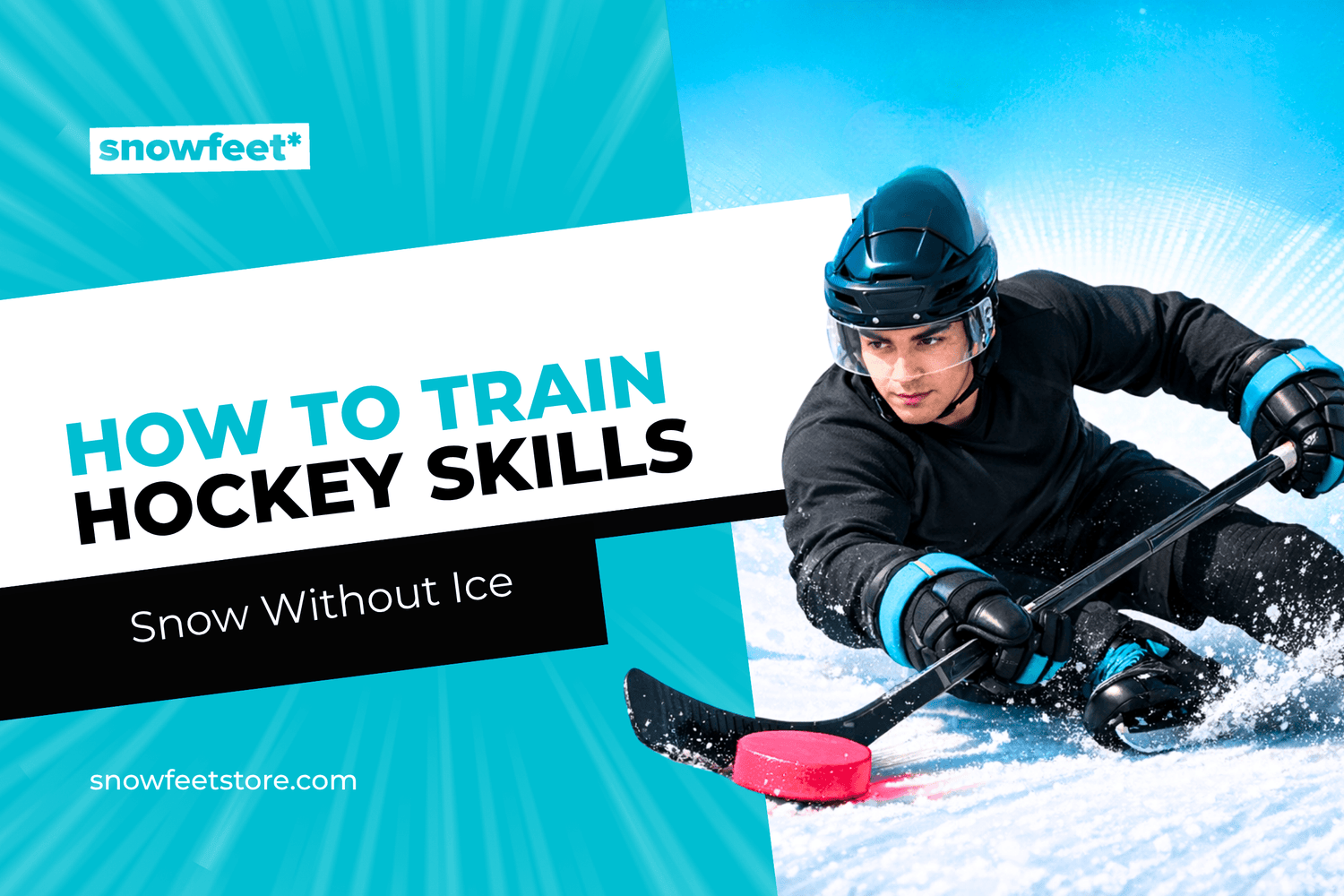
When ice time is hard to come by, you can still train your hockey skills on snow. Snowfeet* products, like Skiskates and Snowfeet PRO, let you practice skating motions on snow-covered surfaces using your regular winter boots. They’re compact, easy to carry, and designed to mimic key hockey movements like gliding, quick cuts, and edge control. This means you can work on balance, agility, and stickhandling without needing a rink.
Here’s the gist:
- Skiskates (44 cm / 17.3 in): Best for beginners working on balance and basic drills. $575.
- Snowfeet PRO (50 cm / 19.7 in): Perfect for advanced players honing edge control and agility. $275.
- Use in your backyard, parks, or snowy fields - anywhere with packed snow.
Drills like figure-eights, lateral cuts, and uphill sprints help you build game-ready skills. Just pick safe terrain, gear up, and keep your Snowfeet in good shape. Snow training doesn’t just keep you sharp - it’s also fun and flexible.
How to do The Hockey Stop on Skis (WITH BONUS TIP!)
sbb-itb-17ade95
Why Snowfeet* Works for Hockey Training on Snow
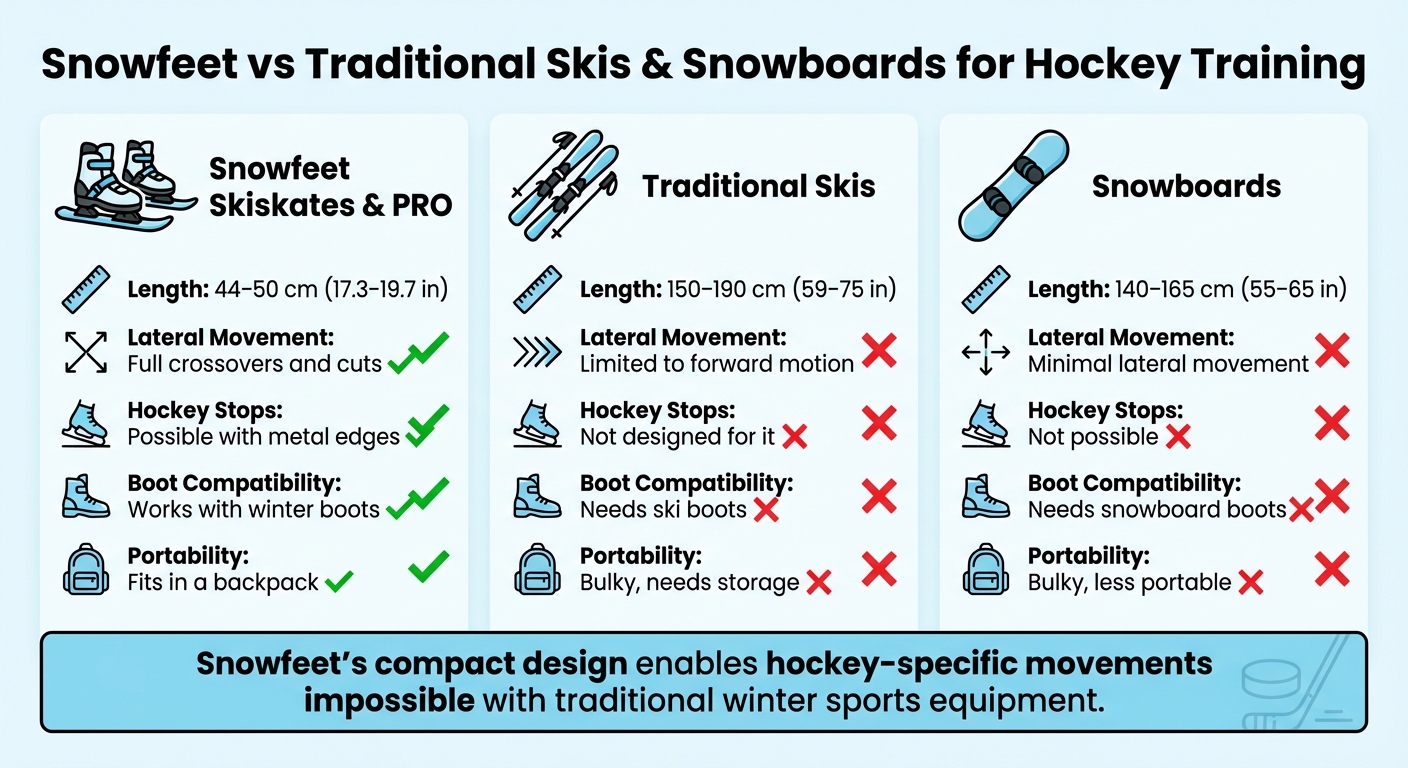
Snowfeet vs Traditional Skis and Snowboards for Hockey Training Comparison
Snowfeet* is designed to mimic the lateral and crossover movements of hockey skating, making it a great tool for on-snow training that aligns with ice performance.
The compact base, measuring 44–50 cm, allows for crossovers and side-to-side cuts that are nearly impossible with longer skis. This size lets you make those quick directional changes that are essential in hockey skating. Traditional skis just can’t match this level of agility.
The high-quality metal edges help you grip packed snow, making sharp turns and hockey stops possible. While it doesn’t feel exactly like skating on ice, the edge control is similar enough to build muscle memory and balance.
Another big plus? Snowfeet* attaches directly to regular winter boots and is small enough to fit in a backpack. That means you can hit a snowy hill or park for a quick training session whenever you want - no hassle, no bulky gear.
Snowfeet* vs Traditional Skis and Snowboards
To understand why Snowfeet* is better for hockey training, let’s compare it to traditional skis and snowboards. Hockey training requires agility, quick direction changes, and lateral movement - things traditional skis and snowboards aren’t built for.
| Feature | Snowfeet* Skiskates & PRO | Traditional Skis | Snowboards |
|---|---|---|---|
| Length | 44–50 cm (17.3–19.7 in) | 150–190 cm (59–75 in) | 140–165 cm (55–65 in) |
| Lateral Movement | Full crossovers and cuts | Limited to forward motion | Minimal lateral movement |
| Hockey Stops | Possible with metal edges | Not designed for it | Not possible |
| Boot Compatibility | Works with winter boots | Needs ski boots | Needs snowboard boots |
| Portability | Fits in a backpack | Bulky, needs storage | Bulky, less portable |
The portability of Snowfeet* is a game-changer. You can toss them in a backpack, keep them in your car, and squeeze in a training session before or after work. Try doing that with traditional skis!
Snowfeet* Product Options for Hockey Training
Snowfeet* offers two options tailored for hockey training, each designed with different skill levels and goals in mind.
- Snowfeet Skiskates (44 cm / 17.3 in): Starting at $575, these feature a wood core construction for stability and maneuverability. They’re perfect for beginners or players focusing on basic skating drills and balance. The shorter length makes it easier to adapt your skating stride on snow.
- Snowfeet PRO (50 cm / 19.7 in): Priced at $275, this model includes adjustable bindings and enhanced edge control. The extra 6 cm offers more surface area for stability at higher speeds, while still providing the agility needed for hockey-specific movements. Advanced players will love the responsiveness for fine-tuning edge work and quick transitions.
With these options, Snowfeet* makes it easy to bring your hockey training to the snow.
Hockey Drills You Can Do on Snow with Snowfeet*
Snowfeet* offer a fun way to work on hockey skills off the ice. These drills mimic real hockey movements and help develop the muscle memory needed for game situations.
Basic Skating Drills for Beginners
Start with the figure-eight drill. This exercise helps with balance, hip rotation, and smooth transitions. Place two markers about 15 feet apart (roughly 5 yards). Skate to one marker, pivot around it, and head back in a continuous figure-eight pattern.
For puck handling practice, set up cones or markers 5 feet apart in a straight line. Weave through them using both your forehand and backhand while keeping control of the puck. Once you’ve nailed these basics, you can move on to more complex drills that challenge agility and stickhandling.
Intermediate Agility and Stickhandling Drills
Step up your game with drills like the Snowman drill. Circle one marker, sprint to the next, and transition quickly from forward to backward skating while maintaining control.
Lateral figure-eights are another great option. These help sharpen your ability to maneuver in tight spaces and mirror an opponent’s movements. Snowfeet* are perfect for these drills, offering the precision needed to practice sharp cuts and stickhandling at the same time.
Once you’ve built up your agility and control, you’re ready to tackle advanced drills designed for slopes and speed.
Advanced Drills: Uphill and Downhill Techniques
For uphill explosive starts, lean forward and take small, rapid steps to simulate on-ice acceleration. This drill is great for building leg power and quick bursts of speed.
Downhill lane changes are all about control at higher speeds. Set up markers to create lanes on a gentle slope. Practice quick lateral movements between lanes while keeping precise edge control. This drill mimics the rapid directional changes you face in a game.
Finally, try hockey suicide sprints. Sprint to a marker, return quickly to the start, then push to a farther marker. This drill focuses on multi-directional movement, replicating the constant changes in direction during competitive play. Thanks to Snowfeet*’s lightweight design, you can set up these drills anywhere there’s snow - something that skis and snowboards just can’t offer.
“Whether it’s quicker first steps, getting lighter and more agile on your skates, or improving your change of direction, hockey players need to be continuously working on improving their footwork.”
Tips for Better Training with Snowfeet*
Make the most of your Snowfeet* sessions with smart terrain choices, proper technique, and regular care. These tips will help you maximize the agility and precision that Snowfeet* bring to your off-ice training.
Choosing the Right Terrain for Training
Picking the right surface can make a big difference in your practice.
- Flat, well-packed snow is ideal for building balance and refining skating strides. Open fields, groomed areas, or packed snow in your backyard work great. Aim for snow that’s 6 to 12 inches deep - enough to provide stability without slowing you down. If the snow is too loose, pack it down with skis to create a smoother surface for your drills.
- Gentle slopes can add a fun challenge, helping you work on control and agility without overwhelming speed. These slopes are perfect for practicing weight shifts and edge control - skills that are crucial in real game scenarios. Just steer clear of steep or icy areas to avoid accidents.
- Your backyard can double as a training ground. Use packed snow for stickhandling drills, like weaving through cones, to sharpen puck control and improve weight distribution. These exercises are great for transitioning smoothly during hockey play.
Once you’ve got the right surface, it’s time to focus on staying safe and keeping your gear in top shape.
Safety and Maintenance Tips
Staying safe and taking care of your Snowfeet* go hand in hand with effective training.
- Always gear up. Wear a helmet, knee pads, elbow pads, and gloves to protect yourself. Hard-packed snow can be harsher than ice, so padding is a must to prevent injuries during falls. Layer up with waterproof clothing to stay warm and dry, and try to train when it’s above 20°F for comfort and safety.
- Stick to proper form. Keep your knees bent, shift your weight correctly, and use a 45-degree push-off to get the most power and control during your movements.
- Take care of your gear. After each session, clean the bindings and edges, tighten screws weekly, and apply wax to the bases. Store your Snowfeet* in a dry spot to keep them in great condition. This upkeep ensures they’ll continue to glide smoothly and feel as close to ice as possible.
Conclusion
Snowfeet* changes the game for off-ice hockey training. With Snowfeet*, any snowy surface becomes your personal training ground. Whether you're honing your balance, agility, or stickhandling, tools like the Snowfeet Skiskates (44 cm / 17.3 in) and Snowfeet PRO (50 cm / 19.7 in) let you replicate essential skating movements without needing an ice rink. Say goodbye to costly rink fees and tricky scheduling - just grab your gear and head to your backyard, a nearby field, or any packed snow area.
What makes Snowfeet* stand out is how closely it mimics the glide and stride of ice skating, all while giving you the freedom to train wherever you want. Unlike skis or snowboards, which can limit stickhandling, Snowfeet* keeps you low to the ground, allowing for precise puck control and quick directional changes. Experts estimate that effective off-ice training can improve balance and explosiveness by 20-30%. Snowfeet* helps you target those areas, turning practice into real progress.
On top of the technical benefits, Snowfeet* makes training fun. It transforms routine drills into an adventure. You can explore different terrains, push yourself with uphill sprints, or practice controlled descents. This variety keeps you motivated and engaged in ways that traditional gym workouts just can't compete with.
FAQs
Do I need a slope to train, or can I practice on flat snow?
You don’t need a hill to practice - flat snow works perfectly fine. Exercises like one-foot glides and figure eights are great on level terrain, helping you sharpen your edge control, balance, and push-off technique. Snowfeet* gear is built to replicate skating motions, making it a great option for hockey training on snowy ground.
What boots and protective gear should I wear with Snowfeet*?
When using Snowfeet*, make sure to wear sturdy, insulated boots that provide solid ankle support and good grip - similar to what you'd use for skiing or snowboarding. Safety is key, so don't skip the protective gear. A helmet, gloves, and knee and elbow pads are must-haves. These not only help prevent injuries but also improve your performance during training. Snowfeet* involves skating-like movements and agility drills, so being properly equipped makes all the difference.
How close does Snowfeet* training feel to real hockey skating on ice?
Snowfeet* training is designed to closely resemble the movements of hockey skating on ice. It emphasizes key skills like edge control, balance, and push-off techniques. While it doesn’t entirely replicate the speed or glide of ice skating, it’s a great way to work on fundamentals such as single-leg balance and maintaining a low stance. Snowfeet* products are crafted to simulate hockey-style movements, providing a compact and practical option when you don’t have access to ice.











Leave a comment
This site is protected by hCaptcha and the hCaptcha Privacy Policy and Terms of Service apply.