



















Winter doesn’t have to slow you down. Off-ice training is the perfect way to sharpen your hockey skills, build strength, and stay game-ready - all without needing rink time. Here’s the deal:
- Why it matters: Ice time is limited, especially in winter. Off-ice drills help maintain and boost your skills, like speed, agility, and core stability.
- How to train: Focus on exercises that mirror on-ice movements, like lateral jumps and stickhandling drills. Tools like Snowfeet Mini Ski Skates let you simulate skating mechanics in the snow.
- Prevent injuries: Correct muscle imbalances caused by hockey’s repetitive motions with targeted strength and mobility exercises.
- Make it fun: Snow-based training is more engaging than gym routines and helps you enjoy the process while improving.
Bottom line: Off-ice training is a must if you want to stay ahead. Whether it’s snow sprints or balance drills, the right exercises can give you the edge when the season starts.
Keep reading for tips, drills, and a 7-day training plan to maximize your winter workouts.
7 "MUST DO" HOCKEY EXERCISES 🏒
Why Hockey Players Need Off-Ice Training
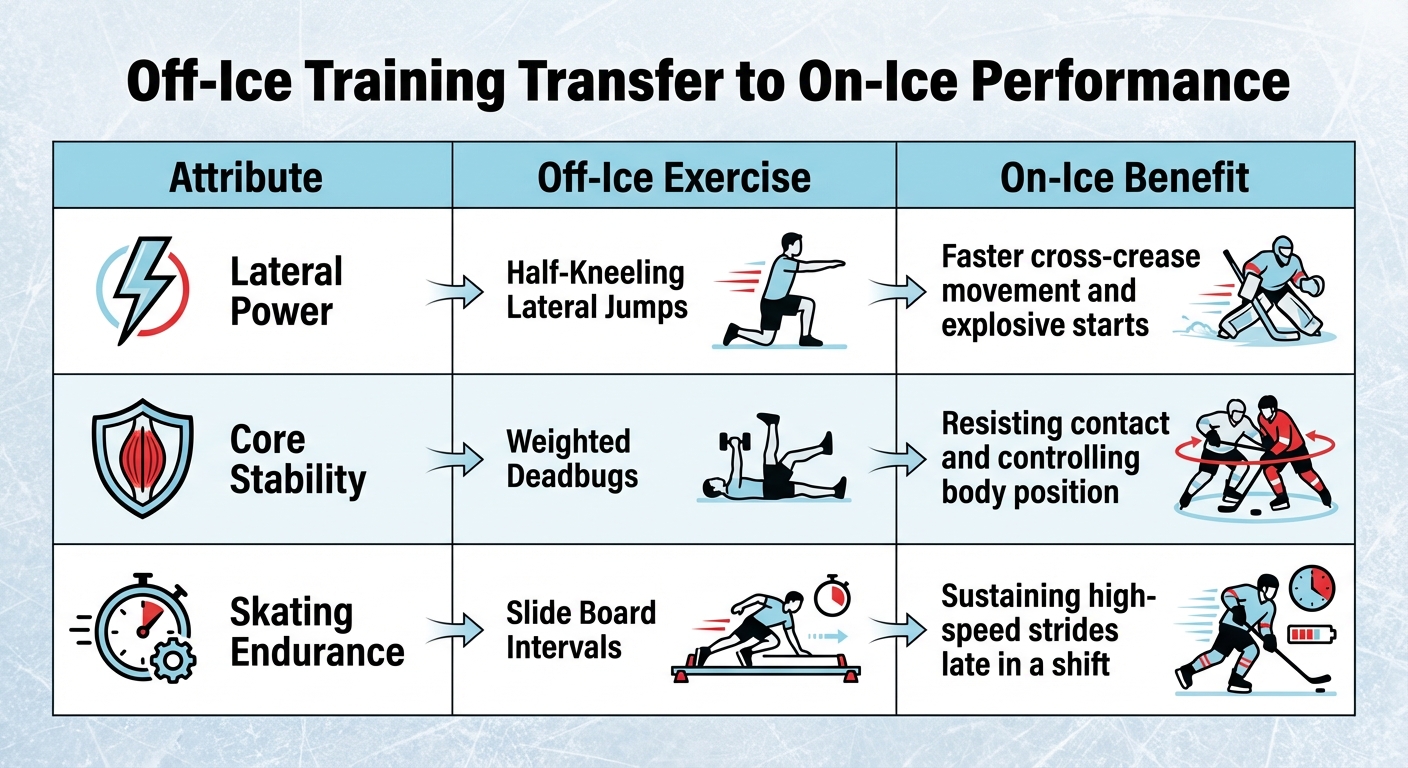
Off-Ice Training Benefits: How Exercises Transfer to On-Ice Hockey Performance
Off-ice training is a game-changer for hockey players. It builds power, speed, stamina, and agility, all of which directly impact performance on the ice. Plus, it targets areas that regular practice often overlooks, like core stability and explosive strength. These improvements show up in faster skating, harder shots, and better puck control. Here’s how off-ice training makes a difference.
Keeping Your Skills Sharp in the Off-Season
When ice time is limited, muscle memory can fade fast. That’s where off-ice stickhandling drills come in. They keep your hands quick and your touch precise, even when you’re not skating.
The secret? Consistency. Just 15 minutes a day of focused stickhandling or edge work simulation can do wonders. These drills help maintain the neural pathways you’ve developed during the season, ensuring your skills stay sharp. And it’s not just about preserving ability - these off-ice routines directly enhance your game-day performance.
Building Skills That Transfer to the Ice
The most effective off-ice training mirrors on-ice movements. Exercises like single-leg jumps, reverse lunges, and lateral jumps build the explosive power needed for quick direction changes. Core-focused exercises, such as deadbugs, help stabilize your trunk during physical contact.
Imagine battling for position in front of the net. Off-ice training can prepare you for that. For instance, the Pallof Press strengthens your core to resist rotation - exactly what you need when an opponent tries to push you off the puck.
| Attribute | Off-Ice Exercise | On-Ice Benefit |
|---|---|---|
| Lateral Power | Half-Kneeling Lateral Jumps | Faster cross-crease movement and explosive starts |
| Core Stability | Weighted Deadbugs | Resisting contact and controlling body position |
| Skating Endurance | Slide Board Intervals | Sustaining high-speed strides late in a shift |
Preventing Common Hockey Injuries
Hockey’s repetitive movements can lead to muscle imbalances. Over time, your feet turn out, your knees cave in, and your shoulders roll forward from constantly holding a stick. These imbalances increase the risk of groin, hip, and shoulder injuries. Off-ice training helps correct these issues before they become major problems.
Strength and conditioning coach Michael Yaremko highlights the importance of this work:
"Avoiding non-contact injuries with corrective exercise can help keep your hockey team on the ice and in the game".
Corrective exercises follow a four-step process: foam rolling, stretching, activating weak muscles, and integrating full-body movements. For example, if your knees turn out during skating, you’d focus on stretching your piriformis and TFL while strengthening your adductors and glutes. This targeted approach ensures your body stays balanced and ready for action all season long. Snowfeet* tools can also help by simulating precise skating mechanics, further reducing injury risks.
Snow-Based Training vs Gym Workouts
Gym workouts are great for building general strength and endurance, but they fall short when it comes to mimicking the specific movements hockey requires. Hockey isn’t about straightforward motions like running or cycling; it’s about lateral power, sharp turns, and edge control. These unique demands call for training methods that go beyond what the gym can offer - methods that replicate the on-ice experience more closely.
Replicating Skating Movements in Snow
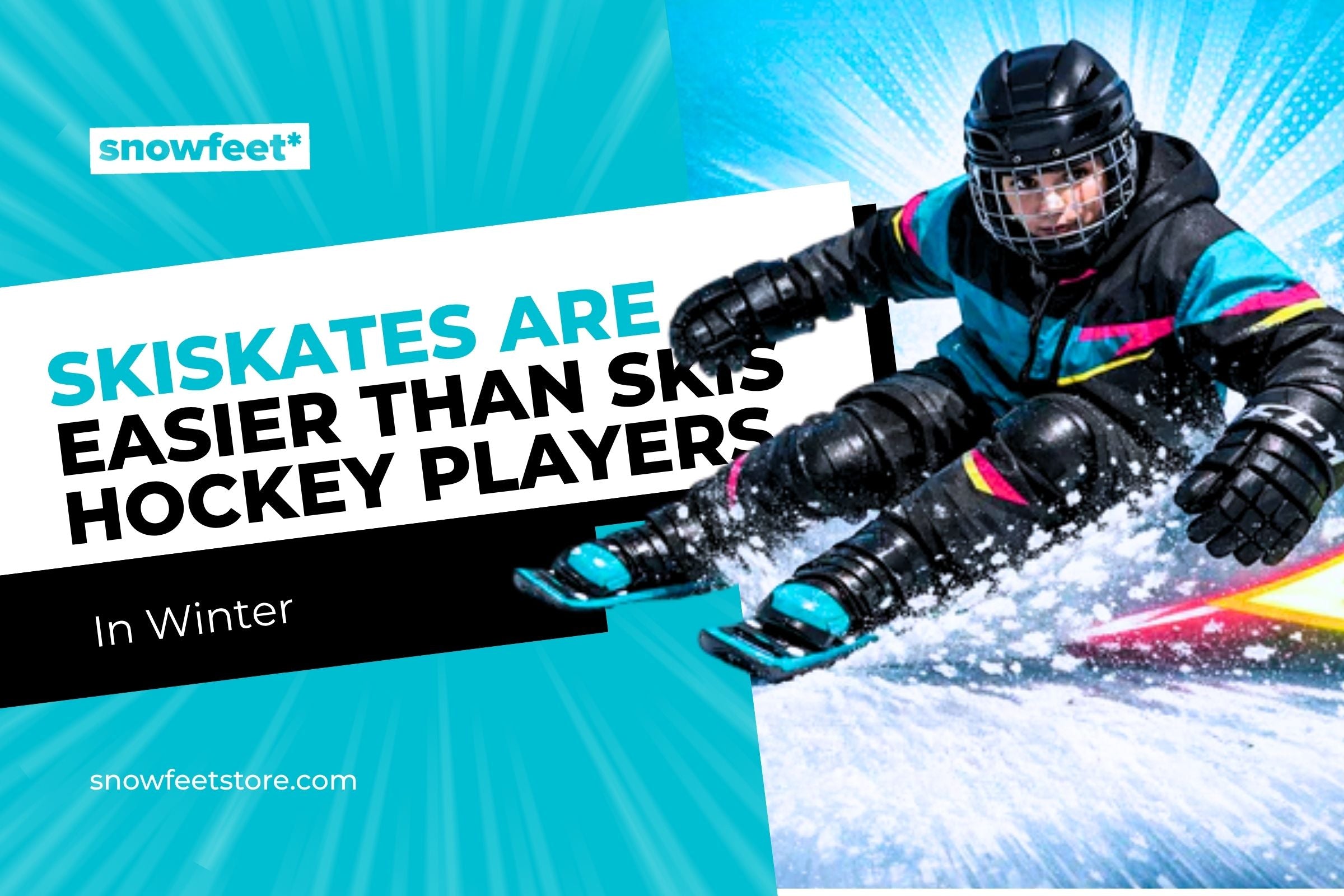
Snow-based tools like Snowfeet* Mini Ski Skates and Skiskates make it possible to practice the sliding mechanics and quick turns that are essential for hockey. These tools engage stabilizer muscles and help develop real-time edge control, something gym equipment just can’t do. It’s no wonder many professional teams are now working with figure skating experts to refine their edge techniques. Tools like Snowfeet* bring the precision and movement of skating to your training, offering benefits that traditional workouts simply can’t match.
Making Training More Enjoyable
Let’s face it: gym routines can get dull fast. For hockey players, some of the best training memories come from off-ice sessions that were fun and competitive. One pro shared:
"Most of our off-ice training in the summer was in the driveway, having fun and trying to beat each other in any game we came up with. Target shooting, stick handling, shooting for posts."
When training feels like play, it’s easier to push yourself without even realizing it. Snow-based training with Snowfeet* turns practice into an adventure. Whether you’re carving down a slope, practicing quick stops, or navigating tricky terrain, you’re improving your hockey skills while actually enjoying the process. That kind of enthusiasm naturally leads to better, more consistent results on the ice.
Training in Real Winter Conditions
Snow-based training also comes with the added benefit of working in real winter conditions. Exercising in the cold helps reduce swelling and inflammation, acting as a natural recovery tool after intense sessions. Plus, dealing with uneven snow and shifting terrain builds balance and mental grit - qualities that are crucial during the high-pressure moments of a game. Snowfeet* products are portable, so you can train wherever there’s snow, whether it’s a backyard or a local slope.
Snowfeet*: The Best Off-Ice Training Gear for Hockey Players
Snowfeet* gear takes off-ice hockey training to the next level by focusing on movements that directly translate to on-ice performance. Unlike traditional skis or snowboards, which are all about long, smooth turns, Snowfeet* products are designed to mimic the quick, sharp, and multi-directional movements that hockey skating demands.
The key difference is in the movement. Traditional skis, which are typically 150–180 cm long, force you into wide, sweeping arcs. Snowfeet* gear, on the other hand, ranges from 38–120 cm, allowing for tight, explosive turns that mirror the agility and edge control you use during a game. This kind of training not only strengthens your legs but also sharpens the muscle memory, balance, and edge techniques that are critical for hockey.
Here’s a closer look at how each Snowfeet* model can help improve your training.
Snowfeet* Mini Ski Skates: Improve Agility and Edge Control
The Snowfeet* Mini Ski Skates (38 cm, starting at $250) are perfect for refining your agility and edge work. Their compact size allows you to practice rapid direction changes, quick stops, and precise edge techniques - just like you would on the ice. Because they’re so short, they let your feet move independently, engaging the stabilizing muscles in your ankles and knees. And since they’re portable, you can train anywhere there’s snow, making them a great option when ice time is limited.
Snowfeet* PRO and Skiskates: Train for Power and Speed
If you’re looking to build explosive power and speed, the Snowfeet* PRO (50 cm, $275) and Skiskates (44 cm, starting at $575) are excellent options. These models are slightly longer, providing more stability for practicing powerful strides and developing the mechanics needed for high-speed skating. The Skiskates, in particular, feature a wood core construction for extra responsiveness and durability, helping you strengthen key muscle groups like your hip flexors, quads, and glutes. They’re a solid choice for players aiming to develop game-changing power when ice time is hard to come by.
Snowfeet* Skiblades: Build Balance and Core Strength
Snowfeet* Skiblades, available in 65 cm and 99 cm options (starting from $635), strike a balance between carving ability and maneuverability. Every turn and edge adjustment challenges your core to stabilize your body, much like when you’re fighting for position on the ice. The 99 cm version even comes in a POWDER model for deeper snow, giving you the flexibility to train on various terrains while staying connected to hockey-specific movements. These skiblades let you turn winter conditions into an opportunity to sharpen your balance and agility, giving you an edge when it’s time to hit the ice.
sbb-itb-17ade95
Hockey-Specific Winter Drills Using Snowfeet*
Take your Snowfeet* training to the next level by structuring your sessions like an on-ice practice. Start with 5–10 minutes of warm-up, including light cardio and dynamic stretching. Follow that with 10 minutes of mobility and stability exercises, then dedicate 25–30 minutes to main drills, and wrap up with a 5-minute cool-down. Doing this 2–3 times a week for 12 weeks or more can make a noticeable difference in your hockey skills. These drills are designed to mimic on-ice movements and sharpen your performance.
Agility and Speed Drills
Quick direction changes are a game-changer for hockey players, and these agility drills help you master them. Using Snowfeet* Mini Ski Skates (38 cm), set up cones 5–10 feet apart and practice quick taps - rapid side-to-side movements for 20–30 seconds, followed by a rest. Perform 4–6 sets to simulate the tight turns and crossovers you need on the ice. To build power for puck battles, try lateral jumps with Snowfeet* PRO. Do 3 sets of 10 reps per side, focusing on fast foot contact to develop explosive strength.
Strength and Stability Exercises
Hockey demands a strong, stable foundation, and training on snow adds an extra challenge. With Snowfeet* PRO, try reverse lunges with lateral load. Step back into a lunge, focusing on your glutes and adductors, and hold the bottom position for 3 seconds. Complete 3 sets of 10 reps per leg to replicate the strength needed for crease pushes. For core stability, try a tall kneeling Pallof press. Resist rotational forces while pressing outward in a braced position on your Snowfeet*. Do 3 sets of 12 reps per side to build the control essential for high-speed play.
Endurance and Conditioning Workouts
Hockey shifts are all about short bursts of effort followed by recovery, and these workouts help you build the stamina to thrive late in games. Use Snowfeet* Skiblades for HIIT snow sprints: alternate 20 seconds of all-out strides with 40 seconds of recovery glides for 8–10 rounds. This mirrors the stop-and-go intensity of a hockey shift and boosts your cardiovascular fitness. For longer sessions, try fartlek endurance flows - a mix of fast skating bursts and steady sliding over 20–30 minutes. USA Hockey’s dryland training guidelines suggest 30-minute sessions 2–3 times a week to build the stamina that translates to real game situations.
Snowfeet* vs Traditional Skis and Snowboards for Hockey Training
Choosing the right gear can make a huge difference in winter hockey training. While traditional skis and snowboards are designed for downhill adventures and need specific snow conditions, Snowfeet* products are built for the fast, sharp movements hockey players rely on. This difference impacts how often you can train, where you can practice, and how quickly those skills translate to the ice.
Easy to Carry and Store
Snowfeet* are incredibly compact and lightweight, weighing just 2–3 lbs and measuring 12–18 inches. They easily fit into a standard backpack, unlike traditional skis or snowboards, which require bulky storage solutions. In fact, Snowfeet* can be stashed in less than 1 cubic foot of space - a game-changer for urban players. Compare that to the 10–15 cubic feet often needed for traditional gear, and it’s clear why Snowfeet* are a more practical option for hockey players on the go.
Use Them Anywhere
Snowfeet* aren't picky about where you use them. They work on any modest snow cover, whether it’s a backyard, a local park, or a small slope. Traditional skis and snowboards, on the other hand, demand perfect conditions and a trip to the mountains. This versatility means you can squeeze in training sessions whenever winter weather hits, no matter where you are. Plus, their straightforward design makes it easier to focus on improving your skills.
Quick to Learn and Easy to Use
One of the best things about Snowfeet* is how simple they are to pick up. Their compact size (12–18 inches) allows for fast edge transitions and better balance, mimicking the tight turns and stops hockey players need. Traditional skis and snowboards, built for carving downhill, don’t offer the independent leg movement hockey training requires. Snowfeet*'s shorter blades make it easy to dive into balance drills right away, which is especially helpful for younger players (U12–U14). In contrast, the steep learning curve of traditional gear often leads to frustration, with dropout rates for beginners reaching up to 50% during initial lessons.
7-Day Off-Ice Training Plan with Snowfeet*
Weekly Training Schedule
This 7-day plan is designed to boost agility, power, balance, and endurance. Each day focuses on a specific aspect of hockey fitness, keeping your workouts varied and effective.
- Day 1: Agility drills like lateral crossovers and shuttle runs using Snowfeet* Mini Ski Skates. These exercises sharpen foot speed and edge control - key skills for game-day moves.
- Day 2: Power-building exercises, including explosive uphill sprints and jumps with Snowfeet* PRO. These help develop the leg strength needed for quick starts.
- Day 3: Balance training with single-leg glides and core rotations. These moves improve stability, especially when protecting the puck.
- Day 4: Active recovery with light trail skating and stretching to maintain flexibility and mobility.
- Day 5: Stickhandling drills combined with movement exercises, such as weaving through cones. This enhances hand-eye coordination while skating.
- Day 6: Endurance training with a 30-minute interval skate using Snowfeet* Skiskates. This builds stamina for long shifts on the ice.
- Day 7: Progress testing with timed drills to assess speed and control improvements.
At the end of the week, review your performance to identify areas for adjustment and improvement.
Tracking Your Progress
Measuring your progress is crucial to ensuring your training is effective. Start by setting baselines during your first week. Record metrics like your 20-meter sprint time, single-leg balance duration, agility weave time, and stickhandling accuracy. Retest these every four weeks to track changes.
For example, after four weeks, you might aim for:
- Cutting 0.5 seconds off your 20-meter sprint.
- Adding 15 seconds to your single-leg balance.
- Reducing your agility weave time by 1 second.
- Eliminating stickhandling errors.
If your numbers plateau, tweak your routine. For slower sprint times, focus more on explosive power drills (Days 2 and 6). If balance needs work, spend extra time on single-leg exercises (Day 3). The secret to improvement? Consistency. Skipping sessions will hinder progress, while sticking to the plan will deliver noticeable results.
Sample Progress Tracking Table
Here’s a simple way to track and evaluate your performance:
| Metric | Week 1 Baseline | Week 4 Goal | Actual Result |
|---|---|---|---|
| 20m Snow Sprint (sec) | -0.5 seconds | ||
| Single-Leg Balance (sec) | +15 seconds | ||
| Agility Weave Time (sec) | -1.0 seconds | ||
| Stickhandling Errors | Zero drops |
Keep updating the table each week to stay on top of your progress and refine your training as needed.
Conclusion
Winter doesn’t have to slow you down. With Snowfeet* off-ice training, you can stay at the top of your hockey game - even when the rink isn’t an option.
One major plus? Portability and ease. Unlike traditional skis, Snowfeet* Mini Ski Skates are compact enough to fit in a backpack. Whether it’s your neighborhood hill, your backyard, or any snowy spot, you can train without the hassle or added expenses.
For hockey players, the transition is a breeze. Your skating instincts kick in right away with Snowfeet*, so there’s no steep learning curve like with skiing or snowboarding. In just minutes, you’re honing skills like edge control, balance, and agility - key abilities that directly improve your on-ice performance.
The 7-day training plan is designed to build power, speed, and endurance. By tracking your progress, you’ll notice real gains: sharper crossovers, better stability, and overall conditioning that puts you ahead of those stuck in the gym all winter.
Snowfeet* turns winter into an opportunity. Starting at $250, they’re affordable, simple to use, and tailored for hockey-specific training. While others wait for ice time, you’ll be gaining the edge that makes all the difference on game day.
FAQs
Do I need Snowfeet* to do off-ice hockey training in winter?
No, you don’t need Snowfeet* for off-ice hockey training. Tried-and-true methods like plyometrics, balance work, and agility drills already do a solid job. That said, Snowfeet* products can bring something extra to the table. They mimic on-ice movements, helping to boost agility, balance, and strength. Plus, they’re portable and specifically designed with hockey players in mind. If you’re stuck without ice time during the winter, they can be a handy addition to your training routine.
Which Snowfeet* model is best for my position and skill level?
The best Snowfeet* model really comes down to what you’re looking for. The 50cm model is a solid pick for versatile off-ice winter training. It works well for all skill levels and offers great control and agility. If agility is your main focus, the 44cm Skiskates might be a better fit. On the other hand, the 65cm and 99cm Skiblades are ideal if you’re after more stability and speed. Designed with hockey players in mind, Snowfeet products are a fantastic alternative to traditional skis or snowboards.
What safety gear and terrain should I use for Snowfeet* training?
When training with Snowfeet, make sure to gear up with protective equipment like helmets, wrist guards, knee pads, and elbow pads - especially if you're a beginner. Stick to flat or gently sloped, snow-covered areas to practice safely and mimic the feeling of gliding on ice. Steer clear of rocky, icy, or uneven spots to avoid falls or damaging your gear. For the best experience, pick well-maintained, groomed snow surfaces to keep things smooth and safe.











Leave a comment
This site is protected by hCaptcha and the hCaptcha Privacy Policy and Terms of Service apply.