




















Skiskating with Snowfeet* might just be the off-ice training solution hockey players have been searching for. Unlike skiing, which focuses on smooth, sweeping movements, skiskating mimics the quick stops, sharp turns, and agility required on the ice. With compact, 17.3-inch skiskates, players can practice hockey-specific skills almost anywhere - no rink required. They’re also portable, easy to learn, and much less of a hassle compared to long skis.
Here’s why skiskating works better for hockey players:
- Agility Training: Skiskating replicates hockey movements like quick cuts and hockey stops, improving on-ice performance.
- Convenience: Skiskates are small enough to fit in a backpack and work on various snow terrains.
- Affordability: Starting at $275, they’re a budget-friendly alternative to skiing gear.
- Fast Learning Curve: Experienced skaters can get the hang of them in just 5 minutes.
Whether you’re looking to stay sharp in the off-season or spice up your winter workouts, Snowfeet* Skiskates are a smart choice for hockey players.
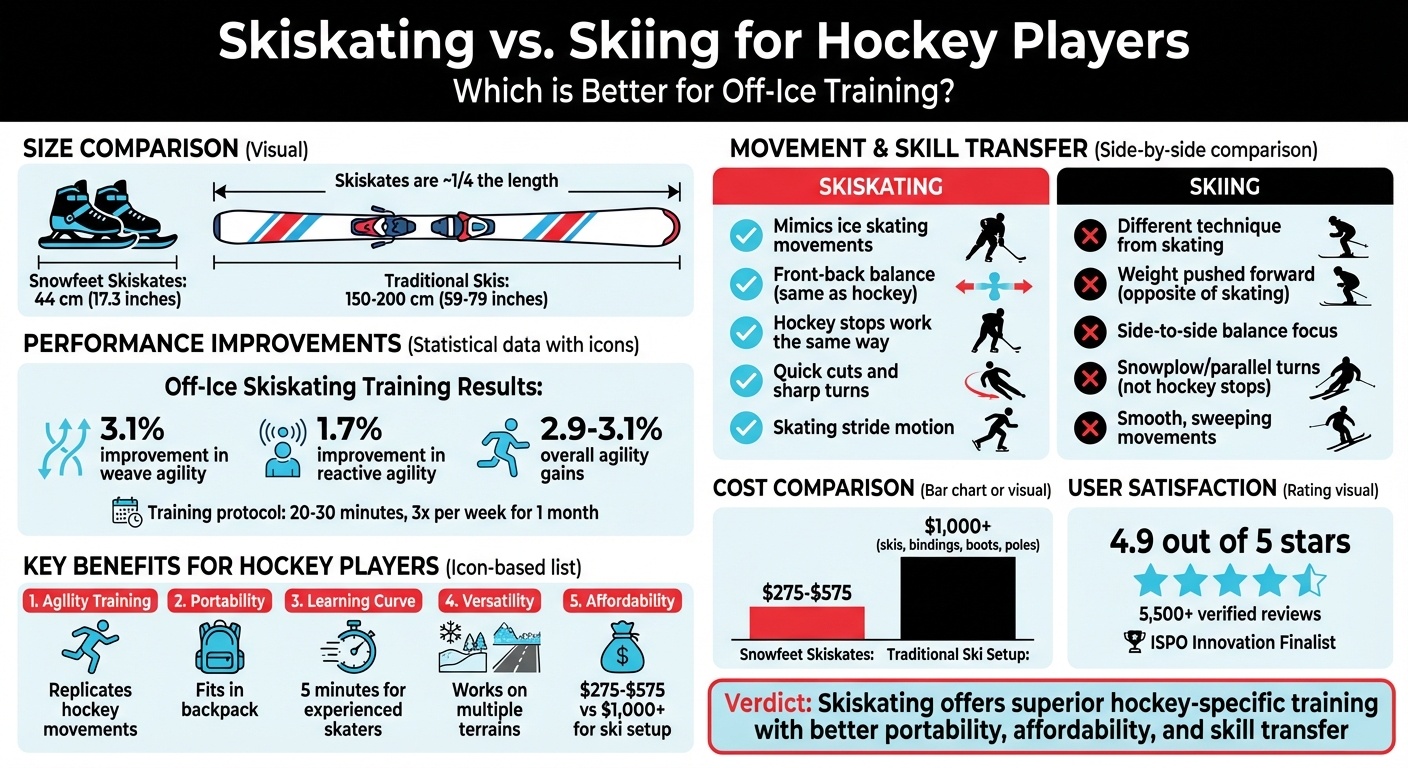
Skiskating vs Skiing for Hockey Players: Key Differences and Benefits Comparison
Movement and Skill Transfer: Skiskating vs. Skiing
How Skiskating Mimics Ice Skating
The link between skiskating and ice hockey is clear as day. Snowfeet* explains it best:
"The best way to start your ride is to skate like a hockey player."
And they’re not wrong. The 44 cm (17.3-inch) skiskates demand the same front-back balance that hockey players rely on when they hit the ice. Picture this: your weight centered over the middle or back of your feet, legs shoulder-width apart, and knees slightly bent. Sound familiar? That’s the exact stance hockey players use during a game.
Even the hockey stop - a move every skater knows - works the same way on skiskates. By evenly spreading your weight across both feet, you can slow down or come to a clean stop. Starting off? You’ll use a skating stride, just like on ice, instead of the parallel sliding motion you’d use with traditional skis.
Ingrid, a Snowfeet* user, sums up the experience perfectly:
"I love them. They are very easy to handle and control especially if you have experience on roller skates or ice skates."
While skiskating feels like a natural extension of ice skating, traditional skiing takes a very different approach.
Why Skiing Falls Short for Hockey Training
Here’s the thing: skiing doesn’t quite cut it when it comes to building hockey skills. Unlike the seamless transition skiskating offers, skiing relies on techniques that don’t translate well to on-ice agility. Long skis push your weight forward, which is the opposite of the front-back balance critical for skating. Plus, skiing’s side-to-side balance doesn’t prepare you for the dynamic, front-back control that skating demands.
Take stopping, for example. Skiing uses snowplow or parallel turns - methods that don’t mimic the quick, controlled stops hockey players need. Long skis also force you to adopt different weight distribution and rotational mechanics, which can hinder the explosive, sharp movements hockey requires. Instead of practicing bursts of speed and quick stops, you’re carving smooth, sweeping turns.
Benefits of Snowfeet* Skiskates for Hockey Players
Snowfeet* Skiskates bring some serious perks to hockey players looking to sharpen their skills off the ice.
Better Agility and Balance
Measuring just 44 cm (17.3 inches) in length, Snowfeet* Skiskates are a fraction of the size of regular skis, which typically range between 150 cm (59 inches) and 200 cm (79 inches). This compact size makes them perfect for replicating the sharp turns and quick cuts that hockey players rely on during games.
Thanks to their lightweight design, these skiskates make it easy to pull off rapid spins, jumps, and quick directional changes. Studies even suggest that off-ice agility training that mimics skating movements can improve weave agility in young hockey players by about 2.9% to 3.1%. As Snowfeet* aptly describes:
"Skiskates... combine the motion of ice skating with the thrill of gliding on snow - all without the hassle of long skis."
Easy to Carry and Store
Say goodbye to roof racks and oversized ski bags. Snowfeet* Skiskates are small enough to fit in your backpack, making them super convenient for hockey players who already lug around heavy gear. Whether you're heading to a nearby hill or trekking to a snowy trail, their portability makes them a breeze to bring along.
Works on Different Terrains
Snowfeet* Skiskates aren’t picky about where you use them. They handle downhill slopes, terrain parks, and even backyard trails with ease. This versatility allows hockey players to work on skating mechanics on almost any snowy surface. Plus, when ice time is hard to come by or gets expensive, skiskates let you keep practicing hockey-specific movements without needing a rink.
The "sliding with push-off" motion you use with skiskates directly translates to better performance on the ice - something traditional off-ice training, like running, just can’t replicate.
These benefits set the stage for a closer look at how Snowfeet* Skiskates stack up against traditional long skis and snowboards.
sbb-itb-17ade95
Snowfeet* Skiskates vs. Long Skis and Snowboards
When it comes to off-ice hockey training, Snowfeet* Skiskates bring something to the table that long skis and snowboards just can’t match.
Shorter Length, Better Control
Measuring only 44 cm (17.3 inches), Snowfeet* Skiskates are a fraction of the size of traditional skis, which typically range from 150 cm (59 inches) to 200 cm (79 inches). This compact size makes them perfect for quick spins, sharp turns, and fast direction changes - moves that come naturally to hockey players. As the Snowfeet Team explains:
Short skis are easier to carve and to turn than long skis, since you don't need to put too much pressure on your knees to actually tilt the skis on their edge
. This design not only boosts precision but also makes skiskates super approachable for just about anyone.
A Breeze for Beginners
Thanks to their intuitive control, most people can get the hang of Snowfeet* Skiskates in as little as 5 minutes. The movements feel more like ice skating than traditional skiing, so hockey players can rely on their muscle memory with almost no learning curve. One happy user, Andrew B., summed it up perfectly:
These skiblades are so much fun and easy to control. Never going back to regular skis
. Compare that to traditional skis, which often require pricey lessons and hours of practice just to feel comfortable. Snowfeet* Skiskates work with your skills, not against them.
Affordable and Convenient
Priced between $340 and $380, Snowfeet* Skiskates are a much lighter hit to your wallet than a traditional ski setup, which can easily exceed $1,000 when you factor in skis, bindings, boots, and poles. Plus, they’re insanely portable - no need for a roof rack or bulky ski bag. These skiskates fit neatly into a backpack. As Uncrate puts it:
Far more portable and affordable than traditional skis or snowboards
. With over 5,500 verified reviews and an average rating of 4.9 out of 5 stars, it’s clear that hockey players are loving how these skiskates align with their needs. They’re not just a fun way to hit the snow - they’re a tool that helps take hockey performance to the next level.
Conclusion: Why Skiskating Works Better for Hockey Players
Main Points to Remember
Skiskating isn’t just a fun alternative - it’s a game-changer for hockey players aiming to sharpen their on-ice performance. Unlike traditional skiing, skiskating mirrors the exact movements used in ice skating. This means you can practice hockey stops, quick turns, and reactive moves in a way that directly translates to the rink. Studies back this up, showing a 3.1% improvement in weave agility and 1.7% in reactive agility after off-ice skiskating sessions. Research led by Dominik Novák and Petr Stastny at Charles University found that players who trained for 20–30 minutes, three times a week for a month, saw measurable gains. According to the Journal of Sports Science and Medicine:
"There is evidence that off-ice agility have motor transfer to on-ice agility. Therefore, we recommend developing on-ice agility with additional off-ice agility training during the ice hockey season."
Beyond the performance perks, skiskating is incredibly convenient. You can train almost anywhere - local sledding hills, hiking trails, or even your backyard - without splurging on resort passes. Plus, with recognition as an ISPO innovation finalist and high user satisfaction, skiskates have proven their worth both for recreational fun and serious hockey training.
Try Snowfeet* Skiskates
If you’re looking to up your hockey game, Snowfeet* Skiskates might just be your secret weapon. These skiskates, measuring 44 cm (17.3 inches), come with metal ski edges and adjustable bindings that fit shoe sizes 6–13 US (38–47 EU). They offer unmatched control and responsiveness, making traditional skis feel bulky and outdated.
For regular training, the Snowfeet* PRO is available for $275. If you’re ready to go all-in, the professional Skiskates (44 CM) start at $575, offering advanced features for serious performance. Every session with Snowfeet* helps fine-tune your skating mechanics, giving you a direct edge when you hit the ice. Why settle for less when you can train smarter and skate better?
FAQs
Why are skiskates better than traditional skis for improving hockey players' agility?
Skiskates are a fantastic tool for hockey players aiming to sharpen their agility. Unlike regular skis, Snowfeet Skiskates are crafted to mimic the movement of ice skating. This skating-like motion is perfect for building balance, improving body control, and mastering quick directional changes - essential skills for anyone on the ice.
Traditional skiing, with its different stance and movement patterns, doesn’t translate as smoothly to hockey performance. But Snowfeet Skiskates are different. Their compact design focuses on skating motions, helping players develop better muscle memory and coordination. Plus, they’re lightweight and portable, so you can train almost anywhere. It’s a fun, effective way to boost agility and fine-tune hockey-specific skills.
Is skiskating a good off-ice training option for hockey players?
Skiskating is a fantastic off-ice training method for hockey players because it closely mirrors the movements of ice skating. With Snowfeet Skiskates, players can work on their agility, balance, and overall skating technique, even when they're away from the rink. These compact skates are specifically designed to fine-tune hockey skills, making them a handy and efficient training tool.
Now, while skiskating isn’t a full substitute for on-ice practice, it’s a super portable and flexible way to stay sharp during the off-season or when ice time is hard to come by. Plus, Snowfeet Skiskates have a big edge over traditional skis or snowboards - they’re lightweight, easy to use, and perfect for athletes who want to keep improving all year long.
Why are Snowfeet skiskates a better option for hockey players compared to traditional skiing gear?
Snowfeet skiskates are a fantastic option for hockey players, combining lightweight design, portability, and simplicity. Unlike traditional ski gear, which can be bulky and a hassle to transport, these skiskates are small enough to fit in a backpack. That means you can take them almost anywhere without the usual storage or travel headaches.
They’re also much easier on the wallet compared to a full ski setup - no need for pricey skis, boots, or bindings. What’s more, their design closely mimics ice skating movements, making them a great off-ice training tool. Whether you're looking to sharpen your agility, improve balance, or work on hockey-specific skills, Snowfeet skiskates let you train effectively without breaking the bank or dealing with cumbersome equipment.













Leave a comment
This site is protected by hCaptcha and the hCaptcha Privacy Policy and Terms of Service apply.