



















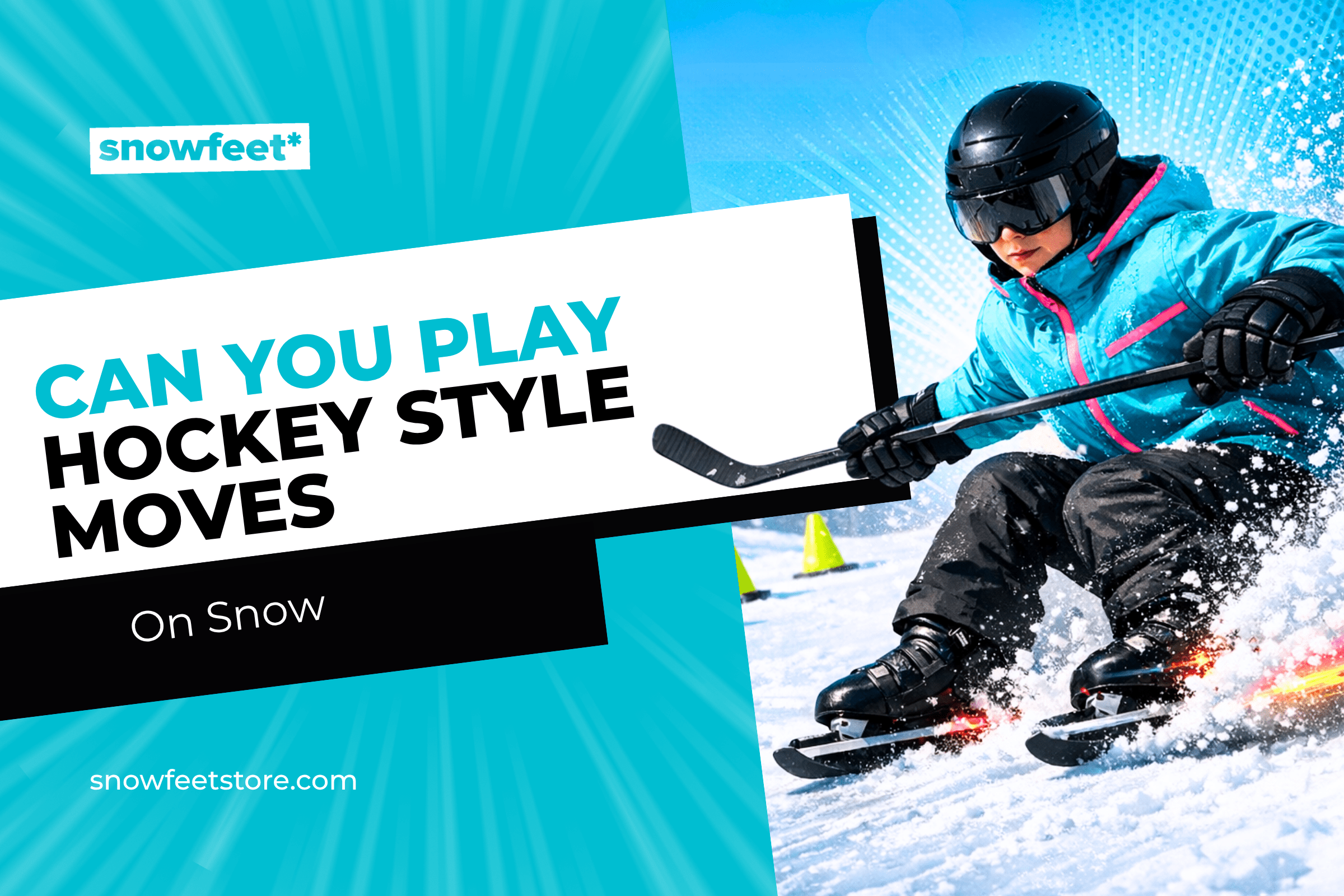
Hockey stops and sharp turns on skiskates? Totally doable - and way easier than you’d think. Snowfeet* Skiskates (44 cm) are compact, lightweight, and designed for precision. Here’s the deal: they’re like ice skates for the slopes, letting you stop, pivot, and change direction with ease. No clunky gear, no steep learning curve - just pure control.
Key Takeaways:
- Why Skiskates Rock: At 17 inches long, they’re much shorter than skis or snowboards, making them super agile for quick stops and tight turns.
- Gear You’ll Need: Regular winter boots, a helmet, wrist guards, and waterproof clothes. Keep it simple.
- Hockey Stop Basics: Shift your weight, engage the edges, and rotate your hips for clean stops. Start slow and practice both sides.
- Sharp Turns: Drop your inside shoulder, shift weight to the outside foot, and press your knee inward for tight, controlled turns.
Skiskates are portable (they fit in a backpack!), easy to learn, and work on slopes, trails, or even your backyard. Whether you’re a beginner or just looking for a fun twist on skiing, these are a game-changer for hockey-style moves. Let’s dive into the details!
How to do The Hockey Stop on Skis (WITH BONUS TIP!)
Body Position and Balance Basics
Getting your body position right is the secret to nailing smooth hockey stops and sharp turns. With Snowfeet* Skiskates, this is a bit easier than with traditional skis. Why? Their shorter length gives you better control, making it feel more natural. Once you’ve got this stance down, you’re set up for precise movements on the slopes.
How to Use the Hockey Stance
The hockey stance is your foundation when using skiskates. Here’s how to get it right:
- Keep your feet shoulder-width apart for stability.
- Bend your knees and ankles - make sure your knees are lined up over your toes.
- Center your weight over the middle to back of your feet. Avoid putting all your weight on your heels or toes.
- Keep your shoulders level and aligned with your hips, facing the direction you’re heading.
Snowfeet* demand precise weight distribution. Unlike traditional skis, which give you more front-end support and allow for some forward leaning, skiskates require a perfectly centered stance. This forces your ankles to stay engaged, making even small movements activate the edges instantly. That’s what gives Snowfeet* their quick, hockey-style precision - something you won’t get with regular skis or snowboards.
Balance Mistakes to Avoid
To keep your stance solid, steer clear of these common mistakes:
- Leaning too far back: This makes it hard to engage the edges properly and can mess up your ability to stop or turn. Keep your weight centered.
- Leaning too far forward: Pitching forward throws off your balance and makes quick maneuvers tricky. Always check that your weight stays centered over your feet.
- Locking your knees: Straight legs can’t absorb changes in the snow surface, leaving you stiff and unable to react. Flex your knees and ankles - they’re your built-in shock absorbers for smooth stops and turns.
How to Perform the Hockey Stop
Snowfeet* Skiskates bring a new level of agility to stopping, thanks to their compact 44 cm design. These skiskates allow for quick lateral transitions and faster edge engagement compared to traditional skis. Their shorter length reduces resistance, making them incredibly responsive to your movements.
Hockey Stop Step-by-Step
Start on a gentle slope to practice. Begin in a solid hockey stance and pick a direction to stop - say, to your right. Rotate your hips and shoulders toward that direction while pushing both skiskates sideways. At the same time, shift your weight onto the downhill edge. Timing is key: the rotation and edge pressure need to happen together.
Use your knees to power the turn. As you rotate, push your knees in the direction of the stop, digging the inside edges into the snow. This will help the skiskates grip and slide sideways. Keep your upper body steady and facing forward while your lower body handles the movement. When you see that satisfying "spray" of snow, you'll know you're nailing the technique. With Snowfeet* Skiskates, you’ll need less edge angle than with traditional skis to achieve the same stopping power. Their compact design makes even small adjustments highly effective.
Practice stopping in both directions. While it’s natural to have a preferred side, being able to stop both ways gives you better control on the slopes. Once you’ve got the basics down, focus on troubleshooting common issues to sharpen your skills.
Fixing Common Problems
If you’re skidding out instead of coming to a clean stop, you might not be using enough edge angle. Push your knees further into the turn and keep your weight centered - don’t lean back on your heels. Snowfeet* Skiskates are designed to be forgiving, so you won’t need as steep an edge angle as you would with traditional skis.
Catching an edge and falling often happens when there’s too much rotation or leaning. Keep your movements smooth and controlled, and avoid over-rotating. Make sure your weight stays evenly distributed over both feet instead of putting it all on your downhill skiskate. The shorter 44 cm length of Snowfeet* Skiskates helps minimize the risk of catching an edge.
If you’re struggling to stop altogether, focus on angling your skiskates by pressing your knees inward to engage the edges. Start at slower speeds if needed - going too fast can make learning this maneuver trickier. As you gain confidence, you’ll find it easier to stop smoothly, even at higher speeds.
How to Make Sharp Turns Like a Hockey Player
Once you've nailed controlled stops, it's time to take on sharp turns. With Snowfeet* Skiskates, these turns feel completely different from what you'd experience on traditional skis. At just 44 cm long, Snowfeet* Skiskates are incredibly responsive. Unlike longer skis that require more effort to maintain edge contact, these let you pivot and change direction with ease. No wrestling with a stiff, lengthy platform here - just quick, precise movements.
Sharp Turn Techniques
The compact design of Snowfeet* makes sharp turns surprisingly simple. Start by dropping your inside shoulder and hip to guide your pivot. Shift your weight to the outside skiskate - this edge becomes your anchor. Press your inside knee inward to engage the edge firmly. Snowfeet* respond instantly to this kind of pressure, unlike traditional skis that need full-edge contact for grip. This means you can make quick, tight turns without breaking a sweat.
Stay low in a hockey stance to keep your turns tight. Picture carving a small circle rather than a wide arc. As you exit one turn, immediately shift your weight to the opposite side to flow seamlessly into the next. Practice linking these turns together for smooth, controlled movement. The more you practice, the more natural this will feel.
Practicing Turns on Different Surfaces
Start with groomed runs, practicing quick, linked S-turns. Once you're comfortable, move to harder-packed snow where edge control becomes more important. The short length of Snowfeet* Skiskates makes it easier to handle these surfaces compared to traditional skis, which demand steeper edge angles.
For extra practice, use flat or gentle terrain to work on your pivoting skills. Set up a mini slalom course with backpacks or markers spaced 10–15 feet apart. This will force you to make rapid direction changes and build muscle memory. When you're feeling confident, try tackling mixed snow conditions - like icy patches combined with softer snow. Snowfeet* Skiskates let you adapt quickly, which is much harder to do with longer, traditional skis.
sbb-itb-17ade95
Advanced Moves: Controlled Slides and Combining Stops with Turns
Once you’ve nailed sharp turns and hockey stops, it’s time to step it up by blending them together. Snowfeet* are perfect for this because their compact design makes quick transitions a breeze - something that’s harder to pull off with traditional skis.
How to Combine Stops and Turns
Now that you’ve got the basics down, it’s all about merging those stops and turns into one smooth flow. The trick? Controlling your momentum. As you finish a sharp turn, start prepping for a hockey stop by rotating your hips slightly. But instead of stopping completely, channel that energy into your next turn. It’s all about shifting your weight seamlessly from one edge to the other.
Picture this: after a sharp turn, you rotate your hips just enough to briefly scrub some speed with a hockey stop, then flow right into your next move. Snowfeet* make this kind of fluid motion easier because of their short, nimble design. Just keep in mind - on crowded slopes, give yourself extra room and avoid sudden stops that might catch others off guard.
How to Perform Controlled Slides
Want to add some flair to your technique? Controlled slides are where style meets functionality. Start in your hockey stance and initiate a hockey stop, but this time, use a shallower edge angle. This lets you slide sideways while keeping some forward momentum. Keep your upper body facing downhill while your lower body turns almost perpendicular to your direction of travel.
Here’s where Snowfeet* shine. Their short length makes them more forgiving than traditional skis, which require super precise edge control to avoid catching. With Snowfeet*, even small adjustments make a big difference. Start practicing on gentle slopes, and once you’re comfortable, pick up the pace. Stay centered with your knees bent - leaning too far back can throw you off balance. These slides show off how responsive Snowfeet* are, but remember to use caution, especially in busy areas. Safety first, always!
Why Snowfeet* Skiskates Beat Traditional Skis and Snowboards
Snowfeet Skiskates vs Traditional Skis and Snowboards Comparison
Once you’ve nailed those hockey-style moves, Snowfeet* Skiskates take things to a whole new level. Their design offers portability and control that traditional skis and snowboards just can’t compete with. Let’s break down why they make these techniques feel so effortless.
Snowfeet* Skiskates vs. Traditional Skis and Snowboards
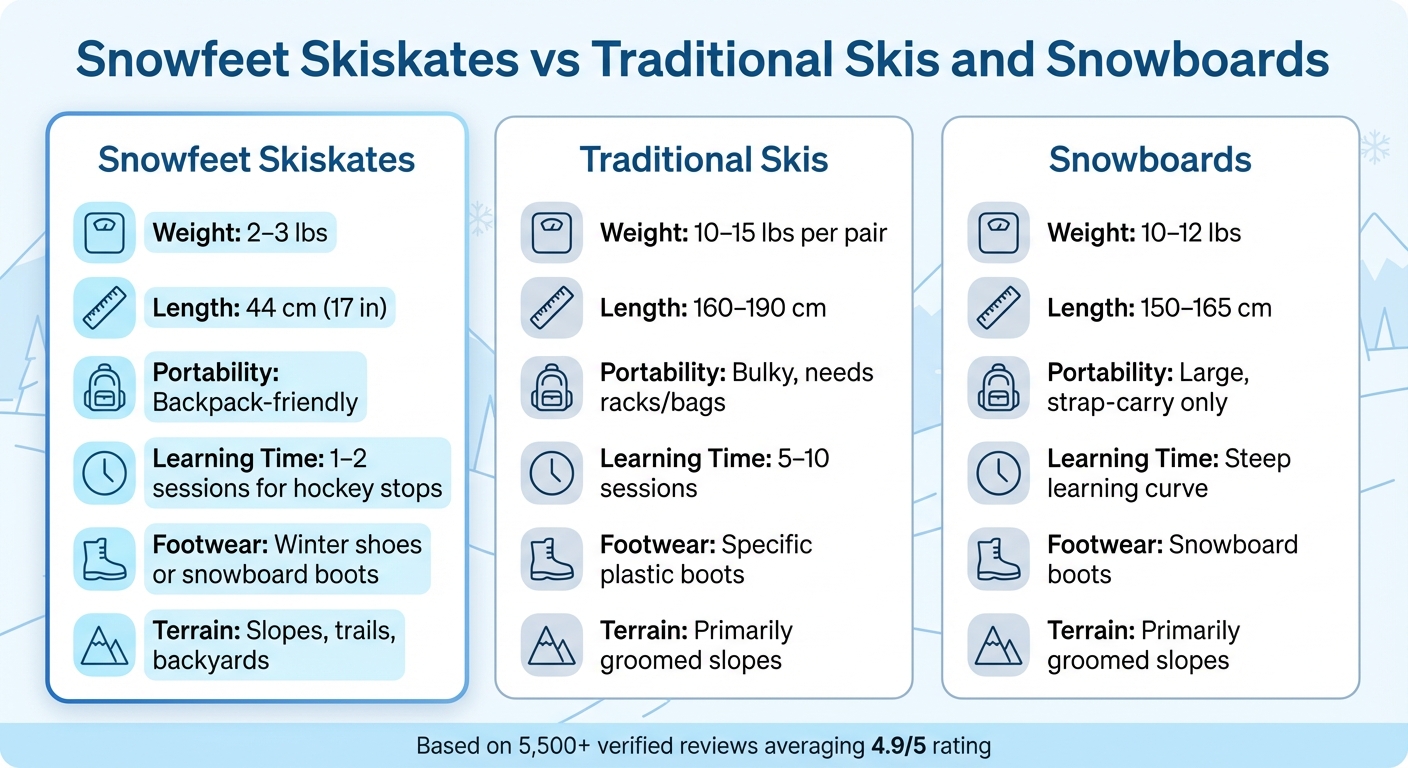
Portability is a game-changer. Weighing just 2–3 lbs and measuring 44 cm (17 in), Snowfeet* Skiskates easily fit into a backpack. Compare that to traditional skis, which are 160–190 cm long and weigh 10–15 lbs per pair - they need roof racks or oversized bags. Snowboards aren’t much better, coming in at 150–165 cm and 10–12 lbs, and they’re awkward to lug around. Skiskates are perfect for urban skaters who rely on public transit or just want something lightweight.
The learning curve is much shorter. Most users can master basic hockey stops on Skiskates in just 1–2 sessions. Traditional skis, on the other hand, often take 5–10 sessions to get the hang of. Their compact design and independent skate setup make balancing and edge control easier, skipping the need for wedge techniques (like with skis) or the tricky weight distribution involved with snowboards.
They’re versatile across all kinds of terrain. Forget the specialized plastic boots you need for skis - Skiskates work with your regular winter shoes or snowboard boots. This opens up a world of possibilities: hiking trails, cross-country paths, sledding hills, or even your backyard. The short length makes walking or climbing uphill a breeze, while the skate-like design lets you pull off quick turns, jumps, and twists that just aren’t possible with heavy, long skis. As Uncrate puts it:
"Far more portable and affordable than traditional skis or snowboards".
Here’s a quick comparison:
| Feature | Snowfeet* Skiskates | Traditional Skis | Snowboards |
|---|---|---|---|
| Weight | 2–3 lbs | 10–15 lbs per pair | 10–12 lbs |
| Length | 44 cm (17 in) | 160–190 cm | 150–165 cm |
| Portability | Backpack-friendly | Bulky, needs racks/bags | Large, strap-carry only |
| Learning Time | 1–2 sessions for hockey stops | 5–10 sessions | Steep learning curve |
| Footwear | Winter shoes or snowboard boots | Specific plastic boots | Snowboard boots |
| Terrain | Slopes, trails, backyards | Primarily groomed slopes | Primarily groomed slopes |
These features make it clear why Snowfeet* Skiskates are a favorite for hockey-style moves and beyond. With over 5,500 verified reviews averaging a 4.9/5 rating, it’s no surprise users rave about how these advantages translate to real-world fun.
Conclusion: Learning Hockey-Style Moves with Snowfeet*
Hockey-style stops and turns are all about precision, and Snowfeet* Skiskates make mastering them easier. Thanks to their compact 44 cm design, you can decelerate quickly by using their sharp edges with minimal friction. Unlike bulky traditional gear, Snowfeet* are designed for quick control, making them a great option for all skill levels. Even beginners can feel more agile right from the start.
The lightweight design means you can practice almost anywhere - whether it’s on groomed slopes, hiking trails, or even a nearby hill. No need for heavy equipment or special boots holding you back.
Whether you’re refining sharp turns or blending stops with smooth slides, Snowfeet* Skiskates give you the control and flexibility to make hockey-style moves feel natural. With every session, you’ll get closer to mastering those agile, precise maneuvers.
FAQs
What edge should I use to stop on skiskates?
To stop while using Snowfeet Skiskates, rely on the edges of the skiskates to control your movement - just like you would with a hockey stop. Apply pressure to either the inside or outside edge, depending on your direction and balance. This technique gives you the control needed for sharp stops. For more tips and detailed instructions, check out Snowfeet’s user guides, which focus heavily on edge control for mastering stops and turns.
How do I hockey stop without catching an edge?
To hockey stop on Snowfeet* Skiskates without catching an edge, you'll want to focus on balance and smooth movements:
- Center your weight over the skiskates to stay stable.
- Shift your weight slightly backward as you start the stop - this helps maintain control.
- Turn your skiskates smoothly and gradually until they’re perpendicular to your direction of travel.
The design of Snowfeet* Skiskates allows for great agility and control, making it easier to practice sharp stops, much like a hockey player on ice.
Are skiskates safe for icy or mixed snow?
When it comes to using skiskates on icy or mixed snow, there isn’t much specific information available about their safety. It’s best to approach with caution. Always factor in your skill level and carefully assess the snow conditions before giving them a try in these settings.











Leave a comment
This site is protected by hCaptcha and the hCaptcha Privacy Policy and Terms of Service apply.