



















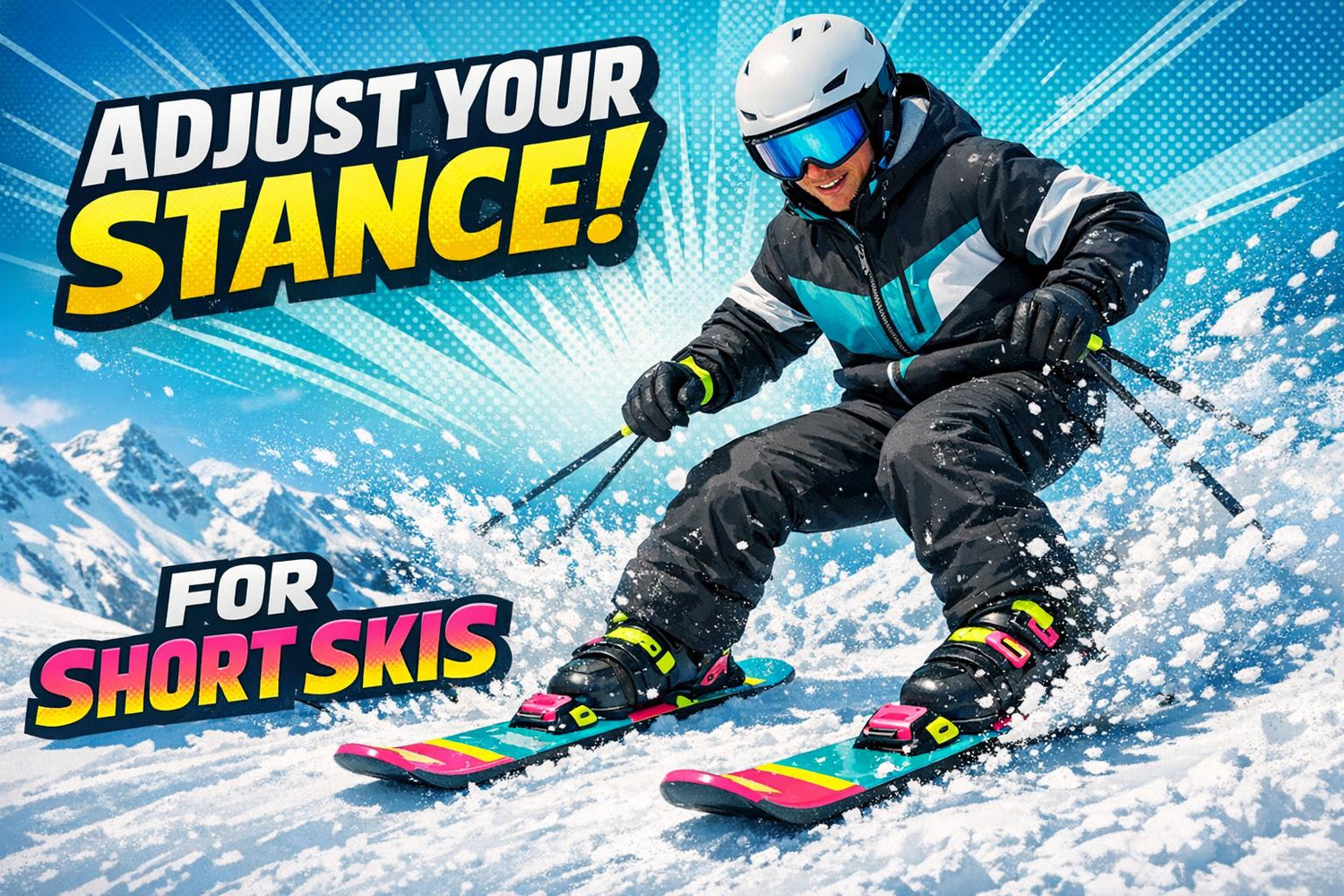
Short skis (like Snowfeet models) are compact, lightweight, and easy to control, but they demand a different stance than longer skis. The key? Focus on balance, weight distribution, and the right posture to make the most of their quick, responsive feel.
Here’s what you need to know upfront:
- Athletic Stance: Keep your legs shoulder-width apart, with slight bends in your ankles, knees, and hips. Stay low for better control.
- Weight Distribution: Unlike longer skis, avoid leaning forward. Keep your weight centered or slightly back, focusing on the middle and back of your feet.
- Adjust for Length: Shorter models (like 44 cm Skiskates) may need a staggered stance for stability. Start on flat terrain to get used to the feel.
- Turning and Stopping: Use your ankles and knees to carve turns. For stopping, practice the hockey stop by pushing your edges sideways.
Snowfeet short skis are compact enough to fit in a backpack, work with regular winter shoes or snowboard boots, and are easier to learn for beginners. Whether you’re on groomed slopes, tight trails, or even hiking paths, mastering the stance is your first step to enjoying these fun, portable skis.
How To Short Turn on Skis | Live Coaching | 10 Tips
Building a Proper Stance for Short Skis
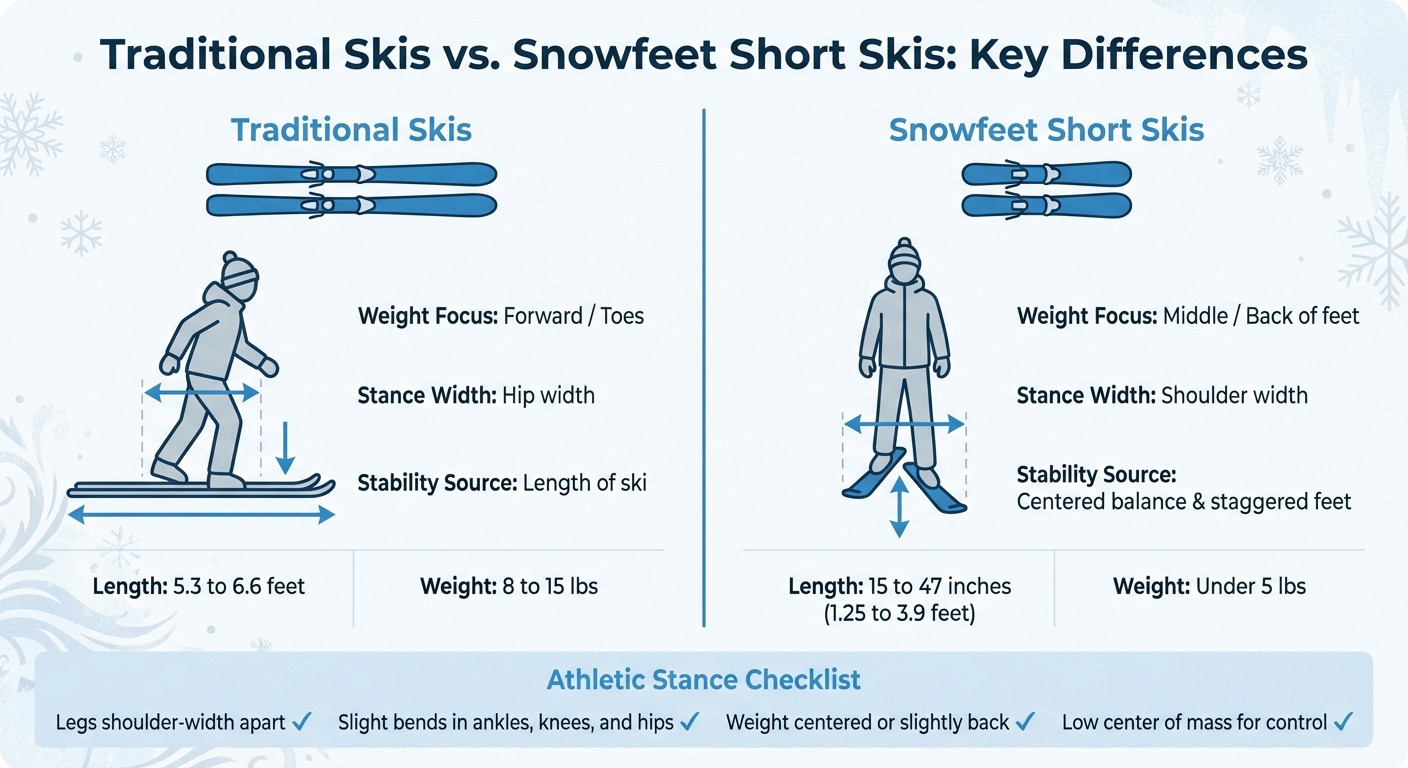
Short Skis vs Traditional Skis: Stance and Weight Distribution Comparison
The Athletic Position Explained
When it comes to riding short skis, everything starts with the athletic stance. This means standing with your legs about shoulder-width apart and bending your ankles, knees, and hips slightly. This posture keeps your center of mass low, giving you the agility you need for quick movements on the slopes.
"An athletic stance involves a wide stance, with the ankle, knees and hip slightly bent... it allows balanced, fast reactions in multiple directions." - Morgan Engel, CSIA Level 4 Instructor
If you're using very short models like the 44 cm Skiskates (starting at $490) or the 50 cm Snowfeet PRO (priced at $275), you might want to tweak this stance a bit. Try placing one foot slightly ahead of the other in a staggered stance. This adjustment gives you a wider base and helps you maintain better balance, especially front-to-back.
Once you've nailed the stance, the next step is learning how to distribute your weight effectively.
How to Distribute Your Weight
Short skis require a different approach to weight distribution compared to traditional skis. Forget leaning forward as you would on longer skis. Instead, focus on keeping your weight centered. The Snowfeet Team explains:
"Don't lean forward like you would do with skis, because you don't have the support of regular-length skis to hold you... instead, stand up straight and place your weight over the middle and back of your feet."
This advice is especially important for compact models like the 65 cm Skiblades ($635) or the 99 cm versions ($675). Leaning too far forward can throw you off balance quickly. For moves like the hockey stop, aim to distribute your weight evenly across both feet. Here's a quick mental checklist: hinge at your hips, engage your core, and keep a slight bend in your ankles. This helps you maintain a solid connection with your boots and keeps your balance centered just ahead of your heels.
Once you’ve got this down, you’ll be ready to fine-tune your posture for any terrain.
Adapting Your Posture for Shorter Length
Riding Snowfeet* short skis is all about mastering front-to-back balance. While traditional long skis offer built-in stability, short skis demand more active balance control. This is especially true when carving turns or skiing backward. To get the hang of it, start on flat, groomed terrain and use a skating motion. This helps you quickly adjust to how these smaller skis respond to even the slightest weight shifts.
Here’s how short skis compare to traditional ones:
| Feature | Traditional Skis | Snowfeet Short Skis |
|---|---|---|
| Weight Focus | Forward / Toes | Middle / Back of feet |
| Stance Width | Hip width | Shoulder width |
| Stability Source | Length of ski | Centered balance & staggered feet |
Snowfeet* designs make these adjustments easier, giving you more control in various conditions. For instance, the 120 cm Short Skis ($775) offer a more familiar, stable feel, while the ultra-compact 38 cm Mini Ski Skates (starting at $250) challenge you to fine-tune your balance with precision. Each model brings its own stance and balance requirements, so choose one that matches your comfort level and skiing goals.
How to Turn and Maneuver on Short Skis
How to Carve Turns
Once you’re comfortable with your stance, the next step is nailing your turns on short skis. Carving starts from the ankles - yes, your ankles! Michael Rogan, PSIA Alpine Team Coach, explains it best:
"All turns should begin from your ankles; first, roll your ankles, then knees, then hips to set and release edges."
This technique is particularly effective with Snowfeet* products. Whether you're using the 65 cm Skiblades (starting at $635) for tight, snappy turns or the 99 cm model (starting at $675) for a smoother, more stable ride, the principle stays the same. Keep your upper body steady and facing downhill while your legs do the work - this helps you carve with ease.
For extra grip and control, Austrian Instructor Examiner Benni Walch shares a helpful tip:
"Focus on rolling from the feet, ankles and knees into the turn, rather than only from the hips. Imagine you're pressing a button towards the hill with your inside knee."
Once you engage those edges, the ski’s design takes over, helping you carve naturally. Thanks to their shorter length, Snowfeet* skis allow for quick, responsive turns, even in tight spots.
Quick Stops and Sharp Turns
Stopping on short skis isn’t quite the same as on traditional skis. Instead of leaning forward, you’ll want to master the hockey stop - push your edges sideways to create friction and come to a halt. This technique is especially useful with Snowfeet* models, like the compact 44 cm Skiskates (from $575) or the 50 cm Snowfeet PRO ($275). These shorter skis are super agile, but that also means balance shifts quickly, so even weight distribution is key.
Many Snowfeet* models also come with an integrated heel brake, making it even easier to control your speed and pull off sharp direction changes. This is a game-changer for weaving through trees or navigating crowded slopes.
Using Your Edges for Better Control
Short skis, like Snowfeet*, rely heavily on active edge control. Unlike traditional skis that use length for stability, short skis demand precision. To get the best grip during turns, roll your ankles and knees toward the hill to engage the edges. For example, the 99 cm Skiblades (from $675) offer more edge contact for solid stability, while the ultra-compact 38 cm Mini Ski Skates (from $250) require sharper, more deliberate movements.
Maintaining your edges is just as important as mastering them. After each session, wipe them dry to prevent rust, use a sharpening stone to keep them in shape, and apply wax to avoid snow buildup. On hard or icy terrain, well-maintained edges make all the difference, giving you the control you need to confidently maneuver short skis. With these techniques and a little practice, you’ll be slicing through the slopes like a pro!
sbb-itb-17ade95
Short Skis vs. Traditional Skis and Snowboards
Easy to Carry and Store
Traditional skis are long and heavy, usually spanning 5.3 to 6.6 feet and weighing 8 to 15 lbs. Snowboards aren’t much better, measuring 5 to 5.6 feet and tipping the scales at 10 to 20 lbs. Now compare that to Snowfeet* products - they’re compact, ranging from just 15 to 47 inches and weighing under 5 lbs. They’re small enough to fit in a backpack or carry-on bag.
This portability is a game-changer. No more lugging around oversized ski bags or paying extra for oversized luggage. Whether you’re flying to a ski resort or squeezing gear into a tiny apartment closet, Snowfeet* Skiblades make storage and transport a breeze. It’s not just about saving space - it’s about making the whole experience simpler, especially for beginners.
Faster Learning Curve for Beginners
Snowfeet* aren’t just easier to carry - they’re also easier to master. Traditional skis require a wide stance and high speeds to stay balanced, which can take 4 to 6 sessions to get the hang of. Snowboards? Those can take days just to figure out the basics, like edge control. But with Snowfeet*, beginners can progress much faster - about 50% faster, in fact. Imagine linking turns in just 30 minutes instead of spending 2 to 3 days on traditional skis.
Why the quicker learning curve? It’s all about the design. Snowfeet* have a lower center of gravity and an easy turning motion that feels natural, even if you’ve never ice skated or rollerbladed before. It’s intuitive, making it the perfect option for first-timers.
Works on More Types of Terrain
Traditional skis shine on open powder runs and groomed slopes, but they’re not great in tight spaces. Snowboards? They can struggle on flat sections or ungroomed trails where maintaining momentum gets tricky. Snowfeet*, on the other hand, are built to handle a much broader range of conditions - up to 80% more terrain types, in fact.
From slopes as steep as 40 degrees to narrow trails, terrain parks, or even areas with minimal snow, Snowfeet* adapt with ease. Whether you’re cruising down a steep hill or navigating tight, tricky paths, these short skis can handle it all. They’re versatile enough to take on almost any challenge the mountain throws your way.
Getting the Most from Your Snowfeet* Short Skis
Pick the Right Model for You
Choosing the right Snowfeet* model can make all the difference in your skiing experience. The right pair gives you the control and agility these short skis are known for. If you're new to skiing, start with the 99 cm or 120 cm Skiblades (priced at $675 and $775). These options offer a stable, compact design that's perfect for carving and all-mountain skiing.
If you're already skilled on ice skates or rollerblades, you might want to try the 44 cm Skiskates (starting at $575) or 65 cm Skiblades (from $635). These shorter models are great for pulling off tricks, quick transitions, and spins up to 1080 degrees. For deeper snow, the 99 cm Powder model (from $675) is a solid choice, though standard models work best in powder under 4 inches. And if you're into backcountry adventures, check out the 100 cm WALKSKI (from $690), which makes uphill climbs and downhill runs a breeze.
Once you've got the right model for your skill level and terrain, start practicing on easy slopes to build your confidence.
Start on Easy Terrain
Begin on flat, snowy ground to get a feel for how Snowfeet* short skis handle. Use a hockey-skate motion to move forward - it’s the most natural way to build momentum. Keep your legs about shoulder-width apart to maintain control.
"A common mistake among beginners is that they spread their legs too wide and have difficulty controlling their rides. Instead, you want to spread your legs to shoulder width." - Snowfeet Team
Once you’re comfortable skating on flat ground, head to gentle slopes. Unlike traditional skis, Snowfeet* don’t provide as much front-end support, so avoid leaning forward. Keep your weight centered or slightly back, and position one foot slightly ahead of the other for better stability.
Maintain Your Equipment
Taking care of your Snowfeet* is just as important as learning the right techniques. Regular maintenance ensures they perform at their best every time you hit the slopes.
- Wax them often with liquid wax to improve glide and keep snow from sticking. Wood core models come pre-waxed, but fiberglass-reinforced ones need more frequent waxing.
- Keep the edges sharp with a stone or tuner for better control.
- Dry the edges thoroughly after each use to prevent rust.
Before storing your Snowfeet* for the off-season, wipe the edges with oil to protect against corrosion. Always check the bindings and adjust the straps to fit US shoe sizes 6–13 before each ride. If you’re using snowboard boots, you may need extra-long straps for the front toe area. With proper care, your Snowfeet* can deliver top-notch performance year after year.
Conclusion
Getting your stance right is the foundation of mastering Snowfeet*. Keep your legs hip-width apart, maintain an athletic posture with bent knees and ankles, and balance your weight over the middle to back of your feet. This compact and balanced position gives you the control and agility that make Snowfeet* short skis so fun and responsive.
This stance not only improves your control but also takes full advantage of Snowfeet*’s clever design. Whether it’s the 44 cm Skiskates (starting at $575), 65 cm Skiblades (starting at $635), or the 99 cm and 120 cm models (starting at $675 and $775), these short skis are built for quick learning and versatile terrain. With over 50,000 riders and a glowing 4.9-star rating from more than 5,500 reviews, Snowfeet* offers a faster learning curve and greater flexibility compared to traditional skis.
Unlike bulky skis that require pricey boots, roof racks, and lessons, Snowfeet* work with regular winter shoes or snowboard boots and fit easily into a backpack. Their lightweight build and agility let you skate uphill, pull off tricks, and explore slopes in ways long skis just can’t match. The right stance unlocks all this potential, turning every run into a playground.
Start on gentle slopes, keep your gear in top shape with regular waxing and sharpening, and see why so many skiers are switching to Snowfeet*. By nailing these basics, you’ll open the door to a winter sports experience that’s more fun, accessible, and adventurous than ever.
FAQs
How is the stance for short skis different from traditional skis?
When you’re on short skis like Snowfeet* Skiblades or Skiskates, your stance tends to be narrower - your feet are usually about shoulder-width apart. For added control, it’s common to position one foot slightly ahead of the other in a staggered stance. This is a bit different from traditional skis, where a wider, parallel stance with both feet side-by-side is the norm.
This unique posture with short skis boosts your agility, making quick, playful turns a breeze. It’s a fun and energetic way to ski, and it’s often easier to pick up than using traditional skis or snowboards.
What’s the best way to distribute my weight when using short skis?
To get the best performance out of short skis like Snowfeet* Skiblades or Skiskates, try keeping your weight slightly forward - mainly on the balls of your feet. Stay balanced from front to back, and focus on applying pressure to the outside ski while keeping the tails light. This technique helps you stay in control, especially when navigating turns.
Short skis are all about being playful and super easy to handle. Adopting a dynamic, active stance can really elevate your experience. With a bit of practice, you’ll find they respond effortlessly to your movements, making them a fun and flexible option compared to traditional skis or snowboards.
How can I quickly stop while using short skis?
Stopping quickly on short skis is all about using the right technique. One effective method is to shift your weight onto the inside edges of the skis and sharply turn them across the slope. This creates a quick, controlled stop. Another option is the compact snowplow technique: keep your stance shoulder-width apart, center your core, and form a wedge shape with the skis. This helps control your speed and brings you to a smooth stop.
Short skis, like Snowfeet*, are built for agility, which makes these stopping methods feel more natural and easier to master compared to traditional skis or snowboards. With a bit of practice, stopping on short skis will feel effortless, letting you fully enjoy their fun and responsive design.











Leave a comment
This site is protected by hCaptcha and the hCaptcha Privacy Policy and Terms of Service apply.