




















Trying short skis for the first time? Here’s the deal: they’re lightweight, easy to carry, and way simpler to use than traditional long skis. Short skis - like Snowfeet Skiblades - are perfect for beginners, trick enthusiasts, or anyone looking for a fun, hassle-free way to enjoy the slopes. They’re compact enough to fit in a backpack and don’t require clunky ski boots. Plus, most people pick up the basics in just 5 minutes. Think of it like skating on snow - quick turns, easy stops, and tons of maneuverability.
Here’s why they’re worth a shot:
- Sizes for everyone: Choose from 65 cm, 99 cm, or 120 cm models based on your height, weight, and style.
- No special boots needed: Use regular winter shoes or snowboard boots.
- Beginner-friendly: Easier to learn compared to traditional skis.
- Portable: Toss them in a backpack - no oversized gear required.
- Fun for all ages: Riders from 5 to 105 years old love them.
If you’ve struggled with long skis or just want a fresh way to hit the snow, short skis could be your new favorite gear. Ready to learn more? Let’s dive in.
Are Short Skis Better for Beginners?
How Short Skis Differ from Traditional Skis
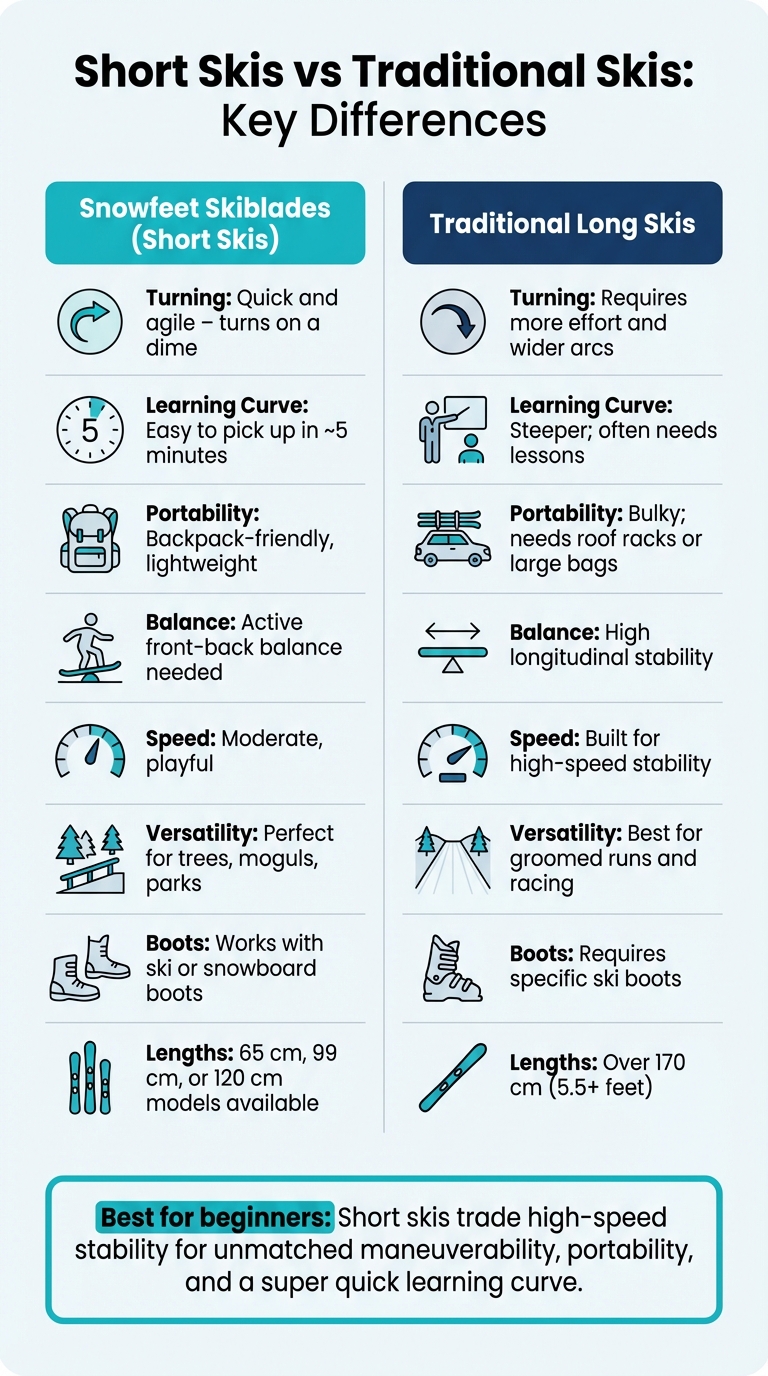
Short Skis vs Traditional Skis Comparison Chart
Short skis aren't just smaller versions of traditional skis - they bring a whole new vibe to the slopes. From their nimble handling to their lightweight design, you'll notice the difference the moment you strap them on.
Turning and Control
Short skis, like Snowfeet* Skiblades, make turning feel effortless. Their compact size lets you pivot quickly, without the need for those wide, sweeping arcs typical of longer skis. It's a game-changer, especially in tight spots like forest trails, moguls, or crowded slopes. A simple shift of your body, and you're carving with ease.
Longer skis, such as those from Rossignol or Salomon, require more effort to initiate turns. They’re built for stability, which means they need more physical input to maneuver. On the flip side, short skis rely on active balance - kind of like ice skating or inline skating. While long skis offer steady front-to-back stability, short skis demand a bit more engagement from you. It might feel different at first, but you’ll adapt quickly.
"With short skis, turning becomes a breeze... you can pivot easily and make quick adjustments, turning on a dime." - Snowfeet Team
If you’re all about speed on wide-open groomers, traditional skis might feel more solid underfoot. But for most riders, especially beginners, the playful, responsive nature of short skis is what makes them so fun.
And that’s not all. Short skis don’t just shine on the slopes - they’re a dream to transport, too.
Transport and Storage
One of the best perks of Snowfeet* Skiblades? You can toss them in a regular backpack. No need for oversized ski bags or roof racks taking up space.
Traditional skis, on the other hand, can be a hassle. Measuring over 5.5 feet (170 cm) in length, they often require special carriers, and just lugging them from your car to the lift can feel like a workout. Snowfeet* models, available in lengths like 65 cm, 99 cm, and 120 cm, are lightweight and easy to handle - just grab and go.
"These shorter skis let you just skate right up the hill." - Sophia Kane
Storage is another win for short skis. While traditional skis need wall mounts or a dedicated corner of your garage, Snowfeet* Skiblades can slide under your bed or tuck neatly into a closet. Simple.
To break it down further, here’s how Snowfeet* Skiblades stack up against traditional skis.
Comparison: Snowfeet* Skiblades vs Traditional Skis
| Feature | Snowfeet* Skiblades | Traditional Long Skis |
|---|---|---|
| Turning | Quick and agile – turns on a dime | Requires more effort and wider arcs |
| Learning Curve | Easy to pick up in ~5 minutes | Steeper; often needs lessons |
| Portability | Backpack-friendly, lightweight | Bulky; needs roof racks or large bags |
| Balance | Active front-back balance needed | High longitudinal stability |
| Speed | Moderate, playful | Built for high-speed stability |
| Versatility | Perfect for trees, moguls, parks | Best for groomed runs and racing |
| Boots | Works with ski or snowboard boots | Requires specific ski boots |
So, what’s the takeaway? Snowfeet* Skiblades trade the high-speed stability of traditional skis for unmatched maneuverability, portability, and a super quick learning curve. For beginners or anyone looking to have fun on the slopes, they’re a fantastic choice.
Preparing for Your First Time with Short Skis
Getting ready for your first ride on Snowfeet* Skiblades? It’s all about picking the right model, gearing up properly, and starting in a safe, beginner-friendly spot.
Picking Your Snowfeet* Model
The length of your skiblades can make or break your experience, so choose wisely. Here’s a quick guide to help:
- 65 cm model: Perfect for riders under 5'6" (168 cm) or weighing less than 150 lbs (68 kg). This shorter length gives you maximum control and a skating-like feel, making it much easier to pick up the basics quickly.
- 99 cm model: A solid choice for most adults (5'6" to 6'0", 150–200 lbs). It strikes a great balance between stability and maneuverability, making it ideal for learning and eventually trying out tricks or tackling terrain parks.
- 120 cm model: Best for taller or heavier riders - or anyone who wants a feel closer to traditional skiing. This model offers more carving power and handles deeper snow better, while still feeling more playful and nimble than traditional skis.
Once you’ve picked your skiblades, it’s time to gather the gear you’ll need for a smooth start.
Required Gear and Accessories
One of the best things about Snowfeet* Skiblades? You don’t need special ski boots. They’re compatible with waterproof winter shoes or snowboard boots, as long as they provide good ankle support. Here’s what else you’ll need:
- Clothing: Dress in layers. Waterproof outerwear and thermal underlayers will keep you warm and dry.
- Safety gear: Always wear a helmet and goggles for protection and better visibility.
- Wax: Fiberglass models perform better with a coat of Snowfeet* wax to reduce friction and improve glide. Wood core models (65 cm and 99 cm) come pre-waxed but can benefit from an extra application.
- Replacement straps: If you’re planning to try tricks, having extra straps on hand ensures a secure fit.
With your gear sorted, let’s talk about where to practice.
Best Places to Practice
Start simple. Flat terrain or wide, groomed beginner slopes are the best places to get the hang of balancing on short skis. Groomed green runs are especially great because the smooth, predictable snow makes it easier to focus on your technique.
If you’re not near a ski resort, local sledding hills or even your backyard can work for your first few runs. Just avoid moguls, terrain parks, or steep slopes until you’re confident in the basics.
Once you’re comfortable, try small terrain parks for some fun jumps and spins. Many U.S. resorts, like Keystone in Colorado, have beginner-friendly parks that are perfect for leveling up your skills.
Your First Time on the Slopes: What to Expect
Got your gear ready and picked a safe spot? Perfect - you're all set to experience the unique ride of Snowfeet* Skiblades on the slopes.
The moment you clip into Snowfeet* Skiblades and push off, you'll notice something different right away. Forget the bulky, board-like feel of traditional skis. These skiblades respond instantly to the slightest shift in your weight. It’s not like gliding on rails; it’s more like skating on snow - similar to the smooth, controlled motion of ice skating.
Movement and Responsiveness
Snowfeet* Skiblades are all about quick reactions. Lean slightly, and you’re already turning. Adjust your edges, and you can pivot on a dime. There’s no lag, unlike traditional skis. Their agility means you can correct mistakes almost immediately with just a small shift in weight.
One user, Daniel Siouffi, shared his experience:
"My first run the skis did shake but soon there after by distributing better my weight on my toes - i was flying like never before. Going fast i was in complete control of every move turns and stops."
Another cool thing? Their lightweight design (less than 160 cm) reduces the physical effort needed. You’ll find yourself experimenting - trying spins, riding backward, or hopping over small bumps. These skiblades encourage fun and creativity rather than sticking to rigid techniques. That instant feedback makes it easier to improve your balance and control as you go.
Balance and Body Position
With all that responsiveness, balance becomes the name of the game. Unlike long skis, which stabilize you naturally, Snowfeet* Skiblades demand active balance. Think of it like riding a skateboard - you’ll need to make constant micro-adjustments. Keep your knees bent, engage your core, and stay centered. This stance helps you avoid tipping and keeps you ready to adapt to changes in the terrain.
Weight distribution is another big deal. If things feel shaky when you pick up speed, try shifting more weight toward your toes. The trick is to stay centered - not leaning too far forward or backward. That way, you’ll work with the skiblades’ natural responsiveness, not against it.
sbb-itb-17ade95
Basic Techniques for Snowfeet* Skiblades
Moving, Turning, and Stopping
Using Snowfeet* Skiblades offers a ride that’s quick to adapt to your movements. To get moving, start with a skating motion - push your legs sideways, just like you would when ice skating. This motion helps you glide smoothly over flat terrain.
Turning is straightforward. Simply lean in the direction you want to go, and the skiblades will follow. For tighter turns, shift more of your weight onto the opposite leg. Thanks to their shorter length (usually between 65 cm and 120 cm), these skiblades let you pivot with ease, unlike traditional skis that can feel more resistant. Once you’ve nailed the basics, try edging the skiblades for carving. This technique not only gives you more control but also helps you manage your speed on steeper slopes.
Stopping comes down to two main techniques. The first is the hockey stop: quickly angle both skiblades perpendicular to the slope while keeping your weight evenly distributed. The second option is the snowplow method - point the tips of the skiblades toward each other and press on the inside edges for a gradual, controlled stop. As the Snowfeet team puts it:
"Make sure you distribute your weight evenly over both of your Snowfeet to make you stop easier and slower."
Before tackling steeper terrain, practice these moves on easy slopes until they feel natural.
Learning Faster: Practice Tips
To speed up your learning, start on gentle slopes and focus on mastering the basics. Practice small, controlled turns instead of wide, sweeping ones. The agility of Snowfeet* Skiblades makes tight maneuvers easier than traditional skis, so take advantage of that. Make stopping a priority too - alternate between hockey stops and the snowplow method until both feel second nature.
If you’ve got experience with ice skating, rollerblading, or hockey, you’ll likely pick up these skills even faster. The key is to practice until every movement feels second nature.
These techniques show why Snowfeet* Skiblades are such an exciting and intuitive way to hit the slopes.
Common Beginner Challenges and Solutions
Getting started with Snowfeet* Skiblades can be a bit tricky, but don’t worry - here’s a breakdown of some common challenges beginners face and how to tackle them.
Improving Your Balance
One of the first hurdles is nailing your front-back balance. Thanks to their compact design, Snowfeet* Skiblades require a level of balance similar to ice skating. It’s completely normal to feel a bit wobbly at first while figuring out how to distribute your weight properly.
If you notice your skiblades shaking, try shifting more weight onto your toes. This small adjustment can make a big difference in stabilizing your ride and giving you more control. Keep your knees bent and stay low - this helps with balance and makes movements smoother. If you’re just starting out, the 99 cm model is a great option since it offers extra stability, making it easier to find your footing. Once you’ve got your balance down, you’ll naturally start focusing on managing your speed.
Controlling Your Speed
Learning to control your speed can feel a bit intimidating at first. Snowfeet* Skiblades are super responsive to your movements, which is great for agility but might catch you off guard in the beginning. The good news? Their design helps keep momentum manageable, especially on gentle slopes.
To get the hang of speed control, practice the snowplow position on easy terrain. Distribute your weight evenly over both feet and, when you need to stop quickly, try the hockey stop technique. These basics will give you the confidence to tackle steeper slopes as you progress.
Handling Falls and Errors
Here’s some relief: falling on Snowfeet* Skiblades is less of a hassle compared to traditional skis. Their compact size means no tangled gear to deal with. As the Snowfeet team puts it:
"Falling is generally much safer than falling with skis or snowboard"
If you take a tumble, getting back up is a breeze since you’re not wrestling with heavy equipment. Their forgiving design also helps if you lean too far or catch an edge, giving you a better chance to recover without wiping out. Many users find that the learning curve is quick, and they gain confidence on the slopes in no time.
Conclusion: Why Snowfeet* Short Skis Work for Beginners
Key Benefits Summary
Snowfeet* Skiblades offer a game-changing option for first-time skiers. Forget the heavy, intimidating gear and lengthy lessons that come with traditional skis. With Snowfeet*, you get a fun, straightforward alternative. Their models - available in 65 cm, 99 cm, and 120 cm lengths - are built for easy handling and quick progression from beginner to intermediate.
What makes them stand out? They're lightweight, incredibly maneuverable, and easy to control. Turning feels natural, especially if you've ever tried ice skating or inline skating. Plus, with over 50,000 riders around the world and a stellar 4.9 out of 5-star rating, their popularity speaks volumes.
While traditional skis may have the edge when it comes to stability at high speeds, Snowfeet* Skiblades shine for beginners and casual skiers. They make learning faster, controlling easier, and the overall experience a lot more fun.
"So I took my wife skiing last season for the first time. She did not enjoy it. This season I purchased these short skis for her and she really enjoy them. So much so that she wants to do it again!" - Brandon Stanley
If you're looking for a simpler, more enjoyable way to start skiing, Snowfeet* Skiblades could be the perfect fit.
How to Get Your Snowfeet* Skiblades
Think you're ready to give them a try? Check out the full range at Snowfeetstore.com. For beginners, the 99 cm model (starting at $590) offers great stability. If you're after a playful, skating-like experience, the 65 cm version (starting at $550) is the way to go. Whichever model you choose, you’ll enjoy free priority shipping, with delivery in just 3 business days.
The site includes everything you need to make the right choice - sizing guides, accessory bundles, and detailed specs for each model. Whether you opt for fiberglass or wood core construction, you'll be ready to hit the slopes with confidence and style.
FAQs
What makes short skis a great choice for beginners?
Short skis are a fantastic option for beginners, thanks to their compact size and lightweight build, which make learning to ski way less intimidating. Take Snowfeet Skiblades, for instance - they come in sizes ranging from just 26 inches (65 cm) to 47 inches (120 cm). This shorter length makes turning, stopping, and balancing feel almost effortless. Plus, their design naturally lowers your center of gravity, giving you a more stable and confident experience on the slopes. They’re also forgiving, so when you make mistakes (and let’s face it, everyone does), it’s easier to bounce back. Many models even have twin-tip designs, perfect for trying out tricks or skiing backward without feeling overwhelmed.
But it’s not just about performance - short skis are super convenient, too. Snowfeet models work with regular winter or snowboard boots, which means you can skip the cost of specialized ski boots. They’re compact enough to fit in a backpack, making them easy to bring along whether you’re heading to a local hill or a big mountain resort. And with prices starting around $150, short skis like Snowfeet offer an affordable, beginner-friendly way to dive into skiing without the steep learning curve or hefty price tag of traditional gear.
How do short skis make learning easier compared to traditional skis?
Short skis, like Snowfeet Skiblades, are perfect for beginners because they’re much shorter - typically measuring between 15 and 47 inches - compared to traditional skis, which are usually 59 inches or longer. This smaller size makes them far easier to handle, helping new skiers learn how to balance, turn, and stop in just a few hours of practice.
Traditional skis often require precise edge control, specialized boots, and a good amount of physical strength. Short skis, on the other hand, are more forgiving and nimble. This makes them ideal for first-timers who want to build confidence and start having fun on the slopes right away. Snowfeet’s short-ski designs offer a beginner-friendly way to enjoy the snow without the steep learning curve that comes with conventional skiing.
What do I need to get started with Snowfeet Skiblades?
To hit the slopes with Snowfeet Skiblades, you’ll need just a few basics:
- Snowfeet Skiblades: Pick the length that matches your skill level - options include 65 cm (about 26 in), 99 cm (39 in), or 120 cm (47 in). These skiblades are lightweight, compact, and work well for both beginners and seasoned riders.
- Winter boots: No need for specialized ski boots! Any insulated winter boots or snowboard boots will do the job.
- Safety gear: A helmet designed for skiing or snowboarding is essential, along with goggles to shield your eyes from UV rays and snow glare.
- Warm clothing: Layer up! Start with a moisture-wicking base layer, add an insulating mid-layer, and top it off with waterproof outerwear. Don’t forget warm gloves or mittens to keep your hands cozy and dry.
That’s all you need! Once you’ve got these, you’re ready to buckle into your Snowfeet Skiblades and enjoy the slopes without the usual bulk of traditional ski gear. Bonus? They’re super easy to carry and cost just $150–$250, making them a fun and budget-friendly alternative to skis or snowboards.












Leave a comment
This site is protected by hCaptcha and the hCaptcha Privacy Policy and Terms of Service apply.