



















Learning to ski can feel overwhelming - long skis, tricky turns, and runaway speed make it tough for beginners to stay in control. Enter short skis like Snowfeet*, which simplify the process. These compact skis (as short as 17 inches) help you balance better, turn more easily, and stop without fear. Plus, they’re lightweight, portable, and work with regular winter boots, saving you money and hassle. Over 50,000 beginners have mastered the basics in just minutes, proving that shorter skis can make skiing more fun and less frustrating.
Why short skis are a game-changer:
- Easier balance: Shorter length reduces wobbling and makes staying centered easier.
- Simple turns: Quick pivots and tight turns feel natural, even for first-timers.
- Better speed control: Stop confidently with basic techniques like hockey stops.
- No bulky gear: Fits in a backpack and works with your regular boots.
With prices starting at $250, Snowfeet* offers an affordable and beginner-friendly way to enjoy skiing. Whether you’re new to the slopes or just looking for a more relaxed experience, short skis make winter adventures more accessible than ever.
How Short Skis Fix Common Beginner Problems
Balance Troubles with Long Skis
Long skis, typically measuring over 160 cm (about 63 inches), can feel like balancing on a seesaw. Their extended length creates a long lever arm both in front of and behind you, amplifying even the tiniest weight shifts. This makes staying centered a constant battle for beginners, who often find themselves wobbling and overcorrecting.
That’s where Snowfeet* Skiblades and Skiskates come in. With lengths ranging from just 44 cm (17 inches) to 120 cm (47 inches), these short skis make balance way easier. Their compact size reduces the lever effect, helping your body naturally stay centered without as much effort. Plus, their lightweight and wide-base design mean you don’t need as much muscle power to stabilize yourself. This not only cuts down on fatigue but also gives beginners a big confidence boost - many find their balance improving within a single day. And once you’re steady, turning becomes a breeze.
Struggling to Make Turns
Turning with traditional skis can feel like steering a bus. Their long length forces you into wide, sweeping arcs that demand precise edge control and weight shifts - skills that take time (and a lot of practice) to master. One wrong move, and you’re dealing with crossed tips or awkward falls.
Snowfeet* short skis solve this problem by making turning intuitive. Their compact design slashes swing weight, letting you pivot quickly and effortlessly. As one user, Daniel Siouffi, shared:
When going fast, I remained in complete control of every move, turn, and stop.
The 44 cm Skiskates provide a skating-like motion that feels natural for many beginners, while the 99 cm Skiblades offer more stability for carving turns. This means you can start making precise, confident turns without months of practice. And with turning under control, you’ll also find it easier to manage your speed.
Speed Control and Stopping Challenges
One of the scariest parts of learning to ski is feeling like you’re going too fast and can’t stop. Traditional skis require advanced techniques - like engaging the edges or using controlled turns - to manage speed. For beginners, this can feel overwhelming and often leads to panic or loss of control.
Snowfeet* Skiskates (44 cm) and Skiblades make controlling speed and stopping much simpler. Their shorter length and responsive design let you stop or slow down using basic techniques, like quick turns or hockey stops, without needing years of practice. Users consistently give these models top ratings - around 4.9 out of 5 stars - for their ability to maintain control, even on steeper slopes. This means beginners can focus on enjoying the ride instead of fearing it.
Heavy Gear and Transport Hassles
Traditional ski gear is, well, a pain to lug around. Long, heavy skis and bulky boots make getting from your car to the slopes a workout in itself. It’s no wonder many people stick to resorts and skip the idea of spontaneous snow adventures.
Snowfeet* gear changes the game here, too. The 44 cm Skiskates are so compact they can fit in a backpack. Even better, they attach directly to regular winter shoes or snowboard boots, so you don’t need special footwear. At $575, they’re among the smallest skis in the world, perfect for casual skiing anywhere there’s snow. The 65 cm and 99 cm Skiblades, starting at lower price points, offer the same portability with added stability for beginners. Even the 120 cm model, priced at $775, is lighter than traditional skis, making it easier to carry. Whether you’re exploring narrow hiking trails, sledding hills, or even your backyard, Snowfeet* gear makes skiing accessible and fun in places where long skis just wouldn’t work.
Why Snowfeet* Short Skis Beat Standard Ski Gear
Compact Design for Multiple Uses
Standard ski gear is great for resort runs, but it can be bulky and limiting. Snowfeet* flips the script with a compact design that ranges from 17 inches (44 cm) to 47 inches (120 cm). This gear is portable enough to fit in a backpack, so you can ditch the roof racks and oversized ski bags. Whether you're tackling narrow hiking trails or heading to popular resorts in Colorado or Utah, Snowfeet* makes transportation a breeze. Imagine going straight from your car to the lift without lugging around heavy equipment - that’s the freedom these short skis offer. Plus, their size makes them perfect for terrain parks, where quick turns and tight spaces call for agile gear. Bottom line: Snowfeet* is all about versatility and convenience.
Features That Help Beginners Learn Faster
Snowfeet* isn’t just compact - it’s also designed to make skiing easier to pick up, especially for beginners. Traditional skiing often means hours of lessons to master edge control and parallel turns. With Snowfeet*, you can feel confident after just minutes on the snow. That’s not just marketing hype - user reviews back it up, with an impressive 4.9 out of 5 stars.
Here’s why they’re so beginner-friendly:
- Metal edges offer solid grip for smooth turns and controlled stops, delivering performance similar to full-length skis.
- Parabolic side cuts and a 3-inch waist make carving feel intuitive.
- Camber-plus-rocker design absorbs bumps, so you don’t have to fight the terrain.
- Asymmetrical twin tips let you ride forward or backward, adding flexibility right from the start.
And the best part? You can use them with regular winter shoes or snowboard boots - no stiff ski boots required. Many users report progressing from total beginner to intermediate in just one day. That means less time learning and more time enjoying the slopes.
A New Way to Enjoy Winter Sports
Snowfeet* isn’t just another piece of gear - it’s creating a whole new way to experience winter sports. By combining its compact design with smart engineering, Snowfeet* introduces skiskating, a hybrid of skiing and ice skating. If you’ve ever tried inline skating or hit the ice rink, the motion will feel second nature. It’s a flexible, natural-feeling alternative to the rigid stance of traditional skiing or the sideways position of snowboarding.
This fresh take on winter fun is catching on fast, with people of all ages - from 5 to 105 - giving it a try. Snowfeet* has even earned recognition with the ISPO Award and the A'design Award. As Uncrate puts it, “far more portable and affordable than traditional skis or snowboards”. Whether you’re carving down groomed slopes, navigating moguls, or gliding across flat terrain to catch a lift, skiskating with Snowfeet* offers a level of freedom that traditional gear just can’t match.
sbb-itb-17ade95
Snowfeet* Short Skis vs. Standard Ski Gear
Short Skis vs Standard Skis: Beginner Comparison Guide
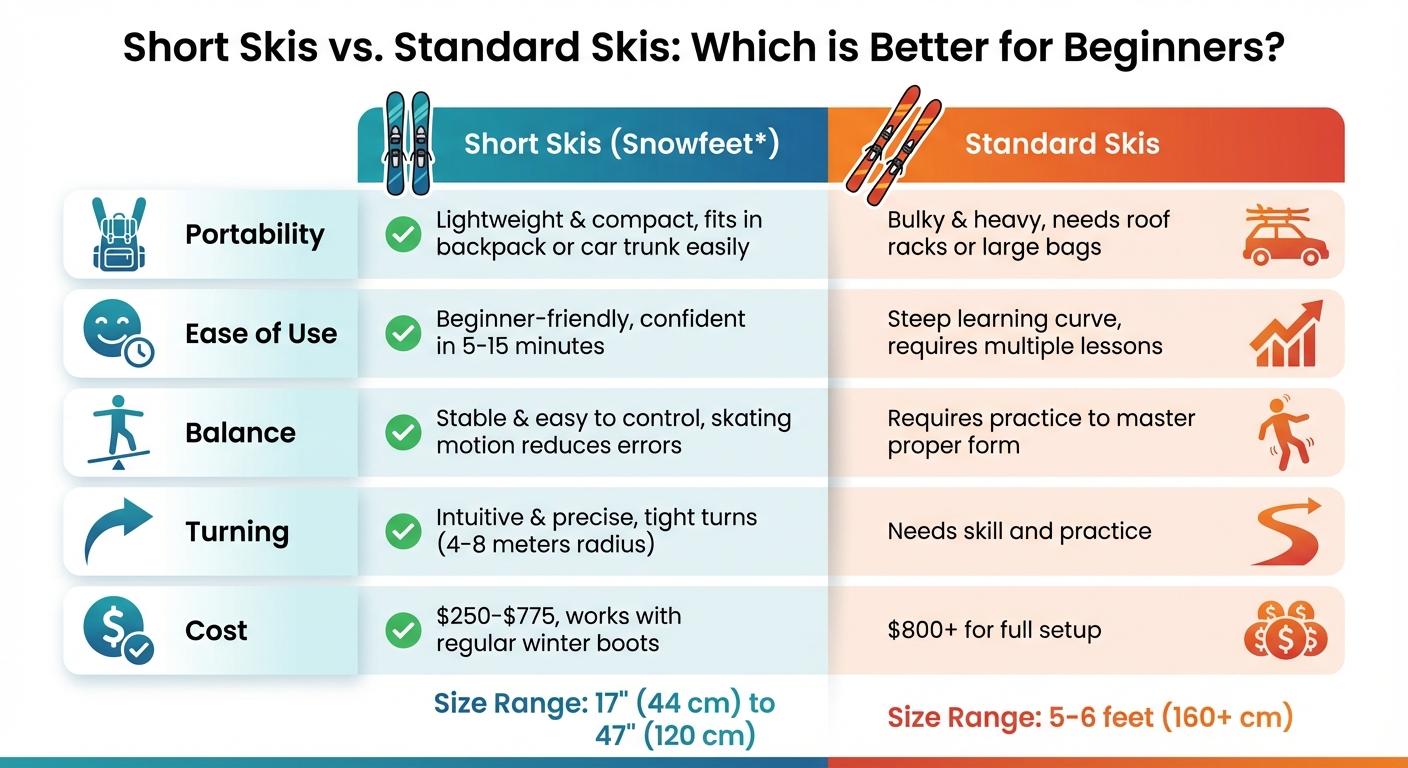
When deciding between traditional long skis and Snowfeet* short skis, the most obvious difference is their size. Standard skis are usually 5 to 6 feet long, while Snowfeet* models are much shorter, ranging from just 17 inches (44 cm) to 47 inches (120 cm). This isn't just about saving storage space - it completely changes how you approach skiing, from learning the basics to navigating the slopes. Here's a closer look at how these differences impact learning, control, and cost.
Learning to Ski
The learning curve is where these two options really stand apart. Traditional skis often require hours of professional lessons to get comfortable with balance and turning. Snowfeet*, on the other hand, simplifies the process. With their natural skating-like motion, they help beginners feel confident within 5–15 minutes. If you've ever ice skated or rollerbladed, the movement will feel familiar, and you won't have to struggle with the leverage issues that come with longer skis.
Cost Considerations
Another big factor is cost. Traditional ski setups, including skis, bindings, boots, and poles, can easily cost over $800. Snowfeet* offers a much more affordable alternative, with complete setups priced between $250 and $775. Plus, they work with your regular winter boots, saving you from buying specialized footwear. For casual skiers who only hit the slopes a few times a season, this is a game-changer.
Comparison Table: Snowfeet* Short Skis vs. Standard Skis
Here's a quick breakdown of how they stack up:
| Feature | Standard Skis | Snowfeet* Short Skis |
|---|---|---|
| Portability | Bulky and heavy; needs roof racks or large bags | Lightweight and compact; fits in a backpack or car trunk easily |
| Ease of Use | Steep learning curve; requires multiple lessons | Beginner-friendly; most users feel confident within 5–15 minutes |
| Balance | Requires practice to master proper form | Stable and easy to control; skating motion reduces beginner errors |
| Turning | Needs skill and practice | Intuitive and precise; short radius (4–8 meters) for tight turns |
| Cost | $800+ for a full setup | $250–$775; works with regular winter boots |
Portability and Versatility
One of the biggest perks of Snowfeet* is how portable they are. Imagine packing your gear into a backpack and walking straight to the lift - no struggling with long skis in a crowded parking lot or dealing with expensive roof racks. Plus, they're not limited to groomed resort runs. Snowfeet* works just as well on hiking trails, in terrain parks, or even on your neighborhood sledding hill. That kind of flexibility opens up a whole new world of skiing possibilities.
Conclusion
Learning to ski doesn’t have to feel like a struggle with heavy, awkward equipment. Snowfeet* short skis tackle common beginner frustrations by offering better balance, smooth turning, easy speed control, and hassle-free portability. With sizes ranging from the compact 17-inch (44 cm Skiskates) to the 47-inch (120 cm Short Skis), these lightweight options keep you centered, make stopping a breeze with familiar techniques, and let you carve sharp turns without the clunky leverage of traditional skis.
Unlike standard ski setups that often demand a hefty investment and hours of lessons, Snowfeet* gets you gliding with confidence in just minutes. They work with your regular winter boots and fit snugly in a backpack, saving you money, time, and effort right from the start. Plus, their portability means you can hit up local slopes, terrain parks, or even hiking trails on a whim - no more wrestling with oversized gear or waiting in endless rental lines.
With Snowfeet*, beginner skiing becomes simple and fun. Whether you’re drawn to the 44 cm Skiskates (starting at $490), the versatile 99 cm Skiblades (from $590), or the longer 120 cm Short Skis ($775), you’re investing in gear tailored to boost your confidence and keep winter adventures accessible. Join over 50,000 riders who’ve discovered the joy of effortless skiing with Snowfeet* - it’s time to make your first run an unforgettable one.
FAQs
How do short skis help beginners stay balanced?
Short skis are a game-changer for beginners. They’re lighter, easier to handle, and perfect for anyone still finding their balance on the slopes. Thanks to their smaller size, they allow for precise movements, which helps reduce the chance of losing control and keeps you upright more often - something every newbie appreciates!
Take options like Snowfeet’s Skiblades and Skiskates, for example. These short skis provide a stable stance that boosts confidence and makes skiing feel a lot less intimidating. With their added stability and easy maneuverability, learning becomes smoother, so you can focus on having fun instead of stressing about taking a tumble.
Can I use short skis with regular winter boots, or do I need special ski boots?
Absolutely! Snowfeet short skis are designed to work with your regular winter boots, so there's no need to splurge on specialized ski boots. This makes them super convenient and easy to use. You can skip the hassle (and cost) of bulky ski boots and still enjoy your time on the slopes.
Whether you're trying out Snowfeet Skiblades, Skiskates, or other short ski models, their lightweight and compact design pairs perfectly with standard winter footwear. It's a simple, beginner-friendly way to dive into skiing without all the extra gear.
Are short skis good for different types of snow and terrain?
Short skis are a jack-of-all-trades when it comes to skiing. They handle a mix of terrains with ease - whether you're tackling icy slopes, cruising down groomed trails, hitting the terrain park, or even messing around in your snowy backyard. Thanks to their compact size, they’re super easy to control. That means better edge grip and faster, sharper turns, making them a fantastic choice for beginners or casual skiers looking for a smoother ride.
That said, short skis aren’t the best pick if you’re heading into deep powder or flying down the mountain at high speeds. In those cases, longer skis shine with better float and stability. But for most recreational skiers, short skis bring a lot to the table. They’re fun, practical, and help build confidence, making it easier to learn and enjoy the slopes.











Leave a comment
This site is protected by hCaptcha and the hCaptcha Privacy Policy and Terms of Service apply.