



















If you’re tired of lugging around long skis on icy slopes, skiblades might be your new best friend. These short skis (65–120 cm) are lightweight, easy to control, and perfect for hard-packed snow. Think of them as a mix between skiing and skating: nimble, quick, and fun.
Here’s the scoop:
- 65 cm skiblades: Great for beginners or tight turns. Super agile but less stable at high speeds.
- 99 cm skiblades: A balance of stability and maneuverability. Ideal for most skiers.
- 120 cm skiblades: Best for speed and carving on icy slopes. Stable but requires more skill.
They’re great for icy U.S. resorts, offering better control and less fatigue compared to long skis. Whether you’re a beginner or a seasoned skier, there’s a skiblade size for you.
Snowboarder tries Snowfeet* | Which Snowfeet* Short Ski is the Best? | Snowblades 44, 65, 99 Review
How Snowfeet* Skiblades Handle Icy Conditions
Snowfeet* Skiblades hold their own on the icy slopes of the East Coast. Here’s a breakdown of how they perform on hard-packed snow:
Edge Grip:
Thanks to their metal edges, Snowfeet* Skiblades carve into firm snow with confidence. The 120 cm model, with its deep parabolic shape and a narrow 7.8 cm waist, offers sharp, responsive edge engagement that rivals full-length skis. To keep their grip reliable, it’s important to maintain well-tuned edges.
Stability:
Each length in the Snowfeet* lineup offers a unique experience. The 120 cm skiblades provide a stability level close to that of traditional skis, making them a solid choice for faster runs on icy terrain. The 99 cm model strikes a balance between stability and agility, while the shorter 65 cm version focuses on quick, nimble movements. Since these blades are shorter than standard skis, they demand more active balance, engaging your core muscles. Daniel Siouffi shared his experience:
Initially, the skis shook until my weight distribution improved; then I experienced unmatched control during fast turns and stops.
A centered or slightly forward stance with bent knees is essential for staying stable on these skiblades.
Maneuverability:
When it comes to maneuvering, Snowfeet* Skiblades shine. Their lightweight, compact design makes weaving through crowded slopes or tight spaces a breeze. Unlike snowboards, which require a sideways stance, the forward-facing position of skiblades improves visibility, helping you spot icy patches well in advance.
Learning Curve:
Snowfeet* Skiblades are surprisingly easy to pick up, thanks to their skating-inspired design. Many riders find themselves mastering the basics within a day, gaining confidence with better speed control and smoother stops. Fredrik Jodin from Stockholm shared his quick progression:
The skiing style needed when using the skiboards suited me very well and I got a hang on it after 2-3 trips down the green slope. After that I managed to ski down the red and black slopes as well.
1. Snowfeet* 65 cm Skiblades
The Snowfeet* 65 cm Skiblades are the shortest in the lineup, designed for quick, precise performance on hard-packed snow. At just 26 inches long, they combine the agility of ice skates with the carving power of traditional skis. If you’ve ever felt bogged down by long, bulky skis on icy terrain, these might just be your new best friend. Let’s take a closer look at what makes them stand out.
Edge Grip
These skiblades come equipped with metal edges that dig into hard snow with ease. Unlike longer skis that require more effort to engage their edges, the compact 65 cm design allows for lightning-fast turns and precise speed control. The shorter length makes edge-to-edge transitions almost effortless, helping you carve sharp, controlled turns - even on icy patches. To get the most out of them, lean into your carves and use your edges actively. You’ll be rewarded with smooth, skate-like precision.
Maneuverability
When it comes to navigating tricky terrain, these skiblades shine. Their compact size makes them perfect for weaving through tight spots, tackling moguls, or maneuvering crowded trails. Michael Hirsch, a user who tested them, shared:
In a couple of descents I had them mastered and their short length helped me manage my daughters learning to ski.
The skate-like movement they offer is a game-changer. You can easily navigate narrow, icy trails, skate up small inclines, or even glide sideways across slopes - things that are nearly impossible on traditional long skis.
Learning Curve
One of the best things about the 65 cm skiblades is how beginner-friendly they are. Most riders can pick up the basics - like turns and stops - within a single day. Their smaller size and easy handling make them especially appealing for newcomers. Fredrik Jodin from Stockholm described his experience:
It was an absolute blast to skate down the slopes. A combination between skiing and ice skating.
If you’re switching over from traditional skis, it might take a moment to adjust to the front-to-back balance. But once you do, you’ll notice the benefits right away: better control, reduced fatigue, and an overall more enjoyable experience on hard-packed snow.
2. Snowfeet* 99 cm Skiblades
If you're looking for a middle ground between the ultra-nimble 65 cm skiblades and the stability of traditional skis, the 99 cm skiblades are a fantastic choice. At about 39 inches long, they strike a balance between quick responsiveness and added steadiness, making them a versatile option for all-mountain use. They're especially well-suited for hard-packed snow, offering playful agility without sacrificing performance.
Edge Grip
These skiblades are built for precision on icy terrain. With high-quality metal edges and a deep parabolic sidecut, they deliver sharp, controlled transitions. The wood core combined with the sidecut gives you excellent carving control, something unique to this 99 cm model. Unlike longer skis that can feel sluggish in hard snow conditions, these skiblades make edge-to-edge transitions feel effortless. Rider Daniel Siouffi shared his experience, saying he felt "complete control during fast descents, turns, and stops".
For the best experience on icy slopes, it's recommended to pair these skiblades with regular ski boot release bindings. This setup not only enhances control but also adds an extra layer of safety.
Stability
At 99 cm, these skiblades shine when it comes to stability, even at higher speeds. The wood core helps absorb vibrations on firm snow, while the Camber + Tip and Tail Rocker shape keeps you steady through bumpy sections. Plus, their lightweight build makes them easy to carry - yes, they’re compact enough to fit in a backpack! Just remember to keep your weight centered (or slightly on your heels) and maintain a slight bend in your legs to stay in control, even on challenging terrain.
Maneuverability
When it comes to navigating tricky slopes, these skiblades are a dream. Their responsive design makes initiating turns almost effortless, no matter the terrain. They combine the agility of skiing with the maneuverability of skating, giving you a smooth and controlled ride. This blend of features makes them ideal for tackling varied slopes with confidence.
Learning Curve
Switching from traditional skis to these skiblades is a breeze. Most riders pick up the basics in just one session. The 99 cm model is forgiving enough for beginners but still packs the performance and versatility that experienced riders crave. While aggressive carving does require some active front-to-back balance, the ease of use makes traditional long skis feel, well, a bit old-fashioned. Pricing for the wood core model starts at $590.
sbb-itb-17ade95
3. Snowfeet* 120 cm Skiblades
The Snowfeet* 120 cm skiblades are the perfect mix of stability and agility. They combine the smooth carving ability of traditional skis with the nimbleness of shorter skis, making them a solid choice for skiers who want high-speed performance without the bulk. These skiblades excel on hard-packed snow and icy slopes, offering a manageable yet powerful ride.
Edge Grip
With metal edges and a 7.8 cm waist, these skiblades are built for sharp, confident carving. The deep parabolic sidecut allows for quick, precise turns, especially on icy groomers where longer skis might feel sluggish. The Camber + Tip and Tail Rocker design ensures dependable control across a variety of terrains, from smooth groomed runs to challenging moguls.
To enhance grip and safety, the 120 cm skiblades come equipped with Pro Ski Boot Bindings (release bindings), which are essential for skiblades over 100 cm. This setup not only improves edge control but also adds critical safety features. At $790, they’re an investment for those who prioritize performance on hard snow.
Stability
Here’s where these skiblades truly stand out. The 120 cm length offers far more stability at high speeds compared to shorter models like the 65 cm or 99 cm versions. This makes them a great option for skiers tackling aggressive, hard-packed slopes. The sustainable wood core construction minimizes vibrations, keeping the ride smooth even on firm snow. Plus, the increased surface area helps maintain balance through bumpy sections and during fast descents.
"My first run the skis did shake but soon thereafter by distributing better my weight on my toes - I was flying like never before. Going fast I was in complete control of every move, turns, and stops." - Daniel Siouffi
For the best results, maintain a slightly forward, centered stance. While there may be a brief adjustment period, most riders feel fully in control after just one session.
Maneuverability
Even though they’re the longest skiblades in the Snowfeet* lineup, the 120 cm model is surprisingly agile. They’re lightweight enough to handle tight spots and icy moguls with ease - situations where traditional 150-200+ cm skis often feel clunky. Their shorter length allows for quick direction changes and smooth navigation through crowded runs.
One forum user clocked 56.7 mph on these skiblades, slightly faster than their 56.4 mph on traditional skis. This shows that you can achieve impressive speed without sacrificing control. The combination of ski-like stability and skate-like responsiveness makes these skiblades versatile, whether you’re carving groomers or hitting terrain parks. Adjusting to their unique feel is quick and intuitive.
Learning Curve
Transitioning to the 120 cm skiblades is a breeze. Experienced skiers will find them familiar, while newer riders appreciate their forgiving design. Many users report feeling comfortable within a single day of use. These skiblades are also excellent for developing carving skills at slower speeds, which can easily translate to longer skis later on.
Pros and Cons
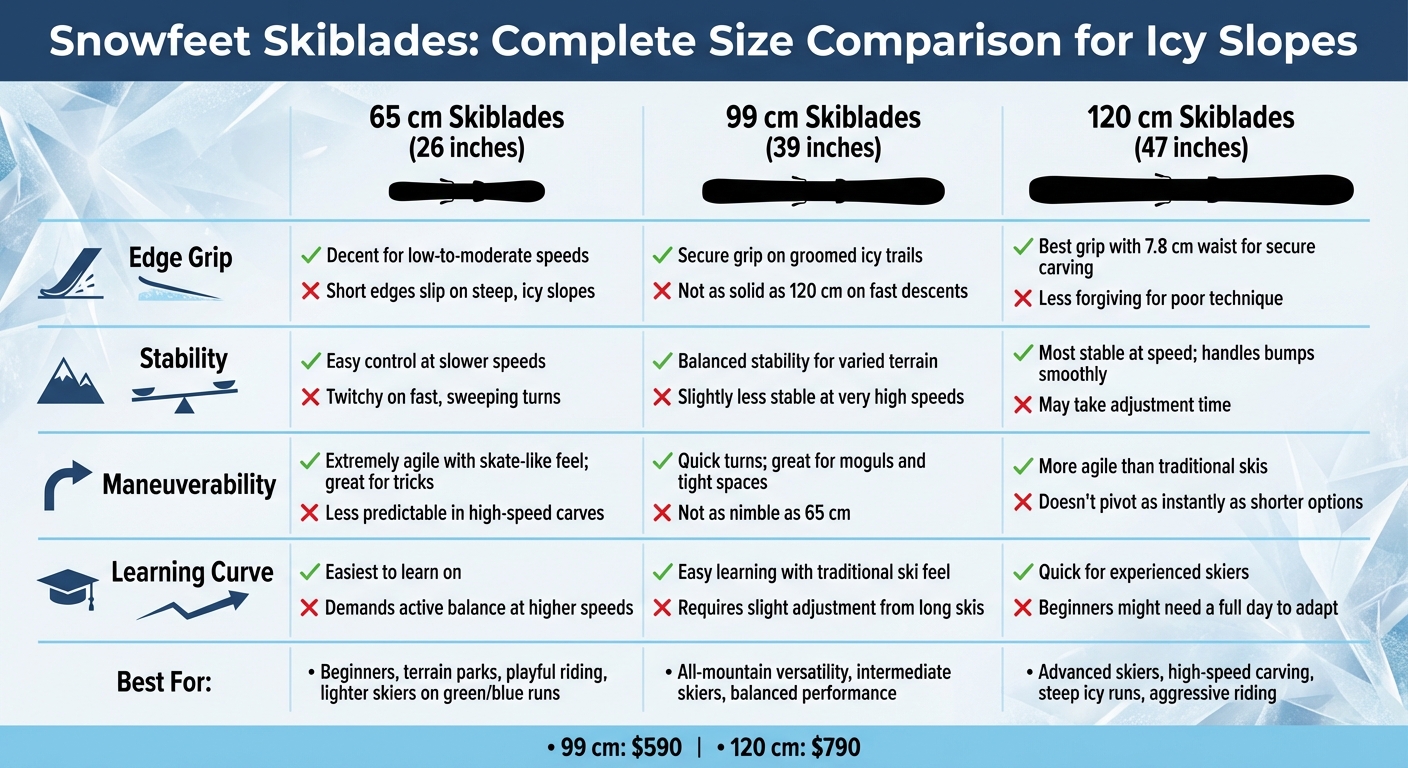
Snowfeet Skiblades Size Comparison: 65cm vs 99cm vs 120cm Performance Chart
Each Snowfeet* length comes with its own set of strengths and trade-offs, especially when tackling icy slopes. The 65 cm model is all about agility. It feels almost like skating, making it super easy to pick up and perfect for quick turns on narrow trails or in terrain parks. That said, its shorter edge doesn’t grip as well at higher speeds, and stability can be a challenge on steep, icy descents. This size is best for playful, moderate-speed riding rather than aggressive carving.
The 99 cm skiblades offer a middle ground. They’re more stable than the 65 cm model while still being easy to maneuver. They handle tight turns, moguls, and quick direction changes like a champ, though they don’t quite match the 120 cm model’s stability at high speeds. On most groomed icy runs, they perform reliably, making them a versatile choice.
At 120 cm, you get the best edge grip and stability. These skiblades excel on icy groomers, allowing for fast, aggressive turns that would leave traditional long skis feeling sluggish. However, they’re less forgiving if your technique isn’t polished. While they’re more agile than full-length skis, they don’t pivot as quickly as the shorter models. Experienced skiers usually adapt quickly, but beginners might need a bit more time to get comfortable.
Here’s a quick breakdown of the pros and cons for each size:
| Aspect | 65 cm Skiblades | 99 cm Skiblades | 120 cm Skiblades |
|---|---|---|---|
| Edge Grip |
Pros: Decent for low-to-moderate speeds. Cons: Short edges can slip on steep, icy slopes. |
Pros: Secure grip on groomed icy trails. Cons: Not as solid as the 120 cm on fast, firm descents. |
Pros: Best grip with the longest edge for secure carving. Cons: Less forgiving for skiers with poor technique. |
| Stability |
Pros: Easy to control at slower speeds. Cons: Feels twitchy on fast, sweeping turns. |
Pros: Balanced stability for varied terrain. Cons: Slightly less stable at very high speeds. |
Pros: Most stable at speed; handles bumps smoothly. Cons: May take some adjustment time for new users. |
| Maneuverability |
Pros: Extremely agile with a skate-like feel; great for tricks. Cons: Less predictable in high-speed carves. |
Pros: Quick turns and great for moguls and tight spaces. Cons: Not as nimble as the 65 cm model. |
Pros: More agile than traditional skis while staying versatile. Cons: Doesn’t pivot as instantly as the shorter options. |
| Learning Curve |
Pros: Easiest to learn on. Cons: Demands active balance at higher speeds. |
Pros: Easy learning with a more traditional ski feel. Cons: Requires slight adjustment from long skis. |
Pros: Quick for experienced skiers to pick up. Cons: Beginners might need a full day to adapt. |
For lighter skiers who stick to green and blue runs, the 65 cm model is a playful and fun choice. Heavier or taller skiers, or those who like to charge down hardpack terrain, will likely prefer the added support and performance of the 99 cm or 120 cm models. No matter which size you choose, all three models are easier to carry and use than traditional long skis, making them a great option for icy conditions at U.S. resorts. Plus, they deliver better control and maneuverability compared to both standard skis and snowboards.
Conclusion
Snowfeet* Skiblades bring a whole new level of control to icy U.S. slopes, outperforming traditional long skis in challenging conditions. With sizes ranging from 65 to 120 cm, these skiblades make turning and stopping on firm, slick surfaces much easier. Plus, their durable metal edges provide excellent grip when the snow gets icy. Given that many U.S. resorts rely on man-made snow and frequent grooming, these are exactly the kind of conditions where skiblades excel.
When it comes to picking the right model, it’s all about your skill level and how you like to ski. Beginners will love the 65 cm or 99 cm options - the shorter length makes learning easier and provides better stability on hard-packed snow. Intermediate skiers, who are already comfortable linking turns, will find the 99 cm skiblades hit the sweet spot between agility and carving stability. For advanced skiers tackling steep, icy runs with speed, the 120 cm model offers more edge contact and stability, all while being far less tiring than traditional full-length skis.
Each size has its strengths: the 65 cm skiblades are perfect for quick maneuvers and freestyle fun, the 99 cm model offers versatile, all-around performance, and the 120 cm option is ideal for high-speed stability.
Thanks to their lightweight, compact design, these skiblades let you ski longer without wearing yourself out. Whether you’re dealing with icy morning corduroy or choppy hardpack in the afternoon, Snowfeet* Skiblades handle it all with ease. They’re built to thrive in the varied conditions you’ll find at U.S. resorts, making every run smoother, more controlled, and, most importantly, more fun. Snowfeet* Skiblades are changing the game on winter slopes, one run at a time.
FAQs
Are skiblades better than traditional skis on icy slopes?
Skiblades, especially Snowfeet Skiblades, bring some big perks to the table when tackling icy, hard-packed slopes. Thanks to their shorter length, they focus your weight on a smaller edge, giving you better grip and making quick, precise turns a breeze. Plus, they’re lighter, easier to handle, and less tiring to use. This makes them a solid choice for both newbies and seasoned skiers who want a smoother ride on icy terrain.
On the flip side, traditional long skis spread your weight over a larger surface area. While that’s great for stability at high speeds and wide turns, it reduces edge pressure, making it tougher to stay in control on slick, hard snow. Long skis can also feel bulky and less forgiving in those tighter, icier spots. That’s where Snowfeet Skiblades really shine - perfect for those tricky conditions and super portable, they’re a win-win for anyone who loves the slopes.
What size skiblades are best for beginners on icy or hard-packed snow?
For those just starting out on icy or hard-packed snow, the 99 cm Snowfeet skiblades are a solid pick. They’re a great mix of stability and easy handling, giving you enough length to feel secure but staying short enough to make quick turns a breeze.
This size is perfect for beginners because it helps you gain confidence on tougher terrain. You can focus on learning techniques without feeling like you’re in over your head. Plus, Snowfeet skiblades are built to deliver excellent grip and precision on hard snow, making your ride smoother and way more enjoyable.
What’s the best stance for staying stable on skiblades?
To stay steady on skiblades, try adopting a slightly wider stance compared to traditional skis. Keep your knees bent just enough and center your weight over your feet. This positioning helps you stay balanced and ready to handle sudden changes in terrain, especially on those slick, icy patches.
Another tip? Stick to small, precise movements instead of big, sweeping turns. This approach lets you make the most of the quick maneuverability that skiblades - like the Snowfeet* models - are built for. With a bit of practice, you'll discover that skiblades give you impressive control and a solid sense of confidence, even when you're tackling hard-packed snow.











Leave a comment
This site is protected by hCaptcha and the hCaptcha Privacy Policy and Terms of Service apply.