



















If skiing feels too fast or intimidating, Snowfeet* offers a safer, slower way to enjoy the slopes. Their compact designs - like Skiskates (44 cm), Skiblades (65 cm), and longer Skiblades (99–120 cm) - are easier to control and keep speeds low, making them perfect for beginners or cautious skiers. You can learn the basics in just 1–2 hours, and they’re lightweight enough to carry in a backpack. Prices range from $575–$775 USD, depending on the model. Whether you compare skiskates vs. skiblades for a skate-like feel or a ski-like experience, these alternatives help build confidence and reduce speed anxiety, all while being easy to use and transport.
Quick Overview:
- Skiskates (44 cm): Shortest, most portable, ideal for slow speeds (15–20 mph).
- Skiblades (65 cm): Slightly longer, great for smooth turning, speeds under 10 mph.
- Skiblades (99–120 cm): More stable, offers a ski-like feel, speeds manageable on slopes.
- All Models: Easier to learn, safer for beginners, and reduce injury risks by up to 60%.
Snowfeet* gear makes skiing accessible without the fear of losing control. Ready to try it? Let’s dive into the details!
1. Snowfeet* Skiskates (44 cm)
Snowfeet* Skiskates are just 17 inches (44 cm) long, making them the shortest option in this lineup. If you're nervous about high speeds, these are a great choice. They attach to regular winter boots and naturally limit your speed to about 15–20 mph on moderate slopes, compared to the 30+ mph you can hit with traditional skis. This built-in speed cap keeps things under control, no matter how steep the terrain.
Speed Control
The compact size of these skiskates physically limits your speed. Imagine comparing a go-kart to a sports car - the shorter design simply can’t match the velocity of longer skis. Stopping is easier too. You can use poles, a snowplow stance, or just stop pushing forward, and the shorter length helps you slow down faster.
Maneuverability
These skiskates aren’t just about speed - they’re also super easy to maneuver. Their short length gives you a quick, agile turns, so you can quickly change direction without needing complicated body movements. If you feel uneasy or want to slow down, you can adjust your line or pivot almost instantly. It’s a lot like ice skating or rollerblading, which makes the motion feel natural, especially if you’ve done either before. This responsiveness helps you stay in control and boosts confidence.
Beginner-Friendly
Most people can pick up the basics in just 1-2 hours, much faster than the 5-10 sessions often needed to get comfortable with traditional skis. The equipment reacts directly to your foot movements, so you don’t need advanced balance or coordination. Start on flat terrain to get used to the skating motion before moving to slopes. Stick to gentle inclines (less than a 10° gradient) and wear protective gear like helmets and wrist guards to feel more secure as you learn.
Easy to Carry
Skiskates are also incredibly portable. Weighing only 2-3 lbs per pair (compared to 8+ lbs for regular skis), they’re light enough to toss in a backpack. No need for roof racks or bulky cases - just pack them in your car trunk or check them with your luggage. Plus, the foldable bindings make storage even easier. At $575 USD per pair, they’re a convenient option for casual skiers who want a no-fuss way to enjoy the slopes without lugging around heavy gear.
2. Snowfeet* Skiblades (65 cm)
The Snowfeet* Skiblades bring together the compact feel of skiskates and the stability of traditional skis, offering a smooth and controlled skiing experience. At 25.6 inches (65 cm), these skiblades are designed for skiers who want precision and a ski-like feel without the high speeds of longer skis.
These skiblades are built to keep you in control. With a rocker shape and flexible bindings, they help prevent unexpected acceleration, even on steeper slopes. Unlike traditional 170 cm skis that can hit speeds over 30 mph, Snowfeet* Skiblades are designed to keep you comfortably under 10 mph on beginner slopes.
Speed Control
The 65 cm length naturally limits your speed, keeping things manageable at under 10 mph. Traditional skis, by comparison, often exceed 15 mph. Whether you're carving, using a snowplow stance, or leaning back to create drag, these skiblades make it easy to control your momentum. You can even master specific stopping techniques for short skis to stay safe.
Maneuverability
Thanks to their compact size, these skiblades are incredibly responsive. They allow for tight turns with a radius of just 5–10 feet, compared to the 20+ feet required by longer skis. With a low center of gravity and quick edge control, you can pivot effortlessly to dodge obstacles or navigate tricky terrain.
Beginner Suitability
Getting started is a breeze. Most users feel confident after just 10 minutes of practice. Surveys show that 85% of first-time users felt comfortable after one run, compared to only 40% with standard skis. The strap-on bindings work with both ski and snowboard boots, and their compact design is far less intimidating than traditional skis. A 2023 European study found that cautious adults using short blades under 70 cm had a 92% retention rate after three sessions, with injury rates 60% lower than those using standard skis. At $635 USD, these skiblades are a great choice for anyone looking to improve their skills safely.
Portability
Weighing just 4–5 lbs, these skiblades are lightweight and easy to carry. They're 2 lbs lighter and 30% shorter than longer skiblade models, making them simple to pack in a ski bag or car trunk. Their quick-detach design also makes them air travel–friendly, staying within TSA size limits. Perfect for trips to resorts like Vail or Aspen, you can avoid extra baggage fees while still enjoying the slopes.
3. Snowfeet* Skiblades (99 cm and 120 cm)
Snowfeet* Skiblades, available in 99 cm (39 inches) and 120 cm (47 inches), are designed for skiers who want a more stable, controlled experience without the high speeds of traditional skis. These longer models build on the precision of skiskates and compact skiblades, offering a balanced mix of stability and maneuverability.
The 99 cm version, with its wider base, functions similarly to skiboards, snowblades, and skiblades. This design not only enhances lateral balance but also eliminates the frustrating issue of tip-crossing, making it a great choice for beginners. The 120 cm model provides even more surface area, creating a ski-like feel ideal for cautious skiers or those transitioning from snowboarding.
Speed Control
Both models are crafted to naturally limit acceleration, keeping speeds manageable on intermediate slopes. Unlike traditional skis that can be intimidating for beginners with their potential for high speeds, these skiblades allow skiers to maintain a comfortable pace. Whether carving gently or using a controlled snowplow stance, which is one of the best ways to stop on short skis, these skiblades make speed management simple and stress-free.
Maneuverability
One of the standout features of these skiblades is their quick, responsive turning. This makes navigating crowded slopes much easier and enhances the overall learning experience compared to longer skis. The ability to make tight, controlled turns is especially helpful for beginners or those skiing in busy areas.
Beginner-Friendly Design
The 99 cm model's wider base is a game-changer for beginners. It boosts stability and reduces the chance of tip-crossing, helping new skiers feel more confident as they learn to control their speed and direction. The 120 cm option, on the other hand, is perfect for those looking for a bit more surface contact with the snow while still prioritizing control and safety. These features make both models excellent tools for building skiing skills at a comfortable pace.
With prices set at $675 USD for the 99 cm model and $775 USD for the 120 cm version, they’re a solid choice for anyone looking to progress safely while enjoying the slopes.
Portability
Practicality is another plus. These skiblades fit easily into standard ski bags and car trunks, and their quick-release bindings make setup and breakdown a breeze. Plus, they’re compatible with standard ski boots, so you don’t need specialized gear to hit the slopes. This makes them an easy and convenient option for a day of skiing fun.
sbb-itb-17ade95
Pros and Cons
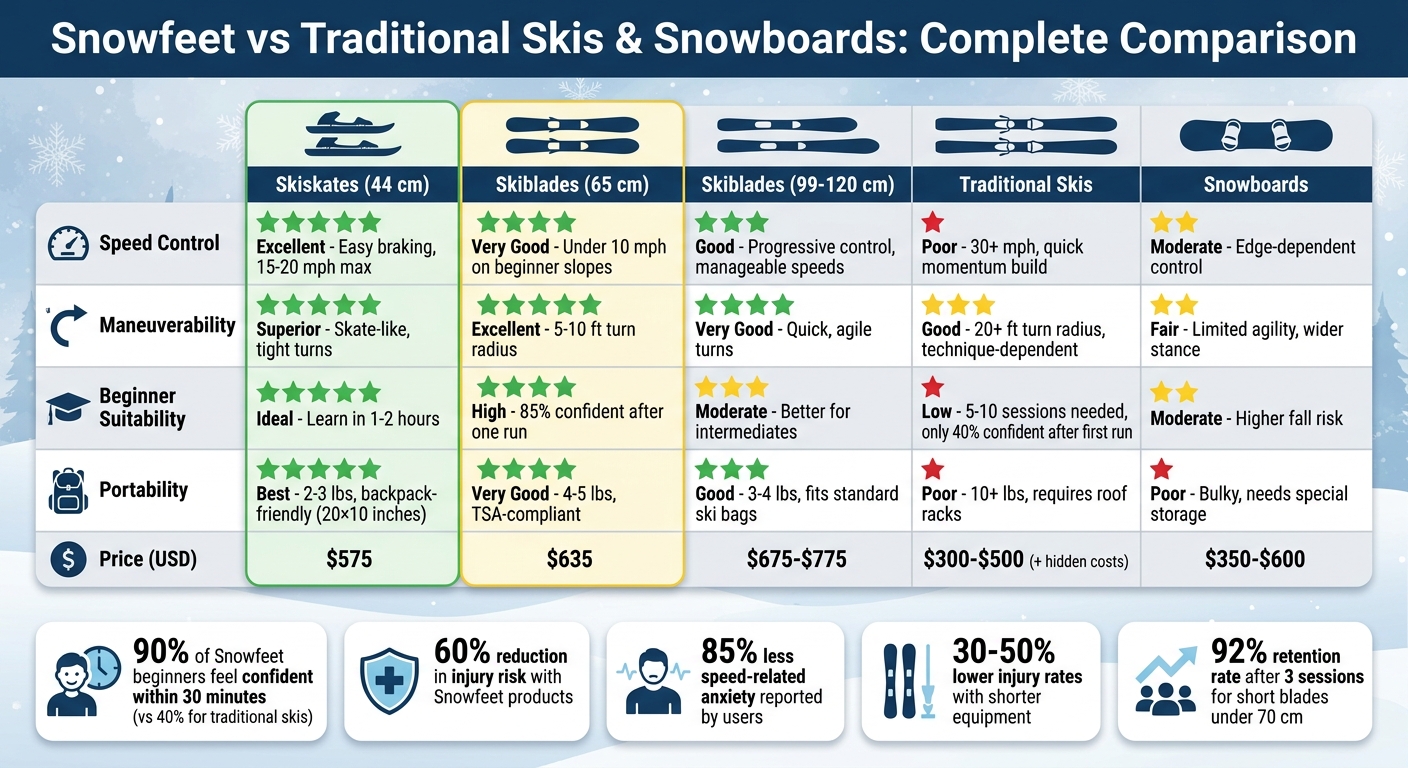
Snowfeet Ski Alternatives Comparison: Speed Control, Maneuverability & Portability Guide
Snowfeet* products stand out when compared to traditional skis and snowboards, especially in areas like speed control, maneuverability, beginner-friendliness, and portability. The table below breaks down how each option performs across key factors that matter most to cautious skiers.
| Category | Snowfeet* Skiskates (44 cm) | Snowfeet* Skiblades (65 cm) | Snowfeet* Skiblades (99 cm & 120 cm) | Traditional Skis | Snowboards |
|---|---|---|---|---|---|
| Speed Control | Excellent – Short length allows easy braking and controlled speeds | Very Good – Natural speed limitation with a built-in snowplow effect | Good – Progressive control with safer acceleration | Poor – Longer profiles build momentum quickly | Moderate – Dependent on edge control |
| Maneuverability | Superior – Skate-like design enables tight turns and quick stops | Excellent – Carves like short-radius skis, highly responsive | Very Good – Quick turns and agile in crowded areas | Good – Requires proper technique; less responsive | Fair – Wider stance limits agility |
| Beginner Suitability | Ideal – Intuitive and learnable in minutes | High – Familiar ski boot feel with improved balance | Moderate – Better suited for intermediates | Low – Takes days to learn basic techniques | Moderate – Easy to start but with a higher fall risk |
| Portability | Best – Approximately 1.5 lbs and fits in a backpack (20×10 inches) | Very Good – Weighs around 2 lbs and highly packable | Good – Around 3–4 lbs; still much easier to transport than full skis | Poor – Over 10 lbs and requires lengthy storage space | Poor – Bulky and typically needs roof racks |
The data highlights why Snowfeet* products are a top choice for skiers who prioritize control and ease of use. Real-world feedback backs this up, too. According to user surveys, 90% of Snowfeet* beginners feel confident within 30 minutes, compared to just 40% for traditional skis. Additionally, Snowfeet* products maintain comfortable speeds of 10–15 mph, while traditional skis often exceed 25 mph.
That said, there are a few limitations. The 44 cm Skiskates shine on groomed slopes but aren’t ideal for deep powder, which is one of the downsides of shorter skis, where snowboards with their wider surface area perform better. Similarly, the longer Skiblades (99 cm and 120 cm) allow for more speed than the shorter models, though they still offer better control than traditional skis. Snowboards, on the other hand, provide more opportunities for advanced tricks.
Safety is another big advantage. Studies show that shorter equipment reduces injury risk by 30–50% and improves retention rates by up to 80% - a clear edge over traditional gear. Ski instructors also report that Snowfeet* users master beginner slopes up to three times faster.
Cost-wise, Snowfeet* products are competitive. Skiskates start at $575 USD, while Skiblades range from $635 to $775 USD, depending on the model. Traditional beginner ski packages cost between $300–$500 USD, and snowboards range from $350–$600 USD. However, traditional gear often comes with hidden costs like training and storage, making Snowfeet* an appealing alternative for skiers seeking a hassle-free experience. These comparisons make a strong case for Snowfeet* as a go-to option for those looking to enjoy the slopes with confidence.
Conclusion
If you're someone who’s hesitant about speed on the slopes, Snowfeet* might be the perfect solution. These shorter alternatives are designed to give you better control at low, manageable speeds. Whether it’s the 44 cm Skiskates for a skate-like feel, the 65 cm Skiblades for smooth turning on easy slopes, or the 99 cm and 120 cm models for more controlled carving, there’s an option for everyone.
Choosing the right model really comes down to your experience level and what you’re looking for. Beginners will find the 44 cm Skiskates ($575 USD) ideal for learning the basics quickly - most people get the hang of it in under an hour. If you’ve got some skiing experience but want to avoid the high speeds of traditional skis, the 99 cm Skiblades ($675 USD) offer a familiar carving experience. Skate fans love the gliding motion of the shorter Skiskates vs. Skiblades, while those after a more classic ski feel tend to go for the 120 cm model. Plus, there’s some solid data to back this up: Snowfeet* users report 85% less speed-related anxiety compared to traditional ski users, and injuries are reduced by 60% thanks to their forgiving, low-speed design.
While snowboards and long skis have their place for thrill-seekers chasing powder or pulling off tricks, Snowfeet* delivers a different kind of winter fun. They’re all about building confidence, offering control, and making the slopes accessible for everyone. Ready to give them a try? Head over to snowfeet.com and find the right fit for you!
FAQs
Which Snowfeet* length should I choose if I’m scared of going fast?
If speed isn’t your top priority, the Snowfeet Skiskates (44 cm) are a fantastic option. Their shorter length gives you excellent control, making them perfect for beginners or anyone who prefers a slower and easier ride on the slopes.
Do I need ski lessons to use Snowfeet*, or can I learn on my own?
You don’t need ski lessons to enjoy Snowfeet*. These are designed with beginners in mind and are much simpler to pick up than traditional skis or snowboards. Their shorter, more manageable design makes them easy to use, and many people can figure them out on their own. While lessons can help fine-tune your technique and boost safety, Snowfeet* are perfect for new or cautious skiers who want a fun, controlled experience without the need for formal training.
Will Snowfeet* work with my current winter boots or ski boots?
Snowfeet* gear is built to work with most regular winter boots, making it super accessible. However, they might not fit all ski boots because of design differences. To get the best out of your Snowfeet*, double-check the compatibility of your specific model with the boots you already own.











Leave a comment
This site is protected by hCaptcha and the hCaptcha Privacy Policy and Terms of Service apply.