



















Standing on a ski slope for the first time can feel intimidating. Your body’s natural reaction to being off balance is fear, and that’s totally normal. But here’s the good news: choosing the right gear and learning a few basics can help you feel steady and confident fast. Shorter skis, like Snowfeet Skiblades or Skiskates, are beginner-friendly because they’re lighter, easier to turn, and simpler to control. Combine that with proper body positioning (keep your weight forward!) and practicing smooth turns, and you’ll be cruising down green slopes in no time.
Quick Tips:
- Gear: Start with shorter skis (like 65 cm or 99 cm Skiblades) for better control.
- Positioning: Lean forward, engage your core, and avoid the “backseat” stance.
- Turning & Stopping: Practice S-turns to control speed and stop safely.
- Mental Prep: Falling is part of learning - don’t stress about it.
- Warm-Up: Stretch before skiing to loosen up and boost balance.
With the right approach and equipment, skiing can go from nerve-wracking to fun in just a couple of days. Ready to give it a shot? Let’s break it down step by step.
Basic Techniques for Staying in Control
How to Balance and Position Your Body
To stay steady on the slopes, keep your weight forward. Leaning back - commonly called the "backseat" position - reduces pressure on the tips of your skis, causing them to chatter and making control harder. For proper balance, face your shoulders and torso downhill (toward the fall line) while letting your hips and lower body rotate naturally. Keep your pelvis neutral and engage your core to create a stable base. Also, make sure your knees align with your second or third toes instead of collapsing inward. Want to sharpen your reflexes for tricky terrain or low visibility? Try practicing one-leg stands with your eyes closed to boost your sense of balance.
How to Turn and Stop
Speed control starts with mastering your turns. Shorter skis, like Snowfeet* Skiblades (available in 65 cm, 99 cm, or 120 cm) or Skiskates (44 cm), make turning easier compared to traditional long skis, which are usually 60 to 72 inches. These shorter options allow for quicker, more precise movements and require less effort, making them perfect for beginners. Their agility helps you make frequent, controlled turns, which naturally regulate your speed and prevent you from gaining too much momentum. Snowfeet* Skiblades and Skiskates are especially handy for refining these techniques, offering quick responses with every move. Once you’ve got these turns down, managing your speed becomes second nature.
How to Control Your Speed
One of the best ways to control your speed is by practicing consistent S-turns while maintaining a forward stance. For beginners, skis around chin height can help you turn more easily and reduce fatigue, making your time on the slopes more enjoyable. This method not only helps you conserve energy but also keeps you in control throughout the day.
HOW TO CONTROL YOUR SPEED WHEN SKIING | How to slow down, control your speed and remain in balance
Choosing the Right Equipment for Beginners
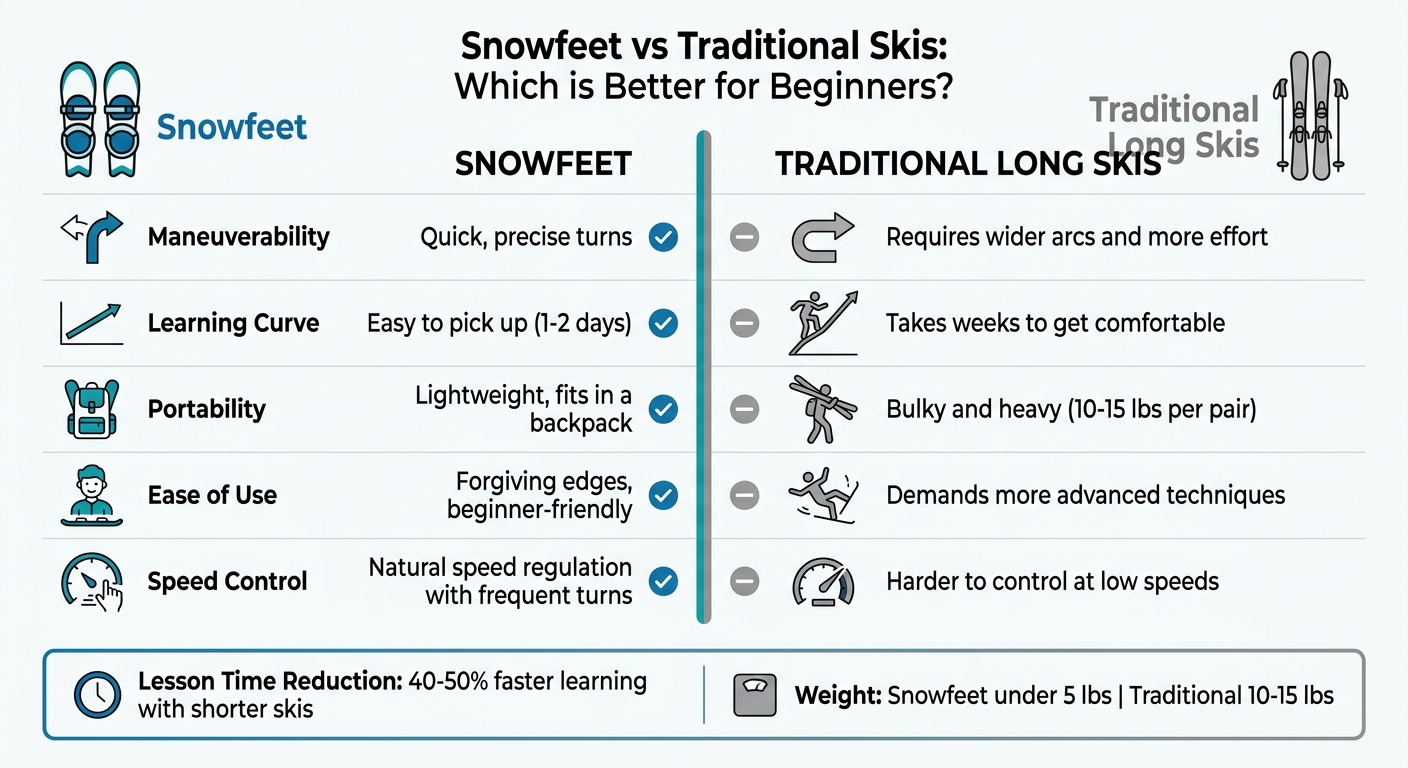
Snowfeet vs Traditional Skis: Beginner Comparison Guide
Pairing good technique with beginner-friendly gear can make learning to ski much smoother and more enjoyable.
Why Shorter Skis Are Easier for Beginners
Starting out with long, cumbersome skis can feel overwhelming. That’s where shorter skis come in - they’re less intimidating and much easier to manage. Traditional skis are typically 63–75 inches long, but Snowfeet* Skiblades (available in lengths of about 26, 39, or 47 inches) and Skiskates (around 17 inches) are nearly half that size.
The difference becomes clear on your first green run. A 99 cm pair of Skiblades, for instance, makes it much easier to recover from a slip on icy terrain compared to traditional skis, which average about 67 inches in length. In fact, ski instructors have found that beginners often learn faster with shorter skis - lesson time can be cut by 40–50%, with many users enjoying better control right away. Plus, Snowfeet* products are lightweight, with each pair coming in under 5 lbs, so your legs won’t get as tired during those early practice runs. For absolute beginners, the 65 cm Skiblades are a great choice for focusing on balance, while the 44 cm Skiskates offer a skate-like feel, making them perfect for mastering basic turns in just one session. This agility and ease of use make Snowfeet* an excellent stepping stone for transitioning to more traditional ski gear.
Snowfeet* vs. Traditional Long Skis
Here’s a quick comparison of Snowfeet* products and conventional long skis to help you decide what’s best for you:
| Feature | Snowfeet* Products | Traditional Long Skis |
|---|---|---|
| Maneuverability | Quick, precise turns | Requires wider arcs and more effort |
| Learning Curve | Easy to pick up (1–2 days) | Takes weeks to get comfortable |
| Portability | Lightweight and fits in a backpack | Bulky and heavy (10–15 lbs per pair) |
| Ease of Use | Forgiving edges, beginner-friendly | Demands more advanced techniques |
| Speed Control | Natural speed regulation with frequent turns | Harder to control at low speeds |
One standout advantage is portability. Snowfeet* gear is as easy to pack as a pair of shoes - no need to lug around a bulky ski bag. As Brad Tolin, a Snowfeet* user, shared:
These ski blades are enjoyable, easy to control, and more forgiving than traditional skis.
This forgiving nature comes from their soft flex design, which helps smooth out turns and reduces the chances of catching an edge - a common issue for beginners. Snowfeet* also offers different models tailored to various beginner needs.
Best Snowfeet* Products for New Skiers
Snowfeet* provides several options to match your skill level and preferences:
- Snowfeet* Skiblades 65 cm (starting at $635): These are perfect for beginners, especially those under 150 lbs. The wider waist design improves balance and makes stopping easier.
-
Snowfeet* Skiblades 99 cm (starting at $675): A great choice for those ready to move beyond the basics. These are excellent for carving turns while still being responsive. As MindySue, another Snowfeet* user, said:
I had a lot of fun with the 99s. They are easier to turn than skis.
- Snowfeet* Skiskates 44 cm (starting at $575): Ideal for freestyle moves or navigating uneven terrain. These have a skate-like design that feels natural, especially if you have skating experience. They’re also compatible with both ski boots and snowboard boots.
All models come with bindings that fit typical U.S. boot sizes (boot sole lengths of about 10–12 inches) and binding heights of 2–3 inches for better control. Before hitting the slopes, it’s a good idea to test your gear on flat snow to get a feel for it. Once comfortable, you’ll be ready to tackle those green circle runs in no time.
sbb-itb-17ade95
How to Progress Safely on Different Slopes
Choosing the right slope can make or break your learning experience in skiing. Green circle runs, often called beginner slopes, are perfect for practicing the basics. These slopes are gentle and wide, giving you the space to work on balancing, controlling your speed with the snowplow, and making those all-important first turns. The gradual incline keeps your speed in check, so you can focus entirely on improving your technique.
Once you're feeling more confident on these beginner-friendly slopes, keep this in mind:
As a beginner, it's wise to start on gentle slopes... The key thing here is not to rush; skiing is about enjoying the journey. With time and practice, you'll be ready to tackle more challenging terrain.
Make sure you master stopping and turning on green slopes before moving to blue runs. Using Snowfeet*, you can develop intuitive speed control, which is essential before tackling steeper terrain. Practice bringing yourself to a complete, controlled stop on a variety of gentle gradients - not just the flattest parts of the slope. Snowfeet* gear is designed for quick braking and sharp turns, making it easier to handle steeper slopes as you progress. Before taking on a blue run, ask yourself: Can I stop reliably when needed? Can I link my turns smoothly without picking up too much speed? If the answer is yes, you’re probably ready. If not, stick to green runs a bit longer and look for the best ski resorts for beginners to build your confidence at your own pace.
Stay off advanced slopes until you’ve mastered blue runs. Black diamond and double black diamond slopes are no joke - they’re steep, narrow, and demand precise edge control and lightning-fast reflexes. Even seasoned skiers take extra precautions, especially on icy days when staying in control is much tougher. Take your time; there’s no rush to tackle these challenging runs until you’re fully prepared.
Mental and Physical Preparation
How to Overcome Fear on the Slopes
Feeling nervous when you're learning to ski? Totally normal. The trick is not letting that fear take over. One of the key mental shifts is understanding that falling isn’t failure - it’s just part of learning. As The Snow Centre says, "Falling is a natural part of learning". Beginners often find themselves stuck between going too slow (which feels boring) and going too fast (which can be terrifying). That sweet spot? It takes practice to find.
Here’s a simple tip: your body tends to follow where your eyes go. So, instead of staring down at your skis, focus on the open slope ahead. This small change can help you feel more in control. Snowfeet* gear can also be a confidence booster - it’s designed to help you recover quickly if you do take a tumble. And when you fall, don’t let frustration get to you. Accepting help - whether from a friend or instructor - can make a big difference. Harvard researchers even point out that frustration can be your “biggest enemy”. [Choosing the right ski boots] (https://www.snowfeetstore.com/blogs/snowfeet_skiskates_skiboards_snowblades_skiblades_mini_skis_short_skis/how-to-choose-ski-boots-that-fit-perfectly-and-dont-hurt-2025-guide) is essential, as they can make it tricky to get back up on your own, so save your energy and let someone lend a hand.
Another thing to watch out for: fatigue and cold hands or feet. Wiggle your fingers and toes while waiting to keep your circulation going. If you notice you’re falling more often as the session goes on, it’s probably not you - it’s just your body getting tired. Harvard highlights that "you'll ski worse when you're tired". That’s your cue to take a break and recharge.
Once you’ve got your head in the right place, it’s time to master some essential skiing skills for beginners and get your body ready.
Warm-Up Exercises and Conditioning
Before you hit the slopes, spend 5–10 minutes warming up. Dynamic stretches like leg swings, hip circles, and gentle lunges are great for loosening up your muscles and improving flexibility. These stretches not only get your body ready for action but also help with balance and control. With Snowfeet*, you can even practice weight distribution indoors or in the lodge, thanks to their compact design.
Relaxation is just as important as strength. Tense muscles can mess with your movements, making them jerky and harder to control. Take a few deep breaths before starting, and consciously relax your shoulders, knees, and ankles. Snowfeet*’s shorter length encourages a more natural, relaxed stance - perfect for avoiding the stiff, awkward positions that beginners sometimes experience with longer skis.
Take Breaks to Prevent Fatigue
Even with all the prep, pacing yourself is key. For your first few days, aim for 3–5 hours of skiing. Overdoing it can lead to tired muscles, sloppy technique, and more falls.
Pay attention to how your body feels. If you start falling more after making progress earlier, that’s a red flag for fatigue. Take regular breaks to hydrate, warm up, and let your muscles recover. If you’re overheating and sweating, unzip your jacket or remove a layer to cool down. While Snowfeet* gear might let you ski a bit longer due to reduced physical strain, it’s still important to listen to your body and rest when needed.
Conclusion
Getting ready to hit the slopes? With some planning and the right approach, you can kick off your skiing adventure with confidence. Skiing becomes much more manageable when you’ve got the right gear and know the basics. Focus on good equipment, learn the fundamentals, go at your own pace, and prepare both mentally and physically. For beginners, shorter skis are easier to control - Snowfeet* Skiblades (65 cm, 99 cm, 120 cm) and Snowfeet* Skiskates (44 cm) are great choices to help you feel stable and in control from the start.
Nail the basics like proper stance, smooth turns, and controlled stops. These simple techniques are the foundation for building confidence and consistency. Combine that with a smart progression plan - stick to green circle runs until you're ready for blues, and save the advanced terrain for later. This step-by-step approach keeps things manageable and avoids the overwhelm that many beginners face. Plus, taking breaks and staying mentally prepared can turn a challenging day into an enjoyable one.
Feeling ready to start your skiing adventure? Grab a pair of Snowfeet* Skiblades or Skiskates and experience control, stability, and fun right from your first run. Gear up and make your first day on the slopes one to remember!
FAQs
Are Snowfeet* Skiblades easier than regular skis?
Snowfeet* Skiblades are much easier to handle than traditional skis, especially if you're just starting out. Their shorter lengths - 65 cm, 99 cm, and 120 cm - offer better stability and control, which can make a big difference for beginners. This compact design helps build confidence and makes the whole experience less intimidating compared to longer skis. Traditional skis, with their added length, often demand more skill and can feel a bit overwhelming when you're new to the slopes.
What size Skiblades should I start with?
For those just starting out, shorter Skiblades are a great choice because they offer better control and stability. Snowfeet's 65 cm Skiblades are an excellent option for beginners - they're easy to handle and ideal for learning the basics. If you're a taller beginner or have a bit of experience, you might want to look at the 99 cm size. However, sticking with the 65 cm Skiblades is usually the best way to skip the struggles of longer skis and build confidence right from the start.
Do I need ski boots for Snowfeet* Skiskates?
Nope, you don’t need regular ski boots for Snowfeet* Skiskates. These come with adjustable bindings that work with a range of standard footwear. That means you can strap them on with your regular shoes or even snowboard boots - no need for specialized ski boots.











Leave a comment
This site is protected by hCaptcha and the hCaptcha Privacy Policy and Terms of Service apply.