




















Looking to hit the slopes without the hassle of long skis? Short skis, also called skiblades or snowblades, are a game-changer, especially for beginners. They’re lighter, easier to control, and even fit in a backpack. Plus, you can use regular winter boots - no need for pricey ski boots. Here’s why they’re worth considering:
- Faster Learning: Most users master basics in 1–2 hours, compared to 4–10 hours with long skis.
- Portability: Compact enough to carry in a backpack - no roof racks or bulky bags needed.
- Cost-Effective: Starting at $179, they’re a budget-friendly alternative to long ski setups.
- Beginner-Friendly: Easier to turn, less tiring, and forgiving on mistakes.
While they’re not ideal for high speeds or deep powder, they’re perfect for groomed runs, terrain parks, and crowded slopes. Whether you’re new to skiing or just want a more convenient option, short skis let you enjoy the snow without the struggle.
Want to know more about models, features, and tips? Let’s dive in!
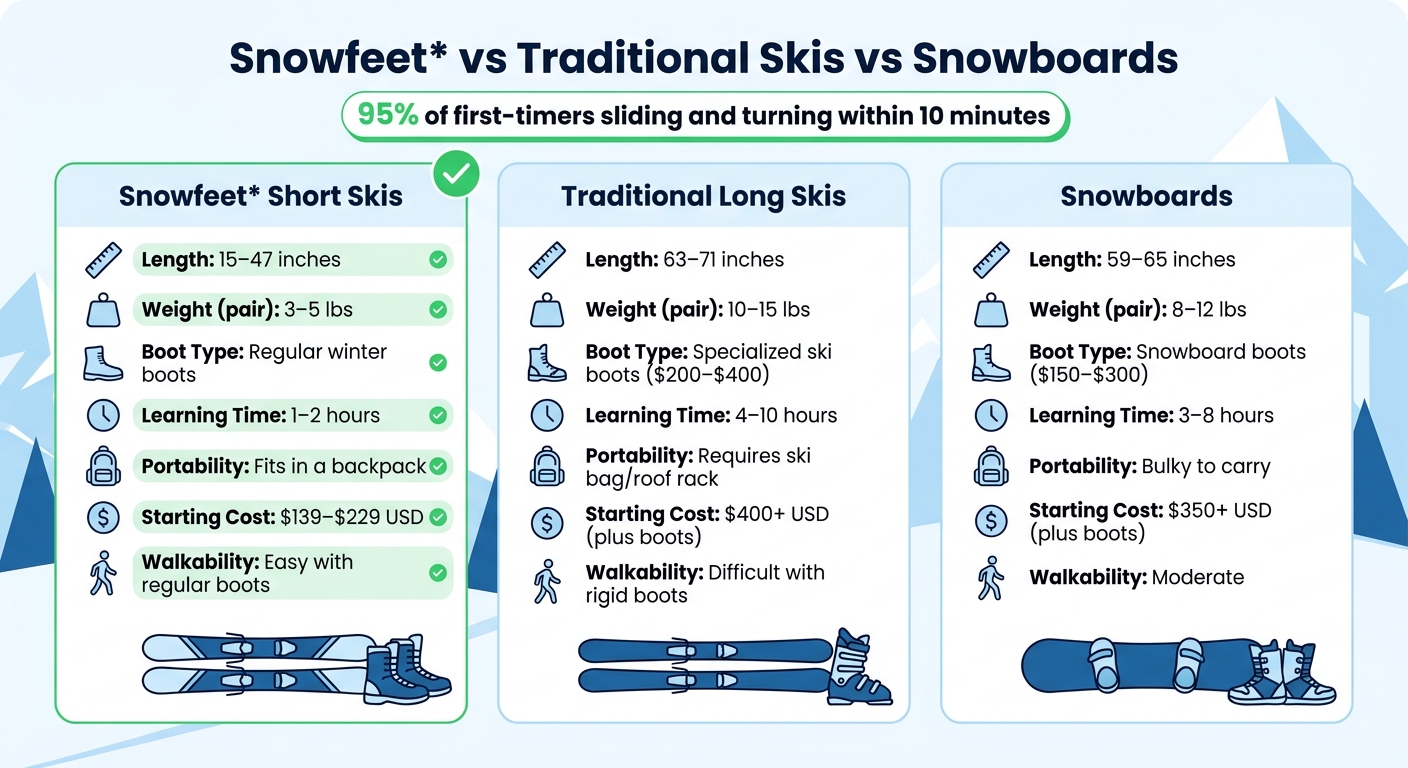
Snowfeet Short Skis vs Traditional Skis vs Snowboards Comparison
Are Short Skis Better for Beginners?
What Are Short Skis and How Do They Differ from Traditional Skis
Short skis are exactly what they sound like - skis that are shorter in length compared to traditional alpine skis. For beginners, they’re usually sized to about chin height, while more experienced skiers can adjust the length based on their preferences.
Their compact size makes them easier to maneuver, requiring less physical effort than traditional skis. Long skis, on the other hand, need more forward pressure and refined technique to maintain stability, especially at higher speeds or in deep powder. If you don’t apply enough pressure at the tips of long skis, they can become unstable - a challenge that’s far less of an issue with shorter skis.
Another key difference lies in the gear they use. Traditional skis require specialized alpine boots and bindings. But short skis, like Snowfeet* Skiblades and Skiskates, are compatible with regular winter or snowboard boots. This makes them a great option for beginners who aren’t ready to invest in a full alpine setup. Snowfeet* has nailed the balance between beginner-friendly performance and compatibility with standard winter gear.
However, short skis do come with trade-offs. They’re not as stable at high speeds and don’t perform as well in deep powder. But for groomed runs, terrain parks, and crowded slopes, they’re easier to handle, less tiring, and more forgiving - especially if you accidentally lean too far back (a common mistake). Unlike long skis, which can become difficult to control in this “backseat” position, short skis remain manageable.
The History of Short Skis
Short skis have been around for decades, designed as a more approachable alternative to traditional alpine skis. They first gained attention in the 1990s and early 2000s, marketed under names like skiblades, snowblades, and skiboards. These skis quickly became a hit with casual skiers and those looking for a playful, less intimidating way to enjoy the slopes. They were especially popular in terrain parks and on groomed runs.
While traditional ski manufacturers continued focusing on longer designs for advanced skiers, short skis carved out a niche of their own. Beginners loved them for their ease of use, and even seasoned skiers appreciated them as a fun change of pace. Over time, companies like Snowfeet* have improved the design, making short skis even more versatile and portable. Today, they’re compact enough to fit in a backpack and can be paired with regular winter boots, eliminating the need for bulky ski boots.
How Short Skis Function on Snow
The magic of short skis lies in their reduced surface area, which makes them easier to control. With less leverage required, you can shift your weight and change directions more quickly. This makes them ideal for groomed slopes and terrain parks, where quick, sharp turns are often necessary.
Here’s the deal: short skis don’t demand perfect technique to stay in control. They’re also easier to handle on flat terrain and narrow trails - places where longer skis can feel clunky and awkward. This is why they’re such a great fit for beginners who are still getting the hang of things.
Of course, there are some limitations. Short skis aren’t as stable at high speeds and don’t perform as well in deep powder. But for most beginners sticking to groomed runs or intermediate terrain, these trade-offs are minor. What you gain is a ski that’s easier to turn, less tiring to use, and far more forgiving when you’re working on your balance.
Why Snowfeet* Short Skis Beat Traditional Skis and Snowboards
If you're new to winter sports, you might be trying to decide between traditional long skis, snowboards, or something a little different - like Snowfeet*. Here's the deal: Snowfeet* short skis make learning easier, are lighter to carry, and offer a faster way to get comfortable on the slopes. They’re especially great for casual skiers who aren’t aiming for competitive runs.
Let’s break it down. Traditional skis are typically 63–71 inches long and weigh between 10–15 lbs per pair. They also require stiff, specialized ski boots that cost about $300 and, let’s be honest, aren’t exactly fun to walk around in. Snowfeet*, on the other hand, are much shorter - ranging from 15 to 47 inches - and weigh just 3–5 lbs per pair. Even better, you can use your regular winter boots, meaning no bulky bags or roof racks to lug around.
The learning curve for beginners is another huge difference. With long skis or snowboards, beginners often spend 4–10 hours just getting the hang of basic moves like turning and stopping. And snowboards? They can be just as tricky, with frequent falls as part of the deal. Snowfeet* flips the script. Most users master the basics in just 1–2 hours, and 95% of first-timers are sliding and turning within 10 minutes. If you’ve ever ice skated or rollerbladed, the movement feels natural. The shorter, lightweight design makes everything easier to control, giving you a smoother start to your skiing adventure.
"Short skis are actually easier to learn than long skis. Skiboards / Snowblades are very responsive, lightweight on your feet, and easy to ride as opposed to cumbersome long skis."
– Snowfeet FAQ
Main Advantages of Snowfeet* Products
Portability: Snowfeet* products are incredibly easy to transport. Take the Skiskates, for example - they’re just 44 cm long and weigh under 2 lbs per pair. Unlike traditional skis that need a dedicated ski bag or roof rack, Snowfeet* can fit in your backpack. They’re even small enough to take on public transportation or flights without extra hassle.
Boot Compatibility: Forget the rigid alpine boots that cost $200–$400 and are uncomfortable off the slopes. Snowfeet* works with sturdy winter boots you already own, saving you money and letting you walk around comfortably.
Lightweight Design: Made from aluminum and composite materials, Snowfeet* are light enough to reduce fatigue. You’ll be able to enjoy longer sessions on the snow without the strain you’d get from heavier traditional skis or snowboards.
Control and Maneuverability: The compact design of Snowfeet* makes turning easier and sharper with less effort. Beginners report about 50% better stability on icy or uneven terrain compared to long skis. Plus, with less risk of catching an edge, you can focus on the fun instead of fighting with your gear.
These perks become even clearer when you compare Snowfeet* directly to traditional skis and snowboards.
Snowfeet* vs. Traditional Skis & Snowboards
| Feature | Snowfeet* Short Skis | Traditional Long Skis | Snowboards |
|---|---|---|---|
| Length | 15–47 inches | 63–71 inches | 59–65 inches |
| Weight (pair) | 3–5 lbs | 10–15 lbs | 8–12 lbs |
| Boot Type | Regular winter boots | Specialized ski boots ($200–$400) | Snowboard boots ($150–$300) |
| Learning Time | 1–2 hours | 4–10 hours | 3–8 hours |
| Portability | Fits in a backpack | Requires ski bag/roof rack | Bulky to carry |
| Starting Cost | $139–$229 USD | $400+ USD (plus boots) | $350+ USD (plus boots) |
| Walkability | Easy with regular boots | Difficult with rigid boots | Moderate |
The numbers speak for themselves. Traditional gear often requires precise techniques and careful weight shifts, making it less forgiving for beginners. Snowfeet*, however, are more intuitive and responsive, letting you focus on having fun instead of worrying about complicated moves. These comparisons make it clear why Snowfeet* is such a smart choice for new skiers. It’s all about enjoying the slopes without the hassle of heavy, cumbersome equipment.
Snowfeet* Product Options for Beginners
Snowfeet* has four main models tailored to different skill levels and preferences. These are designed to make learning easier than traditional skis, while offering portability, control, and fun. Here’s a breakdown of the options:
Snowfeet* Mini Ski Skates (38 cm)
The Mini Ski Skates are the smallest and lightest option, weighing just 1.4 kg (3.1 lbs) per pair. At only 15 inches long, they’re super portable - small enough to fit in a backpack without needing a ski bag or roof rack. These are perfect for gentle slopes, snowparks, and casual fun. They work with regular winter boots, so you don’t need expensive ski boots. Pricing starts at $179 USD per pair.
Snowfeet* Skiskates (44 cm)
Skiskates take it up a notch with a wood core for better durability and edge grip. At 17 inches long and 1.8 kg (4.0 lbs) per pair, they’re still lightweight but offer more stability than the Mini Ski Skates. These are ideal for beginners looking for a smooth carving experience without bulky equipment. Their compact design makes them quick and responsive, great for tight turns. Pricing starts at $219 USD per pair.
Snowfeet* Skiblades (65 cm)
The Skiblades strike a balance between control and agility. At 26 inches long and 2.4 kg (5.3 lbs) per pair, they feature a wood core and a rocker profile for better edge hold on icy terrain. These are great for learning turns, trying out jumps in snowparks, and tackling beginner to intermediate slopes. They’re long enough for stability but short enough for playful maneuvering. Pricing starts at $269 USD per pair.
Snowfeet* Short Skis (120 cm)
The Short Skis are perfect for beginners who want to step up to more speed and flotation. At 47 inches long and 3.2 kg (7.1 lbs) per pair, they’re built with a wood–fiberglass core and pro bindings for excellent edge hold and carving ability. These are a great bridge to traditional skiing, offering more performance without the hassle of transporting full-length skis. Pricing starts at $349 USD per pair.
| Model | Length | Weight (pair) | Best For | Price (USD) |
|---|---|---|---|---|
| Mini Ski Skates | 38 cm (15 in) | 1.4 kg (3.1 lbs) | Casual fun, tricks, kids | From $179 |
| Skiskates | 44 cm (17 in) | 1.8 kg (4.0 lbs) | Beginner carving, groomed runs | From $219 |
| Skiblades | 65 cm (26 in) | 2.4 kg (5.3 lbs) | Carving, snowparks, balanced control | From $269 |
| Short Skis | 120 cm (47 in) | 3.2 kg (7.1 lbs) | Speed, flotation, advancing skills | From $349 |
All models attach easily to standard alpine ski boots (ISO 5355), and setup takes under a minute. They’re suitable for all ages, from young learners to experienced riders, and work well on groomed slopes, in snowparks, and even in light powder. Up next, we’ll cover the essential gear and setup tips to help you get the most out of these designs.
sbb-itb-17ade95
Required Gear and Setup for Short Ski Beginners
Snowfeet* short skis keep things simple when it comes to gear. Both Snowfeet* Mini Ski Skates and Skiskates work with regular winter boots, so you can skip the hassle (and cost) of renting ski boots. Beyond that, dressing right and staying safe on the slopes is key.
Start with the right clothing: wear three layers - a moisture-wicking base layer, an insulating mid-layer, and a waterproof outer shell to keep warm and dry. Safety-wise, a helmet is a must. According to NSAA data, helmets significantly reduce the risk of head injuries. Add goggles with anti-fog lenses (a good pair like Goodr Snow Goggles costs about $75), waterproof gloves, and tall ski socks made from wool or synthetic materials. Skip wearing two pairs of socks - it can actually cut off circulation and make your feet colder.
Taking care of your gear matters, too. Snowfeet* products come pre-waxed, so they’re ready to hit the slopes right out of the box. To keep them in top shape, wax your Snowfeet* at the start of the season and again mid-season - or every 5–7 days if you’re skiing a lot. To check if the edges need sharpening, see if they catch your fingernail; if not, they need a touch-up. After skiing, dry your gear thoroughly and store it in a cool, dry spot. At the end of the season, apply storage wax and loosen the bindings.
If you prefer professional maintenance, expect to pay around $15 for waxing or about $50 for a combined sharpening and waxing service. Or, grab a basic wax kit from Snowfeet* for as little as $6. Most beginners can stick to one professional tune-up per season. With proper care, short skis can last 100–150 days on the slopes, which is impressive considering their compact size and lower price compared to traditional skis, which often cost $650 or more.
Snowfeet* keeps skiing fun and hassle-free, both on and off the mountain.
How to Learn Skiing on Snowfeet*: Basic to Advanced
Basic Skills: Balance and Stopping
Starting with Snowfeet* is simpler than traditional skiing because their shorter length gives you more control right off the bat. To begin, stand with your feet shoulder-width apart, keep your knees slightly bent, and position one foot slightly ahead of the other for better stability. Lean your upper body forward, and keep your weight centered over the middle or back of your feet - leaning too far onto your toes can lead to falls.
To get moving, use a skating motion similar to hockey. This natural movement helps you glide smoothly on groomed slopes. Stopping is straightforward: distribute your weight evenly over both feet. If your Snowfeet* model has a built-in heel brake, use it to control your speed. As Snowfeet Store puts it:
"It is the same as learning to ski or skate. It takes some time but you will definitely have a lot of fun."
Once you’ve nailed balance and stopping, you’re ready to work on turning and tackling different types of terrain.
Turning and Moving Across Different Terrain
With the basics under your belt, it’s time to focus on turning. Snowfeet* makes this easier than traditional skis because of their compact design, which allows for quicker, sharper turns. Start practicing on groomed slopes before venturing into more varied terrain. Steer clear of deep powder or very steep slopes while you're still learning.
To turn smoothly, maintain a shoulder-width stance, keep your knees bent, and shift your weight gradually from one foot to the other. Regular maintenance, like waxing the bases and tuning the edges, keeps your Snowfeet* responsive and ready for action. For backward moves or tricks, shift your weight toward your toes and slightly lift your heels.
Moving Beyond Beginner Slopes
Once you’re comfortable turning on gentle slopes, you can take on more challenging runs. Snowfeet* makes it easier to progress from beginner to intermediate terrain. Try moderately steeper groomed slopes and focus on linking your turns together smoothly. As you gain confidence, start experimenting with carving - using your edges for sharper, more precise turns.
For carving, models like Skiblades or Short Skis provide extra surface area while staying easy to maneuver. Before you head out, adjust your bindings at home with a screwdriver and the boots you plan to wear - this small step saves time and avoids hassle on the slopes. Choose waterproof shoes with solid ankle support; snowboard boots work great for ski slopes, while sturdy winter boots are fine for other snowy activities.
This smooth progression from basic to advanced skills highlights why Snowfeet* is a fantastic choice for both beginners and those looking to level up their skiing game.
Snowfeet* Prices and Where to Purchase
You can snag Snowfeet* products exclusively from their official online store at www.snowfeetstore.com. They offer their full lineup there, and the best part? Free priority shipping is available for major markets like the US, Canada, Japan, Australia, and most of Europe. Standard delivery usually takes about 3 business days, though it might stretch to 3–8 days during the busy season.
Snowfeet* products range in price from $250 to $775, making them a budget-friendly alternative to traditional ski gear. Plus, they save you the hassle and added costs of bulky setups. If you’re someone who hits the slopes for more than four to eight days a season, buying Snowfeet* is a smart move - especially when renting traditional skis can set you back about $40 per day.
Here’s a quick look at the models they offer:
- Snowfeet Mini Ski Skates (38 cm): Starting at $250
- Skiskates (44 cm): From $575
- Skiblades (65 cm): Starting at $635
- Skiblades (99 cm): From $675
- Snowfeet Short Skis (120 cm): $775
For those looking to maximize performance, the premium Wood Core models are a great choice. If you’re on a budget, the Fiberglass Core options deliver solid value without breaking the bank.
What sets Snowfeet* apart isn’t just the price - it’s the combination of affordability and performance. With over 5,500 verified reviews and a stellar 4.9/5 rating from more than 50,000 riders, it’s clear they’ve carved out a loyal fan base. As Uncrate puts it:
"Far more portable and affordable than traditional skis or snowboards."
And customers agree. Nathan F. shares his experience:
"Absolute game-changer! They're light, fast, and incredibly fun to ride."
Another major perk? Snowfeet* gear fits neatly into a backpack, so you can skip the hassle of roof racks or specialized storage - something you can’t say about traditional brands like Salomon or Rossignol. Compact, easy to use, and designed for portability, Snowfeet* makes switching from bulky gear a no-brainer for skiers looking for convenience and fun on the slopes.
Conclusion: Why Snowfeet* Changes Winter Sports
Snowfeet* is shaking up winter sports by making skiing more accessible, whether you're a beginner or just looking for a lightweight, budget-friendly alternative. Unlike traditional skis, which require lengthy lessons and bulky gear, Snowfeet* lets you hit the slopes in no time. In fact, most newcomers pick up the basics in under two hours, compared to the 5–10 sessions often needed for long skis.
One of the standout features of Snowfeet* is its portability. You can toss them in a backpack and head to the mountains - no need for roof racks or oversized ski bags. With prices ranging from $250 to $775, Snowfeet* is also much easier on the wallet than traditional setups, which often cost over $500, not including boots.
But it’s not just about cost and convenience. Snowfeet* is making skiing approachable for everyone. The movements feel more like ice skating than traditional skiing, which lowers the intimidation factor and lets you enjoy the slopes right from the start.
Whether you’re exploring the Rockies or hitting a local resort, Snowfeet* offers a compact, flexible design that bulky snowboards and short skis vs. long skis simply can’t match. They’re versatile enough for groomed runs or backcountry trails, giving you the freedom to experience winter sports on your terms.
Ready to try a smarter, simpler way to ski? Check out www.snowfeetstore.com to see the full lineup, including the 65 cm Skiblades priced at $635, and join the growing community of Snowfeet* enthusiasts redefining winter fun.
FAQs
Are short skis allowed at my ski resort?
Yes, most ski resorts are fine with short skis, but it’s smart to double-check the rules for your specific destination. Some resorts might have equipment guidelines or safety requirements you’ll need to follow. Reaching out ahead of time can save you any surprises and help make your trip hassle-free.
Which Snowfeet* length should I buy as a beginner?
Short skis, like the Snowfeet skiblades (around 65 cm long), are a great choice for beginners. Their shorter length makes them easier to control and more responsive, which is perfect for learning. They’re designed to help you feel more confident on the slopes and make the learning process smoother.
Do I need poles with Snowfeet*?
Poles aren't necessary when using Snowfeet* products. These are crafted specifically for skiskating and shorter skiing techniques, emphasizing balance and natural body movement rather than pole assistance. This design makes them straightforward and beginner-friendly.












Leave a comment
This site is protected by hCaptcha and the hCaptcha Privacy Policy and Terms of Service apply.