



















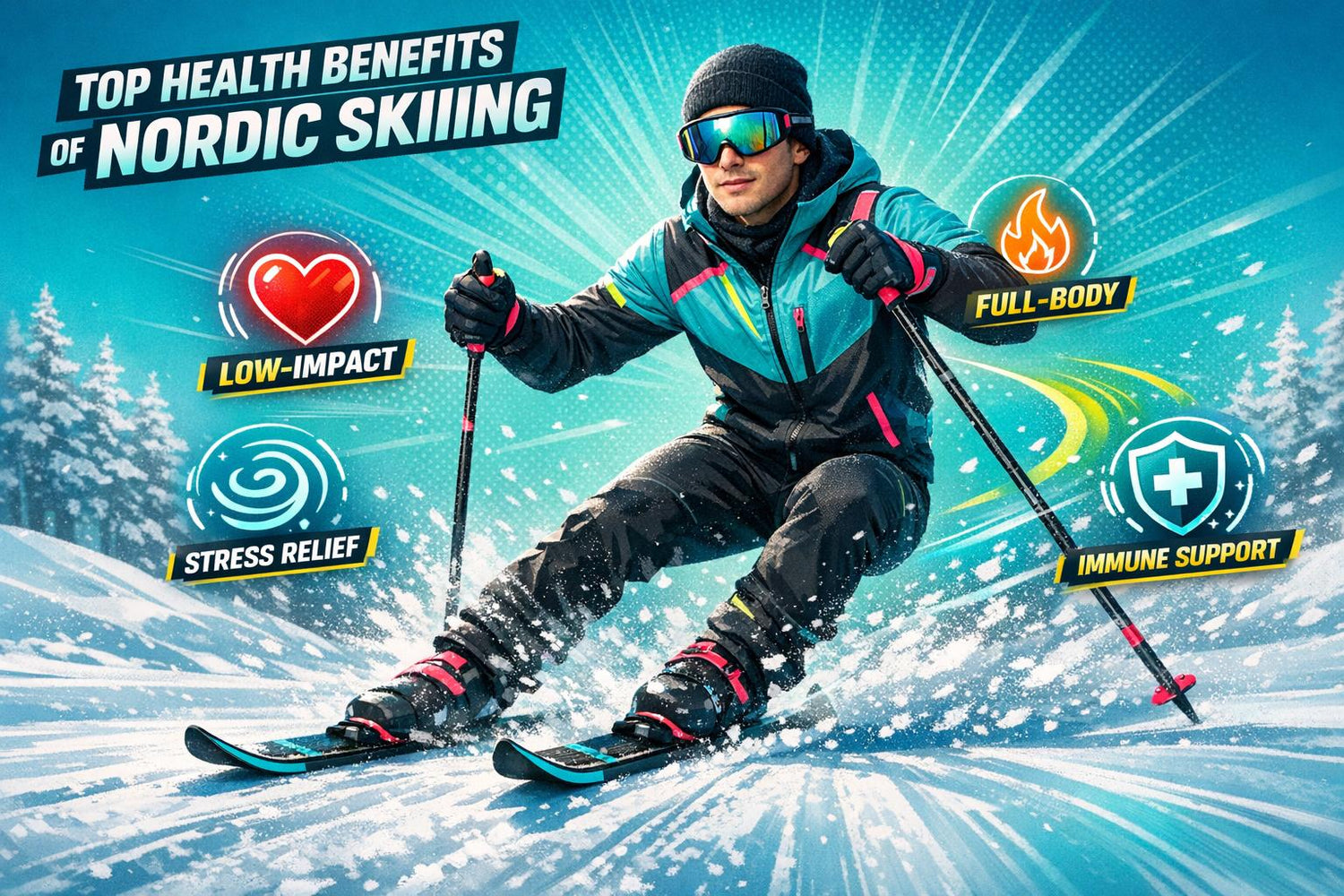
Nordic skiing is one of the best ways to stay active during winter. It’s a full-body workout that burns up to 900 calories per hour, strengthens your heart, builds muscle, and improves endurance - all while being gentle on your joints. Plus, it’s a great stress reliever and helps boost your immune system. Whether you’re a seasoned skier or just starting, it’s an activity that suits all fitness levels.
The Snowfeet NORDIC Cross-country Skate Skis make it even easier to enjoy these benefits. At just 90 cm (35 inches) long, they’re lightweight, portable, and beginner-friendly. These compact skis are perfect for anyone looking to dive into Nordic skiing without the hassle of bulky equipment.
Key Benefits of Nordic Skiing:
- Burns calories: Up to 900 calories/hour, depending on intensity.
- Boosts heart health: Improves cardiovascular fitness and VO2 max.
- Strengthens muscles: Works arms, legs, core, and back.
- Low-impact: Easy on joints, great for all ages.
- Improves balance and coordination: Engages multiple muscle groups.
- Reduces stress: Combines physical activity with the calming effects of nature.
- Supports immunity: Increases Vitamin D and strengthens overall health.
With Snowfeet NORDIC skis, you can enjoy all these benefits with a more portable and user-friendly option compared to traditional gear. Ready to hit the snow? Let’s break it down further.
Nordic Skiing vs Other Winter Sports: Calorie Burn and Health Benefits Comparison
1. Improves Cardiovascular Fitness Through Full-Body Movement
Calorie Burn and Cardiovascular Benefits
Nordic skiing is one of the best winter sports for getting your heart pumping. As you glide through the snow, your heart rate can reach 70-90% of its maximum - a level comparable to running a marathon but without the pounding impact on your joints. The number of calories you burn depends on your effort level and body weight, but the benefits go beyond just burning calories. According to the American College of Sports Medicine, consistent Nordic skiing can cut your risk of heart disease by 30-50%.
If that’s not impressive enough, there’s also evidence that skiing regularly can significantly improve your VO2 max (your body’s ability to use oxygen). In fact, after skiing three times a week for 45-60 minutes over 12 weeks, you could see a 10-20% boost in VO2 max. For context, elite Nordic skiers often have VO2 max levels above 90 ml/kg/min - some of the highest ever recorded.
This activity doesn’t just give your heart a workout - it also gets your whole body involved, making it a powerhouse for building strength and endurance.
Muscle Engagement and Strength Building
Nordic skiing is a full-body workout that engages almost every major muscle group. Your legs drive you forward, your core keeps you stable, and your arms and shoulders work hard with each pole push. This coordinated effort requires your heart to deliver oxygen efficiently to all these working muscles.
"Superior cardio due to diagonal stride engaging 85% more muscles than downhill skiing", says Dr. Steven Mucci, an exercise physiologist, citing data from the US Ski Association.
A 2022 Finnish study followed 50 recreational skiers using shorter skis, like Snowfeet* NORDIC Cross-country Skate Skis, and found some incredible results. Participants aged 35-65 saw their resting heart rate drop by 10 beats per minute and their VO2 max improve by 12% after just one season. Compact skis like the 90 cm (35 in) Snowfeet* NORDIC Cross-country Skate Skis make it easier for beginners to get started and enjoy these benefits. Beginners can start with 20-30 minute sessions on flat trails, focusing on technique, and many report 15-25% heart rate improvements within just 4 weeks.
Whether you're a seasoned skier or just starting, Nordic skiing is a fantastic way to improve your cardiovascular health and build strength - all while enjoying the great outdoors.
sbb-itb-17ade95
THE ULTIMATE FULL BODY WORKOUT : Why Cross Country Skiing SHOULD Be Your New Fitness Trend in 2026.
2. Builds Full-Body Strength and Muscle Tone
Nordic skiing doesn’t just benefit your heart - it’s a powerhouse for building strength across your entire body.
Muscle Engagement and Strength Development
Nordic skiing is one of the few activities that works your arms, legs, core, and back all at once. Unlike running or cycling, which mainly target your legs, Nordic skiing requires multiple muscle groups to work together. Every push of the poles and glide of the skis contributes to building strength that’s functional and balanced.
For example, the diagonal stride technique focuses on your biceps and triceps as you power through each pole push. Meanwhile, the double-pole technique, often used with skate-style equipment like Snowfeet* NORDIC Cross-country Skate Skis (90 cm or 35 in), activates your pectoralis major, deltoids, and latissimus dorsi. Your lower body plays a big role too. The quadriceps and calf muscles (gastrocnemius) are key for propulsion, and navigating uneven terrain involves squatting and lunging movements that improve both flexibility and muscle tone.
"Cross-country skiing is also an efficient way to exercise a large number of muscles at once. Because skiers use ski poles as a means of propulsion, the upper body gets much more of a workout when cross-country skiing compared to when running or cycling", explain Bridget A. Duoos and Anne Rykken, authors of Teaching Cross-Country Skiing.
Elite Nordic skiers are a testament to the sport’s effectiveness. Male athletes typically have about 5% body fat, while females average 11% - both much lower than the typical athletic ranges of 10% for men and 17% for women. You don’t have to train like a pro to see results, but these stats highlight how well Nordic skiing builds lean muscle and burns fat.
Skate-style skis like Snowfeet* NORDIC Cross-country Skate Skis make it easier to practice techniques like the double-pole motion, which places extra emphasis on your core, lats, and deltoids. Plus, their compact design offers better maneuverability and control compared to traditional skis. This is especially helpful for beginners, as it allows for a more effective upper-body workout while refining technique. With improved strength and muscle tone, these skis can help you take your performance to the next level.
3. Burns Calories Effectively for Weight Management
If you're aiming to lose weight, Nordic skiing offers one of the most effective workouts out there. It’s not just about the calories you burn during the activity - it’s about how efficiently your body uses energy when every major muscle group is working together.
Calorie Burn and Cardiovascular Benefits
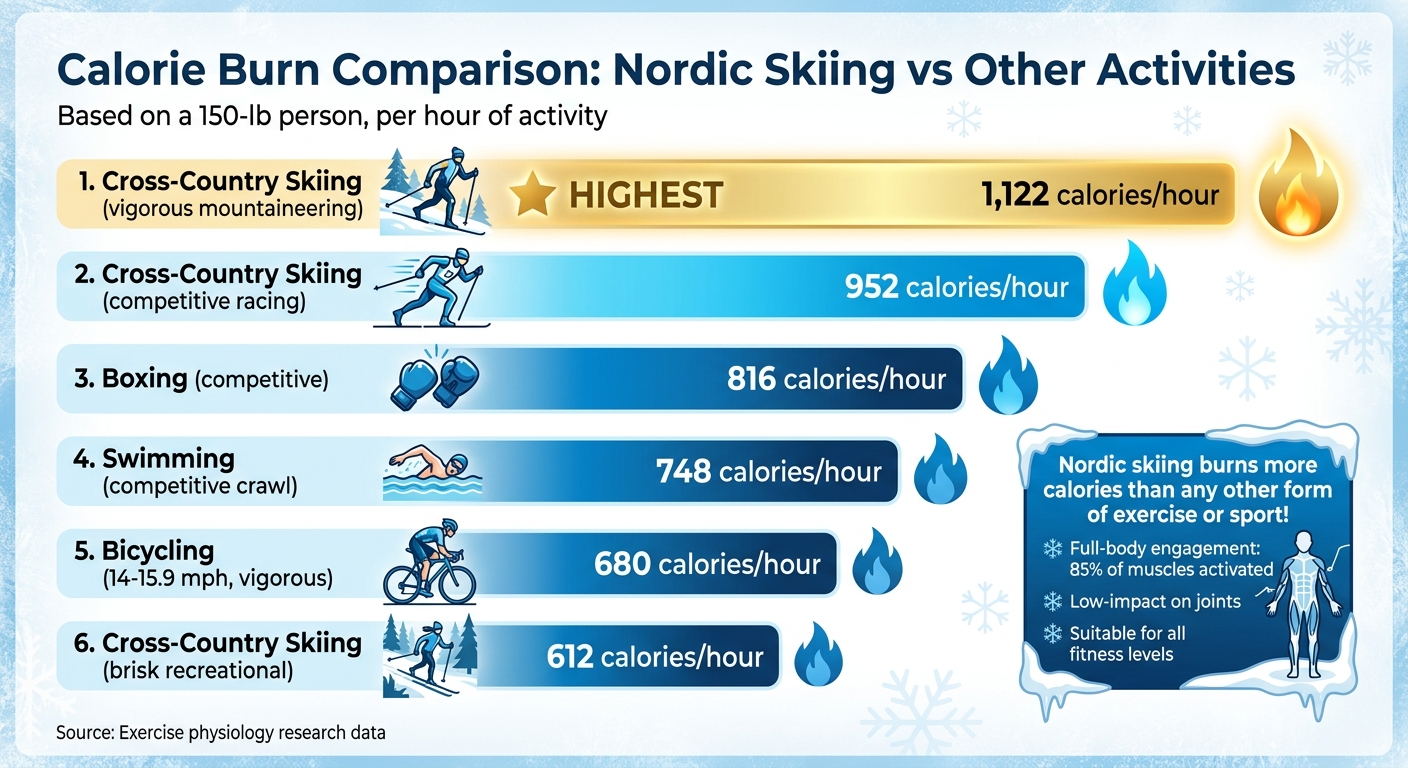
When it comes to burning calories, Nordic skiing is a standout. Unlike downhill skiing or snowboarding, where gravity does much of the work, Nordic skiing keeps you moving actively the entire time. Depending on your intensity level, you can burn 600–900 calories per hour. For those tackling vigorous backcountry mountaineering, the number can climb to 1,122 calories per hour for a 150-lb person.
"Nordic skiing burns more calories than any other form of exercise or sport - up to 1,122 calories per hour for vigorous backcountry mountaineering!" - AK, XCski Indiana
To put that into perspective, competitive Nordic skiing burns about 952 calories per hour, while brisk recreational skiing still comes in at 612 calories per hour. Compare that to other high-energy activities like competitive boxing (816 calories), swimming (748 calories), or vigorous cycling at 14–15.9 mph (680 calories), and it’s clear Nordic skiing is a calorie-burning powerhouse. Plus, the benefits don’t stop when you’re done - the elevated calorie burn can continue even after you leave the trails.
| Activity (Based on a 150-lb person) | Calories Burned Per Hour |
|---|---|
| Cross-Country Skiing (vigorous mountaineering) | 1,122 |
| Cross-Country Skiing (competitive racing) | 952 |
| Boxing (competitive) | 816 |
| Swimming (competitive crawl) | 748 |
| Bicycling (14–15.9 mph, vigorous) | 680 |
| Cross-Country Skiing (brisk recreational) | 612 |
This impressive calorie burn is thanks to the way Nordic skiing engages your arms, legs, and core all at once. To get the most out of your workout, focus on using both your "pushing" and "pulling" muscles, not just your legs. Adding variety to your routine - like tackling different terrains or increasing your pace - can activate even more muscle groups and further boost your calorie burn.
Joint-Friendly and Suitable for All Ages
One of the reasons Nordic skiing is so effective for weight management is its low-impact nature. The smooth, gliding motion reduces stress on your knees, hips, and ankles, making it easier to exercise for longer periods without the wear-and-tear that comes with high-impact sports like running . This makes it a great option for maintaining a consistent workout routine, which is key for weight control.
"The combination of using multiple muscle groups and maintaining a steady pace makes it an ideal choice for those looking to lose weight or maintain their fitness levels during the winter." - Jules, Undiscovered Mountains
Whether you’re a beginner, a seasoned athlete, or someone dealing with joint issues like arthritis, Nordic skiing can be tailored to suit your fitness level. Compact equipment like the Snowfeet NORDIC Cross-country Skate Skis (90 cm or 35 in) makes it even more accessible. These shorter skis are easier to maneuver compared to traditional 6–7 ft skis, helping you maintain control and proper form - especially when focusing on burning calories efficiently. They’re also a great winter cross-training option for athletes like runners, cyclists, and rowers who want to maintain their endurance and strength without the joint impact of their primary sport.
This combination of low impact and high efficiency not only supports weight loss but also boosts endurance and overall fitness.
4. Increases Endurance and Stamina
Full-Body Engagement for Superior Endurance
Nordic skiing pushes your entire body to work together, creating unmatched endurance. Unlike snowboarding or downhill skiing, which mostly target your legs, Nordic skiing activates your arms, legs, core, and back all at once. This full-body effort demands that your cardiovascular system supply oxygen to multiple large muscle groups at the same time, building not just muscle strength but also incredible stamina.
"Cross-country skiing is the only sport that has the combination of that we're standing upright and we're using all four limbs at the same time." - Stephen Seiler, Exercise Physiologist, University of Agder
Because you're upright during the activity, your heart and lungs have to work harder to pump oxygen-rich blood throughout your body. This is one of the reasons why cross-country skiers consistently achieve some of the highest VO2 max values recorded among athletes - up to 97.5 mL/(kg·min) for men and 74–78.6 mL/(kg·min) for women. The result? A sport that not only strengthens muscles but also dramatically boosts your endurance.
Aerobic Efficiency and Cardiovascular Adaptation
Nordic skiing requires sustained aerobic effort, which leads to noticeable changes in your body over time. With regular training, your muscles adapt to prolonged activity, becoming better at using oxygen and clearing out fatigue. At the same time, your heart becomes more efficient at pumping blood, and your lungs expand their capacity to exchange oxygen. These changes translate into greater stamina, even for everyday tasks.
"This increased peak air flow, together with strengthened diaphragm muscles, will enable you to exercise without 'losing your breath,' further increasing your stamina and endurance." - XCski Indiana
Elite Nordic skiers dedicate nearly 1,000 hours of training annually to build their aerobic capacity. But you don’t need to train like a pro to reap the benefits. Tools like the Snowfeet* NORDIC Cross-country Skate Skis (90 cm or 35 in) make endurance-building accessible for beginners. These shorter skis are more stable, allowing you to focus on the rhythmic motion that builds stamina without worrying about balance. Over time, this increased aerobic capacity helps you sustain longer workouts with less strain compared to high-impact sports.
Sustained Training Without Joint Strain
The smooth gliding motion of Nordic skiing is gentle on your joints, making it ideal for consistent training without the risk of overuse injuries. With the added stability of Snowfeet*, even beginners can maintain a steady, endurance-boosting rhythm for extended periods. This low-impact activity has a profound effect on cardiovascular endurance - Olympic-level Nordic skiers often have resting heart rates as low as 28 to 40 beats per minute, compared to the average person's 60 to 80 beats per minute. It’s a testament to how this sport builds endurance through consistent, low-impact effort.
5. Protects Joints with Low-Impact Exercise
Impact on Joints and Accessibility for Different Ages
Nordic skiing is a great option for anyone looking to stay active without stressing their joints. Its smooth, gliding motion minimizes the impact on your knees, hips, and ankles compared to high-impact activities like running or downhill skiing. While running delivers repeated jolts to your joints, Nordic skiing spreads the effort across your entire body, using fluid movements that are much gentler. This makes it a smart choice for people managing arthritis or other joint issues.
"The gliding motion reduces the impact on your knees, hips, and ankles, making it an ideal exercise for people of all ages and fitness levels, especially those with joint issues or arthritis." - Undiscovered Mountains
The difference lies in how your body handles stress. Strong muscles help protect your joints, and Nordic skiing builds that strength without the pounding forces that can lead to joint damage. The poles you use during skiing also take pressure off your lower body, providing extra support with every stride. This added stability can reduce the risk of falls, which becomes increasingly important as you age.
"In terms of the care and longevity of your lower joints, Nordic walking is certainly preferential." - Ben Kuharik, Exercise Specialist
The Snowfeet* NORDIC Cross-country Skate Skis (90 cm or 35 in) take this joint-friendly activity to the next level. Their compact, stable design makes them easier to control than traditional skis, which can feel bulky and increase the chance of falls. Beginners can start on flat terrain and ease into the activity with 5–10 minutes of warm-up exercises. You can adjust your pace based on how your body feels - if you notice sharp pain, it’s easy to slow down or take a break. This adaptability helps build strength while keeping your joints safe, laying the groundwork for even better joint protection as you continue.
Muscle Engagement and Strength Building
Nordic skiing works almost every major muscle group, which means the physical effort is spread across your body rather than being concentrated in your legs. This balanced workload allows your muscles to absorb most of the stress, sparing your joints from taking the hit. The use of poles not only provides propulsion but also reduces fatigue, making it easier to cover more ground - even if you’re recovering from an injury or have lower endurance. By strengthening the muscles around your joints, you’re giving them the support they need to stay healthy and pain-free.
6. Improves Balance, Flexibility, and Coordination
Enhances Balance, Flexibility, and Coordination
Nordic skiing is a full-body workout that requires the coordination of multiple muscle groups, which naturally improves balance and control. Each stride shifts your weight, engaging your core, legs, and arms to work together seamlessly. Techniques like the diagonal stride and double-pole movement train your brain and muscles to synchronize, while the squatting, lunging, and stretching motions improve flexibility and proprioception.
"Each movement challenges your balance, helping you develop better body awareness and coordination." - Jules, Undiscovered Mountains
For beginners, the Snowfeet* NORDIC Cross-country Skate Skis (90 cm or 35 in) are a great option. Their compact design offers more control and stability compared to traditional skis, making it easier to master weight shifts and coordinated movements. These skills not only enhance athletic performance but also contribute to better safety and improved mobility in everyday life.
Impact on Joints and Accessibility for Different Ages
Improved balance and coordination are also key to protecting your joints and reducing the risk of falls. A study by the Cleveland Clinic showed that a three-week Nordic-style movement program significantly enhanced coordination in cardiac rehabilitation participants. The added support from poles is especially helpful as balance naturally declines with age, offering stability and reducing the likelihood of falls.
Nordic skiing lets you control your pace, making it easier to gradually build coordination skills. Over time, this improved body awareness extends beyond skiing to daily activities, like walking on icy sidewalks or climbing stairs. Snowfeet* NORDIC Cross-country Skate Skis (90 cm) are designed for easy maneuverability, making these benefits accessible to skiers of all experience levels.
7. Reduces Stress Through Outdoor Activity
Mental and Emotional Health Improvements
Nordic skiing isn’t just great for your body - it’s a game changer for your mind. This winter sport blends physical activity with the soothing effects of nature. The steady, rhythmic motion paired with crisp, cold air helps release endorphins, those feel-good chemicals that naturally reduce stress and lift your mood. Plus, it’s a fantastic way to push back against the winter blues.
"The combination of physical exertion, fresh mountain air, and the peaceful, snowy surroundings helps reduce stress levels and release endorphins – the body's natural mood enhancers." - Jules, Undiscovered Mountains
Another bonus? Time spent outdoors during winter means soaking up natural sunlight, which can help fend off Seasonal Affective Disorder (SAD). Nordic skiing lets you enjoy that much-needed daylight, giving your body a Vitamin D boost. This not only supports your immune system but also keeps your mood in check during those darker, colder months. It’s a perk you just can’t replicate on a treadmill or stationary bike indoors.
What’s great about Nordic skiing is how it adjusts to your mood. Feeling like a calm, meditative glide through snowy trails? Go for it. Need to blow off steam with a high-energy workout? That works too. The sport meets you where you’re at. And with gear like Snowfeet* NORDIC Cross-country Skate Skis (90 cm), it’s easier than ever to hit the trails. These compact skis are portable and simple to use, making them perfect for quick trips to local parks or groomed trails. Rentals are also budget-friendly, averaging around $15 at some parks, or you can invest in your own pair for regular outings without breaking the bank.
Nordic skiing ties together mental and physical health benefits in a way that feels effortless, offering a complete approach to staying well during the winter months.
8. Strengthens Immune System and Overall Health
Cardiovascular Benefits and Immune Support
Nordic skiing doesn’t just give your heart a workout - it also gives your immune system a boost. By improving cardiovascular function and increasing Vitamin D levels from winter sunlight, this activity strengthens both your bones and your body’s natural defenses. Plus, regular sessions can help lower blood pressure and reduce your chances of developing heart disease.
Now, while intense exercise can sometimes temporarily weaken immunity, Nordic skiers seem to build stronger defenses over time. Helen Hanstock, a Senior Lecturer and Researcher at The Swedish Winter Sports Research Centre, explains:
"It appears that the most successful athletes – those that win medals at major championships – get fewer illnesses... This may be because their immune systems are better able to withstand heavy training".
On average, elite cross-country skiers experience about three upper respiratory tract infections annually. To stay on top of your game, consider taking a daily 25μg Vitamin D3 supplement during winter months and aim for at least 7 hours of sleep each night to help your body recover. And if you’re feeling a bit off, follow the "neck check" rule: symptoms above the neck (like a runny nose) mean moderate exercise is okay, but anything below the neck (like chest congestion) calls for rest. Ignoring this could lead to serious complications, such as myocarditis.
Mental and Emotional Health Improvements
Your mental health plays a huge role in your overall wellness, and Nordic skiing can be a game-changer here. Spending time outdoors, especially in winter, can lower cortisol levels (that’s your main stress hormone), reducing the risk of issues like high blood pressure and a racing heart. Research also shows that being in nature boosts mood and energy - particularly helpful for those battling depression.
Here’s where Snowfeet* NORDIC Cross-country Skate Skis really shine. At just 90 cm long, they’re lightweight, easy to pack, and a breeze to use compared to traditional skis. Their portability and short learning curve mean you can hit the trails without needing professional lessons. This convenience makes it easier to stay active, which not only supports mental health but also keeps your immune system strong. Snowfeet* proves that the right gear can make Nordic skiing more accessible and enjoyable, helping you stay both mentally and physically resilient.
How Snowfeet* NORDIC Cross-country Skate Skis (90 cm) Compare to Traditional Skis
When it comes to Nordic skiing, picking the right gear can make all the difference. Snowfeet* NORDIC skis, measuring just 90 cm (about 35 inches) and weighing around 2.2 lbs per pair, are compact and easy to carry. They’ll even fit in a backpack - no need for roof racks or bulky ski bags. On the other hand, traditional Nordic skis are much longer, typically between 180 and 210 cm (71–83 inches), and require dedicated storage, which can make spontaneous trips a bit of a hassle. Here’s a quick comparison:
| Feature | Snowfeet* NORDIC (90 cm) | Traditional Nordic Skis | Snowboards |
|---|---|---|---|
| Portability | About 2.2 lbs; fits in a backpack | 6–10 lbs; needs a roof rack or storage space | 5–8 lbs; requires a snowboard bag |
| Calorie Burn | 500–600 kcal/hour | 600–800 kcal/hour | 400–500 kcal/hour |
| Learning Time | 15–30 minutes | 5–10 hours | 3–5 hours |
| Joint Impact | Minimal joint stress (lower impact than running) | Low impact but slight hip strain possible | Higher ankle/knee torsion |
| Terrain Options | Great for groomed trails, flat snow, gentle slopes, and frozen lakes | Best for groomed tracks and long distances | Ideal for steep slopes and powder |
Snowfeet* also shine when it comes to ease of use. Most people can pick up the skating motion in just 15–30 minutes using their regular winter boots. Compare that to the 5–10 hours of practice and specialized boots needed for traditional Nordic skis.
When it comes to calorie burn, Snowfeet* hold their own, burning about 500–600 calories per hour - just shy of the 600–800 calories per hour typical of traditional Nordic skiing. They even outperform snowboarding, which generally burns 400–500 calories per hour.
Another big plus? Snowfeet* are easier on your joints. They’re designed to minimize joint stress, making them a favorite among physical therapists, especially for rehabilitation purposes. At $199 USD per pair, they’re also a more budget-friendly option compared to traditional Nordic ski setups, which can cost between $400 and $800.
Whether you’re gliding across frozen lakes or cruising groomed trails, Snowfeet* offer a fun, efficient, and joint-friendly way to enjoy Nordic skiing without breaking the bank - or your back!
Conclusion
Nordic skiing is more than just a winter sport - it’s a powerhouse for your health. It strengthens your heart, works your entire body, burns up to 700 calories an hour for a 190-lb person, and is gentle on your joints thanks to its low-impact nature. Beyond the physical perks, it’s also a stress-buster, an immune booster, and a great way to improve balance, helping you stay active and mobile as you age.
But here’s the thing: the right gear can make all the difference. Traditional Nordic skiing often requires bulky, specialized equipment. That’s where Snowfeet* NORDIC Cross-country Skate Skis come in. At just 90 cm (35 in) long and weighing only 2.2 lbs, these skis are lightweight, portable, and easy to use. You can strap them on with your regular winter boots and get the hang of the skating motion in just 5 minutes. Plus, they help you burn between 500 and 600 calories per hour while keeping stress on your joints to a minimum. It’s a sleek, no-fuss way to enjoy all the benefits of Nordic skiing.
"Committing to consistency over intensity is what's going to get you ready." - Alecia Williams, Fitness Coach
At only $199 per pair, Snowfeet* make Nordic skiing not only more accessible but also more affordable compared to traditional setups, which can run anywhere from $400 to $800. Whether you’re gliding across frozen lakes or cruising down groomed trails, these skis make it easy to embrace the joys and health benefits of Nordic skiing.
So, why wait? Grab a pair of Snowfeet* NORDIC skis and take your winter workouts to the next level while building strength, endurance, and better health this season!
FAQs
How often should I Nordic ski to see real fitness gains?
If you want to see real progress in your fitness from Nordic skiing, the secret is consistency. Try to hit the trails several times a week. This regular practice not only boosts your endurance but also strengthens your entire body. Pair it with some off-season training, and you’ll get even more out of this incredible full-body workout. Stick with it, and the results will follow!
What do I need to start Nordic skiing safely as a beginner?
To get started safely, having the right gear and a little know-how is key. For skis, go with something beginner-friendly like the Snowfeet NORDIC Cross-country Skate Skis (90 cm) – they’re compact and easy to handle. Dress in layers to stay comfortable, and don’t forget essentials like a hat, gloves, and a waterproof shell. Bring along water, snacks, and sunscreen to keep yourself fueled and protected. Stick to groomed trails at first, practice basic techniques, and if you can, learn from an experienced skier or take a lesson to build your skills and confidence.
Can Snowfeet* NORDIC skis work on untracked snow and hills?
Snowfeet* NORDIC skis are built to tackle untracked snow and hills with ease. They’re versatile enough for different terrains, like fresh powder and inclines, offering performance comparable to traditional Nordic skis. What sets them apart is their portability and simplicity, making them a great choice for skiers of all experience levels.













Leave a comment
This site is protected by hCaptcha and the hCaptcha Privacy Policy and Terms of Service apply.