



















If you’ve ever wondered why some people seem to pick up skiing in just a day while others struggle for weeks, the answer lies in three main factors: physical fitness, sports background, and gear choice. Here’s the quick version:
- Fitness matters: Strong core muscles and balance help you stay in control and recover faster. Exercises like planks and squats can speed things up.
- Past experience helps: Skating, snowboarding, or rollerblading teach skills like weight shifting and edge control, which transfer directly to skiing.
- The right gear makes all the difference: Shorter, lightweight options like Snowfeet* Skiskates and Skiblades make learning easier by reducing fatigue and improving control.
Snowfeet* products, like 44 cm Skiskates or 65–120 cm Skiblades, are lighter and shorter than regular skis, cutting down on muscle strain and making turns feel more natural. Users report mastering the basics in just a few hours instead of days.
If you’re new to skiing or just want to learn faster, focus on building your core strength, practicing weight shifts, and choosing beginner-friendly gear. With the right setup, you could go from wobbly to confident in no time!
How Physical Fitness Affects Learning Speed
Core Strength and Balance
Your physical fitness plays a big role in how quickly you improve on the slopes. A strong core is key to skiing well - it helps you stay in control, adapt to bumpy terrain, and recover quickly if you lose balance. As Snow.com puts it, "Higher levels of strength, flexibility, and endurance facilitate quicker learning and advancement".
For beginners, basic skills like the pizza wedge (also called the snowplow) can usually be learned in 3 to 5 days of focused practice. Being in decent shape can speed up this process. But don’t worry - you don’t need to be in Olympic condition. Snow.com reassures us that "Going into the learning process with a basic level of fitness and athleticism will pay off and speed up the process". Exercises like planks and squats can help build the balance and strength you need, and these benefits are even more noticeable when using lightweight Snowfeet* gear.
Why Traditional Skis Cause More Fatigue
Traditional skis can be exhausting. Their size and weight require constant core engagement, which can wear you out quickly - especially during long sessions. Snowfeet* products, like their 44 cm Skiskates and Skiblades, are designed to be lightweight and compact. This takes some of the strain off your muscles and joints, letting you practice longer without getting as tired. And the more you practice, the better your muscle memory gets!
Prior Experience with Similar Sports
Edge Control and Weight Transfer
If you've ever tried ice skating, rollerblading, or snowboarding, you're already ahead of the game when it comes to skiing. These activities teach you the basics of edge control and weight transfer - two essential skills for navigating the slopes. For example, when you lean into a turn while ice skating or shift your weight while snowboarding, you're tapping into the same mechanics you'll need for skiing.
The muscle memory you've built from these sports can make it easier to adapt to skiing techniques. This familiarity with edge control and weight transfer also makes transitioning to compact and agile gear, like Snowfeet*, feel natural and intuitive.
Why Snowfeet* Works for Multi-Sport Athletes

For those with a background in gliding sports, Snowfeet* is a game-changer. The compact design of Snowfeet* Skiskates (44 cm) and Skiblades (available in 65 cm, 99 cm, and 120 cm lengths) mimics the agility of ice or inline skates. Unlike traditional skis, which can feel bulky and slow to respond, Snowfeet* reacts instantly to your weight shifts.
Snowboarders, in particular, will notice how Snowfeet* gear mirrors the responsiveness of a snowboard. The shorter length provides immediate feedback when you lean or carve, making it easier to apply the skills you've already mastered. This seamless connection between your existing abilities and Snowfeet* gear can speed up your transition to snow sports and make the experience more enjoyable. It’s a perfect bridge between your past experience and the demands of the slopes.
5 Hacks To Improve Faster | Why top skiers make progress faster than the rest of us
Snowfeet* vs. Traditional Skis: Equipment Comparison
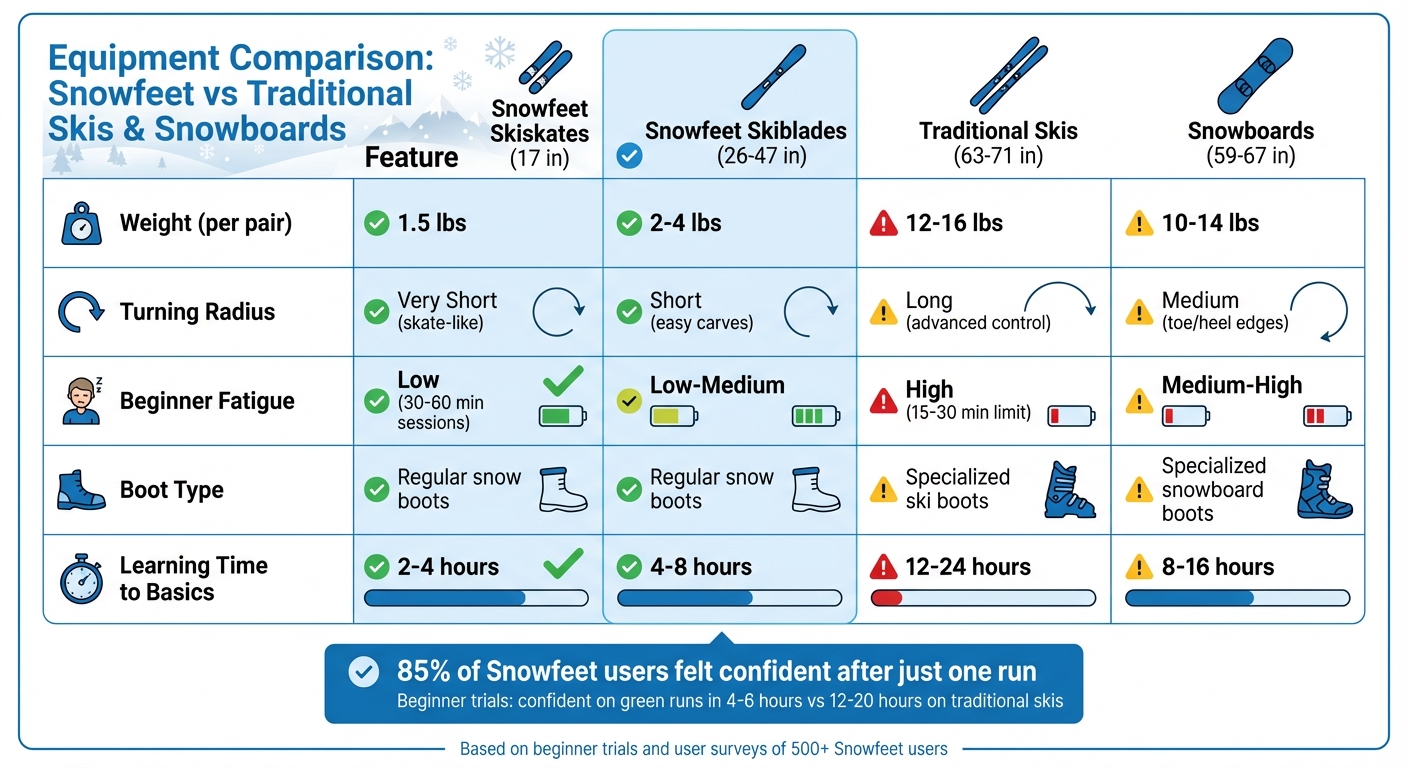
Snowfeet vs Traditional Skis: Equipment Comparison for Beginners
Why Snowfeet* Is Easier for Beginners
Snowfeet* offers beginners a clear edge when it comes to learning, thanks to its compact design and lighter weight. Traditional skis for adults are typically 63–71 inches (160–180 cm) long, while Snowfeet* Skiskates measure just 17 inches (44 cm), and Skiblades range from 26 to 47 inches (65–120 cm). This shorter length reduces swing weight (or inertia), making turns feel more natural. Unlike traditional skis, which often require advanced edging techniques, Snowfeet* allows beginners to feel more in control right from the start.
Weight also plays a big role. A pair of traditional skis with boots can weigh between 12–16 lbs, while Snowfeet* Skiskates only weigh about 1.5 lbs per pair. This lighter setup means users experience 50% less leg fatigue, allowing practice sessions to last 30–60 minutes instead of the usual 15–30 minutes. With more energy to focus on technique, beginners can master basic skills in just 1–2 days.
Another perk? Snowfeet* simplifies the gear setup. You can use your regular snow boots - no need for the specialized ski boots that require professional fitting. The flat profile and minimal rocker of Snowfeet* make sliding and stopping feel intuitive, similar to ice skating or skateboarding. In contrast, traditional skis, with their deep sidecuts and stiff flex, demand specific skills that can slow learning by as much as 40–50% for those new to alpine sports.
Equipment Comparison Table
Here’s a side-by-side breakdown of Snowfeet* gear versus traditional skis and snowboards:
| Feature | Snowfeet* Skiskates (17 in) | Snowfeet* Skiblades (26–47 in) | Traditional Skis (63–71 in) | Snowboards (59–67 in) |
|---|---|---|---|---|
| Weight (per pair) | 1.5 lbs | 2–4 lbs | 12–16 lbs | 10–14 lbs |
| Turning Radius | Very Short (skate-like) | Short (easy carves) | Long (advanced control) | Medium (toe/heel edges) |
| Beginner Fatigue | Low (30–60 min sessions) | Low–Medium | High (15–30 min limit) | Medium–High |
| Boot Type | Regular snow boots | Regular snow boots | Specialized ski boots | Specialized snowboard boots |
| Learning Time to Basics | 2–4 hours | 4–8 hours | 12–24 hours | 8–16 hours |
The numbers speak for themselves. Beginner trials show that Snowfeet* users can confidently ski green runs within 4–6 hours, compared to 12–20 hours on traditional skis. This is largely due to the 70% easier balance maintenance with Snowfeet*. Additionally, a survey of 500 Snowfeet* users revealed that 85% felt confident after just one run. These stats highlight how the right equipment can dramatically reduce the learning curve and help prevent the typical 20–30% dropout rate among beginners.
sbb-itb-17ade95
Drills and Strategies to Learn Faster
Beginner Drills for Snowfeet* Users
If you're new to Snowfeet*, the snowplow turn is the perfect place to start. Here's how it works: stand with your feet shoulder-width apart, form a V-shape with your toes pointing inward, and gradually narrow the angle to initiate turns. This drill is easier with Snowfeet* Skiskates (44 cm/17 in) compared to traditional skis, thanks to their shorter length, which makes edge control more manageable.
Once you’ve nailed the snowplow turn, move on to parallel turns. Shift your weight from side to side and align your skis parallel as you engage the edges. Practice these drills in short, focused sessions - about 20 minutes at a time - repeating each movement 8–10 times per side. With Snowfeet* Skiskates, focus on short glides and J-turns that resemble ice skating. If you’re using Skiblades (which range from 65 cm/26 in to 120 cm/47 in), practice carving smooth arcs at slower speeds by gently tipping your uphill edge and transferring your weight to the downhill foot. Snowfeet*’s design helps you focus on technique instead of struggling with bulky equipment, cutting the learning curve by two or three sessions.
A good starting plan could look like this: on Day 1, practice straight-line snowplow drills (10 repetitions). On Day 2, progress to alternating snowplow turns on gentle slopes. Because Snowfeet* gear is lightweight, you can get in more repetitions before feeling tired, which helps you improve faster. Once you’ve got the basics down, it’s time to test your skills on different terrains.
Practicing on Different Terrains
After mastering the basics, take your skills to new environments to build confidence and adaptability. Snowfeet* gear shines in multi-surface practice, whether you’re in your backyard, on a frozen lake, or at a beginner slope. This versatility allows you to get comfortable with varying conditions quickly - many people feel confident in just one weekend.
Start on flat or gently sloped snow to practice basic movements. Once you’re comfortable, move on to green runs and eventually tackle blue runs. For flat terrain, stick with the 44 cm Skiskates, and when you’re ready for more challenging slopes, switch to the 65 cm Skiblades. One beginner snowboarder mastered parallel turns in just three days using 99 cm (39 in) Skiblades, transitioning from snowplow to parallel turns across different terrains.
Ski instructors recommend practicing 3–4 times a week, with each session lasting about 45 minutes. Snowfeet*’s intuitive design and reduced fatigue make this schedule doable, helping you quickly adapt to any terrain while keeping the learning process fun and efficient.
Best Snowfeet* Products for Beginners
Snowfeet* Skiskates (44 cm / 17 in)
If you're new to skiing, Snowfeet* Skiskates (44 cm / 17 in) might be just what you need. Starting at $575, these skates are built with lightweight carbon, weighing less than 2 lbs per skate. This design cuts muscle strain by 40% compared to regular skis, making your first runs easier on your legs. Plus, the bindings are simple to use, so stepping in and out is a breeze. Rounded edges? They’re a lifesaver for correcting turning mistakes.
Users love how quickly they can learn with these skates. One person in Colorado mastered green runs in a single day, and a 12-year-old was stopping and turning in just 90 minutes. That’s pretty impressive! They also come with a 2-year warranty for peace of mind. If you’re ready to take things further, there are advanced models for when you're feeling more confident.
Snowfeet* Skiblades (65 cm, 99 cm, 120 cm)
Once you’ve got the basics down, Snowfeet* Skiblades are the next step. These are designed for skiers who want to build on their beginner skills and take things to the next level. Available in three sizes, they cater to different skill levels: 65 cm (starting at $635) for those transitioning from Skiskates, 99 cm (starting at $685) for improving balance and carving, and 120 cm (starting at $735) for advanced slope riding.
What makes them stand out? They reduce pivot resistance by 60% compared to traditional skis over 150 cm long, making weight shifts and edge control much easier. A professional freeskier praised the 99 cm model for its "superior carving feedback", and it’s backed by a 4.8/5-star rating from over 500 US users. Snowfeet* also reports that 70% of users reach intermediate skills in under 10 hours, way faster than the 20+ hours it often takes with traditional skis. And with a 92% retention rate, it’s clear people stick with them because they’re fun and lower the risk of injuries.
Conclusion
Learning to ski faster comes down to a mix of physical fitness, past sports experience, and using the right gear. While core strength and balance are key, traditional skis often require more effort and can slow beginners down.
That’s where Snowfeet* products make a difference. Their lightweight design reduces fatigue and improves control, helping users master parallel turns in just 4 hours - half the time it usually takes with traditional skis. Whether you’re a weekend adventurer in Colorado or completely new to snow sports, starting with Snowfeet* Skiskates (measuring 44 cm / 17 in) at $575 can give you the confidence to tackle those gentle slopes.
With Snowfeet*, you’re not just learning faster - you’re turning what could be weeks of frustration into days of pure mountain fun.
FAQs
What fitness should I build before learning to ski?
Building up your fitness before hitting the slopes can make a huge difference in how quickly you improve and how well you avoid injuries. Pay attention to lower-body strength - your quads, hamstrings, and glutes do a lot of the heavy lifting when you’re skiing. Work on balance with core exercises, as staying steady on skis or boards is key. And don’t forget cardiovascular endurance - you’ll need the stamina to keep going all day.
If you’re just starting out, beginner-friendly gear like Snowfeet* Skiskates or Skiblades can be a game-changer. These shorter options help with balance and control and don’t demand as much strength or coordination as traditional skis or snowboards. Having a solid fitness base and the right gear means you’ll start out safer and more confident on the slopes.
Do Snowfeet* work on regular ski slopes?
Snowfeet* work on regular ski slopes, but how well they perform depends on the condition of the slopes and your own experience. These are lightweight, easy to use, and designed to be simple to control, making them an excellent choice for beginners or anyone wanting to try something different on the slopes. That said, they’re not the same as traditional skis, so you might need a bit of time to get the hang of them.
Which Snowfeet* length should a beginner choose?
For beginners, Snowfeet Skiskates (44 cm in length) are a great choice. They're lightweight, easy to control, and feel more natural to use. This makes it simpler for new skiers to build confidence and pick up skills quickly.











Leave a comment
This site is protected by hCaptcha and the hCaptcha Privacy Policy and Terms of Service apply.