



















Learning to ski doesn’t have to mean spending the day face-first in the snow. The key? Shorter skis like Snowfeet skiblades and skiskates. These compact options (as short as 44 cm) make skiing easier by giving you more control, better balance, and less fatigue compared to long skis. Beginners using Snowfeet report falling up to 80% less and mastering the basics in just 1–2 hours instead of 4–6.
Here’s what you need to know:
- Why shorter skis help: Easier turns, quicker stops, and less effort.
- Gear options: Choose from skiskates (44 cm, $575) or skiblades (65–120 cm, starting at $635).
- Beginner tips: Focus on stance, stopping, and turning with simple drills.
- Falling? No problem: Snowfeet’s lightweight design makes standing up faster and easier.
With the right setup and techniques, you’ll spend less time falling and more time enjoying the slopes. Let’s dive into how to get started!
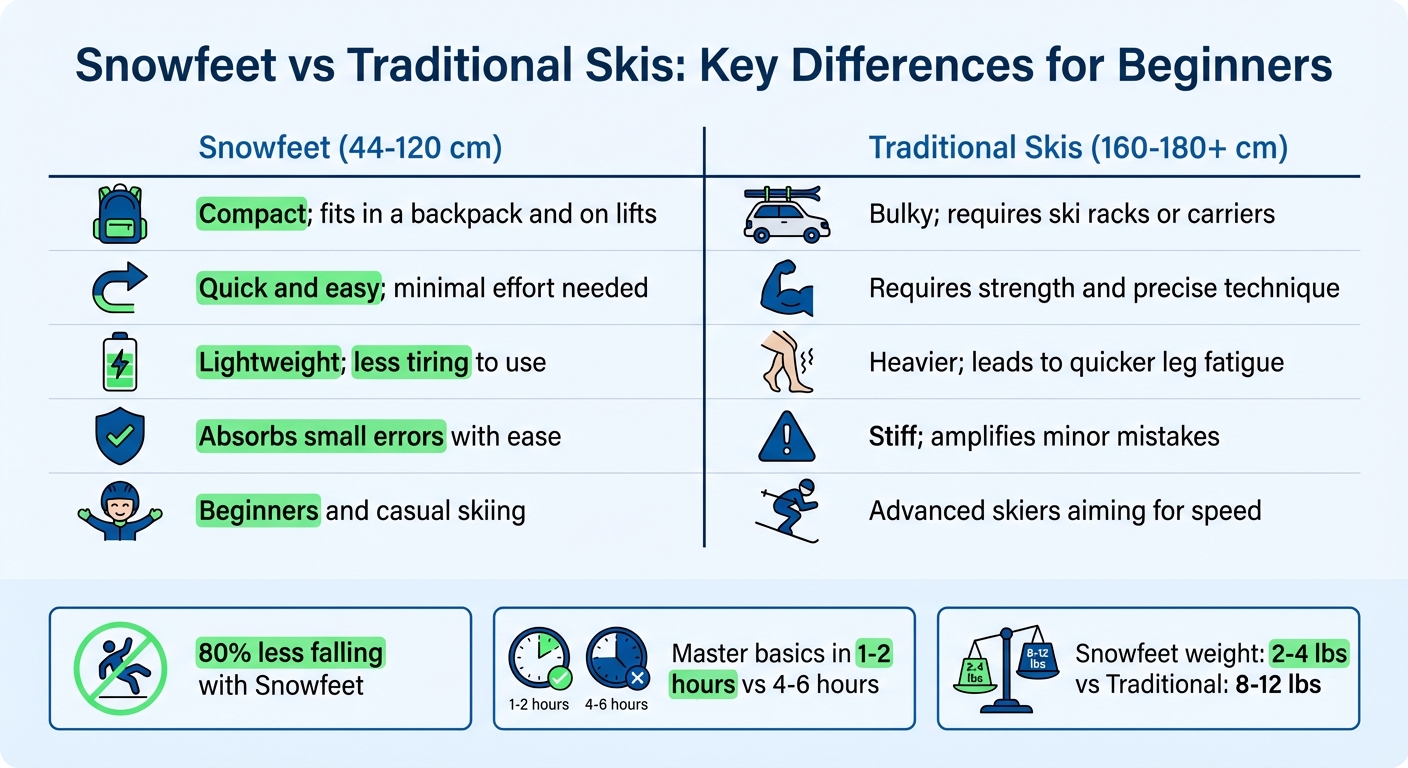
Snowfeet vs Traditional Skis: Beginner Comparison Chart
Are Short Skis Better for Beginners?
Why Snowfeet* Products Work Better for Beginners
Traditional skis, which are often 160 cm or longer, can be tough for beginners. They demand a lot of leg strength and leave little room for minor errors. This can make learning frustrating, as you're constantly trying to stay balanced. Snowfeet* products, however, offer a much easier starting point.
With their compact, lightweight design, Snowfeet* skiblades (available in 65 cm/25.6 in, 99 cm/39 in, and 120 cm/47.2 in) and skiskates (44 cm/17.3 in) make turning a breeze and reduce strain on your legs. This means beginners can practice longer without getting worn out. Plus, their forgiving design helps smooth out small mistakes, like leaning too far or accidentally catching an edge.
Snowfeet* vs. Traditional Skis: Key Differences
Here's how Snowfeet* stack up against traditional skis:
| Feature | Snowfeet* (44–120 cm) | Traditional Skis (160–180+ cm) |
|---|---|---|
| Portability | Compact; fits in a backpack and on lifts | Bulky; requires ski racks or carriers |
| Turn Initiation | Quick and easy; minimal effort needed | Requires strength and precise technique |
| Physical Fatigue | Lightweight; less tiring to use | Heavier; leads to quicker leg fatigue |
| Mistake Forgiveness | Absorbs small errors with ease | Stiff; amplifies minor mistakes |
| Best For | Beginners and casual skiing | Advanced skiers aiming for speed |
How Short Skis Improve Control and Balance
Snowfeet* keep your feet closer to your center of gravity, which naturally improves stability. Their shorter length also makes stopping and turning almost instant, giving you better control over your movements.
Traditional skis, on the other hand, can push beginners into awkward positions as they try to keep everything under control. With Snowfeet*, you can focus on learning proper techniques without the struggle of managing oversized gear.
Gear You Need to Get Started
Having the right gear can make learning to ski smoother and more fun - without needing to invest in heavy, pricey equipment. Snowfeet* products are a game-changer because they work with the footwear you already own. That means no need to rent or buy specialized ski boots.
Choosing the Right Snowfeet* Product
The first step is picking the Snowfeet* model that fits your riding style. Here's a quick rundown of your options:
- Snowfeet* Mini Ski Skates (38 cm/15 in, $250): Compact and portable, these work with regular winter shoes.
- Skiskates (44 cm/17.3 in, $575): Built with a durable wood core, they're great for tackling slopes.
- Skiblades (65 cm/25.6 in, $635): Ideal for a more traditional carving experience. For added versatility, you can opt for the 99 cm/39 in model at $675.
These models are compatible with US shoe sizes 6–13. Depending on the length, you can choose from different binding options: regular ski boot bindings for the longer models (99 cm and 120 cm), non-release bindings for shorter ones, or snowboard bindings if you prefer the comfort of snowboard boots over rigid ski boots.
Snowfeet* products simplify the skiing experience. Unlike traditional skis or snowboards, they’re lightweight and easy to manage, so you can focus on mastering your technique instead of wrestling with bulky gear.
And don’t forget safety! As Ed Zebrowski, Product Information Specialist at REI, emphasizes:
"You could be the best skier in the world. We're human, we crash. You've got to protect the most important part of your body".
That’s why a good ski helmet is an absolute must when using Snowfeet*.
Accessories and Clothing to Bring
Pair your Snowfeet* gear with the right accessories and clothing to stay comfortable and safe on the slopes. Start with goggles to shield your eyes from wind and snow. Use dark or mirrored lenses for sunny days, and yellow, gold, or rose-tinted lenses for overcast or low-light conditions.
For clothing, stick to the three-layer system:
- Base Layer: Choose moisture-wicking materials like merino wool or synthetics to keep sweat off your skin.
- Mid Layer: Opt for a fleece or wool sweater to trap heat.
- Outer Shell: A waterproof jacket and pants will protect you from snow and moisture.
Avoid cotton at all costs. As Nicholas Allen, Senior Sales Specialist at REI, points out:
"Cotton doesn't dry well. You get cold and your experience can take a downward spiral".
Look for jackets with powder skirts to keep snow out if you take a tumble.
Other essentials include waterproof, insulated gloves with gauntlets, knee-length moisture-wicking socks, wax for maintaining your Snowfeet*, and replacement straps. Toss in some hand and foot warmers to keep your fingers and toes toasty without sacrificing grip. With the right setup, you'll be ready to hit the slopes confidently and comfortably.
sbb-itb-17ade95
How to Learn Skiing with Snowfeet*: Step-by-Step
Got your Snowfeet* gear ready? Great! Now it's time to dive into some beginner-friendly techniques. Snowfeet* products are designed to make skiing feel natural, so you can skip the awkward fumbling with traditional gear and get straight to the fun part.
Getting Your Stance Right
First things first: nail your stance. Keep your knees bent, lean slightly forward over the balls of your feet, and make sure your shoulders are aligned with the direction you're heading. Keep your hands forward - it helps with balance. This athletic posture is the key to everything else.
Snowfeet* gear, with blade lengths ranging from 44 cm (skiskates) to 120 cm (skiblades), makes it easier to find and maintain this stance. The shorter design naturally lowers your center of gravity and gives quicker feedback. In fact, instructors have noted that beginners using Snowfeet* manage proper forward lean 30–50% more easily compared to traditional long skis.
Here are a few quick drills to practice on flat snow before tackling slopes:
- Shift side-to-side 10 times.
- March in place with a slight forward lean.
- Balance on one leg for 5–10 seconds.
These simple exercises can help you master your stance up to 70% faster than with traditional skis. Once you're comfortable, you're ready to move on to stopping and gliding.
Learning to Stop and Glide
Stopping is non-negotiable. Start with the snowplow stop: push your heels outward, tips inward, forming a V-shape (think "pizza slice"). Bend your knees and apply even pressure while keeping your gaze downhill. Thanks to the shorter blades - especially the 44 cm skiskates - it's easier to control your edges and stop smoothly.
Begin on gentle slopes with an incline of 10° or less. Start small:
- Practice snowplow shuffles on flat terrain for about 20 feet.
- Side-step up a small slope, then snowplow back down - repeat five times.
- Try straight glides from a 5-foot drop, keeping quick glances uphill to monitor your speed.
Most beginners can get the hang of gliding within 15–30 minutes with Snowfeet*. The lighter, shorter design also means steadier glides and fewer falls. For comparison, traditional skis often lead to poor stops, which account for 60% of beginner falls.
Once you've got stopping and gliding down, you're ready to tackle turns.
Making Your First Turns
Garland turns are a great way to ease into turning. Start with a straight snowplow for about 10 feet. Then, push the tail of one ski uphill to hold the garland position, flatten the ski to traverse the slope, and repeat on the other side.
When you're ready, move on to J-turns. Start in a snowplow position, shift your weight to the uphill ski edge, and release to turn. Do five reps on each side, and practice balancing on one ski while traversing to build confidence. The shorter 44 cm skiskates make carving feel natural, helping you pick up smooth turns 2–3 times faster than traditional skis.
Certified instructors recommend keeping a 70/30 weight distribution - 70% forward and 30% on the outside ski - while keeping your upper body steady. With Snowfeet*, balance errors tend to correct themselves, and most beginners can link turns without falling after just one hour of practice.
On U.S. slopes, from Colorado to Vermont, beginners using Snowfeet* often progress from a static stance to confident turns in about 2 hours. Compare that to the 4–6 hours it usually takes with traditional skis. That means less time falling and more time actually enjoying the ride.
Getting Up After a Fall
Once you’ve nailed your first turns, falling becomes part of the learning curve - but knowing how to bounce back quickly is what keeps you in control.
Falling is normal, and getting back up fast is the trick. This is where Snowfeet* gear really stands out.
Traditional skis can weigh 8–12 lbs per pair and stretch over 5 feet long, making them cumbersome when you’re trying to recover. On the other hand, Snowfeet* skiblades and skiskates are much lighter, weighing just 2–4 lbs per pair and measuring under 4 feet. That lighter weight means you’ll use about 50–70% less effort to stand up. In fact, a 2023 Snowfeet* survey found that 85% of users felt self-recovery was easier with their gear, compared to only 45% of traditional ski users. This design makes getting up a breeze - here’s how to do it.
Quick Recovery Tips
- Start by rolling to your side: Position your Snowfeet* gear downhill and parallel to the slope.
- Push up with your hands and uphill leg: Keep your weight forward as you rise.
- Shift into a forward stance: Once on your knees, lean forward and press onto your toes to stand up smoothly.
For example, beginners using the 44 cm (about 17 inches) skiskates on a 20-degree slope can often get back on their feet in under 15 seconds. Compare that to the 30+ seconds it typically takes with long skis, and you can see the difference.
Handling Steeper Slopes
If the terrain gets steeper, try the “kneel and rise” approach:
- Kneel on your uphill ski.
- Plant a pole uphill for extra support.
- Use your core strength to push yourself up.
Thanks to the lightweight build of Snowfeet*, you’ll face less resistance, making this move feel natural - even for beginners. Many users find that mini-skis encourage efficient recovery techniques right from the start, helping to build confidence quickly.
And let’s not forget snowboards. Unlike snowboards, which often require unstrapping bindings or flipping the board to get up, Snowfeet* skiblades feature simple straps that allow for instant detachment. Plus, since your legs move independently, you can cut recovery time by up to 40%.
Practice Makes Perfect
Start practicing on flat terrain to build muscle memory. This can reduce your falls by around 30% and make standing up second nature. Combine these recovery techniques with what you’ve learned about stance and turning, and you’ll see how Snowfeet* can make your learning journey smoother and more fun.
Conclusion
Learn to ski without spending most of your day picking yourself up from falls. With the right gear and techniques, you can build confidence and start enjoying the slopes much faster.
Snowfeet* skiskates and skiblades give beginners better control compared to traditional skis. In fact, trials have shown that beginners learn to ski up to three times faster and fall less often when using Snowfeet* instead of regular skis. From your stance to recovery, every step has been fine-tuned with Snowfeet* to make the learning process smoother.
By focusing on these techniques while using Snowfeet*, you'll notice progress right away. You'll master essential skills like stance, stopping, turning, and recovery more efficiently. And when you do fall (because let’s face it, everyone does), Snowfeet* gear makes it easier to get back up and keep going, so you spend more time skiing and less time stuck in the snow.
Whether you're carving turns at Tahoe, Vail, or your favorite local resort, Snowfeet* transforms those early, frustrating days into a fun and approachable learning experience. Take these tips, hit the slopes, and see how Snowfeet* can help you enjoy skiing like never before.
FAQs
Are Snowfeet* allowed at most U.S. ski resorts?
There’s no definitive information on whether Snowfeet* products are permitted at most ski resorts in the U.S. To avoid any surprises, it’s best to contact the specific resort you plan to visit and confirm if their policies allow Snowfeet* gear.
Which Snowfeet* length should I start with?
For those just starting out, shorter Snowfeet skiblades - like the 65 cm or 99 cm models - are a great choice. These lengths offer better control and balance, which can make learning much smoother and help you feel more confident on the slopes. Snowfeet gear is built to be easier to use compared to traditional skis or snowboards, so beginning with a shorter blade lets you focus on mastering the basics. Once you're comfortable, you can consider moving up to longer options, like the 120 cm skiblades.
Do I need ski boots, or will my regular winter shoes work?
Snowfeet products let you skip the hassle of traditional ski boots. Their skiblades and skiskates are designed to pair with your regular winter shoes or lightweight boots. This makes them a great option for beginners who might find long skis and bulky boots intimidating. While traditional ski boots are essential for the support needed with long skis, Snowfeet gear keeps things simple. No specialized footwear means hitting the slopes is easier and more enjoyable for newbies.











Leave a comment
This site is protected by hCaptcha and the hCaptcha Privacy Policy and Terms of Service apply.