



















Skiing for the first time can feel like a mix of excitement and frustration. Many beginners struggle with common mistakes that make learning harder than it needs to be. Here’s the good news: small tweaks to your technique - and the right gear - can make a big difference. This guide covers five frequent beginner errors, why they happen, and how to fix them. Plus, we'll explain how shorter skis like Snowfeet Skiblades and Skiskates can simplify learning and help you feel more in control.
Key Takeaways:
- Leaning back is a common issue - stay forward for better control.
- Avoid the A-frame stance by keeping knees aligned and weight balanced.
- A hip-width stance (not too wide) improves stability and mobility.
- Start on gentle slopes and avoid over-relying on the snowplow technique.
- The right gear matters: shorter skis are easier to handle and boost confidence.
Learning to ski doesn’t have to be overwhelming. Let’s break it down and get you gliding down the slopes with ease!
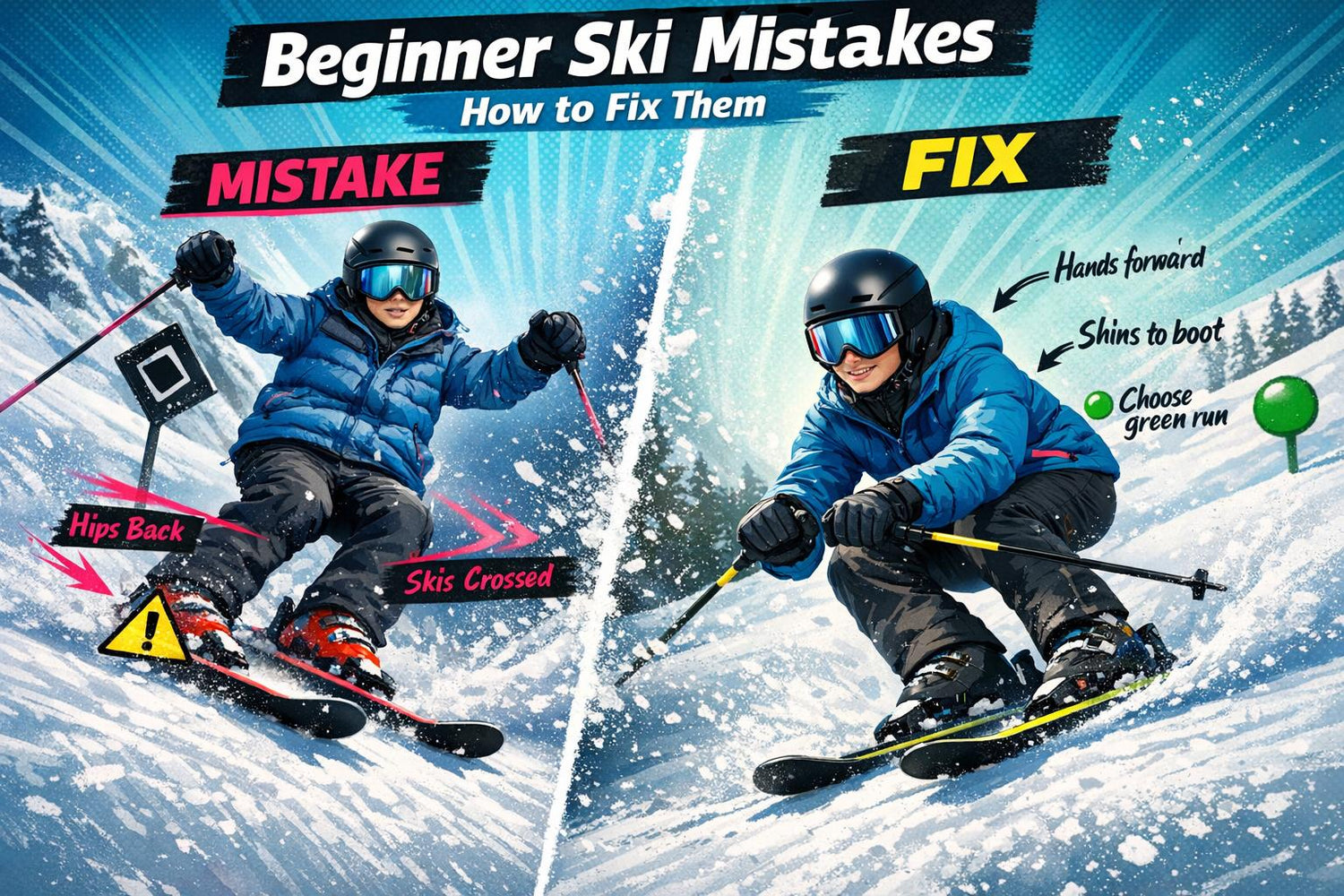
Mistake 1: Leaning Back Instead of Forward
Why Beginners Lean Back
At the top of the slope, many beginners instinctively lean back, thinking it makes them more stable. This habit, often called "sitting on the back chair", happens when skiers straighten their legs and lose that critical shin-to-boot contact. Ski instructor Leonid Feldman explains that this posture compromises control over the front of the skis. Without forward pressure, your skis can act unpredictably, crossing or failing to turn when you need them to.
Another common issue? Staring down at your skis. Fixating on your feet can tense up your shoulders and lock your back in place, which shifts your weight further back. Feldman puts it like this:
"Looking down causes stress and makes the shoulders and back rigid, limiting the dynamics of movements necessary even for initial-level turns".
The solution lies in adjusting your stance to stay forward and balanced.
How to Fix It: Switch to Shorter Skis
Shorter skis can help naturally correct this backward lean by encouraging a forward stance. Long skis, typically ranging from 160 to 190 cm (about 5.2 to 6.2 feet), demand precise shin pressure and a lot of forward-backward movement to execute turns. Shorter options, like Snowfeet* Skiblades and Skiskates, are designed to simplify this process by promoting a forward position without constant effort.
Snowfeet* Skiblades come in lengths of 65 cm (around 25.6 inches), 99 cm (approximately 38.9 inches), and 120 cm (about 47.2 inches). Meanwhile, Snowfeet* Skiskates are even more compact at just 44 cm (around 17.3 inches). Their smaller size keeps your weight centered, making them much easier to handle than traditional skis. This setup not only boosts your confidence but also allows you to focus on learning proper techniques instead of battling bulky equipment.
Mistake 2: Using the Wrong Stance (A-Frame Position)
What Causes the A-Frame Stance
The A-frame stance happens when your knees fall inward while your feet stay wide apart, creating an "A" shape. This misalignment can throw off your control on the slopes.
Several factors contribute to this issue. Dull ski edges, "hip dumping" (when your hips collapse to one side), and not engaging your lower body enough can all push your knees inward. This disrupts the edge angles of your skis, making turns less precise and harder to control. To add to the problem, sticking with the wedge or "pizza" stance for too long - without transitioning to parallel skiing - can reinforce poor alignment habits.
How to Fix It: Use Snowfeet* for Better Alignment
Getting your knee alignment right is key to improving your control and technique. Ski instructor Leonid Feldman suggests keeping your feet about 10–12 inches apart with slightly bent knees for better balance and control.
Here’s where Snowfeet* Mini Ski Skates and Snowfeet* PRO come in. These shorter skis (38 cm and 50 cm, respectively) are easier to handle than traditional long skis. Their compact design naturally encourages a hip-width stance, better edge control, and smoother leg movements. Feldman points out that modern skiing relies on bending your shins and shifting your center of gravity into the turn - movements that feel more intuitive with shorter, more maneuverable gear.
Snowfeet* also helps you maintain steady pressure on your boot tongues, which keeps your weight properly distributed and your knees aligned. Instead of reinforcing bad habits, these mini skis guide you toward a parallel stance, making it easier to move from the wedge position to carving like a pro.
Mistake 3: Keeping Skis Too Wide or Using Poles Incorrectly
Common Stance and Pole Errors
A common misconception among beginners is that a wider stance equals better stability. But too wide - like 10–12 inches apart - can actually reduce control and increase the chance of falling. The sweet spot? About hip-width, which is roughly the same 10–12 inches but with a focus on balance and mobility.
Poles are another tricky area for newbies. Many try to stop by jamming their poles into the snow, which messes with their form. Ski instructor Leonid Feldman explains it like this:
"The skier tries to stop by sticking the poles in the snow. This problem is solved very simply: put away the poles and make sure that your arms are positioned correctly".
When poles are misused, arms tend to dangle awkwardly, pulling weight backward and making it harder to control the front of the skis. This imbalance can lead to unnecessary upper body movement, throwing off your stability even more.
How to Fix It: Try the Pole-Free Snowfeet* Design
Here’s a solution: ditch the poles and try a setup that naturally encourages better form.
Snowfeet* products, like their Mini Ski Skates (38 cm) or PRO models (50 cm), are designed to help you focus on balance without relying on poles. Without the distraction of figuring out where to plant your poles - or accidentally using them as brakes - you can fully concentrate on your stance.
The compact design of Snowfeet* naturally promotes a proper hip-width position. Plus, you can use them with regular winter shoes or snowboard boots, making the experience feel more like walking or skating. Unlike traditional long skis that can trip you up or tangle as you learn, Snowfeet*’s shorter lengths (ranging from 38 cm to 120 cm) make maneuvering a breeze. With your arms free to maintain a steady, "tray-carrying" position, you’ll keep your center of gravity balanced and your focus where it belongs - on the slopes.
Mistake 4: Choosing Slopes That Are Too Steep and Overusing the Snowplow
Why Steep Terrain and Snowplow Dependency Cause Problems
Jumping onto slopes that are too steep for your current skills can mess with your confidence big time. Steep terrain increases the chance of falling and injuries because your technique might not be ready to handle the extra speed that gravity brings into play. On these runs, panic often sets in, leading to over-braking. The result? You’re left physically drained and far more likely to hit the ground.
The snowplow, or "pizza", technique - where your ski tips point inward while the tails stay apart - is a great tool for beginners to control speed. But if you lean on it too much, especially on steep slopes, it can wear you out fast. Overusing this method also makes it harder to distribute your weight correctly, which can keep you stuck in beginner mode instead of advancing to parallel turns.
How to Fix It: Progress Gradually with Snowfeet* Skiblades
The solution? Start small. Stick to flatter, beginner-friendly slopes and use equipment designed to help you improve step by step. Ski instructors from ESF Courchevel emphasize the importance of gradually moving to more challenging terrain rather than rushing ahead.
This is where Snowfeet* Skiblades (99 cm) and Snowfeet* Short Skis (120 cm) come into play. Their compact size makes them a game-changer for learning. With less inertia, they encourage natural edging and make it easier to transition from snowplow to parallel turns. For instance, the 99 cm Skiblades are perfect for green runs, giving you better speed control and helping you build confidence at your own pace. Plus, their forgiving design reduces fatigue and supports proper weight distribution, making turns smoother and less effort-intensive compared to traditional long skis. These tools, combined with good technique and gradual progression, can make learning to ski much more enjoyable.
sbb-itb-17ade95
5 Mistakes Most Skiers Are Making | And How To Fix Them
Mistake 5: Blaming Equipment Instead of Learning Proper Technique
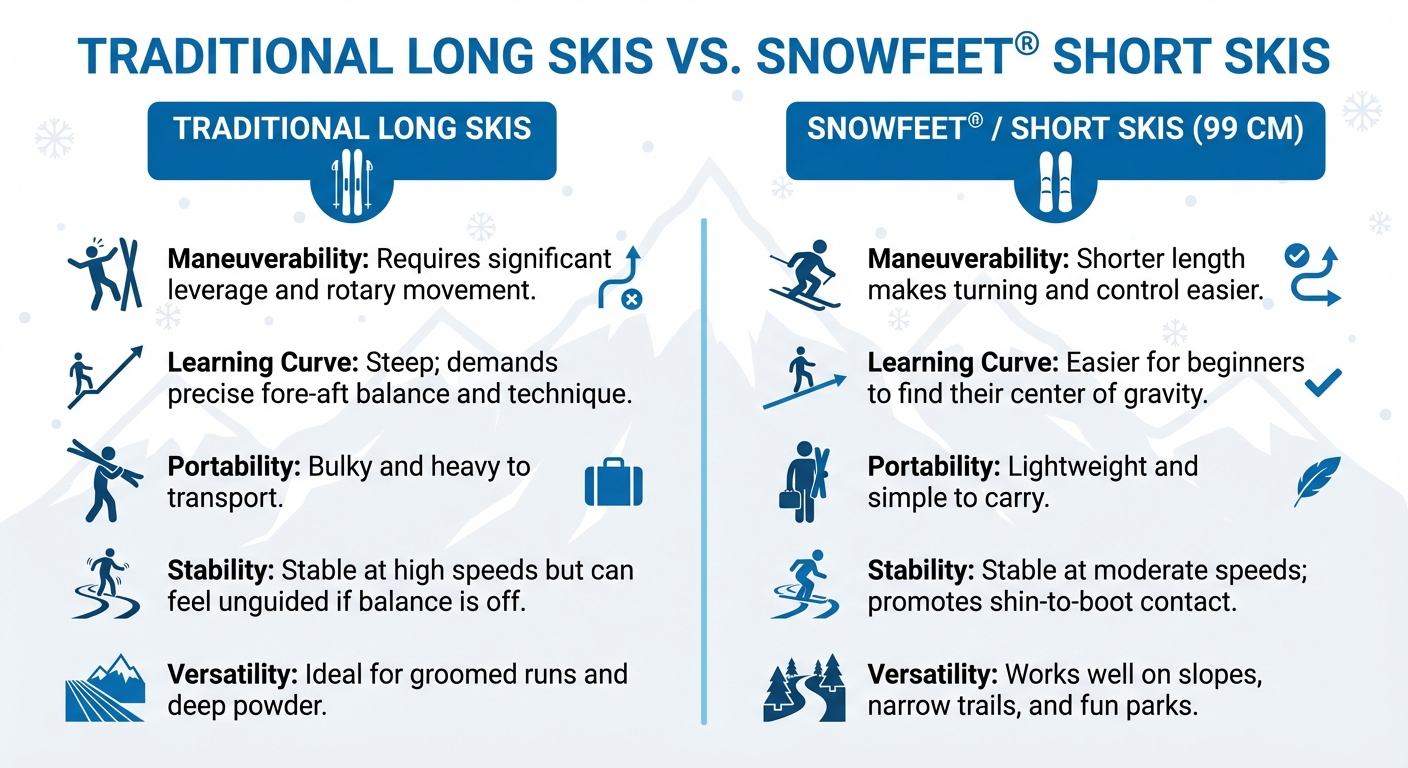
Traditional Long Skis vs Snowfeet Short Skis Comparison Chart
Why Beginners Blame Their Skis
When things go sideways on the slopes - like skis crossing unexpectedly or turns feeling like a struggle - many beginners instinctively blame their gear. It’s an easy trap to fall into. Traditional long skis, while great for experienced skiers, demand precision and a variety of movements that beginners often haven’t mastered yet. Ski instructor Leonid Feldman frequently hears seasoned skiers say, "Help me to re-trained, I am tired of fighting with these skis". The reality? The issue isn’t the skis - it’s the technique. Shifting the blame to equipment only delays progress in mastering the basics.
How to Fix It: Advance Your Skills with Snowfeet*
Instead of wrestling with traditional long skis, consider gear that encourages better technique naturally. Shorter skis, like the Snowfeet* Powder (99 cm) or Snowfeet* Skiblades (65 cm), are much more beginner-friendly. They require less leverage and rotary movement, making it easier to find your balance and refine your stance. With these shorter skis, you’ll quickly discover your center of gravity, maintain consistent shin-to-boot contact, and adopt the proper stance - arms slightly bent and forward (20–24 inches apart), with feet spaced about 10–12 inches apart. Snowfeet* products help you focus on improving your skills instead of battling your equipment.
Snowfeet* vs. Traditional Long Skis: Side-by-Side Comparison
| Feature | Traditional Long Skis | Snowfeet* / Short Skis (99 cm) |
|---|---|---|
| Maneuverability | Requires significant leverage and rotary movement. | Shorter length makes turning and control easier. |
| Learning Curve | Steep; demands precise fore–aft balance and technique. | Easier for beginners to find their center of gravity. |
| Portability | Bulky and heavy to transport. | Lightweight and simple to carry. |
| Stability | Stable at high speeds but can feel unguided if balance is off. | Stable at moderate speeds; promotes shin-to-boot contact. |
| Versatility | Ideal for groomed runs and deep powder. | Works well on slopes, narrow trails, and fun parks. |
Instead of blaming your skis, focus on gear that supports your learning journey. Traditional long skis aren’t the problem - they’re just better suited for skiers who’ve already nailed the basics. Snowfeet* products provide a smoother path to mastering proper technique, making skiing less frustrating and a lot more fun.
Conclusion
Skiing is all about technique and having the right gear to match your skill level. For beginners, the learning process doesn’t have to be frustrating. Most early challenges come from technique struggles, not a lack of ability. The good news? These are things you can fix - especially with equipment designed to help you learn.
Snowfeet* Skiblades (65 cm, 99 cm, 120 cm) and Snowfeet* Skiskates (44 cm) are excellent tools for beginners. They encourage a forward, balanced stance and give immediate feedback, helping you focus on proper weight distribution and posture. With less need for big adjustments, you can concentrate on refining your technique and gradually progressing from simple turns to more advanced maneuvers.
The key to improving quickly is focusing on technique rather than blaming your gear. Practice on gentle slopes with beginner-friendly equipment, and you’ll naturally develop control and confidence. Snowfeet*’s designs make this process smoother, giving you the tools to build a solid foundation for skiing.
With the right mindset and supportive gear, skiing becomes an enjoyable journey. Snowfeet* helps you master the basics faster, so you can spend less time struggling and more time having fun on the slopes. After all, skiing should be exciting, not overwhelming - and with the right approach, it absolutely can be.
FAQs
How do I know if I’m leaning back while skiing?
If you’re wondering whether you’re leaning back while skiing, pay attention to a few key signs. Do you feel wobbly? Is turning harder than it should be? Or do you notice most of your weight sitting on the tails of your skis? These are all clues that your posture might be off.
Good skiing posture means keeping your weight centered over your skis, bending your knees slightly, and keeping your arms forward for balance. If you're just starting out, beginner-friendly gear like Snowfeet Skiblades or Skiskates can help. They’re easier to control and balance on compared to traditional skis or snowboards, making them a great choice for learning proper technique.
What Snowfeet* length should a beginner choose?
Snowfeet* Skiblades are available in three lengths: 65 cm, 99 cm, and 120 cm. If you're new to the slopes, the shorter 65 cm option is a great pick. They’re easier to control, which makes learning smoother and helps you gain confidence faster.
Can I use Snowfeet* without ski poles or ski boots?
Snowfeet* Skiblades and Skiskates are made to be used without traditional ski poles or boots. This design makes them a great option for beginners. They’re easier to pick up and provide better control, giving you a more straightforward and fun experience on the slopes.











Leave a comment
This site is protected by hCaptcha and the hCaptcha Privacy Policy and Terms of Service apply.