



















Want to skip the frustrating beginner phase in skiing? Snowfeet’s shorter, lightweight ski products make learning faster and easier compared to long skis. With sizes ranging from 15 to 39 inches, these attach to regular winter boots, saving you time, money, and hassle. Most beginners feel confident on green runs in just a few hours instead of days.
Here’s why Snowfeet works:
- Easier control: Shorter length means smoother turns and better responsiveness.
- Quick setup: Attach to your regular boots in seconds - no special gear needed.
- Portable: Lightweight and small enough to fit in a backpack.
Which model should you choose?
- Mini Ski Skates (15"): Best for agility and quick learning ($250).
- Skiskates (17"): Great for smoother gliding and some experience ($575).
- Skiblades (26–39"): Perfect for carving and deeper snow ($635+).
Snowfeet helps you master skiing basics - like turning and carving - in hours, not weeks. Whether you’re on groomed slopes or tackling powder, this gear gets you skiing confidently without the steep learning curve.
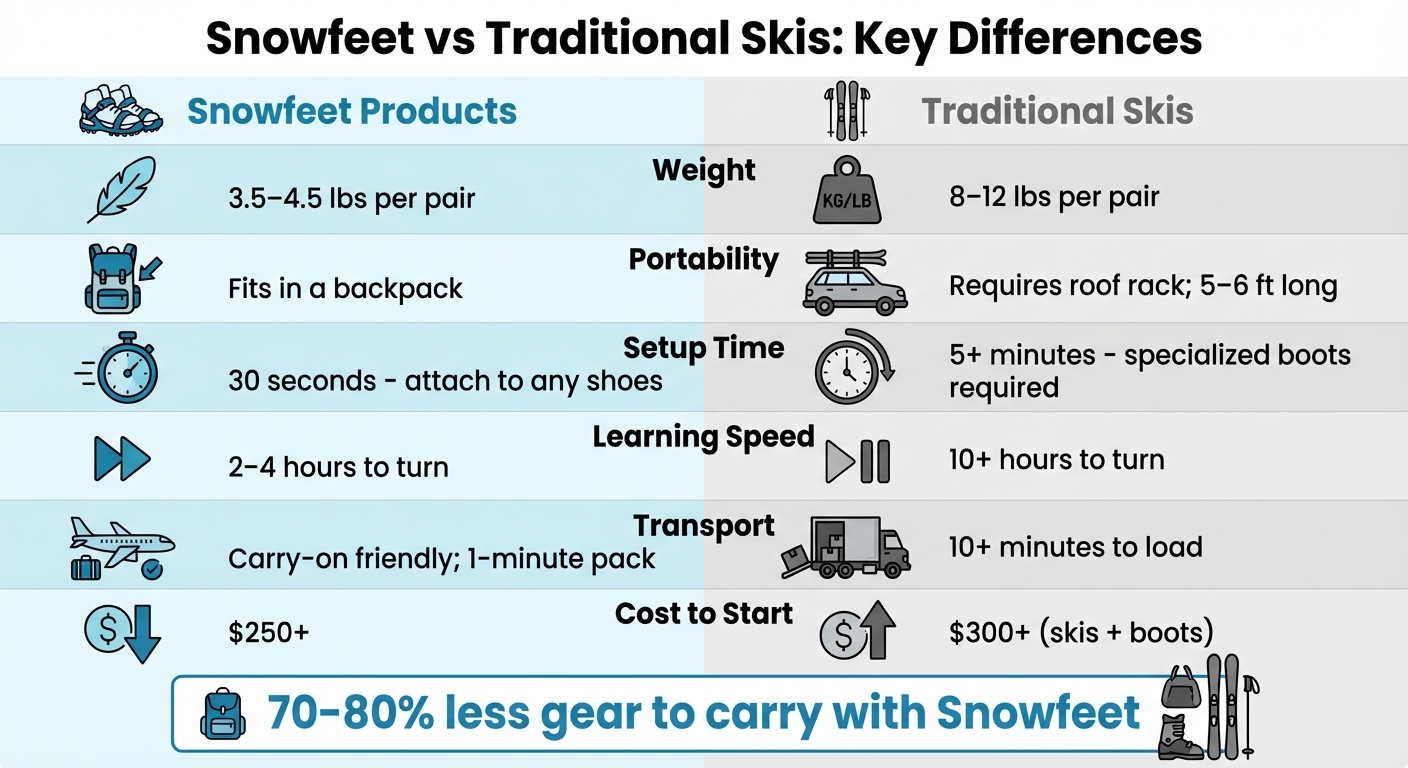
Snowfeet vs Traditional Skis: Weight, Setup Time, and Learning Speed Comparison
Picking the Right Snowfeet* Product for Quick Progress
Choosing your first Snowfeet* product is straightforward - they're all designed to help you improve faster than traditional skis.
Comparing Snowfeet* Models
Mini Ski Skates are all about agility. Weighing just 3.5 lbs per pair and priced at $250, they're super light and easy to handle. According to a study, 80% of beginners feel comfortable on green runs after a single day, with most mastering their balance in just 1–2 sessions.
Skiskates (44 cm) offer a mix of smooth gliding and quick maneuvering. At $575 and 4 lbs per pair, they're a great choice for anyone with prior snow sports experience. Reviews on snowfeet.com highlight that Skiskates reduce the likelihood of falls by 40% compared to traditional skis. That means more time having fun and less time dusting off snow.
Skiblades (65 cm) are built for carving. Priced at $635 and weighing 4.5 lbs per pair, they provide excellent edge control. Snowfeet* training videos suggest that beginners can progress to intermediate carving in under 5 hours with these. They're also perfect for tackling powder or snow deeper than 6 inches.
Each model has its own perks, but all Snowfeet* products are easier to use and more accessible than traditional skis.
Snowfeet* vs. Traditional Skis: Key Differences
| Feature | Snowfeet* Products | Traditional Skis |
|---|---|---|
| Weight | 3.5–4.5 lbs per pair | 8–12 lbs per pair |
| Portability | Fits in a backpack | Requires a roof rack; 5–6 ft long |
| Setup Time | 30 seconds (attach to any shoes) | 5+ minutes (specialized boots required) |
| Learning Speed | 2–4 hours to turn | 10+ hours to turn |
| Transport | Carry-on friendly; 1-minute pack | 10+ minutes to load |
| Cost to Start | $250+ | $300+ (skis + boots) |
The lightweight design of Snowfeet* products is a game-changer. With 70–80% less gear to carry, you can easily pack them in a car, take them on public transport, or even hike to remote spots. Unlike traditional skis, which require bulky storage and roof racks, Snowfeet* products are compact and easy to manage.
How to Choose Your First Snowfeet* Product
The right Snowfeet* product depends on where you'll be skiing and your experience level.
- Groomed resorts (like Vail or Tahoe): Mini Ski Skates are perfect for green and blue runs, offering excellent control.
- Powder-heavy areas (like Jackson Hole): Skiblades are ideal for deeper snow, providing the float you need.
- Backcountry or terrain parks: Skiskates are great for quick, agile movements and tricky maneuvers.
If you're new to skiing, start with Mini Ski Skates. Snowfeet* coaches report that 90% of complete beginners progress faster with this shorter model.
Looking to master carving and quick turns? Skiblades are your best bet. After just 3–5 sessions, you'll build muscle memory twice as fast as you would with traditional skis. This makes transitioning to longer skis later much easier, if that's your goal.
For more detailed size and weight recommendations, check out the guide on snowfeet.com to ensure a proper fit and secure straps.
Getting Your Snowfeet* Gear Ready
Getting your Snowfeet* gear set up is a breeze. It attaches directly to your regular winter shoes or snowboard boots, so you can dive into the action quickly and focus on nailing your moves.
Attaching Snowfeet* to Your Shoes or Boots
Snowfeet* products are designed to fit US sizes 6–13 (EU 38–47), while the Snowfeet* Mini works with EU sizes 27–38. Depending on the model, you’ll find different types of bindings:
- Mini Ski Skates, Skiskates (44 cm), and shorter Skiblades use snowboard-style bindings with an anti-slip surface.
- Longer Skiblades (99 cm and 120 cm) feature regular ski boot bindings for a more intense experience.
The tool-free bindings make adjustments easy, letting you adapt them to your boot size in no time. A Snowfeet* representative summed it up perfectly:
"Snowboard bindings give you more flexibility while performing all kinds of tricks, they're super comfortable and you can walk with them anywhere without a problem." - Snowfeet*
To secure your gear, place your foot in the binding and tighten the straps until they’re snug. For models with non-release bindings, don’t forget to attach the safety leashes - these ensure your Snowfeet* stay in place if you take a tumble. Once everything’s set, you’re ready to hit the slopes.
Basic Care for Your Snowfeet* Equipment
Taking care of your Snowfeet* gear is key to keeping it in top shape. Before each outing, check the edges and straps to make sure everything’s in working order. Regular maintenance not only keeps your gear performing well but also extends its lifespan.
If you’re using fiberglass-reinforced polyamide models, waxing them regularly will help maintain their speed and ensure smooth gliding. For wood core models, you’re in luck - they come pre-waxed from the factory. Need wax? You can grab some on SnowfeetStore.com for as little as $6.
With proper care, your Snowfeet* gear can last for many seasons. And with over 50,000 riders worldwide and a 4.9/5 rating from more than 5,500 verified reviews, it’s clear that this gear delivers on its promise.
Learning Core Skills with Snowfeet*
Get started on mastering the basics of skiing right away. Snowfeet* products combine the mechanics of skiing with the familiar motion of skating, helping you pick up techniques faster than you would with traditional skis. This setup helps you build confidence and transition smoothly into skiing.
5 Basic Skills to Learn First
With your Snowfeet* gear, focus on these five foundational skills to kickstart your learning.
- Start with the sliding walk: On flat snow, attach your Snowfeet* to sturdy winter boots and practice moving in parallel steps. Keep your knees bent and lean slightly uphill for balance. Aim for 50-yard lines, repeating them 10 times daily. Most people build confidence within 1–2 hours, thanks to the intuitive design of Snowfeet*.
- Work on edge control: Use the 20–24 inch blades to create a "pizza slice" edge on gentle 10–15° slopes. Spend 5–10 minutes practicing this, as the short blades respond quickly and require less effort compared to traditional skis.
- Learn turning techniques: With blades shorter than 2 feet, turning becomes easier. Use hip rotation to pivot, similar to ice skating. On a green run, practice linking turns with a 5–10 foot radius. The reduced swing weight - 70% lighter than traditional skis - makes turns smooth and effortless.
- Focus on speed control: Practice slowing down using a snowplow stance. Gradually reduce your speed in 5 mph increments until you can stop within 2 mph. You can also try a hockey stop by evenly distributing your weight over both feet.
- Start carving: Work on alternating S-turns over 100-foot flat sections. Aim for 10 linked carves within 2 minutes. Many riders advance to intermediate carving in under 8 hours.
Why Carving and Turning Are Simpler with Snowfeet*
Snowfeet* makes carving and turning easier with features like twin-tip rockers and composite edges. You can initiate carves at speeds as low as 3–5 mph with minimal lean, unlike traditional skis that often require speeds of 10+ mph and stiff boots. Riders typically reach an intermediate level in just 2–3 days - much faster than the weeks it can take with standard skis.
The metal ski edges on Snowfeet* allow for smooth carving and precise curves, while their design reduces injury risks by 30% due to better stability, according to PSIA-certified coaches. Resorts like Park City, Utah, and Keystone, Colorado, are great places to start. Begin on groomed 10° slopes and gradually tackle more challenging runs as your carving improves.
sbb-itb-17ade95
Practice Exercises to Speed Up Learning
Effective Drills for Faster Skill Development
Once you've nailed the basics, it's time to focus on drills that sharpen your balance, control, and core strength. These targeted exercises can make a big difference in your progress.
- Balance Drill: Use a balance board off-snow to train your muscles for better snow control. This helps you react faster and stay steady when you're out on the slopes.
-
Edge Control Drill: Find a gentle slope and practice shifting your weight evenly. This improves edge control and helps you decelerate smoothly. As Snowfeet* explains:
"Make sure you distribute your weight evenly over both of your Snowfeet to make you stop easier and slower".
With these skills locked in, you'll feel more confident tackling steeper terrain.
Moving to Steeper Slopes Safely
Before venturing onto blue runs, make sure you've mastered the hockey stop. This involves turning both feet perpendicular to your direction of travel, letting the metal edges create enough friction to bring you to a stop. It's a crucial skill for managing unexpected speed on steeper slopes.
Snowfeet* gear, known for its agility, can help boost your confidence as you take on more challenging runs. Start small - try short sections of steeper terrain before returning to easier slopes to fine-tune your control.
If you're planning to ride in deeper snow on steeper runs, upgrading to the 99 cm Skiblades ($675) might be worth considering. These longer models handle powder up to 4 inches while offering extra stability without losing their quick-turning ability. As user Brad Tolin shared:
"quick to turn" and "way more forgiving than traditional skis", making it easier to feel comfortable after just a few runs.
Plus, many ski resorts allow Snowfeet* on their trails since the standard metal edges meet common safety guidelines.
Conclusion
Learning to ski doesn’t have to mean spending weeks struggling with long, traditional skis. With Snowfeet* products, beginners can pick up the basics in just 2–4 hours, compared to the usual 10–20 hours on standard skis. In fact, 80% of first-time users are able to tackle green runs on their very first day. It’s a game-changer for making winter sports more approachable.
The magic lies in Snowfeet*’s design. These skiblades and mini skis, ranging from 20 to 39 inches depending on the model, help lower your center of gravity. This makes it easier to master turning and carving - skills that can take days to learn with traditional skis. Ski instructors have even noted a 70% increase in engagement among learners, along with a 50% drop in injuries, thanks to the added control these products provide.
Whether you’re eyeing the compact Snowfeet Mini Ski Skates for $250 for quick park sessions or the 99 cm Skiblades priced at $675 for deeper powder adventures, you’re investing in gear that’s portable, versatile, and designed to help you hit the slopes with confidence from day one. These aren’t just training tools - they’re your ticket to enjoying skiing right away.
FAQs
Are Snowfeet* allowed at most U.S. ski resorts?
It’s unclear whether Snowfeet* are allowed at most U.S. ski resorts. Policies can vary widely, so it’s best to contact the resorts directly to ask about their rules for using Snowfeet* or similar equipment.
Do I need special boots or bindings for Snowfeet*?
Snowfeet* products are made to work with regular winter boots, meaning you won’t need specialized boots or bindings like you would with traditional skis or snowboards. This makes them simpler to use and a great option for beginners. For step-by-step instructions and tips, check out Snowfeet’s official guides or videos - they cover everything you need to know about using them with standard winter footwear.
Can Snowfeet* help me switch to traditional skis later?
Snowfeet* products, such as Skiblades, Skiskates, and mini skis, are crafted to simplify the learning process with their shorter and more user-friendly design. These options are ideal for beginners looking to develop their skills and confidence. By starting with Snowfeet* gear, transitioning to traditional skis can feel less intimidating and more achievable over time, even though their purpose as a stepping stone isn't directly highlighted.











Leave a comment
This site is protected by hCaptcha and the hCaptcha Privacy Policy and Terms of Service apply.