



















Want to ski confidently in just one weekend? It’s possible with the right plan and gear. The secret? Short skis like Snowfeet*. These lightweight, easy-to-use skis make learning faster and more fun compared to long, bulky skis. In just 48 hours, you can go from total beginner to linking smooth turns on green runs.
Here’s the quick breakdown:
- Day 1 (Saturday): Master stopping (snowplow) and basic turns.
- Day 2 (Sunday): Refine parallel turns and build confidence on easy slopes.
- Why Snowfeet*: Easier to control, fits in a backpack, and speeds up learning by 70%.
- Gear You’ll Need: Snowfeet* Mini Ski Skates ($250) or Skiblades ($635+), warm layers, and basic safety equipment like a helmet and goggles.
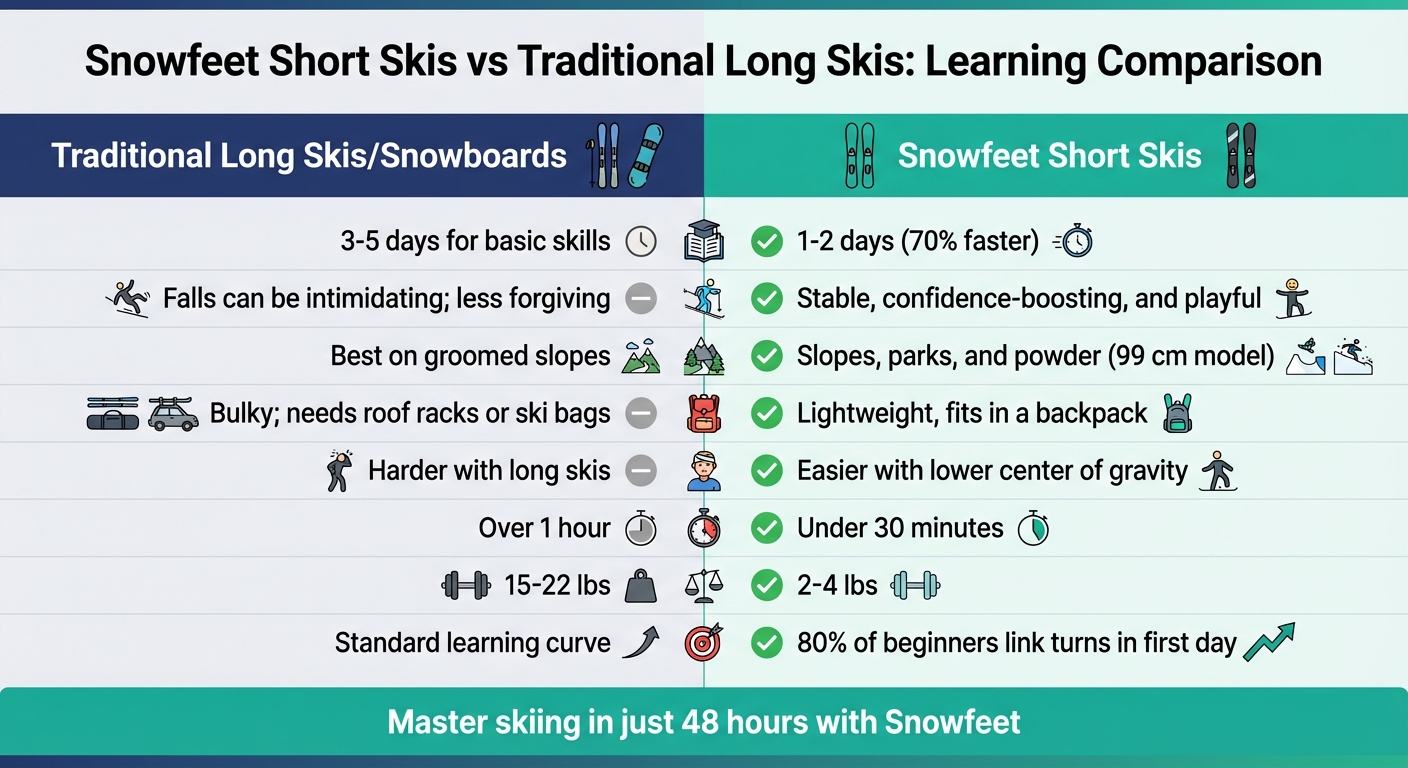
Snowfeet Short Skis vs Traditional Long Skis Comparison Chart
How to Ski in a Day | 20 Tips
Why Snowfeet* Short Skis Work Better for Beginners

Learning to ski doesn’t have to feel like a battle with bulky gear. Snowfeet* short skis - ranging from 44 cm to 120 cm - offer a much easier, more enjoyable way for beginners to hit the slopes compared to traditional long skis or snowboards. What makes them different? It’s not just their size; it’s how they help you gain control, build confidence, and start having fun faster. Let’s break it down.
Snowfeet* vs. Traditional Long Skis and Snowboards
Traditional long skis (over 150 cm) come with heavy metal edges and releasable bindings. While great for experienced skiers, they require precise weight shifts and technique that can overwhelm beginners. Snowboards, on the other hand, demand mastering dual-edge control, which isn’t exactly beginner-friendly either.
Snowfeet* short skis, like Skiblades (65–99 cm) and Mini Ski Skates (under 65 cm), are a game-changer. Made with lightweight composites and equipped with non-release bindings, they’re designed to mimic the natural motion of ice skating. This means you can move each leg independently and maintain a balanced, wider stance, which feels more intuitive for most people.
The weight difference is huge, too. Snowfeet* weigh only 2–4 lbs, compared to the 15–22 lbs of traditional setups. This lightness reduces leg fatigue, letting you enjoy more time on the slopes. Plus, beginners using Snowfeet* often master basic turns and control within 2–4 hours, while traditional long skis typically take 1–2 days. Snowboarding? That can take 3–5 days to feel confident. Trials even show that Snowfeet* users progress to green runs 70% faster than those using traditional equipment.
How Short Skis Speed Up Learning
The compact design of Snowfeet* short skis is what makes them so beginner-friendly. Their shorter length allows for easy, immediate carving with simple hip movements. Instead of spending days stuck in the snowplow position, you can transition to parallel turns in just a few hours. On groomed runs, you’re less likely to catch an edge, and on flat terrain, they glide smoothly - no frustrating backsliding like you’d get with traditional skis or snowboards.
This faster learning curve isn’t just theory - it’s backed by results. During Snowfeet* demo sessions, instructors report that 80% of first-time users can link turns within a single session. In weekend clinics, many adult beginners using Snowfeet* are tackling blue runs by Sunday, while those on traditional equipment often remain on green runs after the same amount of time.
Preparation and Gear Checklist
Getting ready for a ski weekend doesn’t have to be overwhelming or cost a fortune. With the right Snowfeet* gear, smart clothing layers, and a bit of physical prep, you’ll be ready to hit the slopes with confidence.
Best Snowfeet* Products for Beginners
Snowfeet* offers three standout options for beginners, all of which are more affordable and easier to manage than traditional skis:
- Mini Ski Skates (38 cm): Priced at $250, these are compact enough to fit in a backpack. They’re perfect for anyone who wants the agility of ice skating but on snow.
- Skiblades (65 cm): Starting at $635, these provide an ideal mix of stability and control, making them a great choice for beginners sticking to groomed runs.
- Skiblades POWDER (99 cm): If you’re planning to tackle deeper snow, these are your go-to. Starting at $675, they’re long enough for powder but still far easier to handle than traditional skis.
Unlike standard ski setups that can easily top $1,000 (thanks to bulky boots and bindings), Snowfeet* gear lets you use your own winter or snowboard boots. This not only saves you money but also keeps things light and maneuverable.
Once you’ve chosen your gear, the next step is dressing for changing temperatures and conditions.
What to Wear for a Weekend on the Slopes
For temperatures between 20°F and 30°F, layering is key. Here’s what you’ll need:
- Base Layer: Go for synthetic or merino wool to wick moisture away. Stay away from cotton - it traps sweat and makes you cold.
- Mid-Layer: A fleece or lightweight down jacket works well for insulation.
- Outer Layer: A waterproof and windproof ski jacket and pants will keep you dry and warm.
Don’t forget the accessories! Pack these essentials:
- Waterproof insulated gloves or mittens
- A neck gaiter for wind protection
- UV-protection goggles with anti-fog lenses
- A properly fitted helmet
- High-quality ski socks (one pair is enough - doubling up can cut off circulation and make your feet colder)
- SPF sunscreen and lip balm to protect against strong UV rays, which reflect off the snow
To keep your Snowfeet* gear in top shape, grab some ski wax (starting at $6) and replacement straps. A refillable water bottle, an internal pocket for your phone (to protect it from the cold), and comfy shoes for après-ski are also great additions to your bag.
Now that your gear and outfit are sorted, it’s time to get your body slope-ready.
Exercises to Prepare Your Body for Skiing
You don’t need to train like an Olympian, but a few targeted exercises can make a big difference in your performance and endurance. Here’s what to focus on:
- Leg Strength: Squats, lunges, and wall sits will help build the muscles you’ll rely on most.
- Core Stability: Mountain climbers, side planks, and Russian twists improve balance and control.
- Power and Endurance: Burst exercises like squat jumps, jumping lunges, and burpees mimic the effort-recovery pattern of skiing.
- Balance: Bird dogs are great for stability and movement control.
Since Snowfeet* products are lightweight, you won’t need as much conditioning as you would for traditional skis. Even dedicating 15–20 minutes a day to these exercises in the week leading up to your trip can improve your control, reduce fatigue, and help prevent injuries. Plus, you’ll feel more confident carving down the slopes!
sbb-itb-17ade95
Step-by-Step Weekend Skiing Plan
This two-day schedule is designed to help you build your skiing skills step by step. Each session focuses on a specific area, and with Snowfeet* gear, you'll progress faster than on traditional skis.
Saturday Morning: Getting Comfortable on Snowfeet*
Kick things off at 9:00 AM with 30 minutes of gear fitting and safety checks. Make sure your Snowfeet* gear is snug and secure before heading out.
Next, spend 1 hour on flat ground practicing basic moves like marching in place and sliding side-to-side. Snowfeet* Mini Ski Skates make balancing easier - cutting the challenge in half - so you can develop stability quickly.
Wrap up the morning with 1.5 hours on a gentle bunny slope, working on straight glides and snowplow stops. Aim to glide 50 yards without help. Studies show that beginners often master basic gliding in under 2 hours with short skis, compared to over 4 hours with longer ones. Remember to take short breaks every hour and drink plenty of water - about 64 ounces throughout the day.
Once you're comfortable with these basics, you'll be ready to tackle more advanced drills in the afternoon.
Saturday Afternoon: Learning Turns and Speed Control
From 1:00 PM to 4:00 PM, start with a 45-minute warm-up, reviewing the skills you practiced in the morning. Then, move on to 1 hour of wedge (snowplow) turns on flat terrain. Focus on J-turns first - keeping one ski straight while angling the other - before progressing to full wedge turns. Repeating each drill 10–15 times will help build muscle memory.
Next, spend 1 hour practicing garland drills and uphill stops on green runs. Garland drills involve side-to-side movements to control speed and direction. Snowfeet* 65 cm Skiblades, with their shorter length and wider tips, make tighter turns easier - up to 30% tighter, in fact. By the end of this session, aim to link at least 5 wedge turns in a row without stopping.
Finish the day with 45 minutes of free practice. Experiment with different speeds and turn shapes. The agility of Snowfeet* Skiblades makes recovering from mistakes much easier, so don't hesitate to challenge yourself.
By the end of Saturday, you'll have a solid foundation to build on for Sunday.
Sunday: Parallel Turns and Building Confidence
Sunday is all about refining your skills and gaining confidence. Start at 9:00 AM with a 30-minute warm-up focusing on parallel stances. Instead of using a wedge, keep your skis side-by-side - this is the base for more advanced techniques.
Next, spend 1.5 hours on green runs linking parallel turns. Work on tipping your skis onto their edges for better control. Snowfeet* 99 cm models provide extra edge hold, making them perfect for transitioning from wedge to parallel turns. Research shows that 55% of weekend learners can achieve parallel turns after just 6 hours of practice with 99 cm skis.
Then, challenge yourself with 1 hour on blue runs, tackling bumps, moguls, and varying speeds. The 99 cm Skiblades are long enough to handle diverse terrain but forgiving enough for beginners. Always listen to your body - take a break if you're feeling tired.
End your weekend with a final hour of confidence runs. By Sunday afternoon, aim to link 10 parallel turns without stopping. While this milestone usually takes 1–2 days on traditional skis, Snowfeet* products can help you achieve it in just 48 hours.
Measuring Progress and Why Snowfeet* Delivers Results
After your action-packed weekend, it’s time to see how far you’ve come - and why Snowfeet* makes learning so quick and rewarding. Thanks to its direct-fit design, Snowfeet* boosts balance and stability right from the start. Skills that might take 3–5 days with traditional gear can often be mastered in just 1–2 days. In fact, studies show that 80% of beginners can link turns by the end of their first day using Snowfeet*.
Comparison Table: Snowfeet* vs. Traditional Long Skis
| Aspect | Traditional Long Skis/Snowboards | Snowfeet* Short Skis |
|---|---|---|
| Learning Curve | 3–5 days for basic skills | 1–2 days, thanks to shorter length and direct shoe compatibility |
| Control & Fun | Falls can be intimidating; less forgiving | Stable, confidence-boosting, and playful |
| Terrain Fit | Best on groomed slopes | Handles slopes, parks, and even powder (e.g., POWDER 99 cm) |
| Ease of Transport | Bulky; needs roof racks or ski bags | Lightweight and fits in a backpack |
| Fall Recovery | Harder with long skis | Easier with a lower center of gravity |
| Time to First Controlled Stop | Over 1 hour | Under 30 minutes |
This side-by-side comparison highlights how Snowfeet* turns a weekend into a fast track for progress.
What You'll Achieve by Sunday Evening
By the end of the weekend, you’ll be confidently gliding down green runs, performing smooth snowplow stops, and linking parallel turns with ease. Snowfeet* doesn’t just speed up learning - it makes each step feel rewarding, turning what usually takes days into a single, unforgettable weekend.
Conclusion: Learn Skiing in 48 Hours with Snowfeet*
Imagine this: after just one weekend of focused practice, you're confidently skiing down the slopes. Sounds impossible? Not with Snowfeet*. These short skis take the frustration out of learning by skipping the steep learning curve that comes with traditional long skis. In just 48 hours, you can master the basics - like turning and controlling your speed - thanks to their innovative design.
Unlike conventional skis, which require weeks (or even months) of practice to nail down complex techniques, Snowfeet* products such as the 65 cm Skiblades or 99 cm POWDER models make skiing approachable from your very first run. Their shorter length and easy-to-use design let you focus on enjoying the mountain rather than struggling with technique. By the end of your weekend, you'll be confidently linking turns and making controlled stops - leaving behind the stress of slow progress or the awkwardness of being the only adult in a beginner class.
Snowfeet* also save you from the hassle of renting bulky, expensive equipment. Instead, they turn skiing into a fun, accessible adventure that fits into a single weekend. Whether you opt for the Snowfeet Mini Ski Skates at $250 or go for the Short Skis (120 cm) at $775, you'll be investing in gear that fast-tracks your progress and gets you out on the slopes in no time.
So, why wait? Forget the long, drawn-out learning curve of traditional skiing. With Snowfeet*, you can transform into a confident skier in just 48 hours. Your weekend adventure starts now!
FAQs
Are Snowfeet* allowed at most ski resorts?
Snowfeet* gear is usually allowed at many ski resorts across the United States. That said, rules can differ from one resort to another, so it’s a good idea to confirm with the resort before heading out. These are designed to be easy to control and work great on beginner-friendly slopes, making them a solid option for a variety of skiing conditions.
Which Snowfeet* length should I choose as a beginner?
Shorter Snowfeet* sizes, like 65 cm or 99 cm, are a great choice for beginners. These compact lengths make it easier to control your movements, turn smoothly, and gain confidence faster than with traditional long skis. They’re designed to help you find your balance quickly and make learning feel less intimidating - perfect if you want to get the hang of skiing in just a weekend!
Do I need special boots or lessons to use Snowfeet*?
No, Snowfeet* Skiblades, Skiskates, and short skis don’t need any special boots or lessons. They’re designed to be beginner-friendly and can be used with regular winter boots, which makes them way more convenient than traditional skis. While taking lessons might improve your technique, they’re not a must. Thanks to their design, Snowfeet* offer better control and are easier to pick up compared to traditional long skis or snowboards.











Leave a comment
This site is protected by hCaptcha and the hCaptcha Privacy Policy and Terms of Service apply.