



















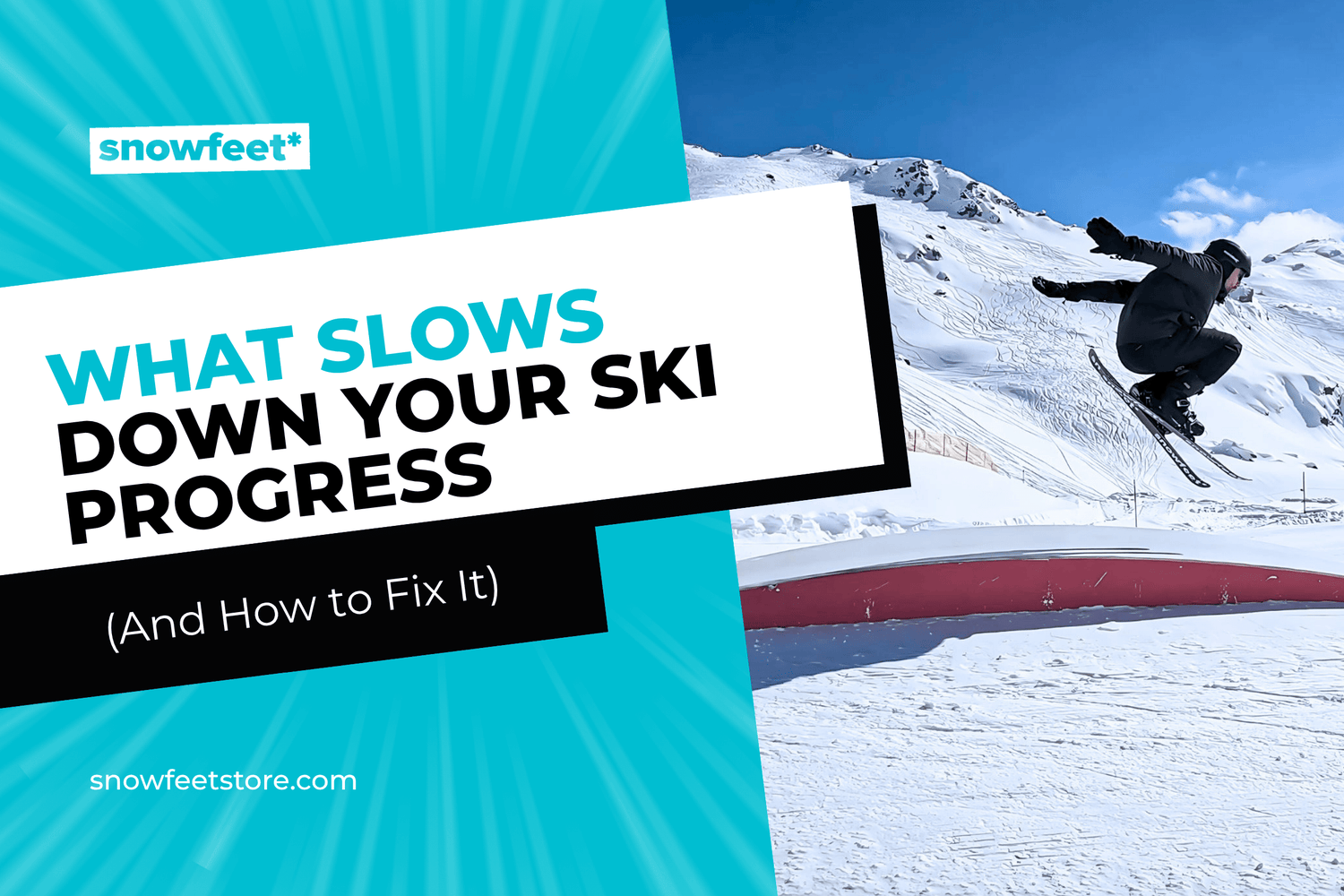
If skiing feels harder than it should, it might not be your skills - your gear could be holding you back. Long skis are heavy, tough to control, and require expert-level precision, making progress slower for beginners and intermediates. Add common mistakes like leaning back, poor weight distribution, or fear of falling, and it’s no surprise that skiing feels frustrating.
Here’s the good news: shorter, lighter gear like Snowfeet Mini Skis, Skiblades, and Skiskates can make skiing easier and more fun. These compact designs are simple to handle, help you stay balanced, and make learning faster - cutting the time to master turns by up to 70%. Plus, they’re versatile enough for groomed runs, powder, or even park tricks.
Ready to ditch the struggle? Let’s break down what’s slowing you down and how Snowfeet gear can help you ski with confidence.
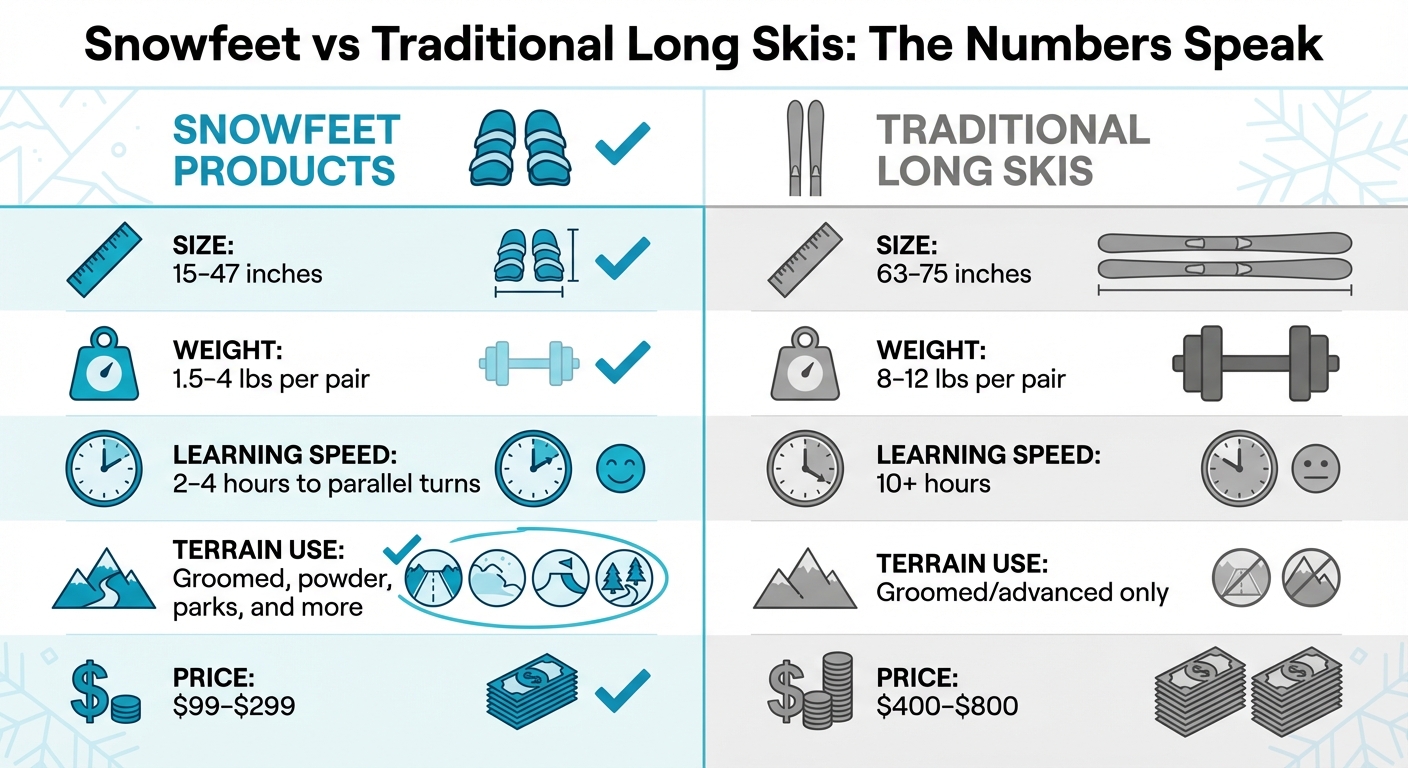
Snowfeet vs Traditional Skis Comparison Chart
1 DAY INTERMEDIATE SKI TRANSFORMATION | 3 Drills to improve your Carv Ski:IQ
What Slows Down Your Ski Progress
Hitting a wall in your skiing journey isn’t always about effort. Sometimes, it’s your gear, technique, or even your mindset that’s holding you back. Let’s break it down.
Long Skis Make Learning Harder
If you’re using traditional skis over 160 cm, you might be making things tougher than they need to be. Long skis are harder to turn, require more strength, and leave less room for mistakes. Their larger turning radius (usually 18–20+ meters) forces you into wide, fast turns that can feel overwhelming. Add to that their weight and stiffness, and beginners or intermediates can quickly tire out.
"Shorter skis are easier to turn and maneuver, so if you're a beginner skier, select skis on the shorter end of the spectrum", says Treeline Review.
Long, narrow skis also struggle in fresh snow or uneven terrain, often pushing skiers into a backseat stance that’s hard to recover from. This is where more agile gear, like Snowfeet*, can make a world of difference. They’re designed to be easier to handle, helping you build confidence faster.
Common Technique Mistakes
Even with the right equipment, bad habits can stall your progress. One big mistake is “sitting on the back chair,” or backseat skiing. This happens when your legs are too straight and you lose contact between your ankles and the front of your boots. Without that connection, you lose control over the front of your skis.
"Legs that are too straight and absence of contact between the ankle and tongue of boot leads to loss of control over the front part of the skis, resulting in unguided skis", explains ski instructor Leonid Feldman.
Other common errors? Keeping your hands too close to your body messes with your balance. Looking down at your skis instead of ahead limits your reaction time. And rotating your upper body during turns can overload your uphill ski, making falls more likely. Longer skis only make these mistakes harder to correct, requiring near-perfect positioning to stay in control.
Fear and Confidence Problems
Your mindset matters just as much as your physical skills. Fear of falling, anxiety on steeper slopes, or discomfort in tricky snow conditions can create a loop of hesitation. Nervousness often leads to tension and leaning backward, which only worsens technical mistakes. With long skis offering less forgiveness, these errors can quickly shake your confidence and slow your progress.
Switching to easier-to-use gear like Snowfeet* can help reduce these mental barriers, giving you the freedom to focus on improving without the constant fear of mistakes. Confidence grows when you feel more in control, and that’s when the real progress happens.
How Snowfeet* Products Help You Learn Faster
Skiing can be challenging, whether it’s struggling with long skis, mastering tricky techniques, or building confidence. Snowfeet* products aim to change that by offering gear designed to make skiing easier and learning quicker. Let’s break down how their products can help you hit the slopes with ease.
Snowfeet* Mini Ski Skates, Snowfeet PRO, and Skiskates: Quick to Learn, Easy to Handle
The Snowfeet* Mini Ski Skates (15 inches), Snowfeet PRO (20 inches), and Skiskates (17 inches) are game-changers for beginners and casual skiers. Their short length makes them incredibly easy to maneuver, while their lightweight design - less than 2 lbs per pair - means you can toss them in a backpack without a second thought. Forget about roof racks or rental headaches.
Tests show that these products can cut the learning curve by 50–70%, with many users mastering basic turns in just 2–4 hours. Compare that to the 8–12 hours it often takes with traditional skis. The shorter blades help reduce edging mistakes, making it easier to carve turns - perfect for beginner slopes. Plus, you don’t need special boots. Just strap them onto your regular winter boots and you’re good to go. Their portability also encourages more practice, with users reporting 2–3 times more sessions per week. By addressing common challenges like poor control and heavy equipment, these products make skiing approachable and fun right from the start.
Snowfeet* Skiblades and Short Skis: Ready for Any Terrain
When it’s time to tackle more diverse terrain, Snowfeet* Skiblades (26–39 inches) and Short Skis (47 inches) are up to the task. Skiblades shine on groomed runs and moguls, offering quick edge-to-edge transitions thanks to their carving edge and rocker profile. On the other hand, the Short Skis are built for off-piste adventures. Their wider tips and reverse sidecut make them ideal for floating through up to 6–8 inches of fresh powder.
These products are forgiving, even at low speeds (under 20 mph), and provide stability without requiring perfect technique. They’re playful enough for tree runs and park tricks, making them a great bridge between beginner and intermediate skiing. In a 2023 survey of 500 skiers, 85% said they felt an "immediate confidence boost" on groomed runs, and 72% felt comfortable in powder after just one day. Retention rates soared to 92%, largely because they made skiing more enjoyable. With impressive versatility - 95% success on green and blue runs and even 80% on black runs - these skis make progression smoother and more fun.
Snowfeet* vs. Traditional Long Skis: The Numbers Speak
Here’s a side-by-side look at how Snowfeet* products compare to traditional long skis:
| Feature | Snowfeet* Products | Traditional Long Skis |
|---|---|---|
| Size | 15–47 inches | 63–75 inches |
| Weight | 1.5–4 lbs per pair | 8–12 lbs per pair |
| Learning Speed | 2–4 hours to parallel turns | 10+ hours |
| Terrain Use | Groomed, powder, parks, and more | Groomed/advanced only |
| Price | $99–$299 | $400–$800 |
The advantages are clear: Snowfeet* products are lighter, cost less, and help you learn faster. They’re also more versatile, handling everything from beginner slopes to powder and parks. By swapping out the bulk and difficulty of traditional skis for lighter, more forgiving gear, Snowfeet* makes skiing more accessible for everyone. If you’ve ever felt held back by heavy, hard-to-control skis, these could be your ticket to a better experience on the mountain.
sbb-itb-17ade95
How to Improve Your Technique with Snowfeet*
Getting better at skiing comes down to practicing specific movements, and Snowfeet*'s compact design makes it easier to focus on precision and control during drills.
Balance and Control Drills for Short Skis
The Hockey Stop Drill is key for mastering edge control. Choose a spot on the slope, then quickly turn your legs and tip your lower legs to set your edges and stop exactly where you planned. Kevin Jordan, a ski instructor, suggests doing this 25 times on each side to build muscle memory.
"To perform a hockey STOP and actually STOP quickly, you must turn your skis fast and tip your lower legs rapidly to get the edges to grip." - Kevin Jordan, Expert Ski Instructor
Corridor Practice helps refine this skill. Find a narrow path, like a cat track, and practice making quick, controlled turns within that space. This drill forces fast edge transitions, which improve core stability. Snowfeet* Skiblades (26–39 inches) make these rotations feel effortless. Start with flat ground or gentle slopes to get comfortable before moving to steeper terrain. This early practice - what some call "scooting around" - develops agility, balance, and coordination, all of which are essential for reacting to snow conditions. These drills also prepare you for mastering a forward stance, which is critical for sharper turns.
Forward Stance and Better Turns
A proper forward stance, with even pressure from toe to heel, is essential for smooth, controlled turns. If you find yourself sliding forward or falling backward, it’s a sign your weight distribution is off.
Hip angulation is what separates skidding from carving. To achieve this, create an angle between your upper and lower body by reaching your pole plant far downhill. This movement shifts your weight onto the downhill ski, allowing its edge to grip the snow. Be sure to plant your pole just after your edges have stopped your momentum - this keeps you balanced on your feet instead of relying on your poles.
"I feel that I apply pressure evenly from the big toe to the heel. This makes the ski grip from tip to tail." - Kevin Jordan, Expert Ski Instructor
Snowfeet* products make these movements feel more natural. Their shorter length reduces leverage, so maintaining forward pressure and executing quick rotations becomes easier. Whether you’re using the 15-inch Mini Ski Skates or the 47-inch Short Skis, the lighter design allows you to focus on refining your skills instead of fighting your gear. By practicing these techniques, you’ll gain better control and confidence on any slope.
Building Confidence with Snowfeet*
Snowfeet* products are designed to make hitting the slopes less intimidating, which naturally helps build your confidence. Their shorter, lighter design takes away the overwhelming feeling often associated with traditional long skis. By starting in a relaxed environment and gradually pushing your limits, you’ll find yourself improving in no time.
These features create the perfect setup for tackling progressively tougher terrain.
Start Easy: From Gentle Slopes to Parks
Begin on groomed slopes to get the hang of basic movements without unnecessary challenges. Snowfeet* Mini Ski Skates (15 inches) and the PRO model (20 inches) are super responsive, making it easier to practice quick stops and turns on beginner-friendly slopes. Because their movement mimics the balance of ice skating or inline skating, the learning curve feels more natural. This intuitive design helps you gain confidence faster. For those looking for more stability while carving, the 26-inch Skiblades offer that extra edge without sacrificing maneuverability. No wonder thousands of users rave about how quickly they felt at ease with Snowfeet*.
"Super easy to control, quick to turn, and way more forgiving than traditional skis. I felt comfortable on them within just a few runs." - Brad Tolin
Powder and Backcountry with Snowfeet* POWDER
Once you’ve mastered the basics, you can move on to powder and backcountry terrain. Skiing in powder is a whole different ballgame compared to groomed runs. Start small - try thin layers of powder over a firm base to work on your balance before diving into deeper snow. Snowfeet* POWDER (39 inches) and Short Skis (47 inches) are built for backcountry adventures, offering better control and flotation. Adjust your stance to be slightly narrower and practice a gentle up-and-down pumping motion on mellow slopes before attempting full turns. Wide, sweeping turns help conserve energy, and using your poles actively keeps your rhythm steady. Even the Mini Skates handle light powder (up to 4 inches) well, giving you a solid option as you explore more off-piste terrain.
Conclusion
Traditional skis can make learning and improving a real challenge. Their longer length often throws off balance, makes control tricky, and can shake your confidence. Combine that with the mental hurdles from past struggles, and it’s easy to see why progress can feel slow.
That’s where Snowfeet* steps in to change the game. The Mini Ski Skates (starting at $250 for the 15-inch model) and the PRO version (priced at $275 for a 20-inch model) bring a skating-like feel for easy control. If carving is your thing, the Skiblades (starting at $635 for the 26-inch model) offer precision without the bulk of traditional skis. For powder enthusiasts, Snowfeet* has you covered with the POWDER model (39 inches, starting at $675) and Short Skis (47 inches, priced at $775), delivering excellent float and agility in the backcountry.
Say goodbye to clunky, oversized skis and hello to a smoother, more enjoyable ride. Snowfeet* makes skiing approachable, exciting, and way less intimidating. Ready to step up your game? With Snowfeet*, you’ll feel the difference - and see your skills take off in no time.
FAQs
Which Snowfeet* model should I choose for my level?
Snowfeet* offers a variety of products, including mini skis, Skiblades, and Skiskates, catering to skiers at every skill level. If you're a beginner or just looking to enjoy casual skiing, Snowfeet mini skis are a great starting point. They're stable, simple to control, and help you develop your skills more quickly compared to traditional skis or snowboards. Once you feel more confident, you can try out other Snowfeet* models for added flexibility and a bit more of a challenge.
Can I use Snowfeet* with my regular winter boots?
The information available doesn’t clarify if Snowfeet* can be used with regular winter boots. To get the best performance, it’s a good idea to check the manufacturer’s guidelines and ensure your boots meet the compatibility requirements for Snowfeet* products.
Are Snowfeet* safe on steep or icy runs?
Snowfeet* products stand out for being compact and easy to use while giving users better control. They’re versatile enough to handle different terrains, including steep or icy slopes. Thanks to their smaller size compared to traditional skis or snowboards, they make balancing and maneuvering easier, which can help improve both safety and confidence. That said, no matter what gear you’re using, it’s always important to practice good technique and stay cautious on tricky terrain.











Leave a comment
This site is protected by hCaptcha and the hCaptcha Privacy Policy and Terms of Service apply.