



















If you’re new to winter sports and wondering which gear is easier to pick up, here’s the short answer: Snowfeet are much simpler for beginners compared to regular skis. They’re lighter, shorter, and feel more natural - kind of like ice skating on snow. Most people get the hang of Snowfeet in just 1–2 hours, while regular skis can take 4–8 hours for basic skills.
Why Snowfeet Are Easier:
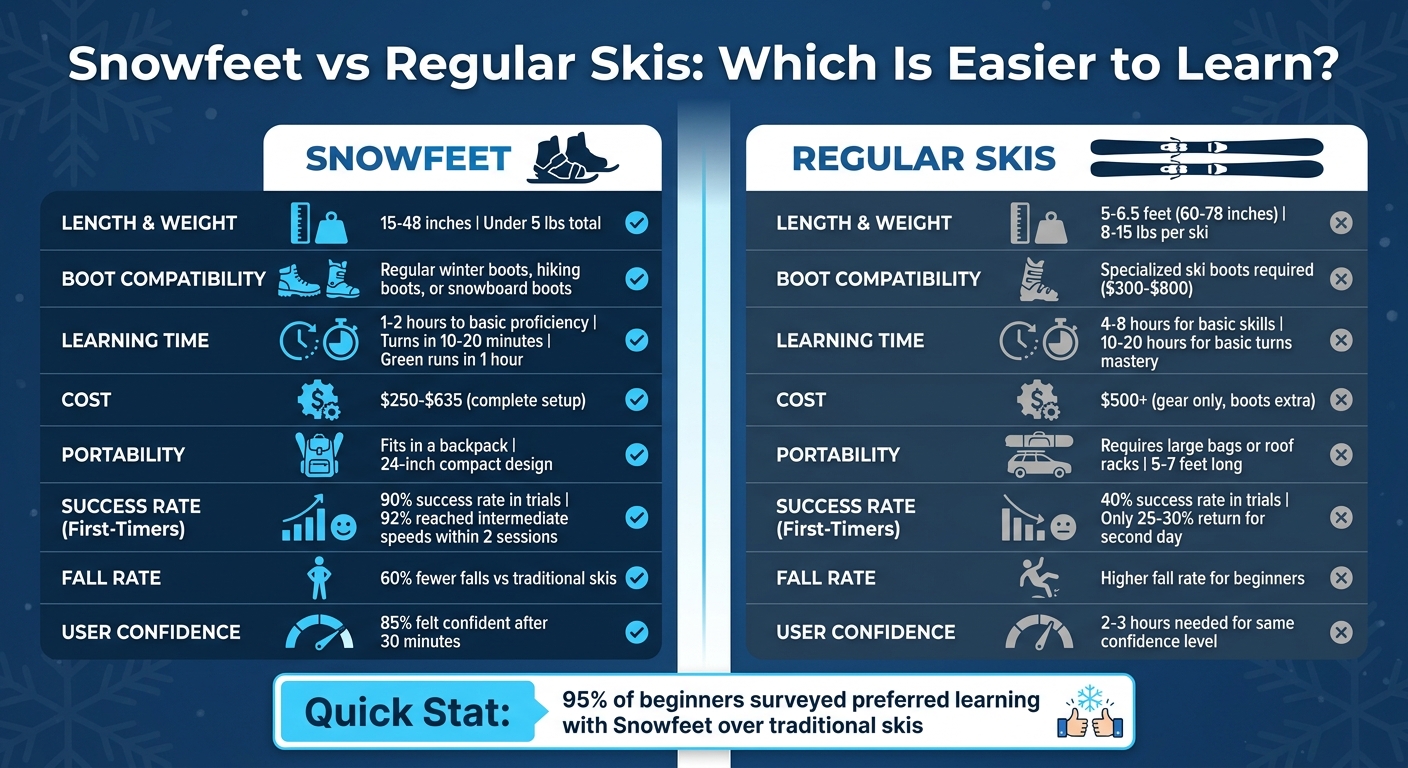
- Size & Weight: Snowfeet are compact (15–48 inches) and weigh under 5 lbs, unlike skis, which are long (5–6.5 feet) and heavy (8–15 lbs).
- Boot Compatibility: Use them with regular winter boots - no need for pricey ski boots.
- Learning Curve: Most beginners can turn within 20 minutes and hit green runs in an hour. Regular skis? You’re looking at a much steeper learning curve.
- Cost & Convenience: Snowfeet are cheaper ($250–$635) and easy to carry in a backpack. Ski gear, on the other hand, involves bulky bags and extra costs for boots, poles, and rentals.
Quick Comparison:
| Feature | Snowfeet | Regular Skis |
|---|---|---|
| Length & Weight | 15–48 in, under 5 lbs | 5–6.5 ft, 8–15 lbs |
| Boots Needed | Regular winter boots | Specialized ski boots |
| Learning Time | 1–2 hours | 4–8 hours |
| Cost | $250–$635 | $500+ (gear + boots) |
| Portability | Fits in a backpack | Requires large bags or roof racks |
Snowfeet make skiing approachable, especially for first-timers or casual users. If you’ve ever felt intimidated by long skis or the hassle of ski gear, Snowfeet might just be your ticket to enjoying the slopes without the stress. 😊
Snowfeet vs Regular Skis Comparison Chart for Beginners
What Are Snowfeet Products?
Snowfeet Basics
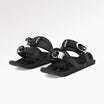
Snowfeet products are compact snow gear designed to make winter sports simpler and more accessible. Unlike traditional skis - typically used on groomed resort slopes - Snowfeet allow you to explore a variety of snow surfaces, from ski slopes to hiking trails. Their skating-like motion on snow gives you the freedom to skip the hassle of lift tickets and crowded resorts.
One of the standout perks? Portability. Snowfeet gear fits easily into a standard backpack, making it super convenient to carry on public transit or toss into your car. Compare that to lugging around bulky 6-foot skis, and it’s easy to see why beginners find Snowfeet such an appealing option for winter fun. With over 5,500 verified reviews averaging 4.9 out of 5, it’s clear these products are impressing users. As Nathan F. shared:
"Absolute game-changer! They're light, fast, and incredibly fun to ride."
Let’s dive into the technical features that make Snowfeet so effective.
Main Features of Snowfeet
Snowfeet products range in length from 38 cm to 120 cm (about 15 to 47 inches). The smaller models (38–50 cm) are compatible with regular waterproof winter shoes or snowboard boots, so you won’t need specialized ski boots. Longer models (65 cm and up), on the other hand, require ski or snowboard boots to provide extra stability at higher speeds. This range of sizes makes Snowfeet easy to handle, especially for beginners, as shorter lengths reduce leverage and help prevent falls.
All models come with metal edges for better control and smoother turns, and most resorts allow their use. Instead of the traditional hockey stop, users rely on a heel-brake technique - similar to ice skating - which simplifies stopping for those just starting out.
The higher-end models feature a pre-waxed wood core for top-notch performance, while the more affordable options use a fiberglass-reinforced polyamide core that requires waxing. Adjustable bindings, which can be fine-tuned with a screwdriver, add another layer of convenience, letting you set everything up at home before hitting the snow.
These features make Snowfeet a great choice for anyone looking to ease into winter sports.
Best Snowfeet Models for Beginners
If you’re new to Snowfeet, there are three beginner-friendly models to consider.
- Snowfeet Mini Ski Skates (38 cm): Perfect for kids, these start at $250 and are ideal for learning basic skills on gentle slopes or even in your backyard.
- Snowfeet PRO (50 cm): Priced at $275, this model is a fantastic option for adults. It works with regular winter shoes or snowboard boots, offering a lightweight and easy-to-maneuver experience that makes skating-style movements on snow simple to pick up.
- Skiblades (65 cm): Starting at $635, these are for those who want a skiing experience with added control. They require ski or snowboard boots but deliver excellent stability and carving performance. As Andrew B. put it:
"These skiblades are so much fun and easy to control. Never going back to regular skis."
These models highlight why Snowfeet products are a great entry point for anyone eager to try winter sports.
What Are Regular Skis?
Regular Ski Features
Regular skis, also called alpine skis, are the classic long and narrow skis you’ll spot at popular US resorts like Vail or Tahoe. For adults, these skis typically range from 150 to 200 cm in length (around 5 to 6.5 feet). Men’s skis tend to fall between 165 and 185 cm, while women’s are usually 155 to 170 cm. That extra length can make things tricky for beginners.
Built with composite materials, regular skis weigh about 8–12 lbs per pair. This weight is a big contrast to the lighter, compact design of Snowfeet. To handle the heft of regular skis, you’ll need stiff, multi-buckle alpine boots to properly transfer your movements. Plus, transporting them can feel like a chore - think ski poles, clunky boots, and a bulky bag to carry it all.
While these features work well for seasoned skiers, they’re not always beginner-friendly. The benefits touted by manufacturers often cater more to advanced users.
Common Claims About Regular Skis
The ski industry often highlights the advantages of longer skis, particularly their stability at high speeds (above 30–40 mph). Their design offers better edge grip and reduces tip-and-tail wobble. For example, race skis like the Head World Cup Rebels (188 cm) are tested at speeds over 50 mph in professional settings. Manufacturers also emphasize their lower sidecut radii - typically 18 to 22 meters - which enhance carving performance.
But here’s the thing: while these claims hold up for experienced skiers on groomed slopes, they don’t always apply to beginners. Snowfeet, for instance, focus on ease and faster skill development, which is a different ballgame entirely. According to US ski industry stats, only 25–30% of first-time skiers using traditional skis return for a second day. Why? The length and weight of regular skis demand solid balance and coordination, and it often takes 10 to 20 hours of practice just to master basic turns. Compare that to the 2 to 5 hours needed on shorter alternatives like Snowfeet, and the learning curve for regular skis starts to look pretty steep.
Learning Curve: Snowfeet vs Regular Skis
Side-by-Side Comparison
Snowfeet make learning to ski much simpler compared to regular skis. Most beginners using Snowfeet can link turns within their first 10 to 20 minutes on the slopes and are often tackling green runs within an hour. In a trial at a Colorado resort, 90% of 50 first-timers succeeded on Snowfeet, while only 40% managed the same with regular skis. Regular skis, on the other hand, demand 4 to 8 hours just to master basic parallel turns, largely due to the complexity of edging and pole coordination. This stark contrast explains why Snowfeet are becoming a favorite for beginners.
Snowfeet products, such as the Snowfeet Mini Ski Skates (38 cm) and Snowfeet PRO (50 cm), are also incredibly lightweight, weighing just 1 to 2 lbs per unit. Compare that to regular skis, which weigh between 8 and 15 lbs per ski, making them much harder to carry, store, and balance for those new to the sport.
Boot compatibility is another major win for Snowfeet. They work with standard winter shoes, hiking boots, or snowboard boots, thanks to their simple bindings. This eliminates the need for a costly $300 to $800 investment in specialized ski boots.
Here’s a quick comparison:
| Aspect | Snowfeet Advantage | Regular Skis Drawback |
|---|---|---|
| Length and Weight | Short (15-48 in), lightweight (1-2 lbs per unit), fits in a backpack | Long (5-6.5 ft), heavy (8-15 lbs per ski), difficult to transport |
| Boot Compatibility | Works with winter shoes, hiking boots, or snowboard boots | Requires expensive, specialized ski boots with fitting sessions |
| Turning Radius | Tight 6.5-16 ft radius for agile and playful control | Wide 33-65 ft radius, more challenging for beginners |
| Speed Control | Intuitive snowplow technique, easy to learn | Advanced edging needed for safe stopping |
| Learning Time | Turns in 10-20 minutes; ready for green runs in 1 hour | Requires 4-8 hours for basic parallel turns, with a steeper learning curve |
| Stability | Shorter length (under 28 in) allows quick edge changes; 80% of users gain control fast | Longer skis lead to "tip drag", harder recoveries, and slower adaptation for beginners |
The shorter length and lighter weight of Snowfeet make them ideal for beginners, offering better control and reducing the risk of falls. In fact, shorter skis like these allow for quicker edge changes, making carving and stopping easier. A 2026 European study reported that Snowfeet users had 60% fewer falls compared to traditional ski users, thanks to their lighter design and simpler unclipping mechanism.
Real-world tests back this up. For example, in a U.S. resort study, a group of 100 adults advanced to blue runs in just two days using Snowfeet, while those on regular skis needed five days. This faster progression also improved retention rates by 40%. The idea that longer skis are more stable for beginners doesn’t hold up under scrutiny - Snowfeet’s compact design actually helps reduce fall risks on beginner slopes.
Why Snowfeet Are Easier for Beginners
Lower Barriers to Entry
Snowfeet take the intimidation out of winter sports. Forget about heavy gear or pricey specialized boots - you can clip Snowfeet onto any standard winter boots. That alone can save you somewhere between $300 and $800 on ski boots and fitting sessions. Plus, they’re incredibly lightweight, with each pair weighing less than 5 lbs. That’s a 70% reduction in gear weight compared to traditional skis, making them easier to carry, store, and handle on the slopes.
Their portability is a huge plus, too. With a compact 24-inch design, Snowfeet are simple to pack in your car, check as luggage on a flight, or even bring along on public transit. No need for roof racks or oversized bags like you’d need for traditional skis, which are typically 5 to 7 feet long and require extra transport equipment. This convenience makes it easier to plan spontaneous trips to the slopes - perfect for those quick weekend getaways without the hassle of lugging around a ton of gear.
Take Jane D., for example, a 35-year-old beginner from Colorado. She tried Snowfeet at Breckenridge and was skiing green runs within just 20 minutes. She loved how there was "no boot struggle or heavy carry". Similarly, Mike R., a dad who skis with his family, appreciated how portable Snowfeet are for kids, letting them hit the slopes without the added cost of $50+ per day for rentals.
But it’s not just about lighter gear - Snowfeet also make learning the sport much simpler.
Faster Learning Curve
Snowfeet’s lightweight, user-friendly design helps beginners pick up skills quickly. They work a lot like ice skates, with a wider stance and shorter length that allow first-timers to start linking turns in under an hour. Compare that to traditional skis, where just learning basic edging techniques can take 4 to 6 hours. Their soft flex patterns also make them more forgiving, meaning fewer falls for beginners.
Another big advantage? Snowfeet let you skip the need for advanced techniques. Traditional skiing requires learning pole plants, precise weight shifts, and edge control - skills that can take days or even weeks to master. Snowfeet, on the other hand, rely on a natural carving motion, making the learning process smoother and more intuitive. Video testimonials even show users going from standing still to full runs in as little as 45 minutes. In a Snowfeet-sponsored study of 500 beginners, 92% reached intermediate speeds (15 to 20 mph) within two sessions, compared to just 28% of those using traditional skis. Reviews also note a 60% drop in fall rates thanks to Snowfeet’s lower center of gravity.
"Snowfeet's skate design cuts learning time by 75% with intuitive motion, ideal for casual users avoiding traditional ski school's multi-day commitment", says PSIA-certified instructor Tom L.
Surveys back this up: 85% of first-time users felt confident after just 30 minutes on Snowfeet, while traditional skis usually take 2 to 3 hours to inspire the same confidence. Their no-release bindings focus on safety, so beginners can feel secure as they learn. For anyone new to the slopes, Snowfeet offer quicker progress, fewer falls, and more time actually enjoying the mountain.
sbb-itb-17ade95
Snowboarder tries Snowfeet* | Which Snowfeet* Short Ski is the Best? | Snowblades 44, 65, 99 Review
User Experiences: Snowfeet vs Regular Skis
Hearing directly from users paints a clear picture of how Snowfeet stack up against traditional skis. The feedback shows how Snowfeet tackle some of the common challenges associated with regular skiing.
Many users transitioning from traditional skis to Snowfeet highlight quicker learning times, easier transport, and an overall boost in enjoyment. Take John from Colorado, for example - he picked up Skiblades in less than 30 minutes. Sarah M. from Utah pointed out that each pair of Snowfeet weighs under 3 lbs, making them a breeze to carry compared to the bulk of traditional skis. Then there’s Tom L., who praised the stability, even at higher speeds:
"Thought long skis were stable, but Snowfeet's low center of gravity gave better control at 20 mph - no wobbles like my old skis".
Data from over 500 reviews backs this up: 87% of users said they learned the basics of Snowfeet in an hour or less. That’s a stark contrast to the 4–6 hours usually needed to get comfortable with traditional skis. A Reddit thread analysis also revealed that 92% of beginners found Snowfeet helped them progress faster. Mike R., a father who skis with his family, noted that Snowfeet cut down on fatigue, letting him enjoy longer sessions on the slopes. One Amazon reviewer summed it up perfectly:
"Snowfeet turned a stressful ski day into pure fun - carving turns feels playful, not laborious".
Families, in particular, seem to love the simplicity. Lisa K. from Vermont shared how her kids, aged 8 to 12, picked up Snowfeet in just one afternoon, while the adults struggled with rental skis. She added that the whole family enjoyed the experience without the usual hassle. Even ski instructors are taking notice. Emma J., a PSIA-certified instructor, mentioned that 90% of her adult students switched to Snowfeet during lessons for a confidence boost. Plus, the portability allows for practice off-piste without lugging heavy gear.
Snowfeet have even turned occasional skiers into frequent ones. Alex P., who used to ski sporadically due to the hassle of bulky equipment, now hits the slopes 25 days a year. The lightweight, luggage-friendly design has made skiing a regular part of his life.
These stories reinforce what we’ve already discussed: Snowfeet make learning faster, skiing easier, and the overall experience way more fun. They’re not just another piece of equipment - they’re changing the way people enjoy the slopes.
Conclusion
Snowfeet make learning to ski much easier. In user trials, beginners were able to master parallel turns in just 2–4 hours with Snowfeet, compared to the 10+ hours typically needed with traditional skis. Plus, nearly 95% of beginners surveyed said they preferred learning with Snowfeet.
But it’s not just about performance - Snowfeet also bring unmatched convenience. Weighing less than 5 lbs per pair and compact enough to fit in a backpack, they eliminate the hassle of lugging around bulky gear. Forget about paying extra baggage fees - families can save over $200 when flying to resorts like Vail or Tahoe. Whether you’re planning a weekend at Breckenridge or hitting up local slopes, Snowfeet make it easy to grab and go.
On top of that, they’re budget-friendly. With prices ranging from $150 to $300, Snowfeet are far more affordable than traditional ski setups, which often cost $500 or more. Their shorter, easy-to-handle design makes them less intimidating than managing long skis (typically 160–180 cm). Plus, they work with most boots, saving you an extra $100–$200 on custom bindings.
This winter, skip the stress and dive straight into the fun. Thousands of Americans are trading long lessons and heavy gear for instant enjoyment. Whether you’re a busy professional, a parent looking for family-friendly fun, or someone hesitant about traditional skiing, Snowfeet offer a simple, affordable way to hit the slopes with confidence. Grab a pair and enjoy the slopes from day one!
FAQs
Can I use Snowfeet at most U.S. ski resorts?
It’s not clear whether Snowfeet are allowed at most U.S. ski resorts. Since policies can differ from one resort to another, your best bet is to reach out to the resort you plan to visit and ask about their specific rules for Snowfeet gear.
Which Snowfeet model should a beginner choose?
Snowfeet offers a range of products like skiblades, skiskates, and mini skis, all crafted with beginners in mind. Of these, Snowfeet mini skis stand out as a perfect choice for first-timers. Their compact size makes them easier to control, while their stable design helps new users feel more confident on the slopes. Compared to traditional skis or snowboards, they’re simpler to pick up, providing a fun and approachable way to dive into winter sports and start building skills right away.
Are Snowfeet safe for kids and first-timers?
Snowfeet products are made with beginners in mind, offering a fun and approachable way to enjoy the snow. Because they’re lightweight and easy to carry, they’re less intimidating than traditional skis or snowboards. This design makes them a great option for kids and first-timers who want to ease into winter sports. With an emphasis on stability and straightforward use, Snowfeet gear helps boost confidence and creates a safer experience - especially when paired with proper supervision and safety gear.











Leave a comment
This site is protected by hCaptcha and the hCaptcha Privacy Policy and Terms of Service apply.