



















Ski orienteering, or SkiO, is a sport that combines cross-country skiing with map navigation. Instead of following a set trail, you choose your own route between checkpoints using a map. It’s not just about skiing fast - it’s about making smart decisions on the go. The sport is popular worldwide, with races ranging from short sprints to endurance challenges.
If you’re a cross-country skier looking for a new challenge, SkiO is worth a try. You’ll need basic gear like skis, poles, and winter clothing, plus a map holder and an electronic chip for checkpoints. A great beginner option? Snowfeet Nordic Cross-Country Skate Skis (90 cm). These compact skis are easy to control, work with regular winter boots, and are perfect for navigating tight trails.
Here’s what sets SkiO apart:
- Navigation: You get a map 15 seconds before starting - no time to plan!
- Tracks: Courses mix wide and narrow trails, often in forests or hilly areas.
- Skills: It’s a mix of endurance, skiing technique, and quick thinking.
Want to start? Learn basic map reading, practice on easy trails, and focus on cross-country skiing basics like balancing navigation with skiing. With the right gear and mindset, SkiO offers a fun way to push both your body and your mind.
We tried XC Ski Orienteering with a Pro
sbb-itb-17ade95
Ski Orienteering vs. Cross-Country Skiing: Key Differences
Ski Orienteering vs Cross-Country Skiing: Key Differences Comparison
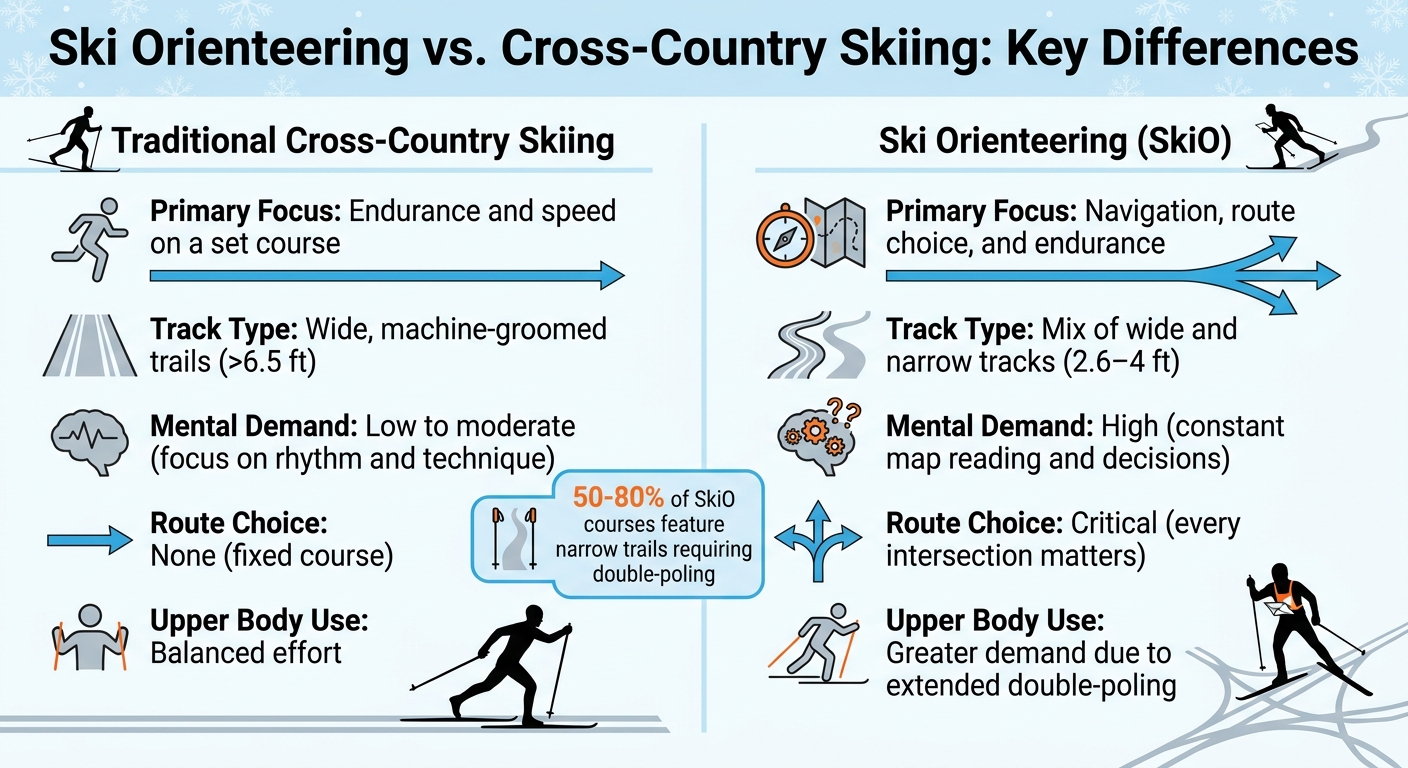
Both ski orienteering and cross-country skiing involve gliding through snowy landscapes, but they couldn’t be more different when it comes to how you approach the course. Cross-country skiing is all about pushing yourself physically along a pre-marked, groomed trail. Ski orienteering, on the other hand, challenges you to navigate a maze of tracks with nothing but a map and your wits.
The key difference? In ski orienteering, your brain works just as hard as your body. While cross-country skiers focus on pacing and technique, ski orienteers are constantly making split-second decisions - choosing routes, interpreting map symbols, and calculating the best path in real time, all while skiing at high speeds. It’s a mental workout as much as a physical one.
| Feature | Traditional Cross-Country Skiing | Ski Orienteering (SkiO) |
|---|---|---|
| Primary Focus | Endurance and speed on a set course | Navigation, route choice, and endurance |
| Track Type | Wide, machine-groomed trails (>6.5 ft) | A mix of wide and narrow tracks (2.6–4 ft) |
| Mental Demand | Low to moderate (focus on rhythm and technique) | High (constant map reading and decisions) |
| Route Choice | None (fixed course) | Critical (every intersection matters) |
| Upper Body Use | Balanced effort | Greater demand due to extended double-poling |
Ski orienteering also puts a heavier emphasis on upper body strength. With 50–80% of courses featuring narrow trails (2.6–4 ft wide), double-poling becomes a necessity. This technique is used far more often than on the wide, groomed trails of cross-country skiing, making upper body endurance a key factor in performance.
Navigation Skills: Maps and Compass Use
The ability to read a map is what truly sets ski orienteering apart. Racers are handed their map just 15 seconds before the start, leaving no time to plan in advance. There are no trail markers, no following the skier ahead - just you, your map, and the challenge of navigating a network of tracks.
Ski orienteers must process spatial information on the fly, memorizing trails, counting intersections, and making split-second choices. Top athletes rely more on their mental map of the track network than on their compass, as constantly checking bearings would slow them down.
"A slight lack of concentration for just a hundredth of a second may cost the medal." - International Orienteering Federation
A wrong turn in ski orienteering is costly. Heading back up a narrow, steep trail wastes precious time and energy, making focus and precision non-negotiable.
Course Layout and Terrain Types
Ski orienteering courses are a far cry from the smooth, predictable trails of traditional cross-country skiing. Instead, they’re a tangled web of tracks ranging from wide skating lanes to narrow paths softened by snowmobiles. A typical course might feature 20–50% wide tracks (over 6.5 ft) and 50–80% narrow tracks (2.6–4 ft). This variety forces skiers to constantly adapt their technique - skating on wide tracks, double-poling, or using diagonal strides on the narrower ones.
The terrain is just as varied as the tracks. While cross-country skiing sticks to groomed trails, ski orienteering ventures into forests, hills, and even urban parks. One moment you’re navigating a steep, narrow path where skating isn’t an option, and the next you’re cruising on a wide track where you can stretch your stride. Every intersection becomes a decision point, and with electronic timing units tracking your movements within 12 inches of each control point, accuracy is just as important as speed.
Equipment You Need for Ski Orienteering
Ski orienteering doesn’t require a ton of specialized gear, but a few essentials can make all the difference. Beyond the basics - like cross-country skis, poles, boots, and warm winter clothing - you’ll need some navigation tools. A chest-mounted map holder is a must-have, allowing you to read your map on the go without stopping. An electronic punching chip is also key for verifying that you’ve hit each control point. And while optional, a compass (either attached to your arm or integrated with your map holder) can be handy for precise navigation.
Among all the gear, your choice of skis is especially important.
Why Snowfeet* Nordic Cross-Country Skate Skis (90 cm) Stand Out
Traditional cross-country skis are long, tricky to transport, and require specialized Nordic boots - not to mention they can be challenging for beginners to master. That’s where Snowfeet* Nordic Cross-Country Skate Skis (90 cm) come in. These skis are designed to solve those pain points, offering a more user-friendly and portable alternative.
At just 35 inches long, Snowfeet* skis pack a punch when it comes to performance. They’re lightweight, highly responsive, and much easier to control compared to traditional long skis. For ski orienteering, where you’re navigating tight turns and narrow trails, this added maneuverability is a game-changer.
Made from fiberglass-reinforced plastic with metal edges, these skis provide excellent stopping power and control. Plus, they don’t require specialized boots - standard waterproof winter shoes or snowboard boots work just fine. This means you can save money on gear and get started without a hefty investment. They’re also compact enough to fit in a standard backpack, making them easy to carry to remote courses - no more lugging around oversized ski bags.
The 90 cm length strikes a great balance. It offers enough stability for carving while being short enough to feel natural and less restrictive, especially for beginners. This lets you focus more on the navigation aspect of the sport rather than wrestling with your equipment.
Snowfeet* vs. Traditional Cross-Country Skis: A Quick Comparison
Here’s how Snowfeet* compares to traditional cross-country skis:
| Feature | Snowfeet* (90 cm) | Traditional Cross-Country Skis |
|---|---|---|
| Portability | Fits in a backpack; easy to carry | Requires roof racks or large ski bags |
| Footwear Required | Standard winter boots or snowboard boots | Specialized Nordic ski boots |
| Maneuverability | High; perfect for narrow trails and quick turns | Lower; less adaptable in tight spaces |
| Learning Curve | Easier; feels more natural for beginners | Steeper; requires mastering kick-and-glide techniques |
| Terrain Flexibility | Works on groomed snow, hiking trails, and sledding hills | Best for groomed tracks or deep powder |
| Price Point | $250 (Mini Ski Skates) to $675 (99 cm models) | $400–$800+ for skis, plus $150–$300 for boots |
A Maintenance Tip to Keep in Mind
Daily waxing is essential to prevent snow from building up and to keep your skis fast and smooth. This applies to both Snowfeet* and traditional skis, but the smaller, more compact Snowfeet* setup makes maintenance a breeze.
How to Get Started with Ski Orienteering: A Beginner's Guide
Step 1: Learn Basic Map and Compass Skills
Start by mastering orienteering maps. Here’s a quick breakdown of symbols: solid green lines represent wide tracks (over 6.5 feet), dashed green lines mean narrow tracks (about 3 feet), blue marks water, brown indicates elevation, and yellow shows open areas.
To orient your map, align its north-south grid with your compass needle. When taking a bearing, place the compass baseplate in the direction you want to go, rotate the dial to map north, and then turn your body until the needle matches the orienting arrow - this process is often called "boxing the needle".
Using a chest-mounted map holder can make navigation easier while skiing. Always double-check your alignment to avoid accidentally heading in the opposite direction (a 180° error). Beginners typically stick to established trails, using the compass mainly for reorienting the map when needed.
Once you’ve got these basics down, you’re ready to plan your course.
Step 2: Plan Your First Course
A ski orienteering course starts at a triangle, includes numbered control points (marked as circles), and ends at a double circle. When mapping out your route, focus on handrails - linear features like trails that can guide you quickly - and attack points, which are landmarks near control points where you can slow down for precise navigation.
Remember, the shortest route isn’t always the fastest. Wide tracks (solid green lines) are better for efficient skating, while narrow tracks (dashed green lines) might require extra effort like double-poling, which can slow you down. Instead of trying to memorize every map detail, simplify things by focusing on key intersections and features. At tricky junctions, you can use the "counting method" - memorize your turn sequence, like “first left, then second right,” to avoid stopping too often.
Don’t forget to consider elevation and snow conditions. Elite ski-orienteers spend over half their time skiing uphill, so plan for elevation changes in your route.
Once your route is set, it’s time to practice on the snow.
Step 3: Practice Navigation While Skiing
When skiing with Snowfeet* Nordic Cross-Country Skate Skis, learning how to use hybrid snow skates is key. Stand with your feet shoulder-width apart, knees bent, and your weight balanced. To check your map, position one foot slightly ahead of the other and lean forward slightly for stability while glancing at your chest-mounted map holder.
Keep your weight centered or slightly back to prevent falls, especially when using Snowfeet*, which are designed for control on narrow tracks. Use a skating motion to propel yourself forward, and attach your compass to your arm or map holder for quick checks without breaking your rhythm.
To stay on course, try "sighting." Look for an object 165 to 330 feet ahead that aligns with your bearing, and ski toward it. This way, you can maintain speed without constantly checking your compass. Stick to groomed trails and the track networks shown on your map - Snowfeet* work best on prepared surfaces, not deep powder. Before attempting more advanced courses, practice stopping by evenly distributing your weight or using the heel brake.
With these steps, you’ll be ready to hit the trails and enjoy the challenge of ski orienteering!
Why Snowfeet* Works Best for Ski Orienteering Beginners
When it comes to ski orienteering, beginners face the dual challenge of mastering navigation and skiing technique. Snowfeet* Nordic Cross-Country Skate Skis are designed to make this learning process smoother and more enjoyable.
Compact and Easy to Carry
At just 90 cm long and weighing about 2.5 lbs per pair, Snowfeet* are a breeze to transport compared to traditional skis, which typically measure 180-200 cm and weigh 4-6 lbs. You can easily fit them in a standard backpack or car trunk - no need for bulky ski bags or roof racks. This makes them perfect for reaching remote trailheads with minimal hassle.
The shorter length also means greater control in tight, wooded areas. Quick turns and stops become much easier, which is a big plus when you’re pausing to check your map. Cross-country coach Mike Doyle highlights how shorter skis can cut the learning curve by 30-50% for beginners, offering a nimble, skateboard-like feel that lets you focus more on navigation and less on staying upright.
In short, their portability and ease of use make Snowfeet* a beginner-friendly choice for tackling varied terrains.
Performs on Multiple Terrain Types
Ski orienteering often involves unpredictable snow conditions, and Snowfeet* rise to the challenge. Thanks to their hybrid design and sturdy 4-inch base, they handle groomed trails, fresh powder, icy patches, and even up to 12 inches of backcountry snow. Unlike traditional narrow skis that struggle in deep powder, Snowfeet*'s shorter profile and aggressive edges provide better grip and stability across diverse surfaces.
For example, during the 2026 Vermont Ski-O Challenge, beginner Sarah Kline completed a 5 km course featuring groomed trails and off-piste snow, finishing in the top 20% of novices. She credited the skis’ versatility for helping her navigate hilly forests and frozen streams. Similarly, a Colorado backcountry group reported Snowfeet* performed seamlessly over 8 miles of mixed powder and crust, where longer skis often faltered.
This adaptability ensures you’re ready for whatever terrain the course throws at you.
Affordable and Beginner-Friendly
Snowfeet* are priced between $149 and $199 per pair, making them far more budget-friendly than traditional skis, which typically cost $300-$600 (bindings not included). On top of that, they’re easier to learn. Most beginners can get the hang of them in just 1-2 hours, compared to the 5-10 hours it often takes with standard skis. Studies show a 70% proficiency rate after one session with Snowfeet*, versus only 40% with traditional gear.
US ski orienteering coach Elena Voss is a big fan:
"Their portability and terrain versatility make them unbeatable for newbies - I've seen novices complete full courses on first tries."
For beginners looking to dive into ski orienteering without breaking the bank - or their confidence - Snowfeet* are a game-changer.
Conclusion
Ski orienteering is an exciting mix of physical endurance and mental agility. Picture yourself gliding through snow-covered trails - whether in city parks, open fields, dense forests, or rugged mountain terrain - all while making quick decisions to find the best route forward. It’s a sport that keeps both your body and mind fully engaged.
For those stepping into ski orienteering, Snowfeet* Nordic Cross-Country Skate Skis are a great starting point. Their compact 90 cm design makes maneuvering through tight, narrow trails a breeze. Plus, they’re built to handle a range of snow conditions - from groomed tracks to powder or backcountry terrain - so you’re ready for whatever the course throws at you.
These skis are designed with beginners in mind, much like XC skiing for absolute beginners, offering a lightweight and portable option that fits in a backpack. Best of all, they’re compatible with regular winter boots, making them super accessible. Instead of worrying about gear, you can focus on learning navigation and enjoying the adventure.
With Snowfeet*, ski orienteering becomes more approachable and fun. Whether you’re an experienced skier looking for a new twist or a beginner eager for an adventure, these skis are your ticket to exploring the sport. So, why wait? Grab a pair and dive into the thrill of ski orienteering today!
FAQs
How do I find SkiO events near me in the U.S.?
If you're looking to join SkiO events in the U.S., your best bet is to check the event calendars from Orienteering USA and the New England Orienteering Club (NEOC). Orienteering USA covers national and regional events, while NEOC focuses on activities in and around the Boston area.
Want to stay in the loop? Follow local orienteering clubs on social media for the latest updates. Keeping an eye on these resources will help you stay on top of upcoming SkiO events near you.
Do I need a compass if I use a map holder?
When using a map holder for ski orienteering, a compass isn’t absolutely required. Map holders make it easy to keep your map visible and safe, helping you navigate effectively by focusing on map reading. That said, a compass can come in handy for more precise navigation, especially in tricky terrain or when visibility is low. If you’re confident in your ability to read the map, you might skip the compass, but it’s always a good backup for extra accuracy.
Are Snowfeet* 90 cm skis allowed in SkiO races?
Snowfeet* 90 cm skis aren't specifically called out in SkiO race rules, but their compact size and versatility make them a go-to option for ski orienteering enthusiasts. Since the sport emphasizes adaptable gear, these skis are probably allowed. Plus, they bring some clear perks to the table - like being super easy to handle and incredibly portable compared to standard skis.












Leave a comment
This site is protected by hCaptcha and the hCaptcha Privacy Policy and Terms of Service apply.