




















If you’re a weightlifter looking for a fresh way to stay active during the off-season, cross-country skiing might be your new best friend. Specifically, Snowfeet NORDIC cross-country skate skis (90 cm) offer a compact, easy-to-use option that delivers a full-body workout without the hassle of long, bulky skis. Here’s why they’re worth considering:
- Why Skiing? It’s not just cardio - it works your stabilizer muscles, core, and balance in ways weightlifting doesn’t, helping you avoid plateaus and improve performance.
- VO₂Max Boost: Skiing is one of the best ways to build endurance. Elite skiers have some of the highest aerobic capacity scores ever recorded.
- Snowfeet vs. Long Skis: At just 35 inches, Snowfeet skis are portable, easy to learn, and work on multiple terrains, unlike their 6–7 foot counterparts.
- Strength Benefits: The lateral skating motion strengthens quads, glutes, and calves while improving core stability and balance.
- 4-Week Plan: Combine Snowfeet sessions with strength training to maintain muscle and enhance endurance.
No need for hours of setup or a long learning curve - Snowfeet skis make it simple to mix up your routine and stay in shape, even when the snow starts falling.
Cross-Country Skiing: The Ultimate Off-Season Training #FightTheCouch
Why Snowfeet* NORDIC Beats Traditional Long Skis for Strength Athletes

For weightlifters, traditional long skis can feel like overkill. At 180–210 cm (around 6–7 feet), they’re designed for hardcore skiers who spend entire weekends on groomed trails. But strength athletes looking for efficient cardio without the hassle? Snowfeet* NORDIC skis are a much better fit. Let’s break down why.
Compact Size and Easy Transport
At just 90 cm (35 inches) long, Snowfeet* NORDIC skis are 60–70% shorter than traditional cross-country skis. This makes them super easy to transport and store. Weighing just 5 lbs for the pair, they can fit into a backpack or the trunk of your car - no roof rack needed. Heading from the gym to a nearby park? Toss them in with your gym bag and you’re good to go.
Traditional skis often require bulky ski bags and can rack up airline fees of $50–$150 per trip. Snowfeet* NORDIC skis, on the other hand, are compact enough to fit within standard luggage allowances on many airlines. They’re also perfect for small living spaces - store them in a closet alongside your kettlebells.
Faster Learning Curve for Beginners
Most weightlifters aren’t seasoned skiers, and traditional skis can take 5–10 hours just to master the basics. With Snowfeet* NORDIC skis, you can cut that down to 1–3 hours. Their shorter length and lower center of gravity make them much easier to handle.
The skate-style design feels natural and intuitive. You’ll be gliding and turning within your first session, keeping frustration at bay. For strength athletes aged 25–45, this quick accessibility is a game-changer. You’re not trying to win a Nordic skiing medal - you just want a cardio workout that fits into your off-season routine.
Works on Multiple Terrain Types
Beyond the easy learning curve, Snowfeet* NORDIC skis shine in their adaptability. Traditional skis are built for groomed trails and need at least 6 inches of packed snow to perform well. Snowfeet* NORDIC skis, however, work on a variety of surfaces - from groomed trails and backcountry areas to packed snow in city parks and even your backyard, as long as there’s 4+ inches of snow.
This versatility means you can train almost anywhere. Urban parks, backyards, or even neighborhood streets with decent snow cover become your training ground. Forget driving an hour to find a ski facility - you can squeeze in a 30-minute conditioning session close to home. Their ability to handle different snow depths makes them a great tool for strength athletes looking to stay active during the off-season.
Physical Benefits of Snowfeet* for Weightlifters
Building Lower Body Strength
Using Snowfeet* NORDIC skis works your legs in ways traditional weightlifting doesn't. Instead of the usual forward-and-backward movement, the skating motion pushes you side to side. This lateral action targets your quads, glutes, and calves, building strength in areas often overlooked by typical gym routines.
Each push-off demands explosive power, similar to movements in Olympic lifts. Your hip extensors and glutes get a serious workout, helping to reinforce the stability needed for heavy lifting. Plus, Snowfeet* skis are much shorter than traditional skis - about 35 inches compared to 6–7 feet - so they constantly challenge your single-leg balance. This strengthens the small stabilizer muscles around your ankles and knees, which is key for preventing injuries when you're back under the bar.
These lower-body gains also lay the groundwork for better core stability.
Improving Core Stability and Balance
Balancing on Snowfeet* demands more from your core than static exercises ever could. Every time you shift your weight on the narrow, moving surface, your abs, obliques, and lower back kick into gear, building functional strength.
"Single-leg balance on a moving object is required. This consistent transfer-of-balance training benefits athletes by improving reaction time and strengthening stabilizers." – Alana Gillmore, Professional Ski Instructor
The multi-directional movement - forward, sideways, and rotational - trains your core to handle shifts that translate directly to better lifting form. While traditional long skis offer some of these perks, Snowfeet*'s shorter length and lower center of gravity make them easier for beginners to handle while still providing a solid challenge for experienced athletes.
The result? A stronger, more balanced core that supports both your lifts and overall performance.
Boosting Cardiovascular Endurance
Cross-country skiing is a cardio powerhouse. It works more muscles than running or cycling because it pairs upper-body effort (thanks to the poles) with a strong leg drive. To put it into perspective, an hour of moderate skiing burns around 470–700 calories.
Elite Nordic skiers boast VO₂Max scores of 96–97.5 mL/(kg·min) - some of the highest recorded in any sport. Even at a recreational level, skiing builds aerobic capacity without the joint strain that comes with running.
For weightlifters, it's crucial to keep lifting heavy during ski season. While skiing builds endurance, intense cardio can chip away at muscle mass. To counteract this, stick with challenging squats and standing presses alongside your Snowfeet* sessions. Think of Snowfeet* as a complement to your lifting routine, helping you become a more well-rounded and conditioned athlete.
sbb-itb-17ade95
Snowfeet* vs Traditional Cross-Country Skis
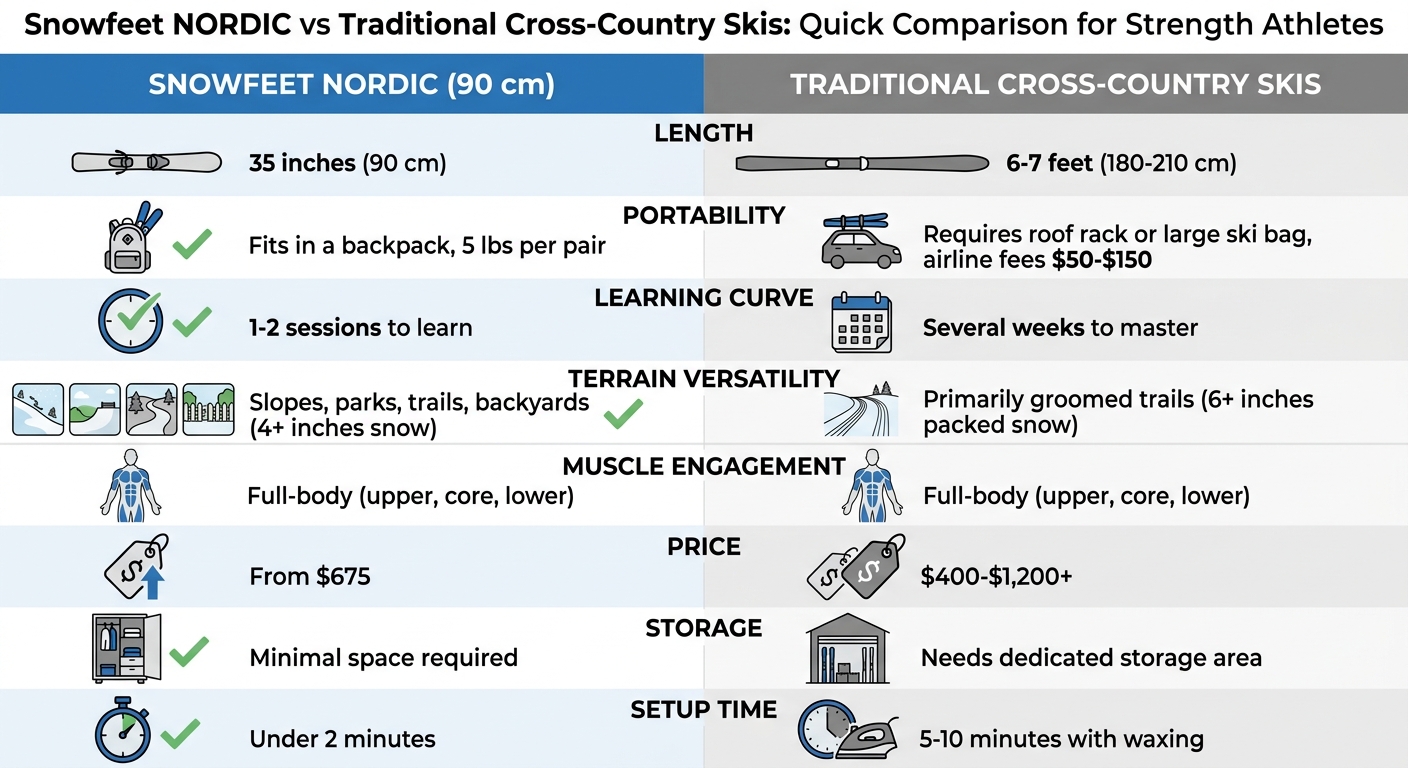
Snowfeet NORDIC vs Traditional Cross-Country Skis Comparison
Let’s break down how Snowfeet* compares to traditional cross-country skis, especially for athletes balancing strength training with outdoor activities.
Traditional cross-country skis are typically 6–7 feet long, making them bulky to transport and store. Snowfeet* NORDIC skis, on the other hand, are just 35 inches (90 cm) long - small enough to fit in a backpack. If you’re juggling gym gear and outdoor equipment, this compact size is a game changer. It makes it easy to carry everything you need without feeling like you’re hauling a ton of extra baggage.
Another big difference? The learning curve. Traditional skis require weeks to master, thanks to their complex techniques. Snowfeet* simplifies things with a skating motion that most people pick up in just one or two sessions. That means you can spend less time learning and more time focusing on cardio and endurance training.
Both options provide a full-body workout, targeting muscles in the upper body (like biceps, triceps, lats, and deltoids), core, and lower body (quads and calves). But Snowfeet* gets you moving faster and with less effort. While traditional skis shine on groomed trails, Snowfeet* is built for versatility. You can use them on slopes, parks, trails, or even your own backyard after a fresh snowfall. For weightlifters, this flexibility means more time training and less time dealing with gear setups.
Here’s a quick look at how Snowfeet* stacks up against traditional long skis:
Comparison Table: Snowfeet* vs Traditional Long Skis
| Factor | Snowfeet* NORDIC (90 cm) | Traditional Cross-Country Skis |
|---|---|---|
| Length | 35 inches | 6–7 feet |
| Portability | Fits in a backpack | Requires roof rack or large ski bag |
| Learning Curve | 1–2 sessions to learn | Several weeks to master |
| Terrain Versatility | Slopes, parks, trails, backyards | Primarily groomed trails |
| Muscle Engagement | Full-body (upper, core, lower) | Full-body (upper, core, lower) |
| Price | From $675 | $400–$1,200+ |
| Storage | Minimal space required | Needs dedicated storage area |
| Setup Time | Under 2 minutes | 5–10 minutes with waxing |
For weightlifters aiming to stay in shape during the off-season, Snowfeet* offers the same cardiovascular and muscle-building benefits as traditional skis - minus the hassle of bulky gear and lengthy setups.
Getting Started: How to Use Snowfeet* NORDIC Skis
5-Step Setup and Technique Guide
Snowfeet* NORDIC skis are simple to use - no waxing or complicated adjustments needed. Here’s how you can get started:
- Step 1: Secure your boots into the bindings.
- Step 2: Choose a flat, open area with fresh snow for your first session.
- Step 3: Use a skating motion, similar to ice skating, to propel yourself forward.
- Step 4: Practice the double-pole technique. This involves planting both poles at the same time and pulling yourself forward using your core, chest, shoulders, and back muscles.
- Step 5: Keep your core tight and balance steady. Use strong kicks with your quadriceps and calves to maintain forward momentum.
"You need to be able to ski well technically, maintaining a strong and stable position during thousands of pole strokes for several hours." - Petter Skinstad, Professional Skier
When starting out, aim for short sessions of about 15–20 minutes at a pace that feels "comfortably hard." This means you’re breathing heavily but still able to talk. Avoid pushing yourself to the limit right away - overdoing it can lead to muscle soreness and make it harder to perfect your technique.
Once you’re comfortable with these basics, you’ll be ready to tackle the structured 4-week training plan below.
4-Week Off-Season Training Plan
This plan combines Snowfeet* sessions with strength training to help maintain muscle while boosting your endurance. Let’s break it down week by week.
Week 1:
Focus on building your foundation. Do two long, easy sessions of 2–3 hours each to get used to the movements and improve your form. Keep up with your regular strength training, and add 5–10 minutes of daily core work (think planks, sit-ups, or hip thrusts) to strengthen your skiing posture.
Week 2:
Add some intensity. Include one interval session with 6x6 minute intervals - six minutes of effort followed by two minutes of rest. Aim for about 90% of your max heart rate during the effort. As Hans Christer Holund puts it:
"I'd rather have you running at a slightly lower intensity that lasts for six minutes than have you giving your all in a four-minute run".
On other days, stick to light sessions on flat terrain. If snow isn’t available, a treadmill set to a 5–6% incline works too.
Week 3:
Step it up by increasing your training volume. Plan for two long sessions (2–3 hours each) over the weekend, starting slow and gradually picking up the pace. Add one mid-week interval workout and include a light recovery day. Holund also stresses the importance of strength training:
"Many skiers strength train in spring, summer, and autumn, but stop in winter. This is the opposite of what you should do because you want to be as strong as possible during the winter".
Stick with compound lifts like squats, deadlifts, and presses, but slightly reduce the volume to balance the added cardio.
Week 4:
It’s time to taper. Reduce your total training distance by about 30%, but increase the intensity of shorter sessions. This approach helps your body recover while keeping the gains you’ve made. By the end of this week, you’ll likely notice better endurance, faster recovery between gym sets, and improved overall fitness.
| Week | Focus | Primary Goal | Key Sessions |
|---|---|---|---|
| Week 1 | Base Endurance | Build volume and technique | Two 2–3 hour easy sessions |
| Week 2 | Interval Introduction | Increase heart rate capacity | One 6x6 minute interval session at ~90% max HR |
| Week 3 | Peak Volume | Maximize distance | Two 2–3 hour sessions plus one interval session |
| Week 4 | Taper & Intensity | Recovery with maintained intensity | Reduced distance by ~30% with higher intensity short sessions |
Conclusion
If you're a weightlifter wanting to stay in peak shape during the off-season, Snowfeet* NORDIC cross-country skate skis could be your go-to tool. Unlike traditional long skis, these are compact enough to toss in your car or even take on a chairlift. Despite their small size, they pack a punch when it comes to delivering a full-body workout - helping you build cardiovascular endurance, core strength, and explosive power. Plus, they’re quick to set up, so you can spend less time fussing with gear and more time training. All of this adds up to real improvements in your performance.
The 4-week training plan shared earlier offers a practical way to maintain your strength while also boosting your aerobic base - key for recovering between heavy lifts. Pairing Snowfeet* sessions with your usual heavy lifts like squats, deadlifts, and presses helps you hold onto muscle mass while also improving movement patterns that standard weightlifting might not address.
FAQs
Will skiing hurt my strength or muscle?
Skiing - whether it’s cross-country with Snowfeet* or using traditional skis - doesn’t typically hurt your strength or muscles. Actually, it can boost endurance, build lower body strength, and improve core stability when done the right way. Snowfeet* skiskates are a great option for off-season workouts because they’re portable and versatile. By focusing on proper technique and balancing your training, skiing can fit perfectly into your strength routine while enhancing muscular endurance without causing muscle loss.
What boots and poles do I need with Snowfeet* NORDIC?
Snowfeet* NORDIC skiskates are a game-changer - they don’t need traditional Nordic ski boots or poles. Instead, they strap right onto sturdy winter boots, making them super portable and easy to use.
Although poles aren’t necessary, it’s important to wear secure and durable winter boots for the best performance and safety. This setup is all about convenience, giving athletes a way to train during the off-season without needing all the specialized gear that traditional Nordic skiing demands.
How do I adjust the plan if I can’t ski every week?
If hitting the slopes every week isn’t an option, you can stay in shape with some alternative cross-training. Activities like running, cycling, or roller skiing are great for building endurance. To keep your muscles strong, mix in strength exercises like squats, lunges, and core workouts.
For something a little different, consider Snowfeet products. These portable mini skis can be a fun way to maintain lower body strength and get your heart pumping. They’re a handy option to keep your skiing muscles ready to go, even when you’re taking a break from the mountains.












Leave a comment
This site is protected by hCaptcha and the hCaptcha Privacy Policy and Terms of Service apply.