




















Cross-country skiing and running are both excellent workouts, but they challenge your body in different ways. Here’s the quick answer: Cross-country skiing is generally harder than running because it engages your entire body - legs, arms, core, and back - while running mostly focuses on your lower body. Skiing also burns more calories and pushes your cardiovascular system harder, especially during uphill efforts. However, it’s gentler on your joints thanks to its low-impact, gliding motion.
Key Takeaways:
- Muscle Use: Running targets your legs; skiing works your whole body.
- Cardio: Skiing requires your heart to pump blood to more muscles, often resulting in higher heart rates.
- Impact on Joints: Running is high-impact, while skiing is low-impact and joint-friendly.
- Calories Burned: Skiing burns more calories per hour than running.
- Learning Curve: Running is straightforward; skiing takes more technique and practice.
- Gear: Skiing requires specialized equipment like skis and poles, while running just needs shoes.
If you’re new to skiing, the Snowfeet NORDIC Cross-Country Skate Skis* ($675) are a great option. Their compact 35-inch design makes them easier to handle than standard skis, perfect for beginners or anyone looking for a portable solution.
Quick Comparison Table
| Feature | Cross-Country Skiing | Running |
|---|---|---|
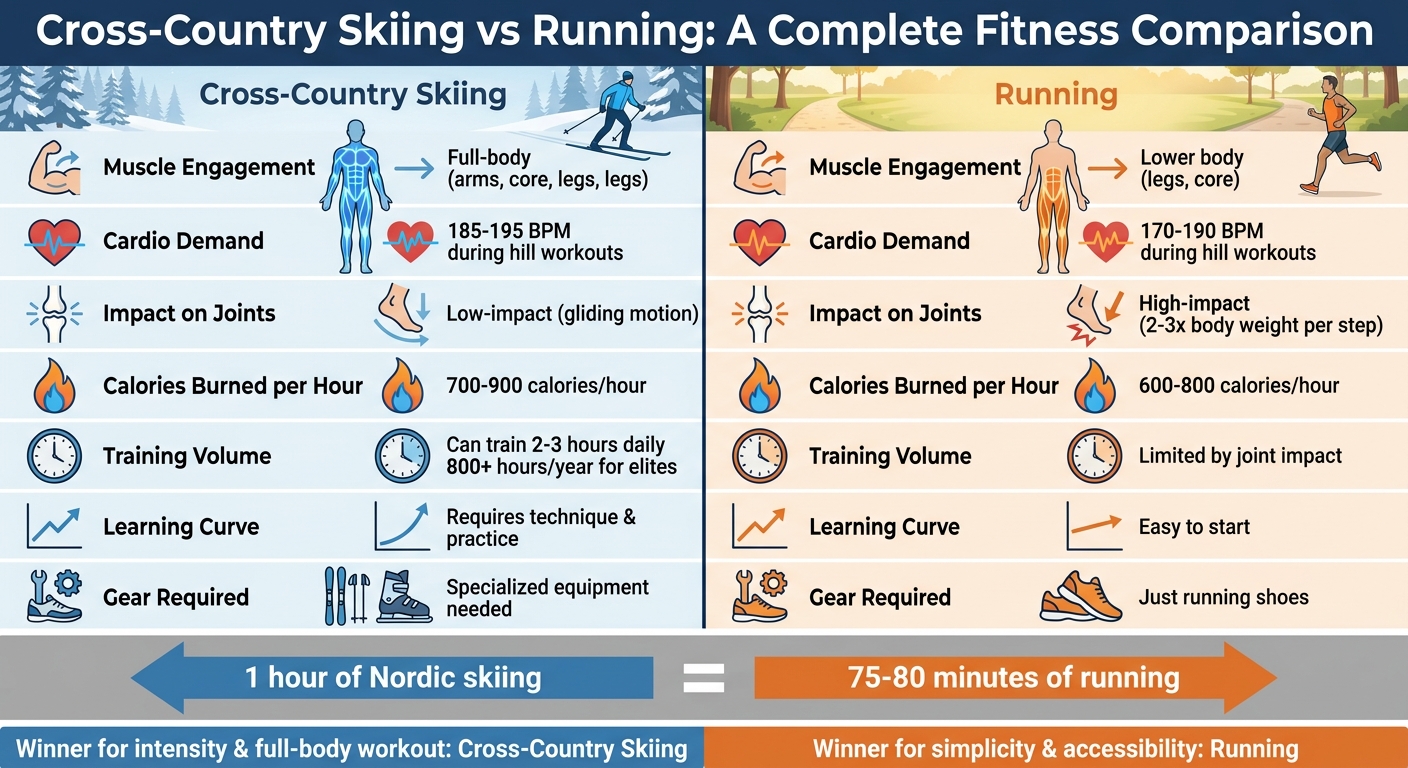
| Muscle Engagement | Full-body (arms, core, legs) | Lower body (legs, core) |
| Cardio Demand | Higher heart rate, full-body effort | Moderate heart rate, legs-focused |
| Impact on Joints | Low-impact (gliding motion) | High-impact (repetitive striking) |
| Calories Burned | ~700–900/hour | ~600–800/hour |
| Learning Curve | Requires technique and practice | Easy to start |
| Gear Needed | Skis, poles, boots (e.g., Snowfeet* NORDIC) | Running shoes |
Both activities are great for fitness. If you want a low-impact, full-body workout and don’t mind learning a new skill, skiing is worth trying. For simplicity and convenience, stick with running. Either way, you’re getting a solid workout. :)
Cross-Country Skiing vs Running: Complete Fitness Comparison
Muscle Engagement: Full-Body vs Lower-Body Focus
Muscles Used in Running
Running puts the spotlight on your lower body. Your quadriceps, hamstrings, calves, and glutes are the powerhouses driving every step. The gastrocnemius, that prominent calf muscle, delivers the "kick" that propels you forward with each stride. While your legs do most of the work, your core stabilizers step in to help maintain balance and proper posture.
"Running primarily targets the lower body".
Muscles Used in Cross-Country Skiing
Cross-country skiing shifts the focus to your entire body. Sure, your legs take charge during the kick and glide phases, but your upper body is just as involved. Your arms, shoulders, and back work hard to drive the poles, while the diagonal stride activates both your biceps and triceps. Techniques like double-poling also engage your core, along with muscles such as the pectoralis major, deltoids, and latissimus dorsi.
This full-body effort makes cross-country skiing a calorie-burning powerhouse. Your heart rate tells the story: during hillbounding with poles, skiers often hit heart rates between 185–195 bpm, with some even exceeding 210 bpm. Runners tackling the same hill typically reach 170–190 bpm.
Snowfeet* NORDIC takes inspiration from these benefits, packing the full-body engagement of skiing into a compact and user-friendly design.
How Snowfeet* NORDIC Delivers a Full-Body Workout
Snowfeet* NORDIC brings the dynamic muscle engagement of cross-country skiing into an accessible, streamlined package. Their Cross-Country Skate Skis are designed to deliver full-body conditioning while being easier to control - perfect for beginners. Measuring just 90 cm in length, they’re significantly shorter than traditional skis, which often range from 160 to over 200 cm. This shorter design enhances maneuverability while still requiring the vigorous poling and side-to-side movements that define skate skiing.
"Demands a continuous, dynamic motion, requiring more vigorous upper and lower body engagement".
The compact size also reduces upper-body strain compared to longer skis, helping you focus on your workout without sacrificing intensity. At $675, Snowfeet* NORDIC offers a practical alternative to traditional brands like Rossignol or Fischer. It’s a manageable yet powerful tool for improving muscle coordination and getting a full-body workout - all while keeping the essence of cross-country skiing intact.
Why cross-country skiing should be more popular than alpine | 2026 Winter Olympics
Impact on Joints: Gliding vs Striking
Cross-country skiing is known for delivering a dynamic, full-body workout while being gentle on the joints. This low-impact nature makes it an excellent choice for consistent training without added stress.
Running: High-Impact on Joints
Running takes a toll on your joints. With every step, your ankles, knees, and hips absorb forces equivalent to two to three times your body weight. This impact is even harsher on hard surfaces like pavement or packed dirt, which offer little to no shock absorption.
"When you run, every footstrike sends jarring forces through your ankles, knees, and hips - as mentioned, roughly two to three times your body weight in impact each stride." - Inez Elpers, Tracks and Trails
Elite runners often develop stronger tendons and bones to adapt to this repeated stress. However, for recreational runners, the constant pounding can lead to overuse injuries, requiring longer recovery times after intense sessions.
Cross-Country Skiing: Low-Impact Movement
Cross-country skiing provides a stark contrast. Instead of the jarring "flight phase" found in running, at least one ski remains in contact with the ground at all times, creating a smooth and fluid gliding motion. Plus, the soft, groomed snow acts as a natural shock absorber, reducing strain on your joints.
The exercise evenly distributes the workload across your arms, shoulders, core, and legs, lightening the burden on your lower body. This makes skiing a fantastic option for runners looking to recover from impact-related injuries. Ingrid Kristiansen, a former world champion runner, highlighted this benefit, noting how skiing allowed her to train more without risking injury, sparing her feet from the relentless pounding of running.
Snowfeet* NORDIC for Joint-Friendly Exercise
Snowfeet* NORDIC takes these low-impact advantages and packages them into a compact, user-friendly design. Unlike traditional skis from brands like Rossignol or Fischer, these shorter skis measure just 90 cm (about 35 inches) and are priced at $675. They offer the same joint-friendly gliding motion while being far more portable.
The shorter length makes it easier to master weight transfer, which not only protects your joints but also simplifies the learning process for beginners. Snowfeet* NORDIC provides a practical way to maintain aerobic fitness while minimizing the orthopedic strain that often comes with other forms of exercise.
sbb-itb-17ade95
Cardiovascular and Endurance Demands
Running and cross-country skiing both push your cardiovascular system, but they do so in different ways because they engage distinct muscle groups. The main difference lies in how much of your body is actively working, which impacts calorie burn and heart rate. This is also why the right equipment can make a big difference in your workout experience.
Cardiovascular Benefits of Running
Running is fantastic for building heart and lung capacity. Each step requires your cardiovascular system to deliver oxygen-rich blood to your quads, hamstrings, glutes, and calves. This repeated effort is excellent for boosting your VO2 max - the maximum oxygen your body can use during intense activity.
However, running has its limits due to its high-impact nature. While your heart might be ready to keep going, your joints and muscles often need rest after long or intense runs. This mechanical stress can restrict how much training you can handle before risking injury. On the other hand, cross-country skiing spreads the workload across your whole body, allowing for even greater cardiovascular gains.
Cardiovascular Benefits of Cross-Country Skiing
Cross-country skiing steps up the cardiovascular challenge by engaging your arms, shoulders, core, and legs all at once. This full-body effort forces your heart to deliver oxygen to a larger group of muscles compared to running.
"Cross-country skiing activates more of the body's skeletal muscles, thereby giving more stimulation and work for your cardiovascular system." - Ingrid Kristiansen, Former World Champion Runner and Elite Skier
The stats back this up. Just one hour of Nordic skiing can deliver the same benefits as 75–80 minutes of running. Plus, elite skiers can train for 800+ hours per year because the low-impact nature of skiing minimizes the wear and tear that often limits runners.
Snowfeet* NORDIC for Efficient Cardio Training
Snowfeet* NORDIC Cross-Country Skate Skis are designed to make these cardiovascular benefits more accessible. Priced at $675, they combine a low-impact design with the potential for high-intensity training. The 35-inch skis reduce technical challenges, letting you enjoy extended cardio sessions of 2–3 hours. This means more calories burned, better aerobic conditioning, and less strain on your joints - all in one workout.
Skill Requirements and Learning Curve
Running: A Simple Start
Running is one of the easiest activities to get into. All you need is a decent pair of shoes, and you're ready to hit the ground - literally. The movement feels natural, and there’s no special technique required. Because of this, most people can start running without much effort and quickly notice improvements in their fitness. On the other hand, cross-country skiing isn’t quite as straightforward.
Cross-Country Skiing: A Technique-Heavy Sport
Cross-country skiing takes a bit more finesse. To move efficiently, you need to master techniques like the glide phase, which involves shifting your weight smoothly onto the gliding ski. It’s not just about the legs - your arms and legs must work together to propel you forward while maintaining balance on slippery surfaces. And then there’s the equipment: traditional skis, often 180–210 cm long, can be tricky to handle, adding another layer to the learning curve.
Snowfeet* NORDIC: A Simpler Way to Ski
This is where Snowfeet* NORDIC steps in to make things easier. These Cross-Country Skate Skis are just 35 inches (90 cm) long, much shorter than traditional skis. That compact size gives you more control and makes it easier to focus on developing balance and glide skills without feeling overwhelmed by your gear. At $675, they offer a great middle ground - combining the ease of running with the full-body workout of cross-country skiing, all while making the learning process a lot less intimidating.
Conclusion: Which is Harder and Why Choose Snowfeet*
Key Differences Between Running and Cross-Country Skiing
Running and cross-country skiing each test your body in distinct ways. Running subjects your joints to repetitive impact with every step, while cross-country skiing leans heavily on your cardiovascular system. For instance, during hill workouts, skiers often hit heart rates between 185–195 bpm, compared to 170–190 bpm for runners tackling similar terrain. Skiing also engages your entire body - arms, core, and legs - offering an intense aerobic workout with less strain on your joints.
When comparing training sessions, a 2-hour run and nearly 3 hours of skiing can deliver similar training loads. However, skiing is gentler on your legs due to the gliding motion, which minimizes the pounding impact of running. As devashish_paul, a contributor on the Triathlon Forum, explains:
"XC Skiing uses all muscles for propulsion, it is not as hard on the legs as running. You can go out day after day and XC ski for 2 hours, but you would not be able to do that running".
Additionally, cross-country skiers often achieve some of the highest VO2 max levels among endurance athletes, highlighting the sport's exceptional aerobic benefits. These differences show how skiing provides a full-body workout while being easier on the legs.
Why Snowfeet* NORDIC Cross-Country Skate Skis Are the Better Choice
Snowfeet* NORDIC offers a fresh approach to cross-country skiing by addressing common barriers. Traditional cross-country skis can feel bulky, require groomed trails, and demand significant technical skill. Plus, getting started often means investing in multiple pieces of gear.
Snowfeet* NORDIC simplifies all of that. At just 35 inches (90 cm) long, these skis are lightweight, easy to control, and portable enough to fit in a backpack. They provide the same full-body workout benefits without the hassle of traditional setups. Priced at $675, they deliver a complete, convenient solution that combines fitness, mobility, and accessibility.
For runners looking to keep their cardio game strong during winter without the joint strain of running, or for anyone wanting the aerobic perks of cross-country skiing without the steep learning curve, Snowfeet* NORDIC bridges the gap. They offer all the benefits of cross-country skiing in a compact, user-friendly package - perfect for those who want to stay active and engaged year-round.
FAQs
Is skiing or running better for weight loss?
Cross-country skiing can be a powerhouse when it comes to shedding pounds - often outperforming running in this department. Why? For one, it torches between 400 and 600 calories per hour. Plus, it’s a full-body workout, meaning it works both your upper and lower body muscles, giving you more bang for your buck.
Another big win? Skiing is low-impact, so it’s much gentler on your joints compared to running. That makes it easier to keep up a high level of intensity without the wear and tear on your knees or hips. While running is definitely effective, skiing often takes the lead in terms of aerobic benefits and calorie burn, all while being kinder to your body.
Can skiing replace running for cardio training?
Cross-country skiing is a fantastic cardio option if you're looking for something different from running. It works your entire body, engaging both upper and lower muscles, while being gentle on your joints. This low-impact activity helps reduce the risk of overuse injuries that runners often face. The Snowfeet Nordic Cross-Country Skate Skis (90 cm) make this sport even more approachable. Their compact and portable design offers an easy way to enjoy a solid cardio workout without the bulk of traditional ski gear.
Do I need groomed trails to use Snowfeet* NORDIC?
No, you don’t need groomed trails to use Snowfeet* NORDIC. These are made to handle both groomed and ungroomed snow, so you can enjoy them across different terrains and snow conditions.













Leave a comment
This site is protected by hCaptcha and the hCaptcha Privacy Policy and Terms of Service apply.