



















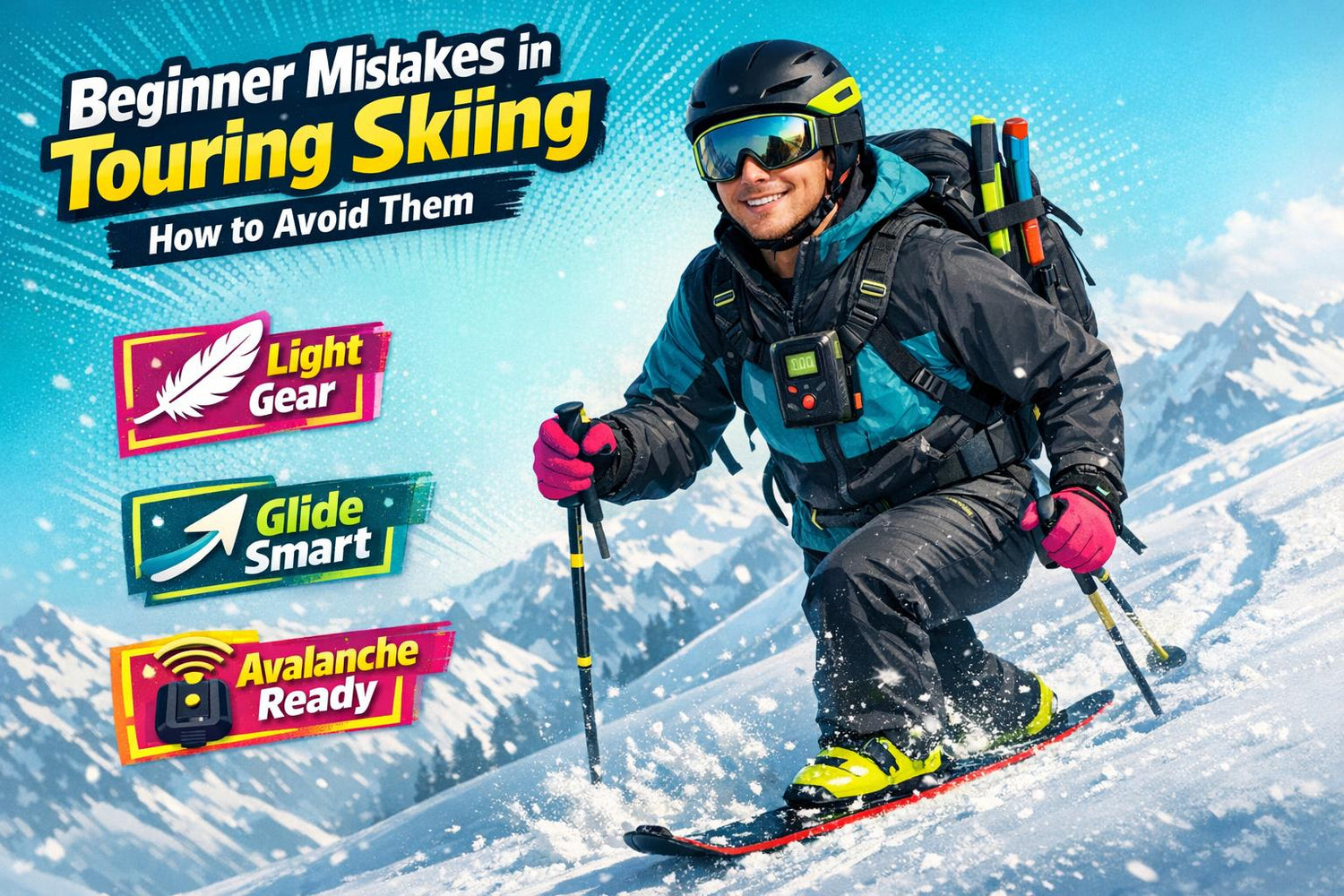
Touring skiing is an incredible way to explore untouched snow and escape the crowds, but beginners often make simple mistakes that can ruin the experience - or worse, put them in danger. The good news? Most of these issues are easy to fix with the right gear, technique, and preparation.
Here’s what you need to know:
- Wrong gear = frustration: Heavy, long skis can make uphill travel exhausting. Opt for shorter, lighter options like Snowfeet WALKSKI for easier handling and control.
- Bad technique = wasted energy: Don’t lift your skis - glide them instead. Staying balanced and leaning slightly forward makes a big difference.
- Skipping safety = serious risk: Always carry avalanche gear (transceiver, shovel, probe) and check conditions before heading out.
If you’re new to backcountry skiing, start with easy terrain, pace yourself, and invest in beginner-friendly gear like WALKSKI. It’s smaller, easier to use, and more affordable than traditional setups. Let’s break it all down so you can focus on enjoying the slopes!
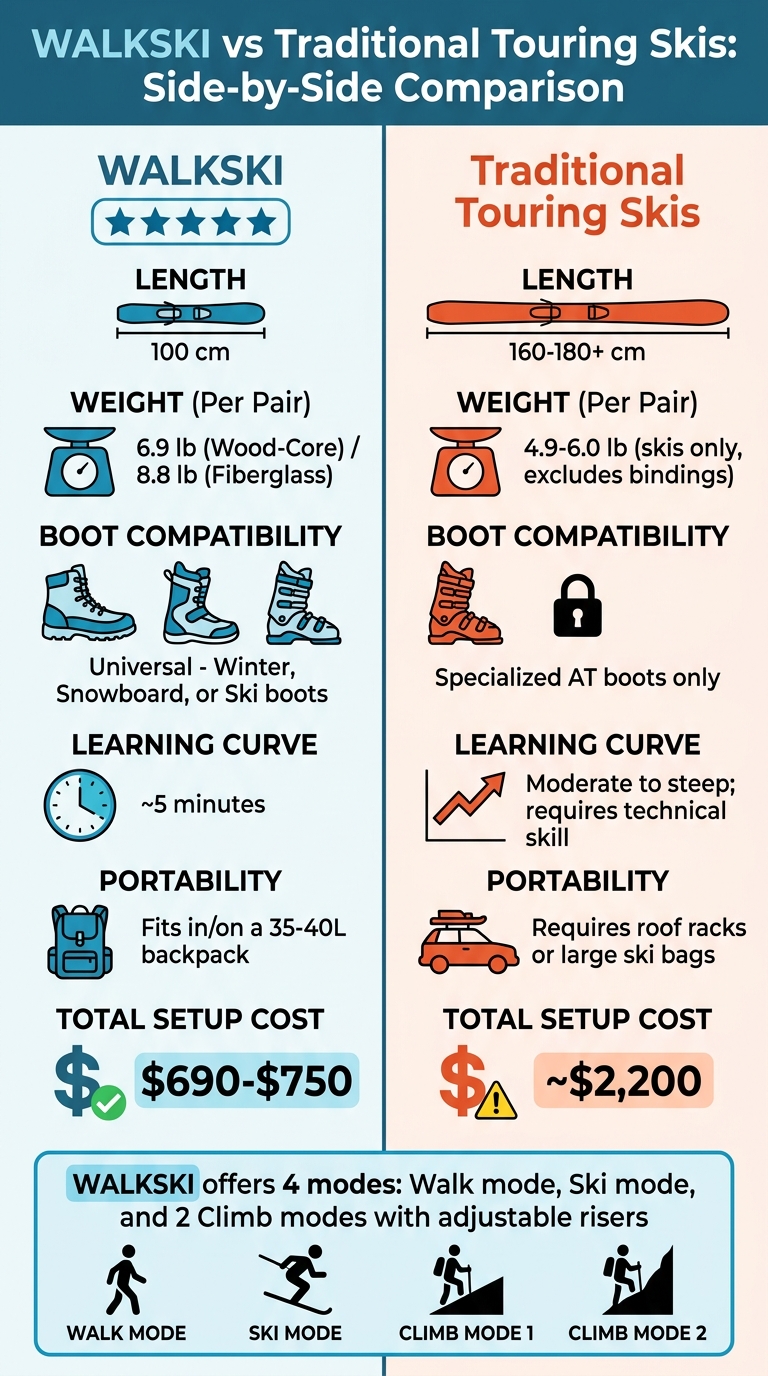
Snowfeet WALKSKI vs Traditional Touring Skis Comparison
Correcting the Three Most Common Mistakes People Make Ski Touring in the Backcountry
Mistake 1: Selecting Inappropriate Gear
Starting out in backcountry skiing can be tough - especially if you're lugging around heavy, complicated gear. It’s a common rookie mistake that can drain your energy before you even get to the fun part: the skiing.
Here’s the deal: 90% of backcountry skiing is uphill travel. That means every ounce of gear you carry makes a difference. Traditional touring skis, which are often 170–190 cm long (67–75 inches) and weigh 8–12 lbs per pair with bindings, can feel more like anchors than tools for adventure. Sean McCoy, Editorial Director at GearJunkie, puts it perfectly:
"Lugging a heavy pack up a skin track and skiing with pounds of gear flopping on your back can spoil an off-piste experience."
For beginners, this weight and bulk can limit the day’s success to just a couple of runs - barely scratching the surface of what backcountry skiing has to offer. Heavy gear doesn’t just slow you down; it can make the whole experience frustrating.
Why Traditional Long Skis Are a Bad Fit for Beginners
Traditional touring skis bring some serious challenges for those just starting out. Their length - usually over 170 cm - makes them tricky to maneuver, especially during kick-turns or on tight terrain. Plus, at more than 10 lbs, they’re exhausting to carry uphill.
Bindings are another issue. Many beginners choose "pin" (tech) bindings because they’re lightweight and versatile. But here’s the catch: these bindings don’t perform like alpine bindings. They offer less suspension and can eject unexpectedly, especially on groomed terrain. As Luke Koppa, Editor at Blister Review, warns:
"Skiing pin bindings in the resort is, at the very least, a fairly serious roll of the dice that can definitely result in an injury."
For someone still learning the ropes, this added risk and complexity can make the process even harder. So, what’s the fix?
How Snowfeet* WALKSKI Solves Gear Problems
Enter Snowfeet* WALKSKI - a game-changer for beginners. These skis are just 100 cm long, making them less than half the size of traditional touring skis. The result? A much easier and more enjoyable learning experience.
The shorter length means instant maneuverability. Whether you’re navigating tight switchbacks or weaving through trees, WALKSKI makes it simpler to stay in control. Plus, their compact size makes them easy to carry, whether you’re tossing them in your car trunk or strapping them to a backpack. No need for bulky roof racks or special equipment.
Shorter skis are also more forgiving, which helps beginners build confidence faster. With WALKSKI, you can focus on mastering the basics - like skinning techniques and kick-turns - without battling your gear. It’s a smoother, less intimidating way to dive into backcountry skiing and actually enjoy the ride.
Mistake 2: Using Incorrect Technique
Messing up your skiing technique can turn a fun backcountry trip into a frustrating grind. A common rookie mistake? Lifting your skis instead of gliding them. Many beginners also lean back too much - what experts call the "banana skin effect." This bad habit causes your skis to slide out from under you, making it hard to stay in control and increasing the risk of falls. As ski instructor Sally Guillaume puts it:
"If you lean back, you lose control of your skis as they accelerate."
Another issue is tension caused by fear. When you're nervous, your muscles tighten up, making smooth movements nearly impossible.
These technique errors don’t just slow you down - they can also be dangerous. Most skiing injuries happen between 2:00 p.m. and 4:00 p.m., when fatigue sets in. For beginners, who are already more prone to accidents, poor technique only increases the risk. That’s why learning to glide properly is so important.
Why Gliding Works Better Than Lifting
Gliding is all about efficiency. When you glide, you maintain momentum and save energy. Lifting your skis, on the other hand, wastes energy as you fight against gravity. A smooth glide lets you cover more ground with much less effort - especially helpful when you’re skinning uphill for hours.
To glide efficiently, you need proper posture and balance. Staying centered over your skis with a slight forward lean is key. But let’s be real - managing long, heavy skis can make this tricky for beginners. That’s where Snowfeet* WALKSKI changes the game.
How Snowfeet* WALKSKI Helps You Nail the Basics
Snowfeet* WALKSKI is a game-changer for beginners. At just 100 cm (39 inches) long, these skis are much easier to maneuver than traditional touring skis. Their shorter length reduces the surface area you need to control, making it simpler to stay balanced and keep that forward-leaning posture.
The compact design of WALKSKI helps you avoid common mistakes like lifting your skis or leaning back too much. Instead, it encourages smooth gliding and proper form. Most beginners can get comfortable with the basics in just 3 to 5 days of focused practice. Using gear that's designed for your skill level can speed up this learning curve dramatically.
As Snow.com explains:
"Investing in or renting high-quality skiing equipment that's appropriate for your skill level can make a substantial difference. Properly fitting boots, skis that match your size and ability... can improve your control, comfort, and confidence on the slopes."
WALKSKI is tailored for beginner needs, helping you develop good habits right from the start. Instead of struggling with oversized, advanced gear, you’ll be able to focus on building your skills. The result? Safer, more efficient backcountry adventures and a better overall experience.
sbb-itb-17ade95
Mistake 3: Skipping Safety and Preparation
Heading into the backcountry without proper preparation is a serious risk. Many first-time touring skiers neglect to check weather and avalanche conditions, forget critical safety gear, or lack familiarity with the terrain. These oversights can have life-threatening consequences, making reliable equipment and preparation non-negotiable. As Cripple Creek Backcountry puts it:
"Taking the leap into the backcountry requires education, gear, and self awareness."
Before setting out, always review daily avalanche bulletins, which use a 1–5 danger rating scale. Interestingly, most avalanche incidents occur when the risk is in the middle range (Moderate, Considerable, or High) rather than at the extremes. Be on alert for warning signs like 12 inches or more of fresh snow or snowfall rates of 2–2.5 inches per hour. Beginners should steer clear of slopes with angles between 30 and 45 degrees, as they’re the most prone to skier-triggered avalanches. If you’re unsure about the terrain, hiring a professional guide can be a literal lifesaver. Proper planning and the right gear are your best defenses against these risks.
Required Safety Equipment for Touring Skiing
When venturing into the backcountry, there are three items you absolutely cannot skip: an avalanche transceiver (worn on your body), a metal snow shovel, and an avalanche probe. These essentials, often called the "Avalanche Trinity", must be part of your kit - and you need to know how to use them. The Uptrack emphasizes this point:
"Going in the backcountry without the potentially life-saving avalanche equipment is a big no-no."
In addition to avalanche tools, a helmet with MIPS technology is a must. The National Ski Areas Association highlights the importance of helmets:
"Skiers and snowboarders who wear helmets are SEVEN times less likely to have a head injury."
Other essentials include anti-fog goggles, a map, a compass, and a whistle for signaling. If you’re heading into remote areas, a satellite communication device like a Garmin InReach can be a lifesaver. Your clothing should follow a three-layer system: a moisture-wicking merino wool base layer, a breathable mid-layer like fleece or a light insulated jacket, and a waterproof Gore-Tex outer shell. Don’t forget backup gloves - one lighter, breathable pair for the climb and a warmer, insulated pair for the descent. All of this should fit in a 35–45 liter backpack, with safety tools stored in a dedicated, easy-to-access pocket.
Snowfeet* Accessories for Safety and Transport
Snowfeet* WALKSKI adds an extra layer of convenience and safety to your touring setup. At just 39 inches long, the WALKSKI fits neatly inside - or straps securely to - a standard 35–40 liter touring pack. Its compact design ensures it won’t upset your balance or snag on branches during your ascent. This leaves room for your avalanche beacon, probe, shovel, repair kit, extra layers, and emergency supplies.
Snowfeet* also offers maintenance kits with tools for binding adjustments and skin wax to prevent mechanical issues that could compromise your safety. Their gear straps keep your equipment secure, reducing the chance of losing anything during a climb or avalanche. Thanks to the WALKSKI’s thoughtful design, you won’t have to sacrifice essential safety items to save weight or space - a decision that could make all the difference in a critical moment.
Why Snowfeet* WALKSKI Beats Traditional Touring Skis
Let’s break down how Snowfeet* WALKSKI stacks up against traditional touring skis and why it’s a game-changer, especially for beginners.
Comparison: Snowfeet* WALKSKI vs. Traditional Touring Skis
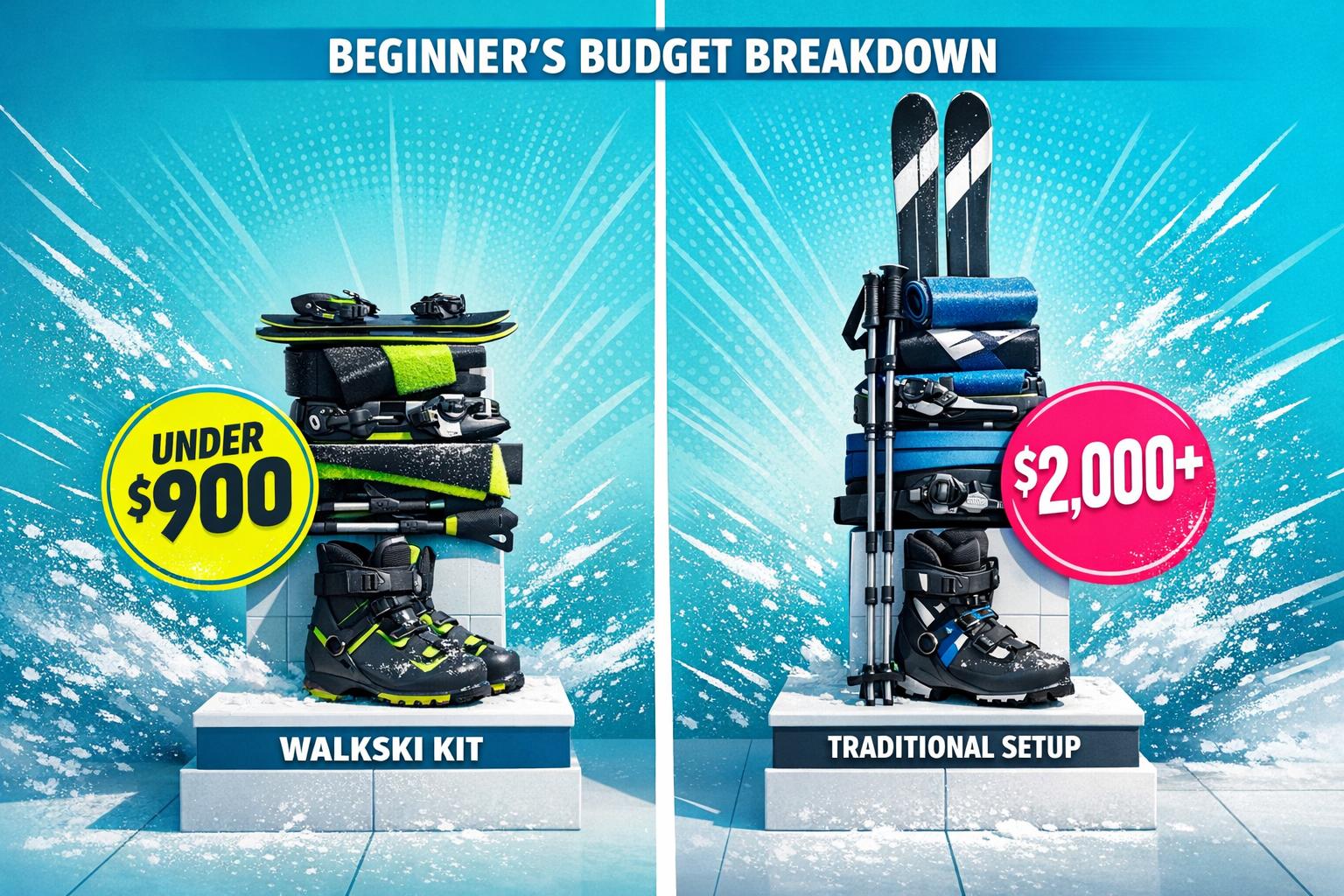
For anyone new to the backcountry scene, Snowfeet* WALKSKI offers a much easier and more affordable entry point. Traditional touring setups often require Alpine Touring (AT) boots, which can be pricey and uncomfortable until properly broken in. In contrast, WALKSKI uses a universal binding system that works seamlessly with your existing winter, snowboard, or ski boots. This alone slashes the cost from around $2,200 for a traditional setup to just $690 for WALKSKI.
Weight is another consideration. While high-end touring skis like the Atomic Backland 89 SL weigh about 1,220 g per ski, the WALKSKI Wood-Core version comes in at 1,558 g per ski. Sure, traditional skis are lighter, but their longer length (160–180+ cm) makes them harder to control. WALKSKI, at just 100 cm, is nimble and perfect for quick, tight turns.
As Brad Tolin put it:
"They're great for carving and navigating crowded slopes without feeling bulky. I felt comfortable on them within just a few runs."
Here’s a quick side-by-side comparison:
| Feature | Snowfeet* WALKSKI | Traditional Touring Skis |
|---|---|---|
| Length | 100 cm | 160–180+ cm |
| Weight (Pair) | 6.9 lb (Wood-Core) / 8.8 lb (Fiberglass) | 4.9–6.0 lb (skis only, excludes bindings) |
| Boot Compatibility | Universal (Winter, Snowboard, or Ski boots) | Specialized AT boots only |
| Learning Curve | ~5 minutes | Moderate to steep; requires technical skill |
| Portability | Fits in/on a 35–40L backpack | Requires roof racks or large ski bags |
| Total Setup Cost | $690–$750 | ~$2,200 |
Key Benefits of Snowfeet* WALKSKI
One of the standout features of WALKSKI is its versatility. It offers four modes: Walk mode (free heel for hiking), Ski mode (locked heel for descents), and two Climb modes with adjustable risers for different slopes. This flexibility means you can adapt quickly to changing terrain without wrestling with your gear.
Its compact 39-inch length isn’t just great for maneuverability; it also fits easily into a standard touring backpack. Reviews frequently mention how even casual skiers find it simple to use.
For beginners, the WALKSKI’s intuitive design is a huge plus. With a learning curve of just five minutes, it eliminates many of the challenges associated with traditional skis, like managing weight distribution and edge control. Its smaller size makes it far less intimidating, which is why it consistently earns rave reviews, including a perfect 5.0-star rating.
All of these features make WALKSKI an ideal choice for anyone looking to dive into backcountry skiing without the steep learning curve or hefty price tag of traditional setups.
Conclusion: Avoid These Mistakes and Improve Your Touring Experience
Your touring experience gets a whole lot better when you steer clear of common beginner missteps. Focus on avoiding three big ones: using the wrong gear, neglecting proper technique, and cutting corners on safety.
Dr. Robert Schneider highlights an important point: "The beginners are the ones getting hurt the most". One of the biggest safety priorities? Controlling your speed. High-speed collisions with fixed objects, like trees, are the leading cause of skiing fatalities. Peter Novom, Manager of the Ski & Ride program at Okemo Mountain, drives this home:
"Going fast is fun, but you need the skills to ski faster. Are you able to make quick changes to your path down the hill as unanticipated challenges arise? If not, you should limit your speed".
For those looking to improve control, the 100 cm Snowfeet* WALKSKI offers agility that traditional longer skis can’t match. It’s perfect for quick turns and helps you stay centered on the trail. Plus, keeping fatigue in check is key - avoid skiing late in the day when you’re tired. Start with easier trails and ensure your bindings are properly adjusted for a smoother, safer ride.
The Snowfeet* WALKSKI setup also makes skiing more accessible. With a price range of $690–$750, it’s far more affordable than traditional setups that can cost upwards of $2,200. On top of that, its compact design and universal boot compatibility allow for better maneuverability and control, especially for beginners. Staying in the middle of runs and away from tree-lined edges is crucial for safety, and WALKSKI’s design makes that easier.
If you want a safer, more beginner-friendly way to enjoy touring skiing, Snowfeet* WALKSKI is worth considering. It’s all about control, convenience, and confidence on the slopes.
FAQs
Is WALKSKI easier than long touring skis for beginners?
At just 100 cm long, the compact Snowfeet* WALKSKI Backcountry Touring Skis are lightweight and easier to handle, making them a great choice for beginners. Their shorter size allows for quicker, more manageable turns with less effort - perfect for learning the basics. In contrast, traditional long touring skis can be more challenging to control, especially on uneven terrain. This makes WALKSKI a more approachable option for those just starting out.
Do I need special AT boots to use WALKSKI?
Nope, you don’t need special AT (Alpine Touring) boots to use Snowfeet* WALKSKI backcountry touring skis. These skis are built to work with a variety of footwear, making them super convenient. They offer great control, are easy to carry around, and simple to use. Unlike traditional skis or snowboards, WALKSKI gives you a flexible and hassle-free experience - no special boots required!
What safety gear is mandatory for backcountry touring?
When heading into the backcountry, having the right safety gear isn't just a good idea - it's non-negotiable. At the top of your list should be an avalanche beacon, shovel, and probe. These tools are absolutely critical for avalanche safety and could make all the difference in an emergency.
If you're new to backcountry touring, beginner-friendly gear like the Snowfeet WALKSKI Backcountry Touring Skis can make things easier and more enjoyable. But remember, even the best skis can't replace the importance of proper safety equipment. Make sure you're geared up and ready before you hit those untouched slopes!











Leave a comment
This site is protected by hCaptcha and the hCaptcha Privacy Policy and Terms of Service apply.