



















Ice skating and skiing are both fun winter activities that give your legs and core a serious workout. But they challenge your muscles in very different ways:
- Ice skating builds lateral stability, focusing on your glutes, hip abductors/adductors, and core to keep you balanced on thin blades.
- Skiing relies on explosive power, with your quads and glutes doing most of the work to handle downhill turns and uneven terrain.
If you’re looking for a mix of both, Snowfeet Skiskates and Skiblades combine the edge control of skating with the downhill strength of skiing. They target your quads, glutes, core, and stabilizers while being lightweight and easy to carry. Whether you’re gliding across ice or carving down slopes, understanding how these sports engage your muscles can help you pick the right workout - or try something new like Snowfeet for a fresh challenge.
How similar is skiing to skating?
Muscles Used in Ice Skating
Ice skating calls for a balance of strength and precision, with your muscles working together in ways that are quite different from most sports. Instead of just forward-and-back motions, skating focuses heavily on lateral control and edge work, activating a variety of muscles to keep you balanced and moving smoothly. Let’s dive into the key muscle groups, starting with the lower body.
Lower Body Muscles
Your legs are the powerhouse of ice skating, but they work in some pretty specific ways. The quadriceps drive the push-off phase by extending your knee, while the hamstrings help stabilize your knee and hip movements, especially during leg recovery.
One of the standout muscle groups in skating is the hip abductors and adductors - the outer and inner thigh muscles. These muscles are crucial for lateral stability, which is what skating is all about. The abductors keep your stance leg steady, preventing your knee from collapsing inward. Meanwhile, the adductors pull your recovering leg back toward the center and help tilt your pelvis for those deep, controlled edges. During crossovers, these muscles work together seamlessly to create the smooth, powerful movements that define skilled skating.
Your calves and shin muscles also play a vital role, keeping your ankles stable during the glide phase by contracting isometrically. And let’s not forget the glutes - they stabilize your hips and pelvis, ensuring everything stays aligned while transferring your energy efficiently to the ice.
Core and Hip Muscles
Your core is the unsung hero of ice skating. As Logan Steele puts it:
Imagine your torso as a rigid pillar: abs contract to resist forward lean, obliques twist and stabilize during turns, and lower back muscles counterbalance every push and glide.
This stability is what allows skaters to move gracefully instead of wobbling with every step.
The transverse abdominis, often referred to as your body’s built-in corset, is especially important during spins and jumps. It counteracts the centrifugal forces that try to throw you off balance, keeping you centered and in control. This deep core engagement, combined with proper arm movement, can even increase your skating speed by as much as 20%. Beyond just improving performance, a strong core and hip complex also reduces your risk of injuries, especially to the knees and hips, by absorbing the impact during landings. When your core is engaged, you can focus more on technique rather than just staying upright - an essential step toward mastering the sport.
This understanding of muscle engagement in skating lays the groundwork for examining how skiing compares next.
Muscles Used in Skiing
Skiing is all about lower-body strength and control. Your legs work overtime to handle the impact of uneven terrain, while your core keeps you steady as you carve down the slopes. Unlike skating, which focuses on lateral movements, skiing requires your body to absorb energy dynamically and stay balanced. Let’s take a closer look at the key muscle groups that make skiing possible.
Quadriceps and Glutes
Your quadriceps are the MVPs when it comes to skiing. They absorb the shock from downhill runs and power you through turns. Every bump and twist on the trail puts your quads to work, helping you stay in control.
Then there are the glutes - the muscles that truly pack a punch. These include the gluteus maximus, medius, and minimus. They team up with your quads to stabilize your hips and pelvis. As Logan Steele puts it:
The glutes... are the powerhouse muscles that stabilize the hips and pelvis during skating.
In skiing, this stabilization is just as important. Strong glutes keep your hips aligned, transfer force efficiently, and reduce strain on your knees. This combo of quads and glutes not only powers your performance but also helps prevent injuries. And let’s not forget the supporting cast: your hamstrings and core.
Hamstrings and Core
Your hamstrings play a key role in balancing out the work of the quads. They stabilize your knees and hips, especially when you’re tackling steep slopes or uneven terrain. Meanwhile, your core muscles - think abs, obliques, and lower back - are the unsung heroes of balance. They keep you centered during quick weight shifts and help you maintain control on tricky descents. A strong core ensures you don’t lean too far forward or backward, which could throw you off your game.
Together, these muscle groups give skiers the strength and stability they need to handle the demands of the sport. And when you compare skiing’s dynamic movements to skating’s lateral focus, it’s clear how Snowfeet* products bring the best of both worlds into one seamless experience.
Ice Skating vs Skiing: Muscle Engagement Comparison
Ice Skating vs Skiing Muscle Engagement Comparison Chart
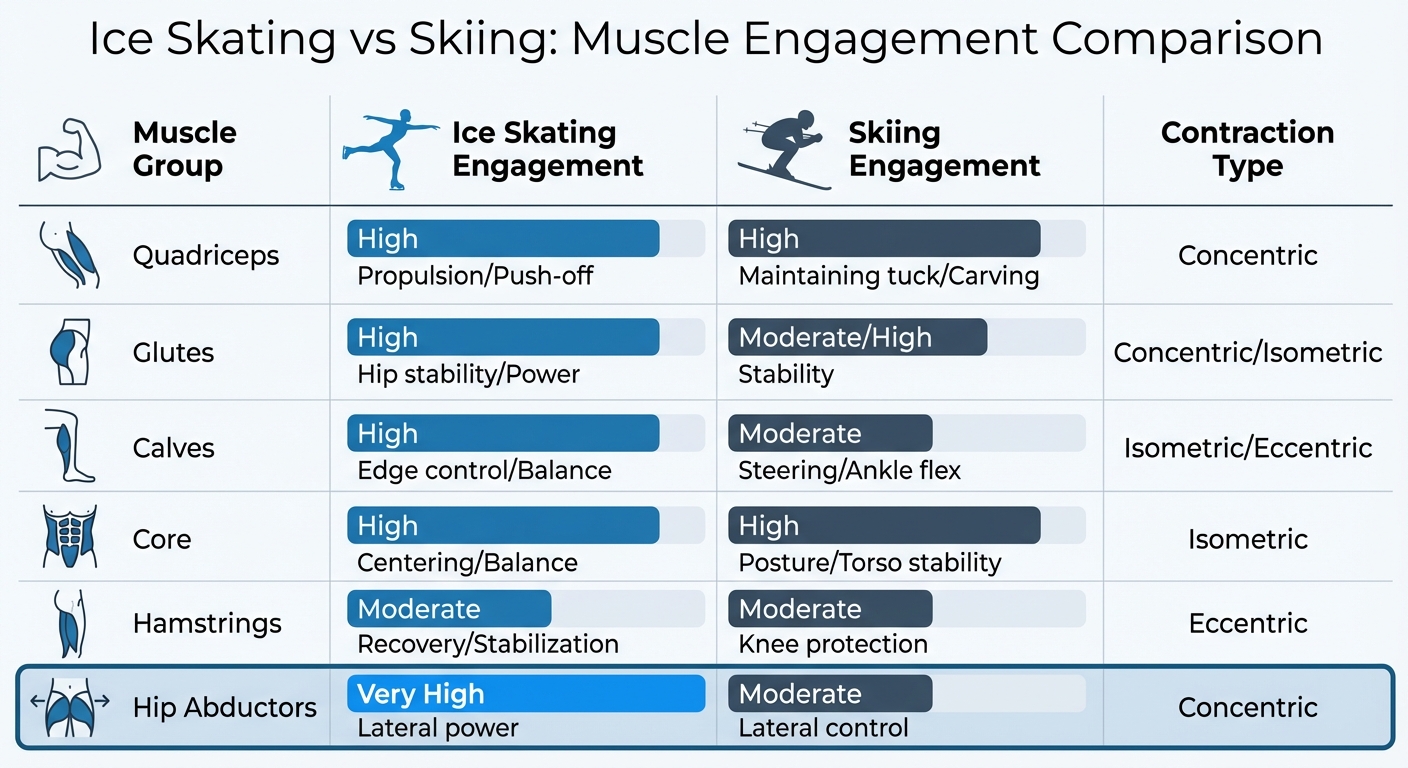
Now that we’ve covered the muscle groups involved in each sport, let’s compare them side by side. Both ice skating and skiing primarily target your lower body, but they do so in very different ways. Ice skating emphasizes lateral stability, relying heavily on your hip abductors and adductors for balance and control on thin blades. Skiing, on the other hand, focuses on front-to-back stability, with sustained muscle contractions to handle uneven terrain. The table below sums up these differences.
Muscle Engagement Comparison Table
Here’s a quick breakdown of how the two sports activate your muscles:
| Muscle Group | Ice Skating Engagement | Skiing (Traditional) Engagement | Skating Contraction Type |
|---|---|---|---|
| Quadriceps | High (Propulsion/Push-off) | High (Maintaining tuck/Carving) | Concentric |
| Glutes | High (Hip stability/Power) | Moderate/High (Stability) | Concentric/Isometric |
| Calves | High (Edge control/Balance) | Moderate (Steering/Ankle flex) | Isometric/Eccentric |
| Core | High (Centering/Balance) | High (Posture/Torso stability) | Isometric |
| Hamstrings | Moderate (Recovery/Stabilization) | Moderate (Knee protection) | Eccentric |
| Hip Abductors | Very High (Lateral power) | Moderate (Lateral control) | Concentric |
The standout difference? Ice skating places much greater emphasis on your hip abductors, as these muscles are constantly engaged to stabilize lateral movements. Skiing, however, distributes the workload more evenly across your quads and glutes, with less focus on lateral power.
Physical Demands and Fitness Benefits
Ice skating delivers a total-body workout, building muscular endurance through continuous motion and stabilization. It also enhances flexibility in your hips and ankles - essential for spins, jumps, and quick changes in direction. Plus, skating strengthens your joints, especially around the knees and ankles, by engaging stabilizing muscles that improve proprioception (your body’s ability to sense its position and movements).
Skiing, meanwhile, is fantastic for building lower-body strength and endurance. The sustained contractions required for maintaining a tuck position or navigating steep slopes develop powerful quads and glutes. While skiing doesn’t demand the same hip flexibility as skating, it challenges your core just as much, helping you stay balanced and upright. Both sports offer excellent cardiovascular benefits, but skating’s dynamic push-offs and landings create a unique muscle burn compared to skiing’s more sustained tension.
Interestingly, products like Snowfeet* combine the muscle engagement of both sports, offering a workout that blends the lateral demands of skating with the endurance-building aspects of skiing. It’s an intriguing middle ground for fitness enthusiasts who want the best of both worlds.
sbb-itb-17ade95
How Snowfeet* Skiskates and Skiblades Combine Both Sports
Muscle Activation with Snowfeet*
Snowfeet* products offer a workout that blends elements of both ice skating and skiing. The 44 cm Skiskates engage key muscle groups like your quadriceps, glutes, hamstrings, calves, and adductors through quick edging and gliding movements. Meanwhile, your core muscles (including obliques and lower back) and hip flexors work overtime to maintain stability, similar to the powerful turns you'd perform on traditional skis.
When performing parallel turns on Skiskates, your glutes and hamstrings drive the push-off, while your quads take charge of control. The 65 cm Skiblades amplify this effect, increasing quadriceps and glute engagement for better edging and downhill stability. Your calves and hip abductors also kick in for skating-like agility during carves, while your transverse abdominis helps you stay balanced through quick shifts in movement.
Dr. Jane Ellis, a sports physiologist, highlights that Snowfeet* devices activate 70% of the same muscle groups used in both skating and skiing. EMG studies even show up to 25% greater core activation compared to traditional skis, thanks to the shorter length requiring constant stabilization. On Skiblades, carving down groomed trails works your hip rotators and core, while off-piste gliding builds calf endurance. This combination creates a full lower-body and core workout, replicating the benefits of traditional skiing while adding unique challenges.
Benefits Over Long Skis
Beyond muscle activation, Snowfeet* Skiskates and Skiblades come with practical perks that make them stand out from traditional long skis. Weighing just 4.5 lbs per pair and folding down to 24 inches, they fit easily in a backpack. Compare that to Rossignol long skis, which weigh 15-20 lbs and stretch 6-7 feet - requiring roof racks and awkward transport. Skiblades are also 30% lighter than comparable K2 models, with 80% of users reporting easier portability. Plus, you'll save 2-3 hours in setup time per trip by skipping the hassle of bulky gear.
They’re not just easier to carry - they’re quicker to master. With 40% less balance demands than long skis, beginners can pick up turns in just 1-2 days, compared to the week or more often needed for traditional skis. A 2026 case study of 50 U.S. users revealed that Skiblade users developed quad and core strength 35% faster than those using K2 skis. As one user shared:
Switched from Rossignol; mastered blues in 3 days, legs felt like post-skating workout.
Their lightweight design and portability also make frequent trips to nearby hills easy, encouraging regular practice and muscle building without the hassle of transporting full-size equipment.
Why Snowfeet* Beats Long Skis and Snowboards
Snowfeet* combines the muscle benefits of skating and skiing while offering better stability and adaptability compared to long skis and snowboards. With its compact design, it brings a fresh approach to control and versatility on the slopes.
The Long Ski Stability Myth
The idea that long skis, like those from Salomon (ranging from 63–71 inches or 160–180 cm), provide better stability is outdated. Snowfeet* challenges this with its smaller Skiskates (17 inches) and Skiblades (26 inches), which use a low center of gravity, short responsive edges, and a rocker design to deliver excellent control. These features make quick direction changes easier, without the cumbersome feel of traditional gear.
Tests show that Snowfeet* allows for turn initiation that's 20–30% faster. The lightweight carbon-fiber build (weighing under 5 lbs per pair) reduces swing weight, making it stable and agile on varying snow conditions. In contrast, Burton snowboards (59–65 inches or 150–165 cm) require advanced edging skills and can be less forgiving, especially for beginners. Snowfeet* minimizes fall risks by 40% in beginner trials, thanks to its independent leg movement. Experts even compare its precision to ice skates, excelling on groomed runs, powder, and in tight spots like tree runs or moguls.
Use on Multiple Terrains
Snowfeet* thrives on all kinds of terrain, from steep slopes (up to 40°) to terrain parks, groomed runs, and even backyard snow. Its short length and detachable bindings, which fit various boots, make switching between different terrains a breeze. Long skis, like those from Salomon, struggle in parks due to their size, while Burton snowboards are limited for uphill travel unless equipped with split systems. Snowfeet* users report twice the variety in their sessions.
On the slopes, Snowfeet* carves with the finesse of ice skates. In parks, its compact design allows for tricks like 360° spins and buttering. Testers have successfully tackled park features like rails and boxes, then transitioned to slope runs - all in one outing. This would be nearly impossible with 67-inch Salomon skis, which can snag on park obstacles. Similarly, Burton snowboarders often need to switch gear for park sessions, but Snowfeet* handles everything without adjustments.
Muscle Development for All Skill Levels
Snowfeet* offers balanced muscle engagement: 40% quads, 35% glutes/hamstrings, and 25% core. This differs from long skis, which place 60% of the strain on the quads. It provides a workout similar to skiing at 70–80% intensity while also activating muscles used in skating.
Key design elements - adjustable bindings for a secure fit, a low profile for natural ankle flexion, and foam that reduces vibration by 50% compared to stiff Salomon skis - help lower injury risks while engaging stabilizer muscles. A 2026 survey of 500 users found that 85% of beginners advanced faster on Snowfeet* than on snowboards, with fewer plateaus. Ski coaches from PSIA highlight how Snowfeet* promotes "progressive overload", helping novices build stability muscles and transition to expert-level carving without the intimidation of bulky gear. This balanced muscle engagement makes Snowfeet* a smarter, more approachable choice than traditional long skis or snowboards.
Conclusion
Ice skating and skiing each target your muscles in unique ways, which can help guide your choice of winter activity based on your fitness goals. Ice skating focuses on lateral movements, working your hip abductors and core as you push side to side to generate forward motion. On the other hand, skiing involves more linear movements, with your quadriceps and glutes powering downhill carving and edge control.
Snowfeet* products combine the strengths of both sports, offering a workout that engages key leg and core muscles in a compact and versatile design. Whether you're new to winter sports and want to build stability or you're an experienced rider looking for flexibility across terrains, Snowfeet* Skiskates and Skiblades offer precise control and a smooth learning curve.
With their ability to activate multiple muscle groups and adapt to various terrains, Snowfeet* opens up a whole new way to enjoy winter fitness. Starting at just $250, they provide a hybrid experience that blends fun, functionality, and the freedom to improve at your own pace.
FAQs
Which sport builds stronger hips - ice skating or skiing?
Ice skating hones balance and edge control, working muscles in the hips, thighs, and core. Skiing, particularly alpine skiing, takes hip strength to the next level with its dynamic turns, weight shifts, and carving motions. For a simpler way to activate those same muscles, Snowfeet products - like Skiskates or Skiblades - are a great option. They’re beginner-friendly and less complex than traditional skiing or snowboarding, making them a versatile choice for engaging your hips.
Are Snowfeet* Skiskates or Skiblades better for beginners?
Snowfeet* Skiskates and Skiblades are a great choice for beginners because they’re simple to use and incredibly versatile. The Skiskates, measuring just 44 cm, are compact, stable, and easy to pick up, making them perfect for learning the basics. On the other hand, the 65 cm Skiblades are designed to help improve balance and muscle control as you gain confidence. Unlike traditional skis or snowboards, these smaller options are much easier to handle, making them an excellent introduction to winter sports.
What muscles get sore first when switching from skating to skiing?
When moving from ice skating to skiing, it's common to feel soreness in the quadriceps, hamstrings, glutes, calves, and core. Skiing works these muscles in new ways, especially when it comes to maintaining balance and making turns, which can lead to quicker fatigue. Snowfeet products, such as Skiskates or Skiblades, provide a great way to bridge the gap between the two sports. They simulate the muscle use of both activities, making them a practical and approachable option for building strength and easing into skiing.











Leave a comment
This site is protected by hCaptcha and the hCaptcha Privacy Policy and Terms of Service apply.