



















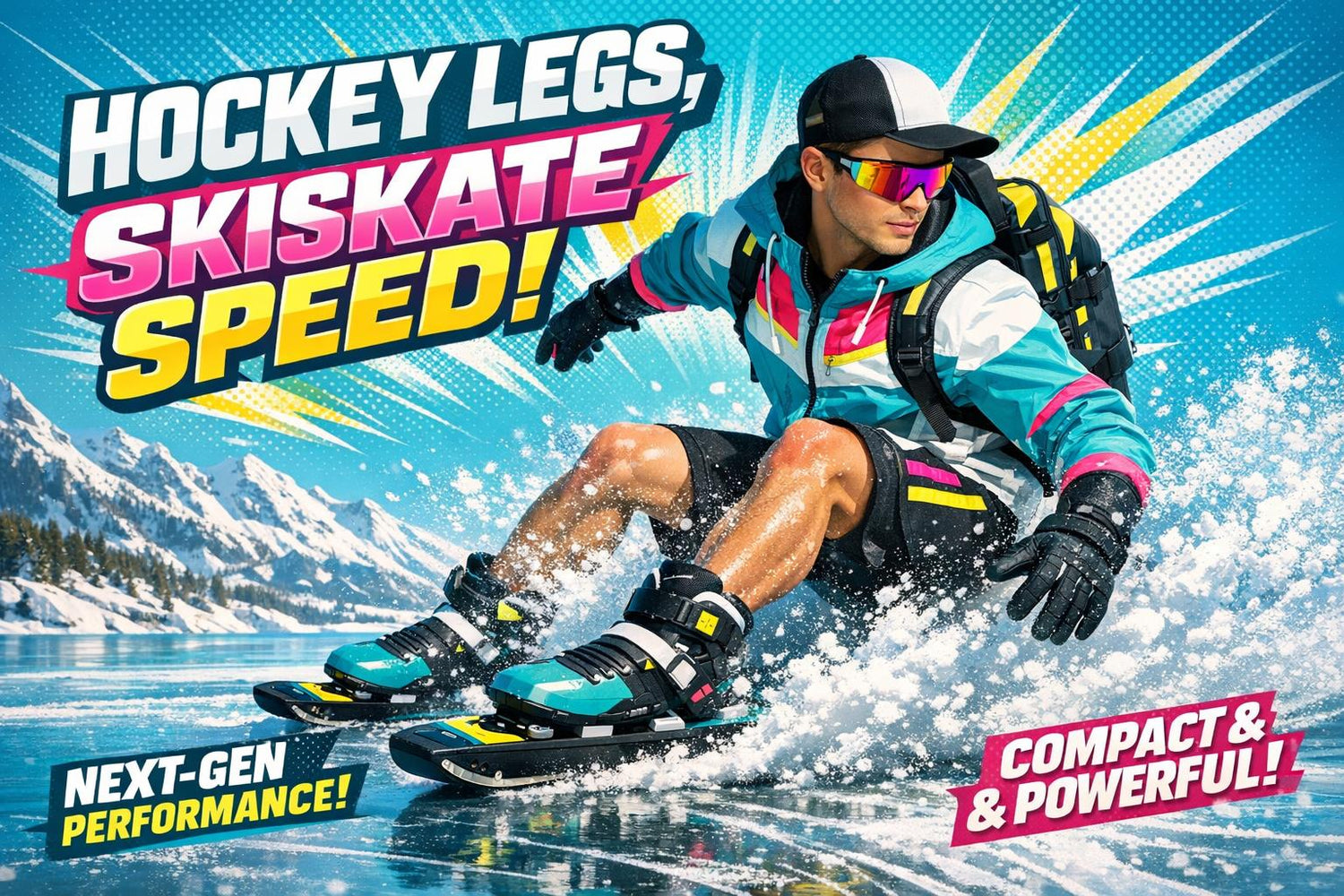
If you’ve spent hours perfecting your hockey stride or nailing sharp stops on the ice, you’re already halfway to mastering skiskating. Snowfeet Skiskates (44 cm) bring the feel of hockey to the slopes, letting you skate on snow with the same lateral pushes, edge control, and balance you’ve honed on the rink. Lightweight and compact enough to fit in a backpack, these skiskates are perfect for hockey players looking for a portable, fun way to hit the slopes.
Why Skiskating Works for Hockey Players:
- Familiar Movements: Skiskating mimics hockey strides, stops, and turns.
- Compact Gear: At just 17 inches long, Snowfeet Skiskates are easy to carry.
- Built for Balance: The same low, stable stance you use on the ice applies here.
- Quick to Learn: Hockey players can master the basics in under 10 days.
Key Gear:
- Snowfeet Skiskates (44 cm): $575, wood core, metal edges, and adjustable bindings.
- Snowfeet PRO (50 cm): $275, fiberglass-reinforced for sharper turns.
- Snowfeet Skiblades (65 cm): $635, longer for stability at higher speeds.
Whether you’re carving down groomed slopes or pulling off hockey stops in the snow, Snowfeet Skiskates make the transition from ice to snow seamless. Ready to skate the slopes? Let’s dive in.
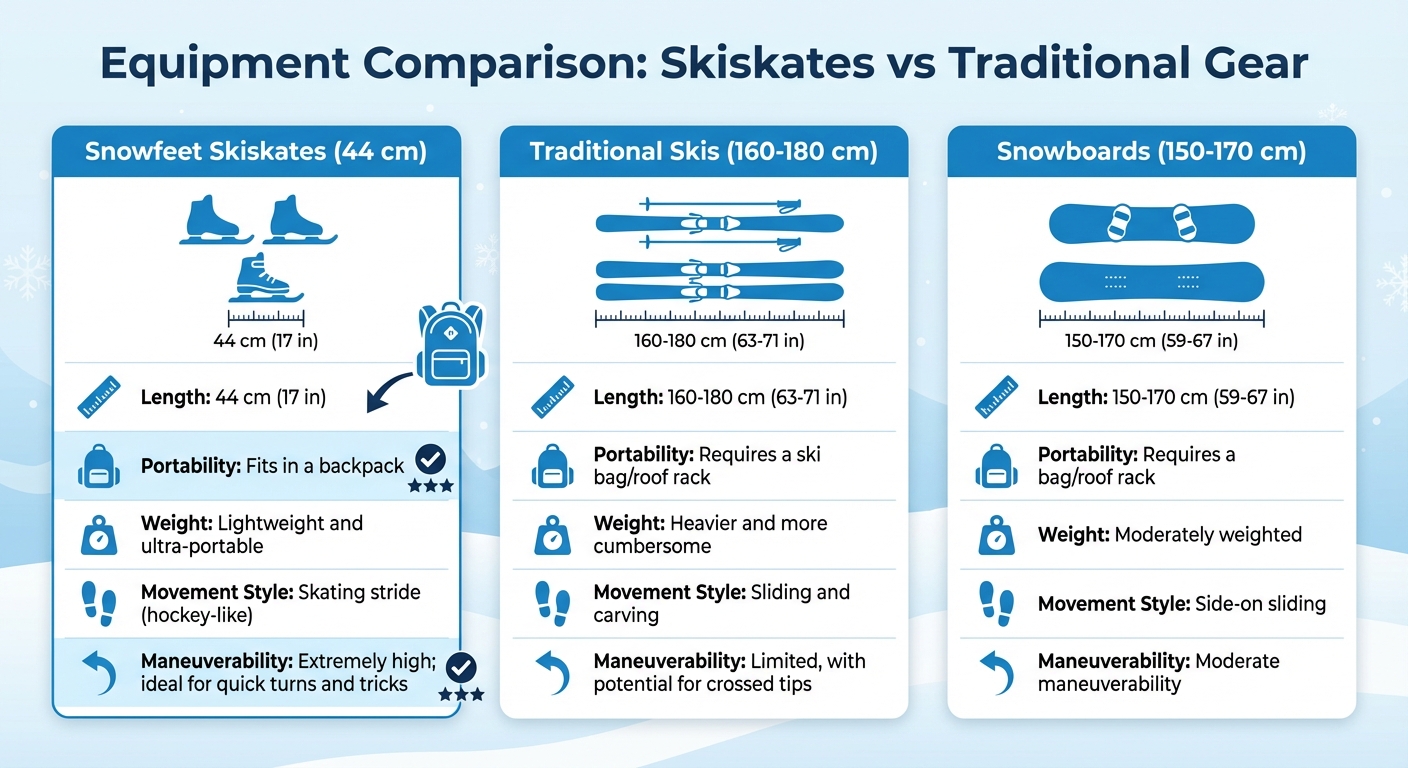
Snowfeet Skiskates vs Traditional Skis and Snowboards Comparison
Hockey Player Tries Snowfeet* Skiskates | See What He Thinks | Skiboards | Short Ski | Mini Ski
Hockey Skills That Work for Skiskating
If you’ve spent hours gliding across the ice with a hockey stick in hand, you’re already ahead of the game when it comes to skiskating. Many of the skills you’ve honed in hockey transfer seamlessly to using Snowfeet* Skiskates. Let’s break it down.
Edge Control and Turning
Hockey players develop an incredible sense of balance and edge control over time. That same awareness of your blade’s edges on ice applies directly to the metal edges of Snowfeet* Skiskates.
Take the hockey stop, for example. It’s that sharp 90° pivot where you dig into the inside edge of your outside skate - a move that works almost identically on skiskates [8, 13]. No need to reinvent the wheel here. If you’ve mastered this on ice, you’ll find skiskating a natural extension of your skills. For seasoned skaters, learning the hockey stop on snow typically takes less than 10 days. If you’re new to skating altogether, it might take 15–20 days to get the hang of it.
In fact, having a background in hockey or figure skating can make skiskating about 10% to 30% easier compared to someone who’s never strapped on a pair of blades. That edge control you’ve already nailed? It’s the key to powering your next stride on snow.
Power from Hockey Strides
Hockey isn’t just about speed - it’s about explosive power. That quick burst of acceleration you’ve trained for on the ice is exactly what you need for skiskating. Most hockey plays are decided in the first 5 meters, and that same explosive energy translates perfectly to Snowfeet* Skiskates.
Your stride mechanics, driven by the triple extension of your hips, knees, and ankles, work just as effectively on snow. It’s not just about raw power; it’s about moving efficiently through positions that generate speed and control.
Strong adductors and full leg extensions are crucial here. They ensure that every push counts, minimizing energy loss and maximizing momentum. Snowfeet* Skiskates, at 44 cm long, are specifically designed to mimic the movement of ice skating, so your hockey-trained stride will feel instantly familiar.
Balance and Athletic Stance
Hockey players are no strangers to balance. That shoulder-width stance with bent knees - the classic hockey-ready position - is exactly what you need for skiskating [8, 10]. Your low center of gravity on the ice translates directly to stability on snow.
Front-to-back balance is particularly important. Unlike traditional skiing, where you shift your weight forward, skiskating keeps your weight centered or slightly back. This distribution will feel second nature if you’ve spent time on hockey blades [8, 10].
The Snowfeet Team puts it simply:
To start your ride, skate like a hockey player. Push your legs sideways.
Start with one foot slightly ahead for a stable base. If your balance wavers, lean forward and spread your arms - instinctive movements for anyone with hockey experience [8, 10]. Years of practice on the ice make this transition to snow a breeze.
Snowfeet* Skiskates (44 cm) vs Traditional Skis and Snowboards
Size and Portability
Let’s face it - traditional skis and snowboards can be a hassle to lug around. Skis typically measure between 160–180 cm (63–71 in), while snowboards range from 150–170 cm (59–67 in). That’s a lot of gear to manage, often requiring roof racks, oversized bags, or even a bigger car to transport everything.
Now compare that to Snowfeet* Skiskates. At just 44 cm (17 in), these compact skates can slide right into a regular backpack. No need for roof racks or bulky storage. If you’re a hockey player, this level of portability is a game-changer. Just pack them up and go.
Founder Zbyněk sums it up perfectly:
"In my opinion, Skiskates is the best product for slopes we developed so far. I love how easy they are to ski and skate and how many different kinds of tricks I can perform without much effort."
Not only are they small and easy to carry, but they also let you move in a way that feels natural for anyone used to skating on ice.
Movement and Speed
Here’s where Snowfeet* Skiskates really shine for hockey players. Traditional skis force you into a sliding, carving motion that can feel awkward if you’re used to a hockey stride. With those long planks strapped to your feet, your movement is pretty much dictated by the equipment.
Snowfeet* Skiskates, on the other hand, let you move the way you’re used to. Their compact size - just 44 cm - mimics the feel of a skate blade, allowing you to maintain that familiar skating stride. You’re free to move your legs independently, just like you would on the ice, without being weighed down by heavy gear.
As the Snowfeet Team puts it:
"The movement is closer to skating rather than regular skiing. Especially suitable for hockey players, ice skaters, or rollerbladers."
And braking? Use the hockey stop you already know - it’s that simple.
Equipment Comparison Table
Here’s a quick breakdown of how Snowfeet* Skiskates stack up against traditional skis and snowboards:
| Feature | Snowfeet* Skiskates (44 cm) | Traditional Skis (160–180 cm) | Snowboards (150–170 cm) |
|---|---|---|---|
| Length | 44 cm (17 in) | 160–180 cm (63–71 in) | 150–170 cm (59–67 in) |
| Portability | Fits in a backpack | Requires a ski bag/roof rack | Requires a bag/roof rack |
| Weight | Lightweight and ultra-portable | Heavier and more cumbersome | Moderately weighted |
| Movement Style | Skating stride (hockey-like) | Sliding and carving | Side-on sliding |
| Maneuverability | Extremely high; ideal for quick turns and tricks | Limited, with potential for crossed tips | Moderate maneuverability |
Because they’re so light and nimble, Snowfeet* Skiskates let you twist, jump, and change direction on a dime - exactly the kind of freedom hockey players thrive on.
sbb-itb-17ade95
How Hockey Players Can Start Skiskating
Getting Started: First Steps
If you’ve spent years gliding on the ice, you’ve already got a head start. Switching to Snowfeet* Skiskates feels pretty natural because the movements are a lot like ice skating - just on snow instead of ice.
Before heading out, take a moment to prep your gear at home. Adjust the bindings using a screwdriver and the boots you’ll be wearing. This little bit of prep work saves you from fumbling around once you’re at the slopes. For the best support, stick with snowboard boots or sturdy winter shoes that offer good ankle stability.
Start on flat, groomed terrain to get a feel for how the skiskates respond. Unlike ice skating, you’ll need to focus on keeping your balance centered from front to back. Stand with your legs shoulder-width apart, knees slightly bent, and your weight over the middle or back of your feet. Avoid leaning on your toes - this can cause the tips to dig into the snow, which might send you tumbling forward.
To get moving, channel your inner hockey player. Push off sideways, using your hockey stride. As the Snowfeet Team puts it:
The best way to start your ride is to skate like a hockey player.
Once you’ve nailed the basics, you can start working on techniques to handle speed and control.
Techniques for Better Control
Now that you’re moving, it’s time to focus on staying stable as you pick up speed. Try placing one foot slightly ahead of the other and leaning your upper body forward. This staggered stance helps you keep your balance when things get faster.
Stopping is where your hockey skills really come in handy. Use the classic hockey stop: spread your weight evenly across both feet and push the metal edges sideways to create friction. If you just need to slow down gradually, the built-in heel brake is a great option.
Want to skate backward? Shift your weight forward while keeping your heels slightly lifted - it’s a bit tricky at first but gets easier with practice. To keep your skiskates performing well, make sure to wax the base regularly and dry off the metal edges after each use.
Stick to groomed slopes or trails when you’re starting out. Avoid deep powder (anything over 4 inches/10 cm) or steep, ungroomed terrain until you’re feeling confident in your skills.
Best Snowfeet* Products for Hockey Players
If you're a hockey player looking to take your skills from the rink to the slopes, Snowfeet* offers some fantastic options. Here are the top picks designed to give you that ice-like feel on snow.
Snowfeet* Skiskates (44 cm): The Go-To for Hockey Enthusiasts
The Snowfeet* Skiskates (44 cm) are a favorite among hockey players for their compact design and ice-like performance on snow. At just 17.3 inches long, these are the shortest professional skis made for slopes. They feature a sustainable wood core - offering the quality you'd expect from premium skis - wrapped up in a portable package.
With asymmetrical high twin tips, you can skate forward and backward effortlessly, just like you would on ice. Plus, they’re designed for moves like the hockey stop, making them a natural choice for players. Priced from $575, these handmade European skiskates boast a high-speed graphite base and tool-free adjustable bindings. Founder Zbyněk shares his thoughts:
"In my opinion, Skiskates is the best product for slopes we developed so far. I love how easy they are to ski and skate and how many different kinds of tricks I can perform without much effort."
Snowfeet PRO (50 cm): Power and Precision
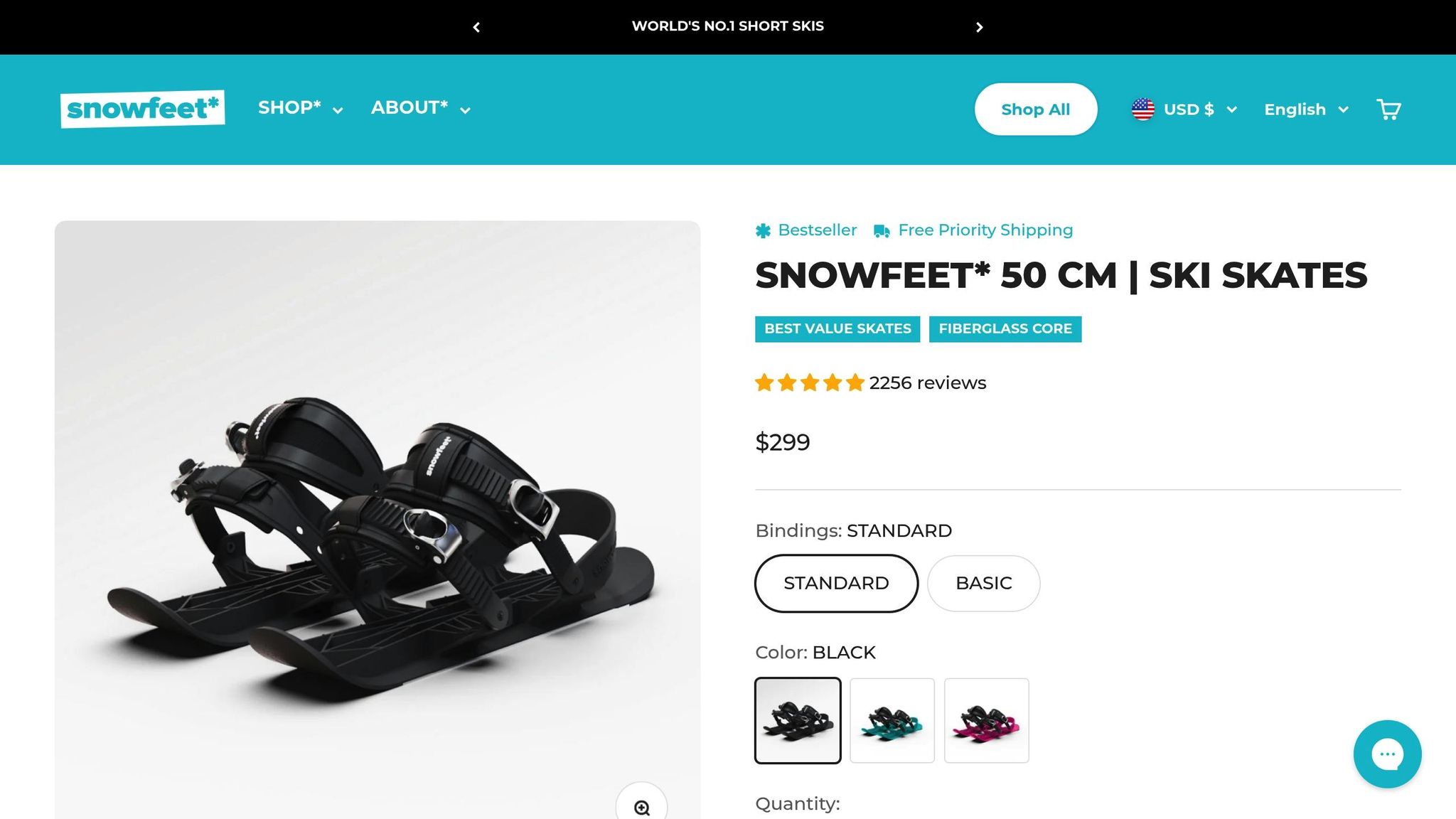
For those who like to skate aggressively, the Snowfeet PRO (50 cm) is built to handle powerful strides and sharp turns. Priced at $275, this model features a fiberglass-reinforced core, which enhances durability and ensures smooth performance. It’s designed to amplify your explosive hockey stride, making it a great choice for snow parks and steep terrain.
The slightly longer length adds extra stability for higher speeds, while still maintaining that skate-like agility. With over 5,500 reviews and a near-perfect 4.9/5 rating, hockey players rave about its balance and responsiveness. Regular waxing keeps the fiberglass base slick, ensuring top-notch performance on groomed runs or in the park.
Snowfeet Skiblades (65 cm): Agility Meets Stability
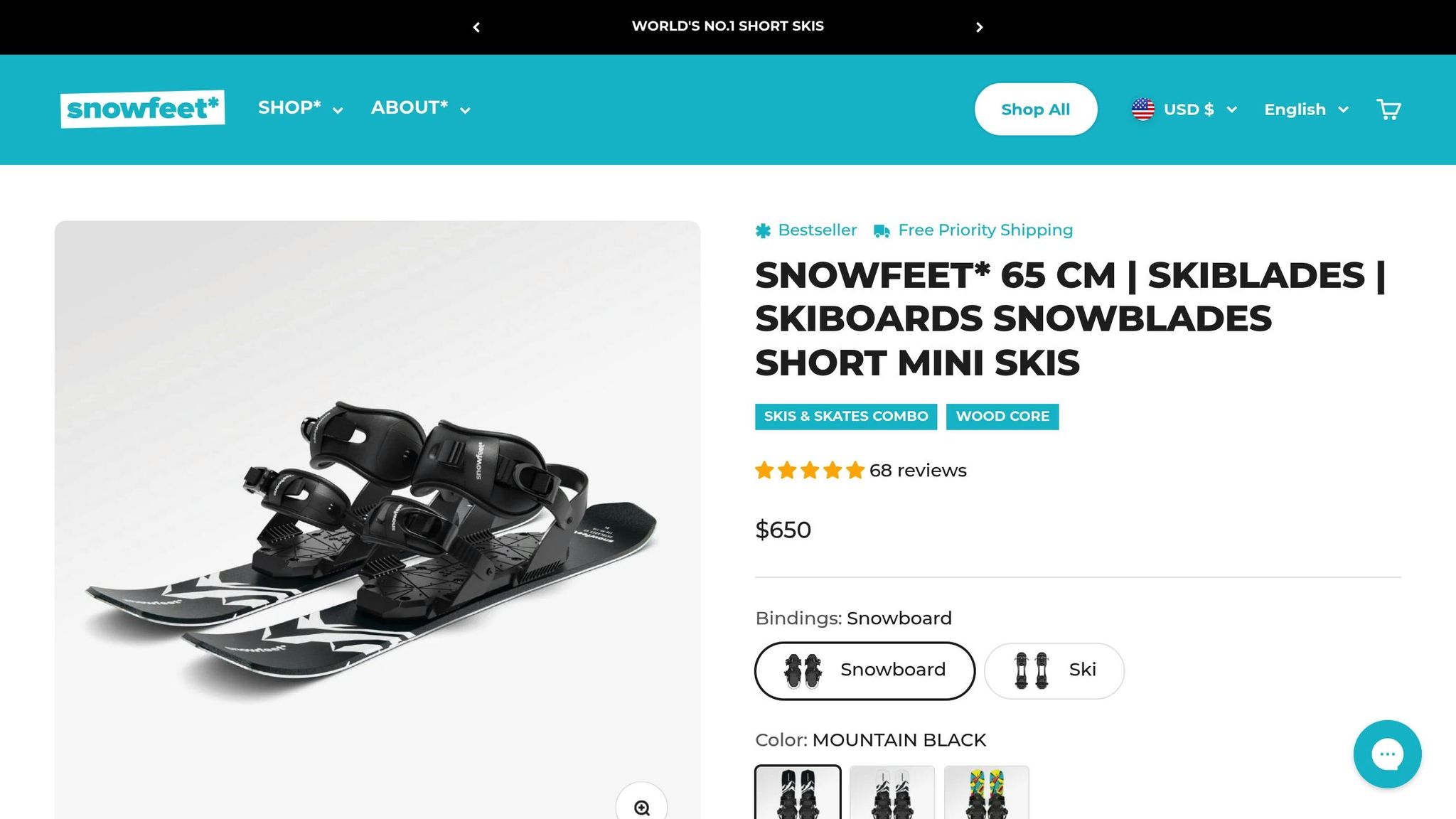
If you’re looking for a bit more length without sacrificing agility, the Snowfeet Skiblades (65 cm) are a solid option. Starting at $635, these skiblades combine a professional wood core with a graphite base, delivering stability at higher speeds while staying short enough for quick turns and nimble moves.
These are perfect for hockey players who want to balance tight, agile skating with the ability to carve through varied terrain. They even handle light powder (up to 4 inches) with ease, offering improved float and control. With a flawless 5.0/5 rating, users consistently highlight the superior performance and versatility of this model for both carving and quick maneuvers.
Conclusion
If you’ve honed your skills on the ice, Snowfeet* Skiskates (44 cm) might just feel like a natural extension of your hockey training. Compact enough to toss in a backpack, these skiskates feature a durable wood core that delivers an ice-like glide on snow.
Hockey players love how easily they can bring their familiar moves - like the hockey stop and skating stride - onto the slopes. With over 50,000 riders and a perfect 5.0-star rating, it’s clear these skiskates are making waves. The metal edges even allow for forward and backward skating, just like on the rink.
What really sets Snowfeet* apart is the simplicity. Forget bulky skis, stiff boots, and complicated gear. These skiskates pair with snowboard boots or sturdy winter shoes, so you’re not learning a whole new sport - you’re just taking your ice skills to a fresh surface.
Priced at $575, you’re investing in handcrafted European craftsmanship with a wood core that offers agility traditional skis can’t match. Every turn you take on these skiskates is powered by your hockey-trained legs, proving that your ice skills were made for more than just the rink.
FAQs
How are Snowfeet Skiskates more portable than traditional skis and snowboards?
Snowfeet Skiskates are a game-changer when it comes to portability. At just 15–18 inches long and weighing only a few pounds, they’re small enough to slip into a regular backpack or duffel bag. Forget the hassle of lugging around oversized gear - these skates are easy to carry on foot, toss in your car, or even take on a lift without any special equipment like roof racks or oversized storage bags.
Compare that to traditional skis and snowboards: snowboards usually measure 54–66 inches and weigh 6–8 pounds, while skis are often over 60 inches long and even heavier. Both require dedicated bags or racks for transport, which can be a pain to deal with. Snowfeet Skiskates, on the other hand, offer a lightweight and compact solution, making them ideal for quick getaways or spur-of-the-moment winter fun.
How do hockey skills translate to skiskating?
Hockey players have a knack for picking up skiskating quickly, and it’s no surprise. Many of the skills they’ve mastered on the ice translate almost perfectly to the snow. Think about it: their low, balanced stance with bent knees, the way they shift their weight with precision, and their top-notch edge control are all essential for skiskating. Plus, their ability to stop smoothly by spreading their weight evenly - without leaning too much on their toes - makes the whole process feel natural.
This makes hockey players an ideal match for Snowfeet Skiskates. These skiskates are lightweight, easy to carry, and built for quick, controlled movements - just like skating on ice. With Snowfeet, hockey players can seamlessly bring their ice skills to the slopes and enjoy a whole new way to glide.
Why are Snowfeet Skiskates great for hockey players?
Snowfeet Skiskates are a game-changer for hockey players, offering an easy transition from ice to snow. With their compact 17-inch design, they replicate the feel of hockey skates, allowing you to use your balance, agility, and quick weight shifts naturally. If you’re confident on the ice, hopping onto these skiskates will feel like second nature.
At just 3.5 pounds, they’re super lightweight and easy to carry - no need to lug around heavy gear or deal with clunky bindings. Even better, they work with your regular winter shoes or snowboard boots, so you can skip the stiff ski boots. This means you’ll keep the ankle flexibility you need for sharp pivots and precise edge control. Starting at about $330, they’re a budget-friendly, portable, and fun way for hockey players to enjoy a new winter activity.











Leave a comment
This site is protected by hCaptcha and the hCaptcha Privacy Policy and Terms of Service apply.