




















Want your kids to ski with confidence? The secret is shorter skis. For children aged 4–8, long skis can make learning frustrating. Shorter options like Snowfeet's 44 cm Skiskates or 65 cm Skiblades are easier to control, helping kids balance faster and fall less. Studies show they improve balance 40–50% quicker and reduce falls by 70%. Plus, kids can master basics in just 1–2 sessions instead of 15+ hours.
Here’s what you’ll learn:
- Why shorter skis are easier for kids to handle.
- How to pick the right gear (hint: shorter is better!).
- Simple drills and fun games to improve balance.
- Safety tips every parent should know.
Key takeaway: Short skis make skiing fun, safe, and less overwhelming for kids. Ready to hit the slopes? Let’s get started!
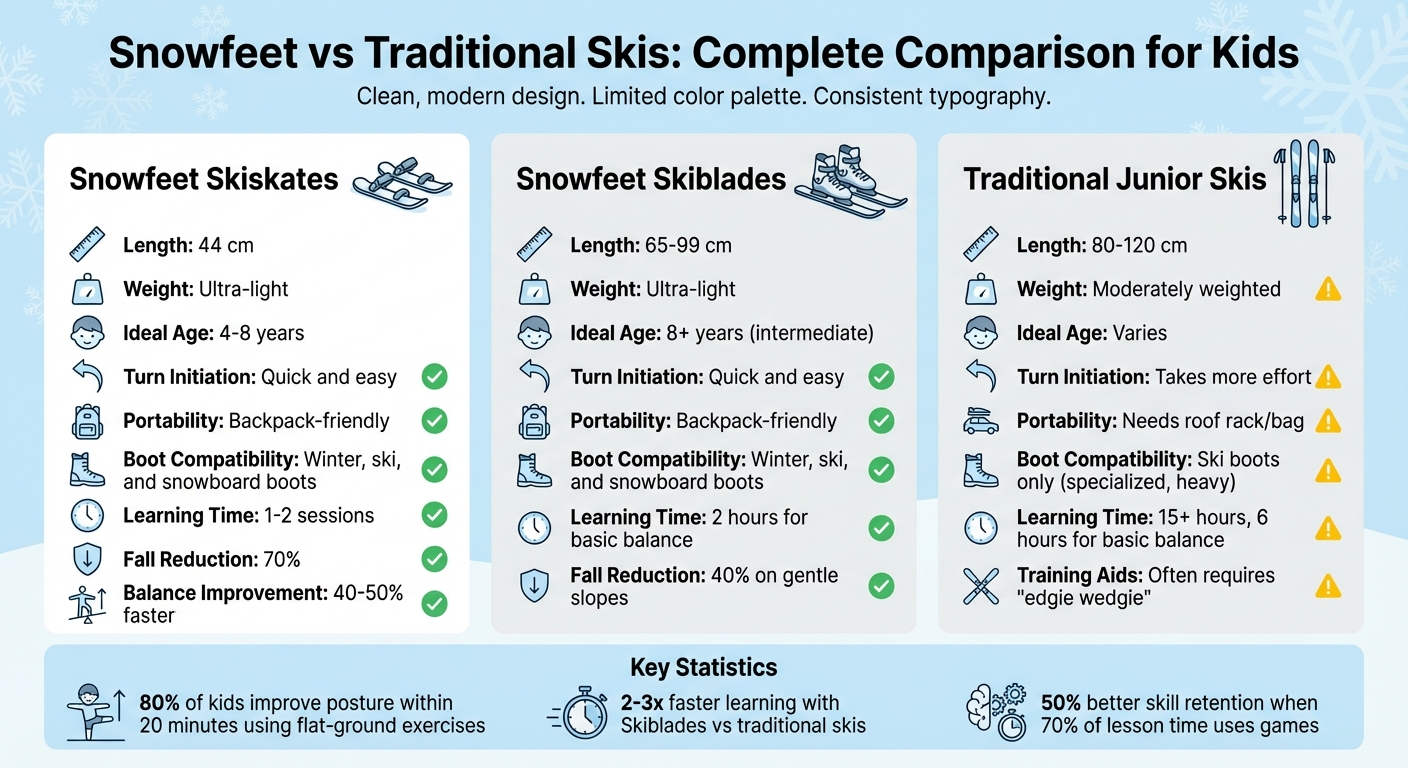
Snowfeet vs Traditional Skis: Complete Comparison for Kids
PSIA-AASI Go With A Pro: Helping Kids Find Balance
Why Short Skis Work Better for Kids
Control is key when kids are learning to ski. Shorter skis are much easier for kids to handle, letting them steer, pivot, and turn without feeling like they're fighting their gear. Carolyne Vigeant, Writer and Editor at Oberson, sums it up perfectly:
"The shorter the skis, the more maneuverable they are. This means your child will have more control over them and be able to initiate turns more easily".
This better control makes it easier for kids to pick up skiing basics quickly. Snowfeet* Skiskates (44 cm) and Skiblades (65 cm and 99 cm) are designed with this in mind, giving young skiers a head start.
Long skis, on the other hand, can be a real hurdle. For beginners, skis that are too long add unnecessary challenges. They make simple moves like the snowplow harder to master and can even feel like a workout just to carry around.
Getting the right ski size for kids matters, too. For beginners, the ideal ski length is about 6 to 8 inches shorter than their height, or roughly chin-level. For instance, a child standing 40 inches tall would do best with skis around 32 to 34 inches long. Snowfeet* products simplify this process, offering easy-to-use options that skip the guesswork.
How Short Skis Help Beginners Learn Faster
Quick control builds confidence. Short skis respond instantly to shifts in weight and edge pressure, helping kids learn turning and balance faster. This immediate feedback keeps them engaged and motivated.
The learning process feels smoother. With short skis, kids can master snowplow stops and basic turns in just a few runs, making skiing feel rewarding right from the start.
Less strain, more focus. Lightweight and easy to maneuver, shorter skis let kids focus on their posture and technique instead of battling heavy, awkward equipment.
Snowfeet* vs Traditional Skis and Snowboards

Let’s break down how Snowfeet* products stack up against traditional skis and snowboards. They offer distinct advantages, especially for younger or shorter skiers. Traditional junior skis, which range from 80 to 120 cm, often feel unwieldy for kids under 48 inches tall. Meanwhile, snowboards require learning a completely different skill set that doesn’t directly translate to skiing.
| Feature | Snowfeet* Skiskates & Skiblades | Traditional Junior Skis | Junior Snowboards |
|---|---|---|---|
| Length | 44 cm to 99 cm | 80 cm to 120 cm | 80 cm to 110 cm |
| Weight | Ultra-light | Moderately weighted | Generally heavier |
| Turn Initiation | Quick and easy | Takes more effort | Full body rotation |
| Portability | Backpack-friendly | Needs a roof rack/bag | Requires a separate bag |
| Boot Compatibility | Works with winter, ski, and snowboard boots | Ski boots only | Snowboard boots only |
Snowfeet* also avoids the common mistake of buying skis "to grow into." Oversized skis often overwhelm beginners and make learning frustrating. Instead, the 44 cm Skiskates are ideal for kids aged 4 to 8, while the 65 cm Skiblades ease them into more advanced skiing. Both options stay manageable for smaller bodies, keeping skiing fun and frustration-free.
Getting Kids Ready with the Right Snowfeet* Gear
Picking the Right Snowfeet* Product for Your Child
When choosing Snowfeet* gear for your child, their age and skill level are key factors. For the youngest beginners, the 44 cm Skiskates are a great starting point because they’re lightweight and easy to handle. As your child becomes more confident and skilled, you can step up to the 65 cm Skiblades. These offer a bit more versatility and control. For kids ready for higher speeds and advanced performance, the 99 cm Skiblades are the way to go.
One of the best things about Snowfeet* gear? It works with regular winter boots, ski boots, or snowboard boots. That means no need to splurge on pricey, specialized footwear. Just make sure the boots fit well and feel comfortable - have your child try them out at home to check the weight and fit.
Once you’ve got the right gear, it’s time to focus on safety to ensure a fun and secure experience on the slopes.
Safety Gear and Setup Tips
Safety is non-negotiable when it comes to kids and skiing. First on the list? A helmet. As Stephanie Anderson, an ER nurse and ski parent, wisely advises:
"There are only two rules: Have fun and be safe."
The helmet is hands-down the most important piece of safety gear for young skiers.
Next, dress your child in layers for warmth and flexibility. Start with a moisture-wicking base layer, add a fleece mid-layer, and finish with a waterproof outer shell or one-piece suit. For their hands, mittens without thumb holes are a lifesaver - they’re easier to put on and keep little fingers warm. Don’t forget goggles to shield their eyes from wind and snow.
If your child is just starting out, consider using an Edgie Wedgie. This handy little tool clips onto the front of their Snowfeet* gear, helping them keep their feet from spreading too far apart while they learn to steer.
One important safety tip: never ski with your child between your legs. While it might seem like a good way to help, it can actually be very dangerous. In the event of a fall, this practice can lead to serious injuries, like spiral femur fractures. A safer alternative is to use a hula hoop or a ski pole held horizontally to give your child some extra stability and support.
Balance Drills and Exercises for Kids
Flat Ground Exercises with Snowfeet* Skiskates
Starting on flat ground is key to helping kids build confidence and improve their core stability. The compact 44 cm Snowfeet* Skiskates make it easier for kids to move and get the hang of balancing.
Begin with a simple side-to-side sliding drill. Hold your child's hands as they shift their weight from one foot to the other, teaching them how their movements control the skis. Once they’re comfortable, move on to small hops - have them jump 6–12 inches forward or sideways, aiming for controlled landings. Five to ten repetitions should do the trick. To further challenge their balance, try marching in place or single-leg stances. Encourage them to hold each position for 5–10 seconds on each leg. These drills mimic natural skating movements and help improve their body awareness (or proprioception).
Keep these sessions short - 10 to 15 minutes is plenty to avoid fatigue. Adding cones to mark boundaries can turn these drills into a fun game. Interestingly, ski school data shows that about 80% of kids improve their posture within just 20 minutes of these exercises.
Once your child feels confident on flat ground, you can move on to gentle slopes to continue building their skills.
Activities for Gentle Slopes
After mastering flat-ground basics, it's time to take the fun to gentle slopes. The 65 cm or 99 cm Snowfeet* Skiblades are a great choice for this stage. These shorter skis lower the risk of falls by up to 40% compared to traditional skis, making it easier for kids to explore and enjoy.
Start with slalom weaving. Set up 6 to 8 poles, spaced 10 to 15 feet apart, on a slope with a mild 10 to 15-degree incline. Have your child weave between the poles, leaning into each turn. This helps them practice edging and shifting their weight.
Another fun activity is follow-the-leader. Create a winding path down the slope and let your child copy your movements. This keeps the focus on speed control and balance recovery while making practice feel like play. You can also try games like red light/green light for stop-and-start balance practice or ski tag for an energetic twist.
Studies show that turning drills into games can boost skill retention by 50% in kids' programs. Snowfeet* pilot programs also found that kids using Skiblades learn basic balance two to three times faster than those on traditional skis - needing just 2 hours of practice instead of 6.
sbb-itb-17ade95
Teaching Methods for Parents and Instructors
Physical Support and Verbal Guidance
Teaching ski balance works best when you mix hands-on support with simple, encouraging instructions. A great starting point is the "ski sandwich" method - stand behind your child on your skis and hold their hands as they glide on flat ground. This setup helps them feel supported while learning to shift their weight correctly, avoiding the common tendency to lean too far forward or backward. It’s all about building their confidence step by step.
For younger kids (ages 4–6), use fun, easy-to-understand cues like "Bend your knees like you're sitting on a magic chair!" or "Look ahead like a superhero!" For slightly older kids (ages 7–10), you can introduce more detailed tips, such as "Shift your weight to the balls of your feet for turns" or "Keep your arms out like airplane wings for balance." Keep it simple, though - stick to two or three key tips per session so they don’t get overwhelmed.
Snowfeet* Skiskates, with their compact 44 cm design, make physical support easier compared to traditional skis. You can hold one of your child’s hands as they practice one-footed glides without needing to bend down too much, allowing for 20–30% more practice repetitions in the same time frame. With Snowfeet* Skiblades (65–99 cm), you can try the "T-bar pull" technique on gentle slopes, where you gently pull them forward to help maintain momentum while they focus on balance.
Here’s a simple structure for lessons:
- Start with about five minutes of flat-ground practice, holding hands and using basic cues like "snowplow to stop."
- Move to a gentle slope, offering hip support and using commands like "pizza for slow, french fries for fast."
- Finish with short independent runs.
This 20–30-minute progression keeps things safe while helping them build skills and confidence. Once they’ve got the hang of these techniques, incorporating games and drills for balance can make learning even more effective and fun.
Making Learning Fun with Games
Adding games to ski lessons can make practice sessions more exciting and help kids learn faster. Research shows that turning about 70% of lesson time into game-based activities can improve skill retention by 50% compared to traditional drills. Plus, it keeps the energy up and prevents boredom. The Professional Ski Instructors of America (PSIA) even suggests tracking progress with fun milestones like "win streaks" - celebrating five successful cone runs in a row, for example, is a great way to boost confidence.
On flat ground with Snowfeet* Skiskates, these games are a hit:
- "Freeze Tag Ski": Kids balance in place when tagged, helping them practice stability.
- "Animal Skis": They mimic penguin waddles or frog hops, exaggerating balance movements.
- "Follow the Leader": You create a wobbly path, and they copy your moves.
- "Cone Slalom Challenge": Set up 10 cones spaced 3 feet apart for a weaving competition.
Short, fun games like these can increase engagement by 80% compared to regular drills.
When transitioning to gentle slopes, adapt these games with safety in mind. For example:
- Set up a zigzag cone course about 20–30 feet long. Start by holding their hands, then let go as they gain confidence.
- Encourage one-foot balancing downhill by counting, "Hold it for 3 seconds!"
Snowfeet* products, thanks to their compact design, allow for more practice repetitions and easier maneuvering, whether you’re offering guided support or playing games. And don’t underestimate the power of positive reinforcement - studies show that immediate, specific praise can boost skill learning by 40%.
Celebrate their small wins with encouragement like "You’re doing great - feel that balance!" If they fall, motivate them with "Try again, you’re almost there!" Ending each run with a high five and a cheerful "strong knees!" keeps the mood upbeat and makes them excited for the next session.
Snowfeet* vs Traditional Ski Equipment: Side-by-Side Comparison
Comparison Table: Snowfeet* vs Traditional Skis
When it comes to teaching your child balance on the slopes, it’s worth comparing Snowfeet* products with traditional ski equipment. Snowfeet* Skiskates (44 cm) and Skiblades (65–99 cm) are designed to be lightweight and manageable, making them ideal for young learners. In contrast, traditional ski boots and skis can feel bulky and oversized, especially for beginners.
Stephanie Anderson, a professional ski instructor, shared her experience:
"We used strap onto shoe skis for her tiny feet and I honestly found them too slippery and wouldn't recommend them for more than just getting used to walking around."
Here’s a quick breakdown of how Snowfeet* products stack up against traditional ski gear:
| Feature | Snowfeet* Products | Traditional Ski Equipment |
|---|---|---|
| Length | 44 cm (Skiskates); 65–99 cm (Skiblades) | Typically 80–120 cm or longer for kids |
| Weight | Lightweight and easy to handle | Bulky and oversized, especially for toddlers |
| Learning Curve | Simple – kids can start sliding quickly | Requires practice on flat terrain before sliding |
| Portability | Compact; fits easily in a backpack | Heavy and requires carrying separate boots and skis |
| Training Aids | None needed | Often requires aids like an "edgie wedgie" to help with wedge control |
| Boot Compatibility | Works with regular winter or snowboard boots | Requires specialized, heavy ski boots |
The compact, lightweight design of Snowfeet* products means less hassle for kids and more time spent building confidence on the slopes. Traditional ski gear often demands extra time for kids to get comfortable shuffling around in heavy boots before they can even think about sliding. This difference in design makes Snowfeet* a great option for young learners eager to develop balance and control quickly.
Conclusion
Using the right gear can make teaching kids to balance on skis a breeze. Snowfeet* products, like the 44 cm Skiskates and 65–99 cm Skiblades, offer a smarter way to get young learners gliding, turning, and feeling confident faster than traditional skis. Their lightweight, compact design means less hassle with bulky equipment and more time focusing on balance and fun.
Snowfeet* tackles common learning challenges by giving kids immediate control and confidence. Start with simple flat-ground exercises, then move to gentle slopes while incorporating engaging games to keep the experience enjoyable. Plus, there’s no need for special footwear - Snowfeet* works perfectly with regular winter or snowboard boots.
Parents across U.S. ski resorts are discovering how Snowfeet*'s shorter design removes barriers, making it easier for kids to master the basics and have a great time on the snow.
Want to elevate your family’s ski adventures? Check out Snowfeet* at snowfeet.com, choose the right skis for your young skier, and create unforgettable memories this winter.
FAQs
Can my kid use Snowfeet* with regular winter boots?
Snowfeet* products, such as Skiblades and Skiskates, are usually made to pair with regular winter boots. This makes them a practical and comfy option for kids. Using standard boots helps young skiers focus on building balance and control more easily than they might with traditional skis or snowboards, which often need special boots. Just make sure the boots fit securely with Snowfeet* to keep things safe and ensure they perform well.
When should we switch from 44 cm Skiskates to 65 cm Skiblades?
When your child feels comfortable and balanced on the 44 cm Skiskates, it’s time to upgrade to the 65 cm Skiblades. These longer skis offer increased stability and control, making them a great choice for advancing skills. Unlike traditional skis or snowboards, Snowfeet’s designs are easier for beginners to handle, helping young skiers transition smoothly while keeping their confidence high.
What’s the safest way to support my child without skiing between my legs?
When helping kids learn to ski, it’s best to avoid direct physical support that might throw off their balance. Instead, consider tools like Snowfeet Skiblades or Skiskates. These can help kids gain confidence and control on their own. Another option is to gently guide them by holding their hands or using a ski harness, all while keeping a safe distance. These approaches are much safer and more effective for teaching independence and balance compared to skiing between your legs, which can actually be risky.













Leave a comment
This site is protected by hCaptcha and the hCaptcha Privacy Policy and Terms of Service apply.