




















Skiing should be fun for kids, but heavy gear, slow progress, and freezing weather often make them give up. The good news? There’s gear like Snowfeet* Skiskates and Skiblades that can turn things around. These lightweight, compact options are easier for kids to use, helping them learn faster and enjoy skiing more. Plus, they work with regular winter shoes - no clunky boots needed.
Quick Tips to Keep Kids Skiing:
- Use kid-friendly gear like Skiskates (44 cm) or Skiblades (65 cm).
- Focus on fun, not badges or levels.
- Take warm-up breaks with hot chocolate.
- Mix group and private lessons for skill-building and social fun.
- End ski days on a positive note to keep them excited.
Switching to lighter, easier-to-handle equipment and making skiing playful can keep kids excited about hitting the slopes.
Why Kids Quit Skiing: Common Problems
Long Skis Are Hard to Control
Traditional skis can be a real challenge for kids. Their small bodies and developing motor skills often make it tough to handle long, awkward skis. Many kids struggle to move from the basic "pizza" wedge to parallel skiing, leading to frequent stumbles and falls that can shake their confidence.
One parent shared how her daughter fell behind her lesson group because she couldn’t keep up. As the instructor moved on, she missed out on valuable practice time, which only made things worse. For kids, this can make skiing feel more like a chore than fun. When they can’t control their skis, it’s easy for frustration to set in.
Slow Progress Hurts Confidence
Kids thrive on seeing progress, but when improvement is slow, their confidence can take a hit. Without noticeable success, they might start to think they’ll never get the hang of it. This can lead them to play it safe rather than trying new techniques.
You might notice signs like a lack of enthusiasm, needing constant reminders, or looking to adults for reassurance after every mistake. Over time, this can snowball. Systems like the ESF "star" badges can sometimes add to the problem - kids who don’t advance to the next level may feel left behind. Some even cry or refuse to go back to the slopes. This lack of confidence, combined with the challenge of managing heavy equipment, can make skiing feel overwhelming.
Heavy Equipment Is a Burden
Let’s face it - ski gear can be a lot for kids to handle. Long skis, clunky boots, and heavy bindings can feel like a workout before they even hit the slopes. For beginners, this extra strain can be a dealbreaker. After a tough day of learning, the last thing they want is to wrestle with oversized gear.
And it’s not just the weight. At freezing temperatures, like 5°F, kids with poor circulation can struggle with numb hands and feet, making it even harder to manage their gear. It’s no wonder some kids decide skiing isn’t worth the hassle.
9 Lessons I’ve Learnt Helping My Son Love Skiing
How to Keep Kids Skiing
Getting kids into skiing can feel a bit daunting, especially with the challenges posed by heavy, traditional skis. That’s where Snowfeet* products come in, offering a smart solution for young beginners.
Start with Snowfeet* Skiskates (44 cm / ~17 inches)

Snowfeet* Skiskates, measuring just 44 cm, are a game-changer for kids learning to ski. These compact skates make skiing easy to pick up, even for first-timers. Because they’re so lightweight, kids can carry them in a backpack with no hassle.
The Skiskates’ design mimics a natural skating motion, so if your child already knows how to ice skate or inline skate, they’ll adapt to these in no time.
"The kids had a blast with these. Everyone was asking where they got them"
MindySue, a parent, shared her excitement about how much fun her kids had with Skiskates. Unlike bulky traditional skis, these allow children to move freely, making every slope feel like a playground. Plus, they work with regular winter shoes - no need for stiff, uncomfortable ski boots.
Safety is another bonus. Since Skiskates don’t have heavy, lever-like parts, there’s less risk of awkward twists during falls. With over 5,500 verified reviews and a perfect 5.0 rating, parents are seeing the benefits firsthand. Starting at $575, Skiskates are versatile enough for groomed slopes, sledding hills, hiking trails, or even the backyard - offering way more flexibility than a standard ski resort experience.
Progress to Snowfeet* Skiblades (65 cm / ~26 inches)
Once your child feels confident on Skiskates, upgrading to Snowfeet* Skiblades is the next step. At 65 cm, these provide extra stability for faster speeds and steeper slopes. They’re great for carving, landing jumps in snowparks, and even handling light powder - all while staying much lighter than traditional skis.
"These skiblades are so much fun and easy to control. Never going back to regular skis"
Andrew B.’s review captures the excitement of using Skiblades. Starting at $635, they’re a solid investment for kids ready to level up their skiing skills without being weighed down by heavy equipment.
With these simplified options, you can keep the focus on fun while helping your kids improve at their own pace.
Parent Tips for Success
Using Snowfeet* gear is one part of the equation, but keeping kids motivated and happy on the slopes takes some thoughtful parenting.
"Make playing in the snow a game and not a task. Bribery works well, and games like a friendly competition to build a snowman... Children have a lifetime to learn how to ski. Parents need to be patient with the process"
Sue Way, Director of Children's Programs at Aspen Snowmass Ski School, suggests turning skiing into a fun, playful experience. Games like “Catch Me” or “Follow the Leader” can make practice feel less like a chore. And don’t underestimate the power of a hot chocolate break - especially for younger kids.
"The first rule for keeping kids happy is to make sure they are warm and comfortable. Skiing is challenging enough as it is, being improperly dressed for the weather and temperatures only makes things harder"
Ted Mahon, a ski instructor, emphasizes the importance of keeping kids warm and cozy. Start on flat ground so they can practice basic movements like walking and shuffling. Pay attention to their mood - ending the day on a positive note is way better than pushing them to the point of frustration.
Another tip? Consider mixing group and private lessons. Group lessons help kids make friends, while private ones are ideal for building confidence in more hesitant learners.
sbb-itb-17ade95
Snowfeet* vs. Long Skis and Snowboards
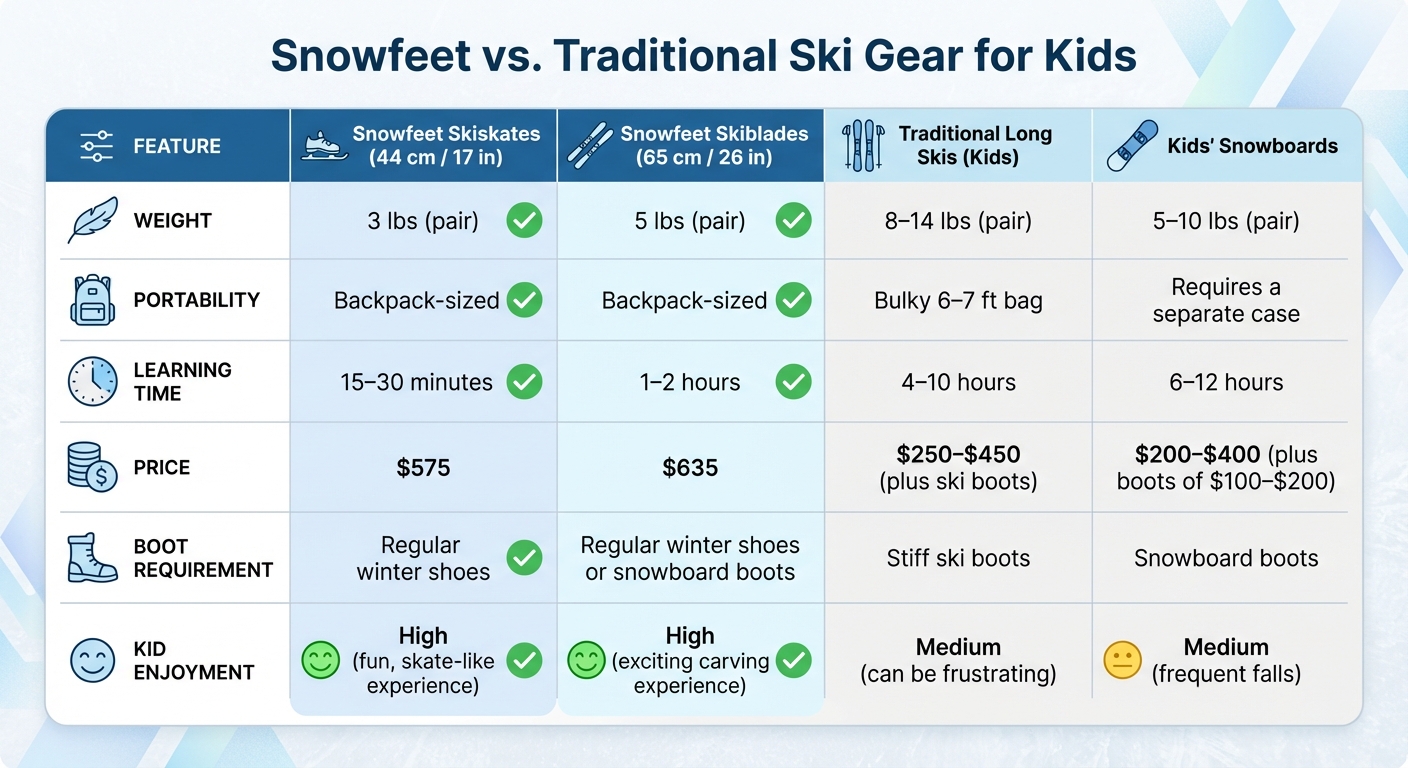
Snowfeet Skiskates vs Traditional Ski Gear Comparison for Kids
Snowfeet* gear stands out for being lighter, easier to carry, and quicker to learn compared to traditional long skis and snowboards. Let’s talk numbers: long skis for kids typically measure 51–59 inches and weigh around 8–14 lbs per pair, while snowboards weigh between 5–10 lbs. In contrast, Snowfeet* Skiskates weigh just 3 lbs per pair, and Skiblades come in at about 5 lbs. That’s a huge difference! This lightweight design makes it easy for kids to carry their own gear, giving them a sense of independence and confidence right from the start.
Comparison Table: Snowfeet* vs. Standard Gear
| Feature | Snowfeet* Skiskates (44 cm / 17 in) | Snowfeet* Skiblades (65 cm / 26 in) | Traditional Long Skis (Kids) | Kids' Snowboards |
|---|---|---|---|---|
| Weight | 3 lbs (pair) | 5 lbs (pair) | 8–14 lbs (pair) | 5–10 lbs (pair) |
| Portability | Backpack-sized | Backpack-sized | Bulky 6–7 ft bag | Requires a separate case |
| Learning Time | 15–30 minutes | 1–2 hours | 4–10 hours | 6–12 hours |
| Price | $575 | $635 | $250–$450 (plus ski boots) | $200–$400 (plus boots of $100–$200) |
| Boot Requirement | Regular winter shoes | Regular winter shoes or snowboard boots | Stiff ski boots | Snowboard boots |
| Kid Enjoyment | High (fun, skate-like experience) | High (exciting carving experience) | Medium (can be frustrating) | Medium (frequent falls) |
In nearly every category, Snowfeet* gear outshines traditional options, making it a fantastic choice for hassle-free fun on the slopes.
One of the best things about Snowfeet* is how quickly kids can pick it up. Skiskates mimic a natural skating motion, so most kids get the hang of it in just 15–30 minutes. Skiblades take a little longer - about 1–2 hours - but still beat the 4–10 hours it often takes to learn parallel turns on long skis. Snowboards? Those can take 6–12 hours of practice to get comfortable. According to surveys from US ski schools, Snowfeet* gear reduces learning time dramatically, which means fewer tears and more smiles.
Another big win for Snowfeet* is cost. At $575 for Skiskates and $635 for Skiblades, the price might seem steep at first glance. But here’s the kicker: they work with regular winter shoes (or snowboard boots for Skiblades), so you don’t need to shell out for specialized ski boots. Compare that to traditional skis or snowboards, where boots alone can cost $100–$200 on top of the gear itself. Snowfeet* delivers fun, simplicity, and value all in one package.
Conclusion
Kids often lose interest in skiing when bulky, complicated gear and slow progress take the fun out of it. Equipment that’s hard to control can chip away at their confidence. But it doesn’t have to be that way. Snowfeet* Skiskates and Skiblades offer a lightweight, simple alternative. They work with regular winter shoes - no clunky ski boots needed. If you're unsure which style to choose, check out this skiskates vs. skiblades comparison. Plus, their compact size makes them easy to carry, and the quick learning curve means your child can be zipping down the slopes much sooner than with traditional skis.
What happens off the slopes is just as important. Calling your trip a "snow holiday" instead of a "ski holiday" can take the pressure off. Let your child pick their runs, skip rigid grading systems that might feel discouraging, and mix in some off-slope fun - like a hot chocolate break. Pairing Snowfeet* gear with strategies like combining group and private lessons can create a well-rounded, enjoyable experience.
When you focus on fun and use freestyle skis for kids, skiing stops being a chore and starts feeling like an adventure. That’s the secret to keeping kids excited about winter sports.
FAQs
Are Snowfeet* Skiskates allowed at most U.S. ski resorts?
Snowfeet* Skiskates are typically allowed at most ski resorts in the U.S. They’re lightweight and easy to use, which makes them a solid option for beginners or anyone looking for something different from traditional skis. That said, always double-check the rules at the resort you’re planning to visit to make sure they’re permitted.
What age and ability level are best for Skiskates vs. Skiblades?
The right option depends on your child's size, skill level, and skiing experience. Skiskates (44 cm) work best for younger kids or beginners. Their smaller, lightweight design makes them much easier to handle. On the other hand, Skiblades (65 cm) are better suited for older kids or those who are more confident and have developed some balance and coordination. These provide a smoother, more stable glide. Compared to traditional skis, Snowfeet products are easier to use, helping kids get into skiing and enjoy it from an early age.
What winter shoes work best with Snowfeet* for kids?
When it comes to pairing Snowfeet* with winter shoes for kids, the ideal choice is lightweight, waterproof boots or winter shoes. These should offer a snug fit and solid ankle support, ensuring both safety and optimal compatibility with Snowfeet's Skiskates or Skiblades. The right footwear keeps kids comfortable and secure, so they can fully enjoy their Snowfeet* adventures.













Leave a comment
This site is protected by hCaptcha and the hCaptcha Privacy Policy and Terms of Service apply.