




















Short skis like Snowfeet* Skiblades and Skiskates are fun and agile but require a different balance technique than longer skis. The key? Stay centered over the middle or back of your feet - don’t lean forward like you would on longer skis. This guide breaks down five simple drills to help you master balance and control on short skis:
- Single-Leg Holds: Practice standing on one leg to build stability.
- Inside Ski Lift: Lift one ski during turns to improve weight distribution.
- Forward Hands and Weight Shift: Learn how to shift your weight smoothly while staying upright.
- Mini Shuffle Turns: Use small, controlled steps to perfect balance during turns.
- Core Engagement Turns: Tighten your core for better control in sharp turns.
Snowfeet* skis make learning easier because they’re lightweight, compact, and work with regular winter or snowboard boots. Whether you’re using the 38 cm Mini Ski Skates or the 65 cm Skiblades, these drills will help you feel confident on the slopes. Ready to give it a shot? Let’s dive in!
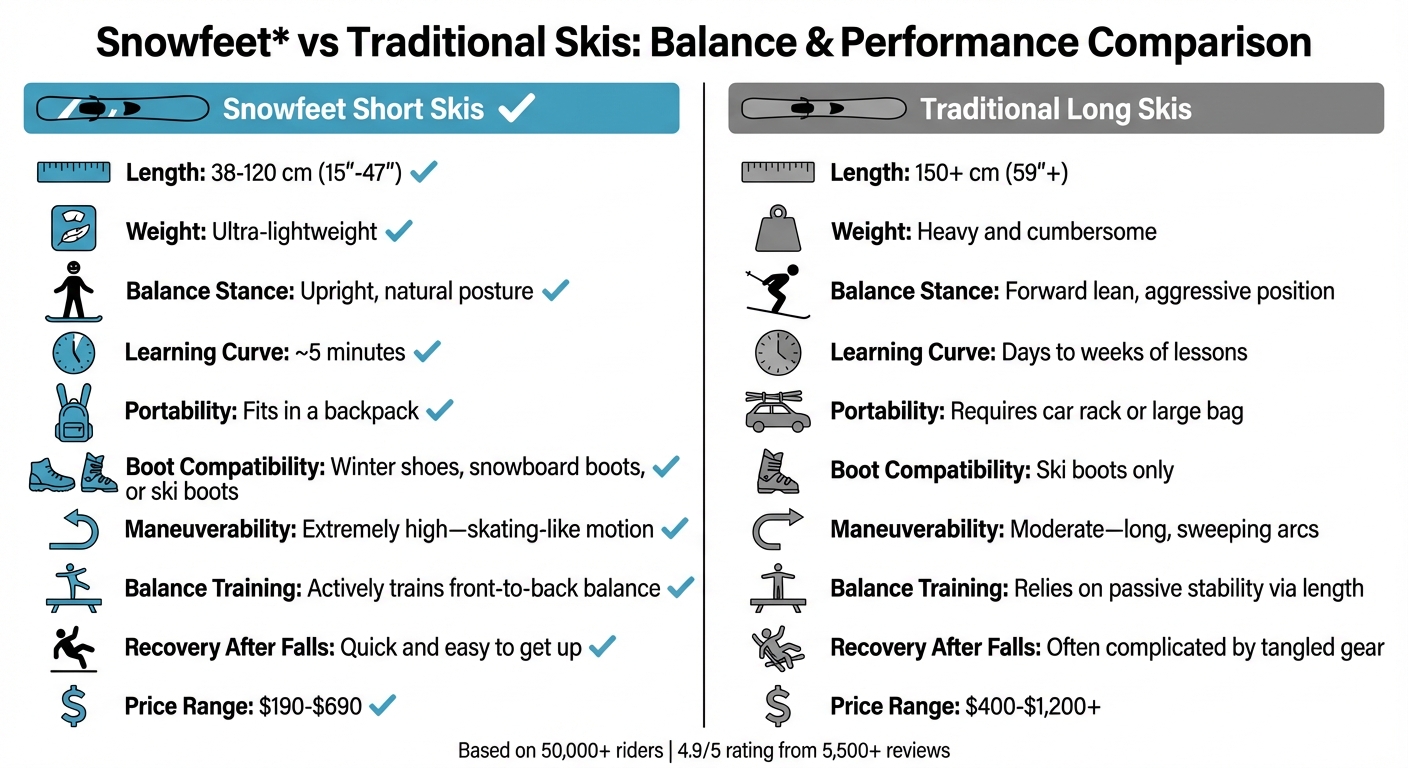
Snowfeet Short Skis vs Traditional Long Skis Comparison
Drill 1: Single-Leg Holds on Snowfeet* Skiskates

How to Perform the Drill
Begin on flat, groomed terrain with your Snowfeet* Skiskates securely strapped on. If you're feeling a bit wobbly, position yourself near a wall or tree for extra support. Stand with your feet shoulder-width apart, keeping your weight evenly distributed.
Now, lift one foot off the snow and bend that leg behind you. Keep the knee of your standing leg straight and focus on holding this position for 20 to 30 seconds. Afterward, take a 10-second break. Repeat this exercise 6 to 8 times for each leg. Once you’re comfortable, take it up a notch by closing your eyes and holding the position for 30 seconds - this will push your balance skills even further.
As you practice, keep your weight centered, your hands slightly forward, and your eyes on the horizon. Avoid leaning too far forward or crouching - staying upright is key to building stability.
This simple yet effective drill lays the groundwork for improving balance on short skis, giving you the confidence to handle Snowfeet* gear with ease.
Why Snowfeet* Skiskates Work Best
Snowfeet* Skiskates, measuring 44 cm (about 17 inches) and starting at $490, are perfect for this drill. Unlike traditional skis that range from 150 to 180 cm, these compact skates are lightweight and easy to maneuver. The shorter length means less rotational weight, making it much simpler to lift one foot during balance exercises.
What’s more, Snowfeet* Skiskates work with winter shoes or snowboard boots, providing better ankle support and a natural range of motion. This flexibility helps you move freely, which is crucial for nailing single-leg balance. As Snowfeet* explains:
"You are able to move freely as opposed to wearing heavy clunky skis".
The design feels similar to ice skating or inline skating, so if you’ve ever laced up hockey skates or rollerblades, the front-to-back balance will feel second nature.
With a perfect 5.0/5 rating from over 5,500 verified reviews, users love how these Skiskates make balance drills feel effortless. Nathan F. described them as a "standout performer" that’s "light, fast, and incredibly fun to ride". Plus, their compact size means you can practice just about anywhere - a big win over bulky traditional skis. These features make Snowfeet* Skiskates the ideal choice for mastering this drill and setting the stage for more advanced skills.
Drill 2: Inside Ski Lift with Snowfeet* Skiblades
Step-by-Step Instructions
To get started, find a gentle, well-groomed slope where you can practice safely. Strap on your 65 cm Snowfeet* Skiblades, making sure they’re securely fastened, and position your feet shoulder-width apart. This stance gives you better control without overextending your base. Begin by initiating a slow turn, shifting your weight toward the middle and back of your feet - this helps you avoid the forward lean that’s common with longer skis.
As you reach the peak of the turn, lift your inside ski off the snow for a moment. This forces your balance onto the outside ski’s edge, helping you develop the skill of relying on a single point of contact. Start with small lifts lasting one to two seconds, and gradually increase the duration as your confidence grows. Keep your hands forward and press your shins into your boots to stay responsive. Mastering these movements will prepare you for the heightened control and agility that Snowfeet* Skiblades are known for.
Benefits of Snowfeet* Skiblades
The 65 cm Snowfeet* Skiblades, priced at $550, come with a wood core that provides excellent responsiveness compared to fiberglass alternatives. These Skiblades give you clear feedback when you shift your weight onto the outside ski, which is crucial for perfecting this drill. At just 26 inches long, they’re much shorter than traditional skis (which typically range from 59 to 71 inches), making it easier to lift your inside leg during turns.
Andrew B., a satisfied user, shared his experience:
"These skiblades are so much fun and easy to control. Never going back to regular skis."
Snowfeet* Skiblades are designed to strike the perfect balance: “long enough to ski, short enough to skate”. This makes them stable enough for carving while still allowing for quick, precise balance adjustments. Their high-quality metal edges provide a firm grip on the snow, keeping you steady on your outside ski. With a perfect 5.0/5 rating from verified users, these Skiblades make the inside ski lift drill feel natural and achievable - even for beginners.
Drill 3: Forward Hands and Weight Shift on Snowfeet* PRO
How to Practice the Drill
Start on a gentle slope with a low incline - nothing too steep or intimidating. Secure your Snowfeet* PRO snugly and stand with your feet about shoulder-width apart. For added stability, position one foot slightly ahead of the other.
Keep your hands forward and press your shins into your boots to stay in an athletic, balanced stance. As you begin to traverse the slope, face your body downhill and shift your weight steadily toward the downhill side. This movement should feel smooth and controlled.
To avoid falls, keep your weight centered with a slight lean toward the back of your feet. Mastering this weight shift is crucial for getting the most out of your Snowfeet* PRO. This drill is a fantastic way to fine-tune the balance needed for short skis, which is one of the standout features of Snowfeet* products.
Advantages of Snowfeet* PRO
This drill is made easier thanks to the thoughtful design of the Snowfeet* PRO. At just 50 cm (around 20 inches) long, these ski skates strike the perfect balance - long enough to glide like skis but short enough to maneuver like skates. With a price tag of $275, the lightweight fiberglass core ensures that shifting your weight feels natural and fluid, unlike the effort required with heavier, traditional skis.
What makes the PRO model shine is its simplicity. Forget about bulky, restrictive bindings. Instead, you can use your favorite winter boots or snowboard boots, giving you more comfort and flexibility than stiff ski boots ever could. It’s no wonder the Snowfeet* PRO has earned a 4.9/5 rating from over 2,243 reviews. Users frequently highlight how quickly they can find their balance without needing expensive lessons. As the Snowfeet* Team puts it:
"You have to keep the front-back balance, so it feels very natural to those who play ice hockey, ice skate, or even use inline skates."
Drill 4: Mini Shuffle Turns with Snowfeet* Mini Ski Skates
Steps to Perform Mini Shuffle Turns
The Mini Shuffle Turns drill is all about sharpening your balance and control on short skis. Start by finding a flat, groomed area. Strap into your Snowfeet* Mini Ski Skates, standing with your feet shoulder-width apart. Bend your knees slightly and keep your weight centered over the middle or back of your feet - this setup is key for staying stable.
Now, it’s time to shuffle. Move forward using small, controlled steps while carving an S-turn pattern in the snow. As you shift your weight from side to side, your feet will naturally make tiny adjustments to maintain balance. To turn right, shift your weight onto your left leg; for a left turn, shift to your right leg. The trick is to keep the motion smooth and rhythmic - no jerky movements.
Your ankles should stay flexible, and you’ll want to avoid leaning too far forward. Unlike traditional skis, which offer more support at the front, the compact 38 cm Mini Ski Skates demand active balance along the length of your feet. As Snowfeet rider Chan Saelee explains:
"SnowFeet feel more like ice skating on snow, which is both challenging and exciting. It took me a little time to get used to the balance and movement, but once I got the hang of it, I was able to carve 'S' turns as a first-timer."
Mastering this drill sets you up for the quick, responsive movements that Snowfeet* Mini Ski Skates are known for.
Why Snowfeet* Mini Ski Skates Shine
At just 15 inches (38 cm) long, these are the shortest in the Snowfeet* lineup, making them perfect for quick, precise movements. Compare that to traditional skis, which are typically over 5 feet long and limit agility.
The Snowfeet* Mini Ski Skates are built with a lightweight, fiberglass-reinforced core, giving them excellent responsiveness. Priced at $250 (or $190 for the Basic model), they’re packed with features like metal ski edges for carving and a built-in heel brake for added control - options you don’t often see in ski gear at this price range.
Another standout feature? Their boot compatibility. You can wear regular winter or snowboard boots, which keeps your ankles mobile for those skating-style moves. With a 4.9/5 rating from over 2,244 reviews, users frequently highlight how easy it is to pick up balance drills. As one happy reviewer put it:
"They are fast and agile, and great for shreddage. 100% recommend!"
Drill 5: Core Engagement Turns on Snowfeet* Skiblades
Steps for Core Engagement Turns
Your core plays a crucial role in maintaining balance during tight turns on short skis. To get started, find an intermediate slope and strap on your Snowfeet* Skiblades (65 cm). Stand with your feet shoulder-width apart - placing one foot slightly forward can help with stability if needed.
Before initiating a turn, tighten your core as if preparing for a light impact. This creates a solid foundation. To start a short-radius turn, bend your knees into the turn and let the metal edges of the Skiblades grip the snow. Stay in a stacked stance and focus on smooth, controlled movements.
Keep your weight evenly distributed and avoid leaning too far forward - short skis don’t offer much support at the front. Throughout the turn, your knees should remain bent and flexible, ready to adjust as needed.
If you feel off balance, lean slightly forward and extend your arms to lower your center of gravity. This drill is a full-body workout, requiring precise movements for balance, making it more dynamic than traditional skiing [8]. It’s a perfect example of how Snowfeet* Skiblades shine in responsiveness.
Core Benefits of Snowfeet* Skiblades
Mastering core engagement doesn’t just refine your turns - it enhances your overall balance, a key skill for all Snowfeet* drills.
Snowfeet* Skiblades are designed for agility, thanks to their compact 65 cm (about 26 inches) length. This size strikes the perfect balance: short enough for skating-like movements but long enough to ski effectively [8]. Compared to traditional skis, which can easily exceed 5 feet, these Skiblades feel lightweight and far more maneuverable. Their wood core construction adds to their responsiveness, reacting instantly when you engage your core and shift your hips.
The parabolic shape and narrow waist are tailored for sharp, responsive carving. These features allow you to grip the edges more effectively during turns. Plus, with no long tails dragging behind, you gain better hip separation and freedom of movement [8]. As Snowfeet rider Daniel Siouffi puts it:
"Going fast I was in complete control of every move, turns, and stops."
Priced at $550, these 65 cm Skiblades have received glowing feedback, boasting a perfect 5.0/5 star rating from verified customers. Riders often highlight their "ease of control" and "freedom of movement". With over 50,000 Snowfeet* users worldwide and more than 5,500 verified reviews averaging 4.9/5 stars, it’s clear these aren’t just empty claims.
sbb-itb-17ade95
How to Ski on ONE SKI – The Ultimate Balance Exercise!
Why Snowfeet* Short Skis Are Better for Balance
Let’s dive into why Snowfeet* short skis are a standout choice for improving balance compared to traditional skis.
Traditional skis rely on their length to provide stability, but that stability comes at the cost of limiting active balance training. Snowfeet*, on the other hand, encourage you to engage your front-to-back balance - similar to the intuitive movements you’d use while inline skating. So, instead of just coasting along, every ride becomes a mini balance workout.
Snowfeet* skis, ranging from 38 to 120 cm, are also far lighter than the average traditional ski, which typically starts at 150 cm or longer. This reduced weight means less strain on your body and more freedom of movement. Their compact design isn’t just about portability; it also makes recovering from falls a breeze. Meanwhile, traditional skis often force you into a forward-leaning stance that puts unnecessary stress on your shins and quads. With Snowfeet*, you’re free to adopt a natural, upright posture, distributing your weight evenly across your midfoot and rearfoot. Want even more stability? You can stagger your feet - a technique that’s nearly impossible with long skis or a snowboard.
And the results speak for themselves. With over 50,000 riders and 5,500+ reviews averaging a stellar 4.9/5, Snowfeet* users consistently rave about how quickly they pick up the basics - often in as little as five minutes. As Nathan F. shared:
"Absolute game-changer! They're light, fast, and incredibly fun to ride."
Here’s a quick comparison to sum up the advantages:
Snowfeet* vs Traditional Skis
| Feature | Snowfeet* Short Skis | Traditional Long Skis |
|---|---|---|
| Length | 38 cm to 120 cm (15″ to 47″) | 150 cm+ (59″+) |
| Weight | Ultra-lightweight | Heavy and cumbersome |
| Balance Stance | Upright, natural posture | Forward lean, aggressive position |
| Learning Curve | ~5 minutes | Days to weeks of lessons |
| Portability | Fits in a backpack | Requires a car rack or large bag |
| Boot Compatibility | Works with winter shoes, snowboard boots, or ski boots | Ski boots only |
| Maneuverability | Extremely high - skating-like motion | Moderate - long, sweeping arcs |
| Balance Training | Actively trains front-to-back balance | Relies on passive stability via length |
| Recovery After Falls | Quick and easy to get up | Often complicated by tangled gear |
| Price Range | $190 to $690 | $400 to $1,200+ |
Snowfeet* short skis aren’t just a fun alternative - they’re a smarter way to train your balance while keeping things light, portable, and accessible.
Tips for Practicing Balance on Snowfeet*
Proper Stance and Preparation
Getting your stance right is key to staying balanced on Snowfeet*. Start by keeping your feet shoulder-width apart - too wide, and you’ll lose control. For extra stability, try a staggered stance, where one foot is slightly ahead of the other.
Unlike traditional skiing, Snowfeet* calls for a different approach to balance. The golden rule? Stand up straight. Don’t lean forward - short skis don’t have the long tips to catch you, and leaning forward could send you face-first into the snow. Instead, focus on keeping your weight centered over the middle and back of your feet. As the Snowfeet Team explains:
"Don't lean forward like you would do with skis... instead, stand up straight and place your weight over the middle and back of your feet."
To make things easier on the slopes, strengthen your core off the slopes. Exercises like planks can help you maintain the upright, centered posture Snowfeet* requires. A strong core is your best friend when navigating unpredictable terrain.
Mastering these basics will not only improve your stance but also make learning Snowfeet* much smoother, especially for beginners.
Snowfeet* Advantages for Beginners
Once you’ve nailed your stance, Snowfeet* offers some great advantages for those just starting out. At just 15 to 40 inches (38 to 100 cm) long, they’re much smaller than traditional skis, making them easier to handle.
One of the best parts? You don’t need stiff, uncomfortable ski boots. Snowfeet* works with regular winter or snowboard boots (US sizes 6–13). Just strap in, secure the bindings, and you’re good to go.
And here’s the kicker: over 50,000 riders worldwide have already joined the Snowfeet* community. With an impressive 4.9/5 rating from more than 5,500 verified reviews, many users report mastering the basics in just 5 minutes. Start on flat, groomed terrain with a hockey-style skating motion. Once you’re comfortable, you can tackle steeper slopes and let the fun really begin.
Conclusion: Mastering Balance with Snowfeet*
These five drills are all about fine-tuning your balance, stance, and control on short skis. By practicing single-leg holds, inside ski lifts, forward hand positioning, mini shuffle turns, and core engagement turns, you'll sharpen your ability to stay centered and steady on any terrain. These exercises train your body to react quickly to shifts in balance - an essential skill when using shorter skis, where the usual forward-leaning techniques don’t quite work.
Pairing these drills with Snowfeet* takes things to another level. Unlike traditional skis, Snowfeet* are ultra-portable, easy to maneuver, and have a much shorter learning curve. They work with your everyday winter boots, skipping the need for specialized gear like ski boots or roof racks. Plus, they’re so compact they fit right into your backpack. Their design responds instantly to your movements, making balance easier to master compared to the bulk of traditional skis.
With tens of thousands of happy users and glowing reviews, Snowfeet* have proven themselves as a game-changer. As Andrew B., a verified user, put it:
"These skiblades are so much fun and easy to control. Never going back to regular skis".
Snowfeet* aren’t just for balance drills - they’re versatile enough for groomed runs, snow parks, hiking trails, or even your backyard. They’re lighter on your knees and safer in falls since there’s no long ski to twist your legs. Whether you go for the 38 cm Mini Ski Skates (starting at $190), the 65 cm Skiblades (starting at $550), or something in between, you’re choosing gear designed to make skiing simpler and more enjoyable.
When combined with the drills in this guide, Snowfeet* give you everything you need to master balance, build confidence, and embrace the fun of winter sports. Start practicing today and see why so many are swapping out traditional skis for something lighter, easier, and way more fun.
FAQs
How do Snowfeet short skis help improve balance compared to traditional skis?
Snowfeet short skis are all about making your time on the slopes feel more natural and manageable compared to traditional long skis. With a compact length of 17 to 26 inches, they keep your weight centered over a smaller area. This means even the tiniest shifts in your hips or ankles can help you engage the edges, giving you a sense of stability and control that feels almost instinctive.
Their lightweight design and reduced swing weight are a big plus, too. If you slip or wobble, it’s easier to recover without putting in a ton of effort. Unlike the bulkiness of regular skis, Snowfeet short skis allow for a more relaxed, natural stance - just a slight knee bend is all you need. This is especially helpful for beginners and intermediate skiers who want to feel more confident on the snow.
What’s more, these skis excel when it comes to quick edge transitions and gripping icy slopes. Whether you're working on balance or building agility, Snowfeet short skis offer a smoother ride without the steep learning curve that often comes with longer skis.
What kind of footwear can I use with Snowfeet products?
Snowfeet gear is made to pair effortlessly with your everyday winter footwear. Whether you’ve got winter boots, ski boots, or snowboard boots, you’re good to go. The best part? No need to splurge on extra gear - just attach Snowfeet to the boots you already have and dive into the snow-filled fun!
Are Snowfeet skiblades a good choice for beginners?
Yes, Snowfeet skiblades are a great choice for beginners. Thanks to their small size and lightweight build, they’re much easier to handle than traditional skis or snowboards. This makes it simpler for new riders to find their footing and build confidence on the slopes.
What’s more, Snowfeet skiblades are designed with ease of use in mind, making the learning process less intimidating. Whether you’re cruising down groomed trails or tackling those tricky icy spots, these skiblades give you the control and flexibility to sharpen your skills without feeling out of your depth.













Leave a comment
This site is protected by hCaptcha and the hCaptcha Privacy Policy and Terms of Service apply.