



















If you’re new to skiing, shorter skis are your best friend. Forget the old advice about skis that reach your chin or head - those are tough to handle if you’re just starting out. Instead, go for skis under 4 feet (120 cm). Why? They’re easier to turn, less tiring to use, and much more forgiving when your form isn’t perfect (which, let’s be honest, happens a lot when you’re learning).
Snowfeet’s lineup, like their 17-inch Skiskates or 39-inch Skiblades, is specifically designed to help beginners feel confident and in control. Plus, they work with regular ski boots, so no extra gear is needed. Here’s the takeaway: shorter skis make learning to ski smoother, safer, and way more fun. Ready to hit the slopes? Let’s find the right pair for you.
How to Choose the Right Ski Length | BLISTER
Why Traditional Ski Length Advice Doesn't Work for Beginners
Walk into almost any ski shop, and you'll probably hear this classic advice: pick skis that fall somewhere between your chin and the top of your head based on your height. Sounds simple, right? The problem is, this "rule of thumb" was designed with seasoned skiers in mind - not beginners. For someone just starting out, it can turn skiing into a frustrating uphill battle.
These traditional guidelines were developed by ski brands catering to intermediate and advanced skiers - those who already know how to carve turns, maintain forward pressure, and control their speed. But if you're still figuring out how to stay upright on a bunny slope, this advice might actually make things harder. Let’s break down why.
Why Long Skis Are Challenging for Beginners
Skis longer than 5 feet (150 cm) demand skills that beginners simply don’t have yet. The biggest challenge? Turning. As The Ski Monster explains, "Shorter skis are always quicker and easier to initiate a turn on for a given ski". When you're learning, quick turns and small adjustments are crucial - longer skis just don’t respond as easily.
Then there’s the dreaded "backseat" problem. Beginners often lean back when they feel off-balance. On long skis, this causes the tips to wobble or chatter, making it harder to stay in control. Shorter skis, on the other hand, are more forgiving. They stay stable even when your technique isn’t perfect, giving you a chance to recover and keep going.
And let’s not forget the physical strain. Longer skis are heavier, which means more effort to pivot, edge, and steer. After a few hours, that extra work adds up, turning what should be a fun day on the slopes into an exhausting struggle.
Better Options Beyond Traditional Ski Brands
Traditional ski brands tend to focus on performance and speed - great for experienced skiers, but not so much for beginners. A first-timer doesn’t need skis designed to crush downhill races or glide effortlessly through powder. What they need is equipment that makes turning easy and builds confidence from the get-go.
K2 Skis puts it perfectly: "Shorter skis are easier to maneuver, especially at low speeds. Ideal for learning basic turns and controlling speed". But even their beginner recommendations often suggest skis around 5 feet (148–158 cm) for someone who’s 5'4" (163 cm) tall. For many new skiers, that’s still too much ski to handle comfortably.
The game-changer? Skis specifically designed for beginners. These shorter options let new skiers focus on the basics - like turning and balance - without the added stress of managing oversized gear. Up next, we’ll dive into how shorter skis can make all the difference when you’re just starting out.
Why Shorter Skis Work Better for Beginners
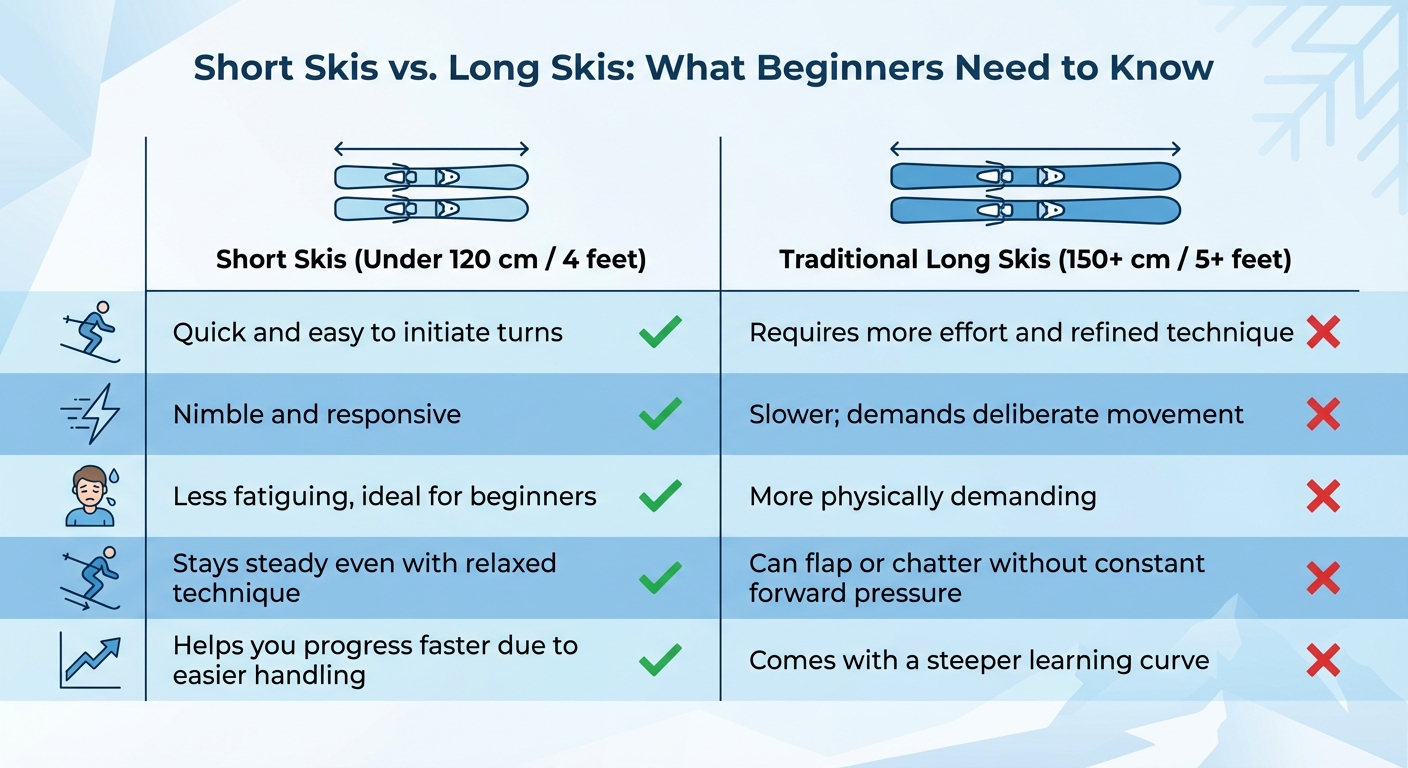
Short vs Long Skis Comparison for Beginners
For beginners, skis under 4 feet (120 cm) offer some real perks. They respond faster, make turning easier, and are more forgiving when your technique isn’t perfect - qualities that can make learning to ski a lot less intimidating.
Easier Turning and Better Control
One of the biggest advantages of shorter skis is how effortlessly they turn. As The Ski Monster points out:
Shorter skis are always quicker and easier to initiate a turn on for a given ski
. This quick response allows you to focus on improving your form without exhausting yourself. Plus, with less energy required for each turn, you can ski longer without feeling wiped out.
Building Confidence and Staying Safe
Beginners often have a tendency to lean back, which can make longer skis feel unstable. Shorter skis, on the other hand, stay more balanced, even when your weight shifts back. This stability helps you recover from small mistakes and keeps your early ski days safer and more enjoyable. It’s all about building confidence while keeping things fun.
Long Skis vs. Short Skis: Side-by-Side Comparison
Snowfeet* models highlight these beginner-friendly features, giving you better control and more confidence as you learn the ropes.
| Feature | Short Skis (Under 120 cm) | Traditional Long Skis (150+ cm) |
|---|---|---|
| Turning Ease | Quick and easy to initiate turns | Requires more effort and refined technique |
| Responsiveness | Nimble and responsive | Slower; demands deliberate movement |
| Physical Effort | Less fatiguing, ideal for beginners | More physically demanding |
| Control When Leaning Back | Stays steady even with relaxed technique | Can flap or chatter without constant forward pressure |
| Learning Speed | Helps you progress faster due to easier handling | Comes with a steeper learning curve |
sbb-itb-17ade95
Why Snowfeet* Products Are Best for Beginners
Snowfeet* Skiblades and Skiskates Explained
Snowfeet* products are designed with beginners in mind, offering shorter skis that make learning easier. Their lineup includes the compact 17-inch (44 cm) Skiskates for tight maneuvers, and Skiblades available in 26-inch (65 cm), 39-inch (99 cm), and 47-inch (120 cm) lengths to suit different terrains. Plus, all models are compatible with regular ski boots, making the transition to Snowfeet* gear simple and hassle-free. These thoughtful features give Snowfeet* a real edge over traditional ski brands.
How Snowfeet* Beats Traditional Ski Brands for Beginners
Snowfeet* takes a fresh approach to beginner skiing challenges. While brands like Rossignol and Salomon often recommend skis that are 5 to 6 feet (150–180 cm) long, Snowfeet* focuses on shorter designs. This not only reduces fatigue but also allows beginners to enjoy longer, smoother sessions on the slopes. The shorter length also enhances stability, even if your technique isn’t perfect yet. Another perk? The rocker design helps prevent edge-catching - a common cause of falls for new skiers. And with lengths under 4 feet (120 cm), Snowfeet* skis are lightweight and easy to carry, making them a practical choice for beginners.
Snowfeet* Models Compared
| Model | Length | Best For | Price |
|---|---|---|---|
| Skiskates | 17 in (44 cm) | Beginners needing maximum control | From $575 |
| Skiblades | 26 in (65 cm) | Quick turns and snowpark features | From $635 |
| Skiblades | 39 in (99 cm) | All-around versatility and progression | From $675 |
| Short Skis | 47 in (120 cm) | Transitioning to varied terrain | $775 |
For most beginners, the 39-inch (99 cm) Skiblades are a great middle ground - they’re short enough for easy turns but long enough to handle a variety of snow conditions. If you're just starting out and want something budget-friendly, the 17-inch (44 cm) Skiskates are an excellent choice with a super easy learning curve. On the other hand, if you’re planning to ski more often and want equipment you can grow into, the 47-inch (120 cm) Short Skis provide extra stability without the bulk of traditional beginner skis.
How to Pick the Right Snowfeet* Model
Step 1: Match Your Height and Skill Level
Your height and experience play a big role in finding the perfect Snowfeet* model. Picking the right size helps you stay in control and feel confident as you learn. Here’s a quick guide:
- Under 5'2" (157 cm) and just starting out? Go for the 17-inch (44 cm) Skiskates. They’re super stable and great for learning the basics.
- If you’re between 5'2" and 5'7" (157-170 cm), the 26-inch (65 cm) Skiblades are a solid option. They balance stability and control, making them ideal for gentle slopes.
- Progressing beginners between 5'7" and 6'0" (170-183 cm) who can snowplow should consider the 39-inch (99 cm) Skiblades. These offer more versatility as you improve.
- Over 6'0" (183 cm) with some skiing experience? The 47-inch (120 cm) Short Skis give you added stability without the bulk of full-length beginner skis from brands like Rossignol or Salomon.
Once you’ve got the size sorted, it’s time to think about where you’ll be skiing.
Step 2: Consider Your Skiing Environment
The type of terrain you’ll be skiing on can help narrow down your choice:
- Backyard fun or flat snow? The 17-inch (44 cm) Skiskates are perfect for casual use.
- Beginner slopes at resorts? The 26-inch (65 cm) Skiblades are easy to control and great for practicing turns on green runs.
- Snow parks or groomed runs? The 39-inch (99 cm) Skiblades handle jumps and turns like a pro.
- Advanced slopes or looking for speed? The 47-inch (120 cm) Short Skis are built for performance without being overwhelming.
Step 3: Buy Your Snowfeet* Model
Once you’ve figured out the right model based on your height, skill level, and skiing plans, it’s time to make your purchase. Head to snowfeetstore.com to find your match.
Here’s a quick price breakdown:
- 44 cm Skiskates: $575
- 65 cm Skiblades: $635
- 99 cm Skiblades: $675
- 120 cm Short Skis: $775
Good news: orders over $200 ship free within the US! Plus, all models work with standard ski boots, so you don’t need to invest in extra gear. Pick your length, hit the slopes, and you’ll be carving turns in no time - without the hassle of traditional long skis.
Conclusion
If you're new to skiing, it might be time to rethink the classic advice about using chin-height skis. While traditional long skis might look impressive, they can make learning much harder. As K2 Skis puts it: "Shorter skis are easier to maneuver, especially at low speeds". And for beginners, that ease of control can make all the difference in mastering the basics.
Snowfeet* offers a fresh approach to skiing for beginners. Whether you go with the 17-inch (44 cm) Skiskates for casual backyard fun or the 47-inch (120 cm) Short Skis for hitting the slopes, these options are designed to help you learn faster and enjoy the process. With shorter skis, you'll find it easier to turn, manage your speed, and avoid the exhaustion that often comes with handling full-length skis.
Here's the bottom line: Long skis require precise technique and can be unforgiving if you lean back too much. Snowfeet* models, on the other hand, give you more room for error. They're lighter, easier to control, and won't rattle or flap when you're tired. That means more fun, less frustration, and better runs overall.
Ready to skip the hassle? Head over to snowfeetstore.com and pick the model that fits your height and goals. These shorter skis work with standard ski boots, so making the switch is simple. With Snowfeet*, shorter really does mean better - and a whole lot more fun.
FAQs
Will shorter skis limit me as I improve?
Shorter skis, such as Snowfeet* Skiblades (65 cm, 99 cm, 120 cm) and Skiskates (44 cm), are fantastic for beginners. They’re easier to handle, making them ideal for building confidence and mastering the basics. Plus, they won’t hold you back as you progress. Once you’re ready, transitioning to longer skis offers added stability, but starting small makes the learning process much smoother.
Which Snowfeet* length is best for my height?
The ideal Snowfeet* length varies based on your height and experience level. If you're just starting out, shorter options like the 44 cm Skiskates or 65 cm Skiblades are your best bet - they’re much easier to handle. On the other hand, if you’re taller or have more skiing experience, you might feel more comfortable with the 99 cm or 120 cm Skiblades, which offer greater stability. Snowfeet* gear is crafted to be easier to use than traditional skis, making them a fantastic choice for beginners.
Can I use Snowfeet* with my current ski boots?
Snowfeet* products are made to work with regular shoes or specific footwear recommended by Snowfeet*, not traditional ski boots. This design makes them an easier-to-use and more controllable option compared to regular skis, especially for beginners. To ensure safety and the best experience, make sure your footwear attaches securely to the Snowfeet* skiblades or skiskates.












Leave a comment
This site is protected by hCaptcha and the hCaptcha Privacy Policy and Terms of Service apply.