




















Want to train for hockey when ice time is scarce? Use ski slopes. With Snowfeet® Skiskates, you can practice hockey moves - like sharp turns, stops, and lateral shifts - on snowy terrain. These compact skates (44–50 cm) attach to your winter boots, mimicking the feel of skating while building balance, strength, and agility. Plus, they’re small enough to toss in a backpack.
Here’s the deal: Snowfeet® lets you refine hockey-specific skills on slopes, from gentle hills to steeper runs, all while boosting lower-body power. It’s a smart way to stay sharp year-round. Whether you’re a beginner or advanced, there’s a model and training plan to suit your needs. Ready to hit the slopes? Let’s get into it.
Learn to Ski Parallel Turns - The Hockey Stop Drill
Why Snowfeet* Skiskates Work for Hockey Training

Hockey skating involves a unique mix of movements - edge work, quick starts, stops, and backward skating - that traditional skis or snowboards just can’t replicate. Snowfeet* Skiskates fill this gap by enabling players to practice those exact motions on snow. With their compact 17–20-inch length, they force you to synchronize your leg movements and fine-tune edge control, mirroring the mechanics of hockey skating. These skiskates naturally position you in a basic hockey stance, requiring constant edge adjustments - similar to the "Hockey 1-4" curriculum that focuses on quick footwork and agility.
"A hockey coach will develop the player by teaching the strategy of the game, while a skating coach will focus on a foundation of proper skating technique".
Snowfeet* helps build that technical skating foundation right on the slopes, preparing you for the unique benefits outlined below.
Benefits of Short Skis for Hockey Players
Snowfeet* Skiskates are small but mighty. Their compact size - 44 cm (17 in) and 50 cm (20 in) - makes them incredibly portable and agile, unlike traditional skis that are 150–180 cm long. You can toss these skiskates into a backpack, strap them onto your winter boots in seconds, and hit the snow without the hassle of ski boots or bulky bindings. This means you can train pretty much anywhere there’s snow, whether it’s a resort slope or your neighborhood hill.
What really sets Snowfeet* apart for hockey players is their maneuverability. Long skis force you into wide turns and slow, sweeping movements, which don’t translate well to hockey’s fast-paced directional changes. Snowfeet*, on the other hand, allow for the tight crossovers and quick lateral movements that hockey demands. Their shorter length keeps your core and leg muscles constantly engaged to maintain balance - just like on the ice. This strengthens the same stabilizing muscles you use for crossovers and pivots. Plus, ice skating burns up to 200 calories per hour, so training with Snowfeet* can help build the endurance and strength hockey players need. By blending hockey-specific movements with winter sports, Snowfeet* offers a seamless way to train year-round.
How Snowfeet* Connects Hockey and Winter Sports
Snowfeet* doesn’t just mimic hockey movements - they bridge the gap between hockey and broader winter sports. Their design mirrors the gliding mechanics of ice skating on snow, making them a valuable training tool all year. The synchronized leg movements required for gliding help improve joint flexibility and reinforce proper stride mechanics.
NHL center Joe Pavelski once worked with figure skating coach Cathy Andrade to focus on "stride mechanics and quick feet" - the exact skills Snowfeet* helps develop on varied snow terrain.
USA Hockey even recommends players spend a full year learning skating fundamentals before joining formal programs. Snowfeet* makes this process easier by offering a way to practice three to four times a week on accessible slopes. This consistent training builds agility and speed faster than sporadic practice. Start simple: work on your stance and edge control on gentle slopes. As you gain confidence, you can move on to more advanced maneuvers, all while maintaining hockey-specific movement patterns. This step-by-step approach ensures steady improvement and sets the stage for more advanced drills and training methods covered in the next sections.
Equipment Needed for Ski Slope Hockey Training
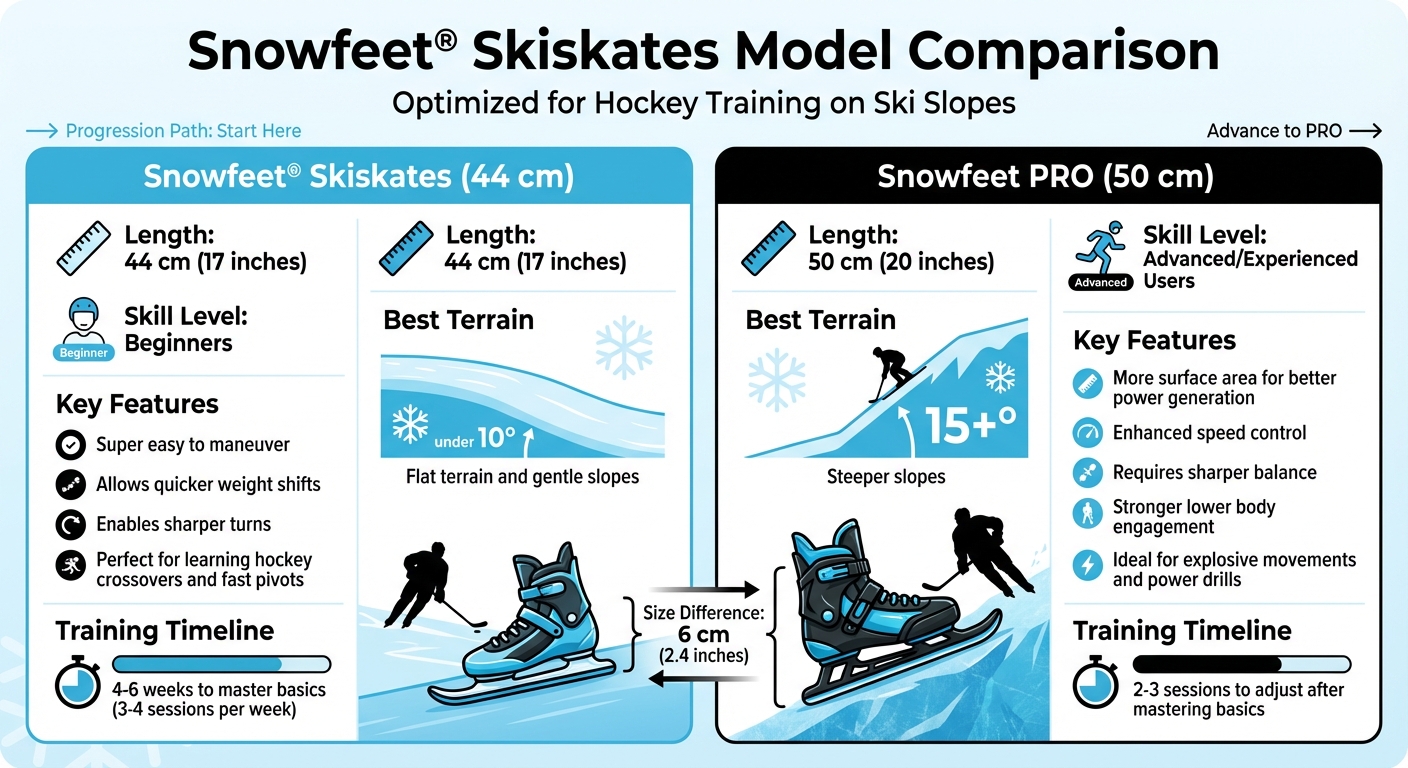
Snowfeet Skiskates Models Comparison: 44cm vs 50cm PRO for Hockey Training
Getting started with ski slope hockey training doesn’t require a ton of gear. The main item you’ll need is Snowfeet® Skiskates - compact, ski-like tools that allow you to practice hockey-specific moves on snow. These are a fantastic alternative to traditional long skis because they’re lightweight and work with your regular winter boots. No need for special bindings or bulky boots, which makes them super convenient for hockey players looking to mix up their training routine.
Safety is key, so make sure to wear a certified helmet, wrist guards, knee and elbow pads, and winter clothing that’s warm, moisture-wicking, and waterproof. Your boots should offer solid ankle support since quick lateral movements and weight shifts are a big part of mimicking on-ice action. With the right setup, you can safely practice hockey drills while enjoying the snowy slopes.
After training, take care of your gear. Clear off any snow and ice, dry your skiskates thoroughly, and store them in a cool, dry place. Check your bindings monthly, and at the end of the season, lightly lubricate them and store the equipment horizontally. Keeping the edges sharp and well-maintained will ensure your gear performs like it should during those intense drills.
Here’s a closer look at the two Snowfeet® models we recommend, starting with the beginner-friendly option.
Snowfeet® Skiskates (44 cm): Best for Beginners
The 44 cm Skiskates are perfect for anyone new to ski slope hockey training. These skates are just 17 inches long, making them super easy to maneuver, especially if you’re still learning. The shorter design allows for quicker weight shifts and sharper turns, which are ideal for practicing hockey crossovers and fast pivots on snow.
This model works best on flat terrain and gentle slopes. Start by adjusting the bindings to fit your boots snugly and securely. Begin your practice on flat ground to get a feel for your balance, and once you’re comfortable, move to gentle slopes (under 10°). Most beginners feel at ease after about 4–6 weeks of consistent practice - training three to four times a week. Once you’ve nailed the basics, you’ll be ready to tackle steeper slopes or upgrade to a longer model.
For those ready to step it up, the PRO model is your next move.
Snowfeet PRO (50 cm): Advanced Performance for Experienced Users
If you’ve mastered the fundamentals, the Snowfeet PRO (50 cm) is designed to push your training further. This model is slightly longer - nearly 20 inches - giving you more surface area for better power generation and speed control, especially on tougher terrain. The added length means you’ll need sharper balance and stronger lower body engagement, which helps build strength and endurance for on-ice performance.
The PRO skiskates are best suited for steeper slopes (15+°), making them ideal for advanced drills that focus on explosive movements and power. Keep in mind, the longer design feels a bit different, so you’ll likely need a couple of sessions - usually 2–3 - to adjust. Start on flat terrain again to get used to the feel, then gradually work your way up to steeper slopes. The PRO model gives you the control and precision needed to refine your skills, helping you develop the speed, power, and awareness that set elite hockey players apart from the rest.
sbb-itb-17ade95
Drills and Techniques for Hockey Training on Ski Slopes
The following drills are designed to mimic hockey movements - like sharp turns, explosive push-offs, and rapid weight shifts - while taking full advantage of the resistance provided by snow. Unlike traditional skis, Snowfeet* allow for faster pivots and enable hockey-specific moves with agility that feels close to on-ice performance. Their compact design gives you the control and precision needed for hockey-style training on winter terrain. These exercises build on the basics we covered earlier, pushing your training to the next level.
Balance and Agility Drills on Gentle Slopes
Start on flat terrain or gentle slopes (under 10°) with one-foot glides. Push off with both feet, then lift one skiskate off the snow, holding your balance for 5–10 seconds before switching sides. This strengthens the single-leg stability crucial for powerful skating strides. Next, work on weight transfers by shifting your weight smoothly from side to side as you glide. For an added challenge, carve figure-eights on gentle slopes, focusing on clean transitions and edge control.
Snowfeet* Skiskates, measuring 44 cm (about 17 inches), are perfect for these drills. Their shorter length allows for quicker adjustments and tighter turns compared to traditional skis. Once you're confident with your balance on gentle slopes, you can move on to more advanced power drills on steeper terrain.
Advanced Power Drills on Steeper Terrain
Take things up a notch with steeper slopes (15° or more) and the Snowfeet PRO model, which measures 50 cm (about 20 inches). Start by practicing hockey stride push-offs - explosive pushes as you descend. Focus on bending your knees deeply and fully extending your legs with each stride. This builds strength in your quads, hamstrings, and glutes while taking advantage of gravity and snow resistance.
Next, work on hockey stops by digging your edges into the snow to stop quickly, then push off in the opposite direction. Finally, practice carving turns at higher speeds. These require precise edge control and strong core engagement, helping you master sharp cuts and quick direction changes - skills that translate directly to the ice. The extra surface area of the PRO model enhances both power and precision, making it ideal for these advanced drills.
Lower Body Strength Workouts for Endurance
For endurance and strength, incorporate uphill sprints on moderate slopes. Sprint hard for 20–30 seconds, rest for 60 seconds, and repeat for 6–8 rounds. This simulates the short bursts of energy and recovery needed during a hockey game. Another great option is suicide drills: set markers at intervals up the slope, sprint to each one and back, gradually increasing your explosive power and stamina.
Snowfeet* make these drills effective by allowing quick, precise footwork that mirrors the dynamic movements of hockey. Whether you’re sprinting uphill or executing sharp stops, these exercises will leave you game-ready.
How to Progress from Flat Terrain to Full Slope Training
Starting with the Basics: Flat Terrain and Gentle Slopes
Start on flat terrain - think parking lots, groomed cross-country trails, or the base of ski resorts. These areas let you focus on basic movements without worrying about slopes. Begin with standstill starts, where you push off from a complete stop, mimicking the start of a hockey game. Work on edge control by practicing gentle weight shifts while gliding. This helps you develop the lateral grip needed for quick turns and sharp stops.
The 44 cm Skiskates are perfect for this stage. Their compact size allows you to feel even the smallest adjustments, without the bulk of traditional skis getting in the way. Once you’re confident with gliding, stopping, and turning on flat ground, move on to slightly inclined terrain. Keep focusing on balance and control as you progress. This adaptability is why Snowfeet* stands out as a great tool for refining on-ice hockey skills.
Moving to Steeper Terrain with Confidence
Once you’ve nailed the basics on flat and gentle slopes, it’s time to tackle steeper terrain. Here’s where understanding the grip versus glide trade-off comes into play. Digging your edges deeper gives you sharper turns and better acceleration, but it also creates more resistance, which can tire you out faster. Start each session by warming up on easier slopes before gradually moving to steeper ones.
At this stage, the Snowfeet PRO (50 cm) becomes your go-to option. Its extra 6 cm (about 2.4 inches) of surface area compared to the standard Skiskates offers more stability and power during hard carving or fast hockey stops. Practice angling by using your edge control, just like you would on ice. This not only improves your forechecking skills but also builds lower-body strength. These drills develop leg power and precision in a way that long skis simply can’t match for hockey-specific movements.
Conclusion
Using ski slopes as part of your hockey training routine can be a game-changer. Snowfeet* skiskates let you work on critical hockey skills like edge control, stride mechanics, and quick footwork in a way that traditional skis or snowboards just can’t match. Their compact design mirrors the feel of a hockey skate blade, making moves like crossovers, backward skating, and tight spins feel natural - and directly applicable to your on-ice performance.
Beyond technique, training on slopes builds strength in your legs and core while improving flexibility and overall athletic ability.
"Learning proper skating techniques allows hockey players to be more successful throughout their careers".
Whether you’re sticking to flat terrain with the 44 cm model or tackling steeper runs with the PRO version, each session helps improve balance, agility, and lower-body power that translates to the rink. For optimal results, aim for three to four sessions per week - consistent practice on the slopes will make you faster and sharper on the ice.
Snowfeet* creates a unique connection between winter sports and hockey training, offering a tool that enhances your skills in ways traditional equipment can’t. Add Snowfeet* to your training routine and see how it can take your game to the next level.
FAQs
Can Snowfeet® really improve my on-ice skating?
Yes, Snowfeet® can help you sharpen your on-ice skating skills by boosting balance, agility, and lower body strength during snow slope training. Their design closely mirrors natural skating movements, making it easier to fine-tune edge control, push-offs, and weight transfer. Unlike regular skis or snowboards, Snowfeet products are specifically designed to translate skating techniques, offering a practical way to improve hockey and ice skating skills off the ice.
Which Snowfeet® size should I choose: 44 cm or 50 cm PRO?
The 44 cm Snowfeet® Skiskates are a great pick if you're looking for easier control and better agility. They're especially ideal for beginners or anyone who wants to work on balance and build lower body strength.
On the other hand, the 50 cm PRO version is designed for more advanced users. It offers a tougher challenge for stability and allows you to fine-tune your precision.
Both sizes are compact and highly versatile, making them a fantastic alternative to traditional skis or snowboards - especially if you're into hockey skill training.
Where can I train safely with Snowfeet® on snow?
You can train safely on snow with Snowfeet® products like Snowfeet Skiskates (44 cm) and Snowfeet PRO (50 cm). These are built for balance, agility, and movements similar to hockey. Pick a flat, snow-covered spot free of obstacles - think trails, sports parks, or open fields. Don’t skip the safety gear: a helmet, gloves, and padding are must-haves for a secure and enjoyable session.













Leave a comment
This site is protected by hCaptcha and the hCaptcha Privacy Policy and Terms of Service apply.