



















Learning to ski? The first steps are turning and stopping - it’s how you stay in control and safe on the slopes. But let’s face it, long skis can feel clunky, especially when you’re starting out. That’s where Snowfeet* Skiblades and Skiskates come in. These shorter, lightweight skis (17–47 inches) make it easier to learn the basics without the bulk of traditional skis.
Here’s the deal:
- Stopping: Start with the snowplow stop (form a wedge with your skis) and work up to skidding stops (like a hockey stop).
- Turning: Begin with wedge turns (shift weight to the outside ski) and move on to parallel turns for smoother control.
- Why Snowfeet*: Their compact size makes turning and stopping simpler, improves balance, and builds confidence faster. Plus, they’re easy to carry and don’t need special boots.
Whether you’re on gentle slopes or snowy trails, Snowfeet* makes skiing less intimidating and more fun. Ready to hit the slopes? Let’s dive into the details!
How NOT to stop on skis – and what to do instead (beginners)
Understanding Snowfeet* Skiblades and Skiskates
Snowfeet* Skiblades and Skiskates are compact mini-skis designed to work with your regular winter shoes - no need for bulky ski boots. Skiblades are available in three lengths: 26 inches (65 cm), 39 inches (99 cm), and 47 inches (120 cm). Skiskates, on the other hand, are even smaller at just 17 inches (44 cm). Compare that to traditional skis, which typically range from 63–71 inches (160–180 cm), and the difference is clear: Snowfeet* offers a much more agile and portable alternative.
Their lightweight design makes them easy to pack and carry, unlike traditional skis, which are not only heavier but also require expensive, specialized boots. With Snowfeet*, you skip the hassle of boot fittings and dive straight into the fun. This compact design also translates to quicker responsiveness, giving you a smoother experience on the slopes.
Why Shorter Skis Are Beginner-Friendly
Shorter skis mean better control, especially for beginners. Snowfeet* products respond quickly to your movements, making it easier to switch edges and adapt to the terrain. That means less fumbling with oversized gear and more time mastering the basics. This quick feedback helps you build muscle memory faster, speeding up the learning process.
Light, responsive equipment also boosts confidence. Traditional long skis can feel intimidating because they pick up speed quickly and demand more advanced balance. With Snowfeet*, you’ll feel more in control, which helps you progress faster - getting to your first proper turns in a matter of days, not weeks.
Picking the Right Snowfeet* Model
Choosing the right model depends on your skill level and the type of terrain you’ll tackle. If you’re a beginner sticking to gentle slopes, the 65 cm Skiblades are your best bet. They’re forgiving and offer excellent control, perfect for those still finding their footing. Once you’re ready to explore more varied terrain or go faster, consider the 99–120 cm models for a bit more versatility.
Looking for something different? The 44 cm Skiskates are ideal for flat areas or terrain parks, offering a skate-like experience on snow. Think of them as ice skates, but for snowy conditions. For those who need extra durability for rugged terrain, the Snowfeet PRO models provide a tougher build while maintaining the same easy handling that makes Snowfeet* so beginner-friendly. Picking the right model ensures you get the most out of your winter adventures, no matter where you’re headed.
How to Stop on Skis
Stopping on skis is essential for staying safe and in control. With Snowfeet* Skiblades and Skiskates, learning to stop becomes a bit easier thanks to their compact and lightweight design, which simplifies movements compared to traditional skis.
The Snowplow Stop
The snowplow stop is a go-to method for beginners. Here’s how to do it:
- Bend your knees slightly and keep your back straight.
- Bring the tips of your skis closer together while pushing your heels outward, forming a wedge shape.
- Roll your ankles inward to engage the edges of your skis.
With Snowfeet*, the smaller size makes forming and controlling this wedge shape much simpler, giving you precise control as you slow down.
The Skidding Stop
After mastering the snowplow, you can step up to the skidding stop, also known as the "hockey stop." This technique is perfect for quick stops, especially when you need to avoid something in your path.
Here’s how it works:
- Keep your skis parallel and quickly rotate them to a perpendicular angle.
- Flatten the skis slightly to release the edges and slide sideways to slow down.
As the Snowfeet Store puts it:
You stop just like on skis or skates - with a hockey stop or heel brake.
Snowfeet*’s lightweight design makes this maneuver easier than with traditional skis. Distribute your weight evenly over both feet, keep your upper body steady, and let your legs do the work. If you’re finding the skidding stop tricky, consider using a Snowfeet* model with a heel brake for extra support.
How to Turn on Skis
Turning is essential for controlling your direction, avoiding obstacles, and navigating slopes safely. With Snowfeet* Skiblades and Skiskates, turning becomes easier compared to traditional long skis. Their compact design (ranging from 44 cm to 120 cm) allows for quicker responses and smoother maneuvering, making it easier to learn and master. Just like stopping builds confidence, learning to turn gives you even more control on the slopes.
The Wedge Turn
The wedge turn is a perfect starting point for beginners. To do this, form a wedge shape with your skis by pointing the tips together and keeping the tails apart. Shift your weight to the outside ski to turn in that direction. Keep your torso facing downhill and look where you want to go.
The shorter length of Snowfeet* Skiblades makes this process feel more natural and intuitive. These skiblades respond quickly to even subtle weight shifts, giving you better control. You can also try lifting your inside ski slightly to feel how the outside ski takes over most of the turning. This feature is especially helpful when navigating steeper terrain or busy slopes, as it reduces the intimidation factor for beginners.
Parallel Turns
Once you’ve got the hang of wedge turns, you can move on to parallel turns. This technique is smoother and works well at higher speeds. Start by rolling your ankles to release the ski edges, bringing both skis into a parallel position. Then, roll your ankles, knees, and hips to re-engage the edges, shifting about 90% of your weight onto the outside ski as you complete the turn.
Snowfeet* Skiblades and Skiskates make learning parallel turns much easier. Their shorter length reduces swing weight, so aligning your skis takes less effort. You can practice releasing and re-engaging your edges on moderate slopes without picking up overwhelming speeds. This setup allows you to build confidence faster than you would with traditional skis. When combined with solid stopping techniques, these turning skills create a complete control system, setting you up to refine your technique and tackle more challenging runs.
sbb-itb-17ade95
Common Beginner Mistakes and Fixes
When you're learning to master turning and stopping, it's easy to fall into some common traps. These mistakes can slow your progress, but the good news is they’re easy to fix once you know what to watch for. Snowfeet* Skiblades and Skiskates make the learning curve less intimidating compared to traditional long skis. Their shorter length means quicker feedback and easier recovery when things go off track.
Leaning Back Instead of Staying Centered
Leaning back is a classic mistake that can throw off your balance and make turning a challenge. When you lean back, your weight shifts away from the ski tips, which makes steering and stopping harder. This often happens when beginners feel nervous or pick up speed. The solution? Keep your knees bent while staying centered over your skis - don’t let your weight drift backward. Thanks to Snowfeet*’s design, recovering from this mistake is easier. Whether you’re using the 26-inch (65 cm), 39-inch (99 cm), or 47-inch (120 cm) Skiblades, the shorter length helps you regain balance faster than with traditional skis.
Putting Equal Weight on Both Skis
Another common error is failing to shift most of your weight - about 90% - onto the downhill ski. This weakens the edge grip and can lead to unpredictable turns. To fix this, focus on transferring your weight to the outside (downhill) ski. Try lifting your inside ski slightly to feel the weight shift. Snowfeet*’s compact size makes it easier to sense and correct your weight distribution quickly. This immediate feedback helps you develop better habits right from the start.
Turning Your Upper Body Instead of Your Legs
Using your upper body to turn instead of your legs can throw off your control. The trick is to keep your torso steady, facing downhill, while your legs handle the turning. Keep your shoulders parallel to the slope and look ahead toward where you want to go - not down at your skis. Snowfeet* Skiskates, especially the 17-inch (44 cm) model, are designed to give you quick feedback. This helps you notice when your upper body is over-rotating so you can adjust and let your legs take charge of the movement.
Why Snowfeet* Beats Traditional Skis and Snowboards
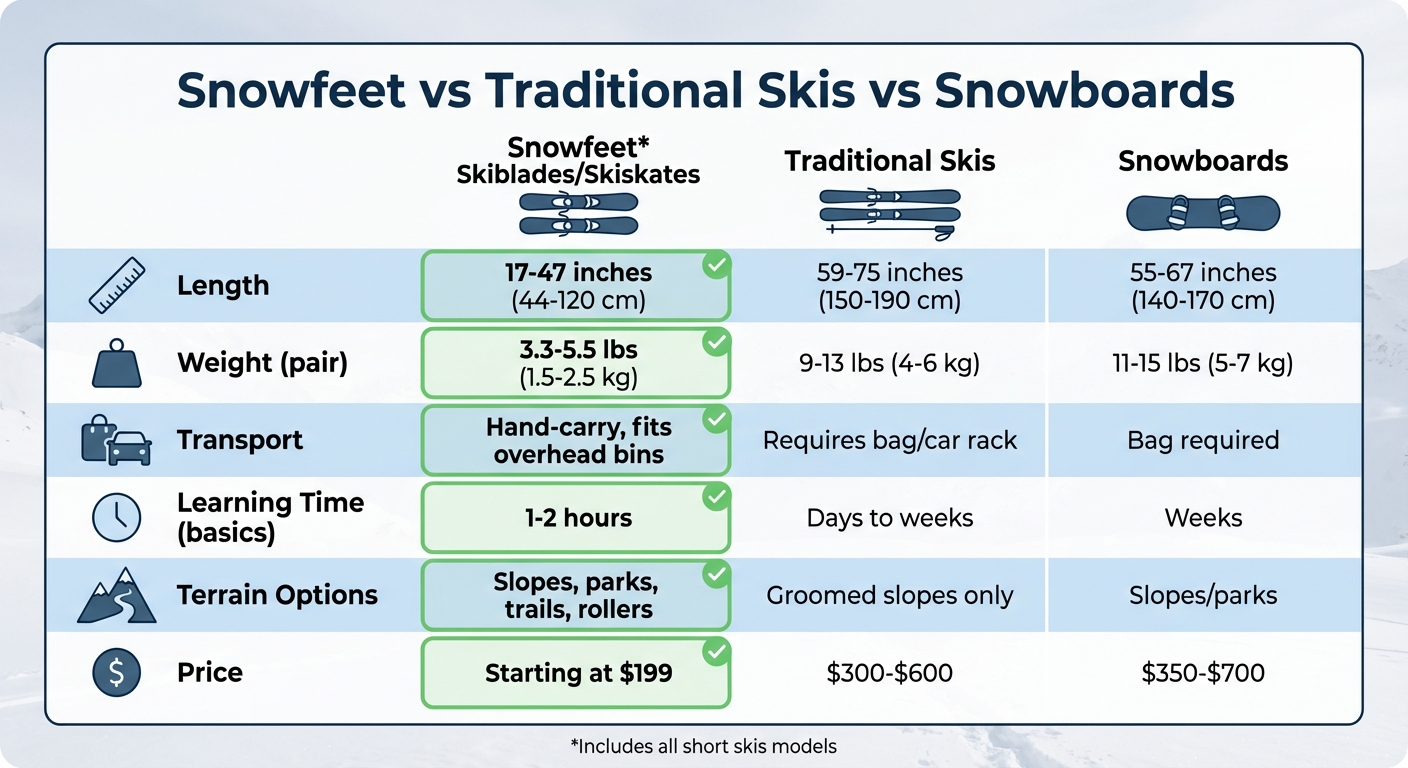
Snowfeet vs Traditional Skis vs Snowboards Comparison Chart
Once you’ve got the basics of turning and stopping down, you’ll quickly notice how Snowfeet* makes progress feel smooth and straightforward compared to traditional skis or snowboards. But it’s not just about technique - Snowfeet* stands out in portability, learning curve, and versatility. These differences make the experience both practical and fun.
Easy to Carry and Store
Traditional skis and snowboards are, let’s face it, a hassle to lug around. Skis can be 59–75 inches long and weigh 9–13 pounds, while snowboards clock in at 55–67 inches and 11–15 pounds. They need special bags or car racks, and storing them at home can feel like a game of Tetris. Snowfeet*, on the other hand, are a game-changer. Measuring just 17–47 inches and weighing only 3.3–5.5 pounds, they fit in a backpack, your car trunk, or even an airline overhead bin. No more wrestling with oversized gear or paying extra baggage fees. At home, they tuck away easily in a closet or under a bed. Plus, with prices starting at $199, Snowfeet* offers a budget-friendly alternative to traditional skis ($300–$600) or snowboards ($350–$700).
Learn Basic Skills Faster
Snowfeet* makes learning the basics a breeze. Thanks to their compact size, you can master turns in just 1–2 hours - compare that to the days or even weeks it often takes with traditional skis. Their shorter length means you don’t need a ton of space to practice, and their responsive design gives you immediate feedback. Forget the frustration of tangled ski tips or managing long equipment. Snowfeet* lets you focus on the essentials, so you can build confidence quickly.
Use Them Anywhere
Here’s where Snowfeet* really shines: they’re not tied down to resorts or groomed slopes. You can use them on snowy hills, in your backyard, on hiking trails, or even on paved surfaces with rollers. This flexibility means you’re not stuck planning expensive trips to the mountains - you can practice wherever there’s snow or smooth ground. The freedom to train anywhere helps you improve faster and makes the experience more accessible and enjoyable.
| Feature | Snowfeet* Skiblades/Skiskates | Traditional Skis | Snowboards |
|---|---|---|---|
| Length | 17-47 inches (44-120 cm) | 59-75 inches (150-190 cm) | 55-67 inches (140-170 cm) |
| Weight (pair) | 3.3-5.5 lbs (1.5-2.5 kg) | 9-13 lbs (4-6 kg) | 11-15 lbs (5-7 kg) |
| Transport | Hand-carry, fits overhead bins | Requires bag/car rack | Bag required |
| Learning Time (basics) | 1-2 hours | Days to weeks | Weeks |
| Terrain Options | Slopes, parks, trails, rollers | Groomed slopes only | Slopes/parks |
| Price | Starting at $199 | $300-$600 | $350-$700 |
Conclusion
Learning to turn and stop on skis doesn’t have to feel overwhelming. By focusing on key techniques like the snowplow stop, wedge turn, and eventually parallel turns, you can quickly build confidence and control. Remember to stay balanced, shift your weight as needed, and keep your eyes forward to smoothly navigate turns and stops. These basics apply to any skis, but they’re especially easy to pick up with Snowfeet* Skiblades and Skiskates.
Thanks to their responsive design, Snowfeet* products make it easier to focus on honing your technique instead of wrestling with heavy, cumbersome equipment. With sizes ranging from compact 17-inch Skiskates to 47-inch Short Skis, they’re perfect for helping beginners progress faster while enjoying a more comfortable learning experience. This streamlined approach not only simplifies early lessons but also lays the groundwork for tackling advanced skills down the road.
Snowfeet* also offers practical perks that traditional skis and snowboards can’t compete with. Their lightweight, portable design lets you toss them into a backpack, and with prices starting at $199, they’re an affordable way to get into winter sports. Whether you’re hitting groomed slopes, a snowy hill nearby, or even your backyard, Snowfeet* makes it easy to enjoy the snow without the hassle of expensive resort trips or bulky equipment.
Ready to make skiing more fun and accessible? Check out the Snowfeet* store to explore options like the nimble 44 cm Skiskates or the stable 120 cm Short Skis. Grab a pair, hit the slopes, and start mastering your skills today!
FAQs
Are Snowfeet* easier to learn than regular skis?
Snowfeet* products, such as Skiblades and Skiskates, are perfect for beginners thanks to their compact size, ranging from 44 cm to 120 cm. The shorter length makes them easier to control, allowing for quicker turns and smoother stops. Unlike traditional skis or snowboards, which can feel overwhelming for newcomers, the smaller design of Snowfeet* helps build confidence and makes learning the basics much more approachable. It’s a great way for anyone new to the slopes to enjoy a smoother and more manageable experience.
Do I need ski boots for Snowfeet*?
Snowfeet* products, such as Skiblades and Skiskates, are crafted to work without traditional ski boots. Instead, they’re designed to be used with regular winter footwear, making them a more convenient and approachable option compared to traditional skis or snowboards. While it’s always a good idea to check the product instructions for any specific requirements, in most cases, you won’t need specialized ski boots to enjoy Snowfeet*.
Which Snowfeet* length should I start with?
For those just starting out, shorter options like the _Snowfeet Skiskates (44 cm)_* or smaller Skiblades (65 cm) are perfect. Their compact size makes it easier to control your movements and master turning and stopping. Once you feel more comfortable, you can step up to longer Skiblades (99 cm or 120 cm), which offer better stability when you're zipping along at faster speeds. Snowfeet* gear is crafted to make skiing less intimidating compared to traditional skis or snowboards.












Leave a comment
This site is protected by hCaptcha and the hCaptcha Privacy Policy and Terms of Service apply.