



















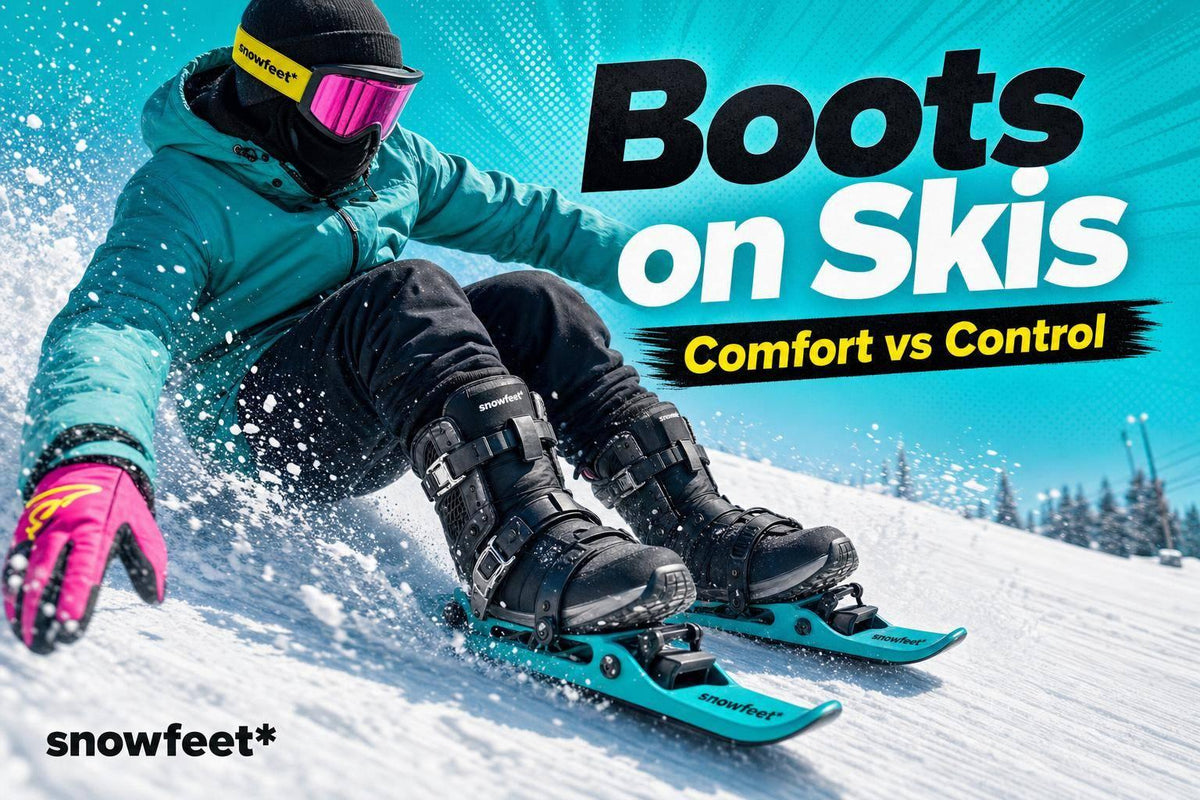
Yes - you can use snowboard boots on some short skis, but only with the right bindings. If you use standard alpine ski bindings with snowboard boots, that’s a safety problem. For most riders, snowboard boots work best on 44 cm, 50 cm, 65 cm, and 99 cm short skis, while 120 cm setups lean more toward ski boots.
Here’s the short version:
- Best for comfort: snowboard boots
- Best for edge grip and higher speed: ski boots
- Best short-ski match for snowboard boots: 99 cm for most people
- Best for travel: 44 cm and 50 cm
- Best for parks and tight turns: 44 cm and 65 cm
- Not a good idea for deep powder or icy, fast runs: snowboard boots on very short skis
If I already own snowboard boots, this setup can cut costs by skipping an extra pair of ski boots. It also makes walking, packing, and lift-line life way less annoying. That’s a win.
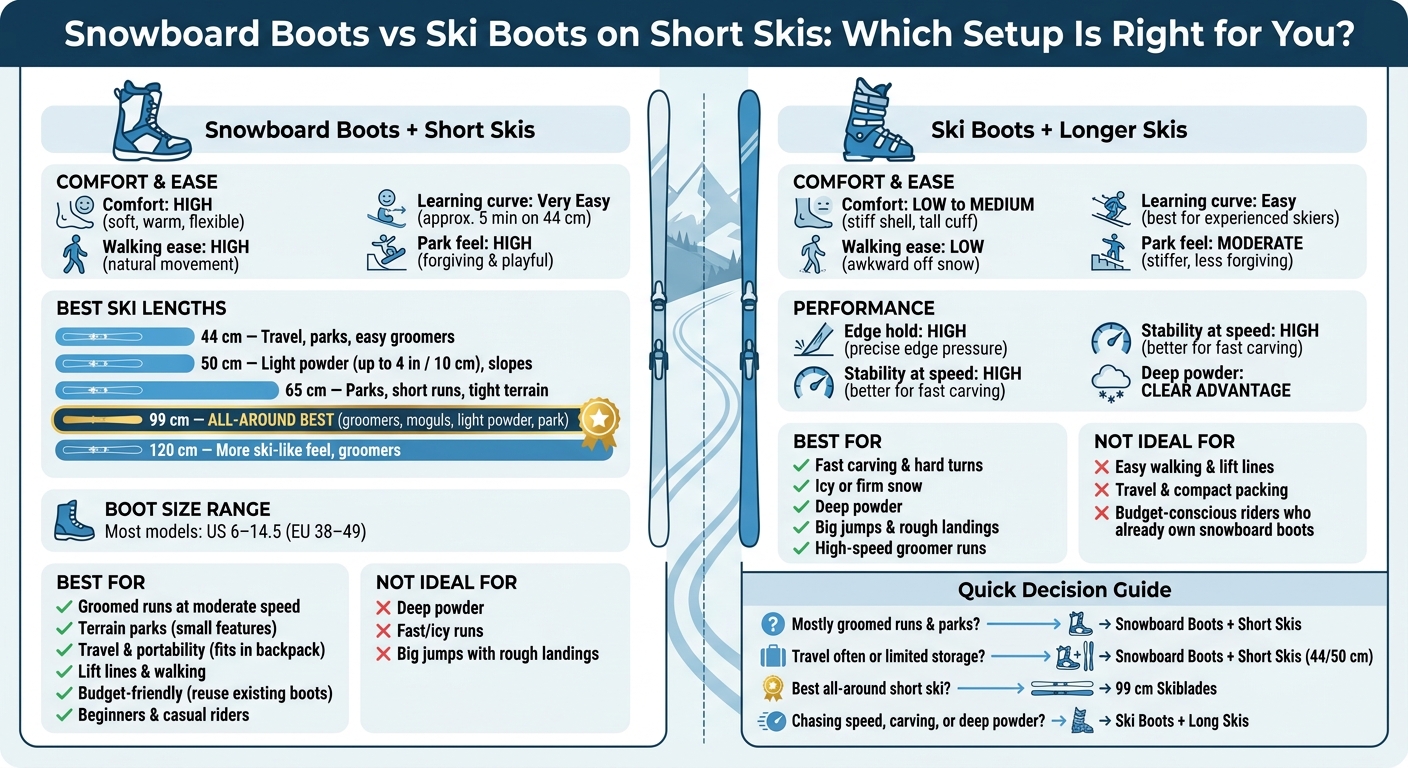
Snowboard Boots vs Ski Boots on Short Skis: Which Setup Is Right for You?
Bindings for Short Skis | All You Need to Know
Quick Comparison
| Setup | Comfort | Control | Best Use | Main Downside |
|---|---|---|---|---|
| Snowboard boots + 44/50 cm short skis | High | Medium | Travel, parks, easy groomers | Less stable at speed |
| Snowboard boots + 65/99 cm short skis | High | Medium to high | Groomers, mixed resort riding, park laps | Less edge power than ski boots |
| Snowboard boots + 120 cm short skis | Medium to high | Medium | Riders who want more ski feel without ski boots | Not as sharp as ski boots |
| Ski boots + longer skis | Low to medium | High | Fast carving, icy runs, deep powder | Bulkier, harder to walk in |
A few numbers help tell the story:
- Short skis here range from 44 cm to 120 cm
- The all-around sweet spot is often 99 cm
- The 50 cm model is said to handle up to about 4 in. (10 cm) of powder
- Many compatible bindings fit about U.S. sizes 6 to 14.5
So, if you want a fun, simple setup for groomers, park laps, and travel, snowboard boots on short skis make a lot of sense. If your day is all about speed, hard carving, or deep snow, I’d stick with ski boots and longer skis. Nice and simple :)
For a quick visual explainer, these videos can help:
- What are skiblades? YouTube search
- Snowfeet short skis review YouTube search
- Skiskates riding demo YouTube search
Snowboard Boots vs. Ski Boots on Short Skis
Comfort and Learning Curve
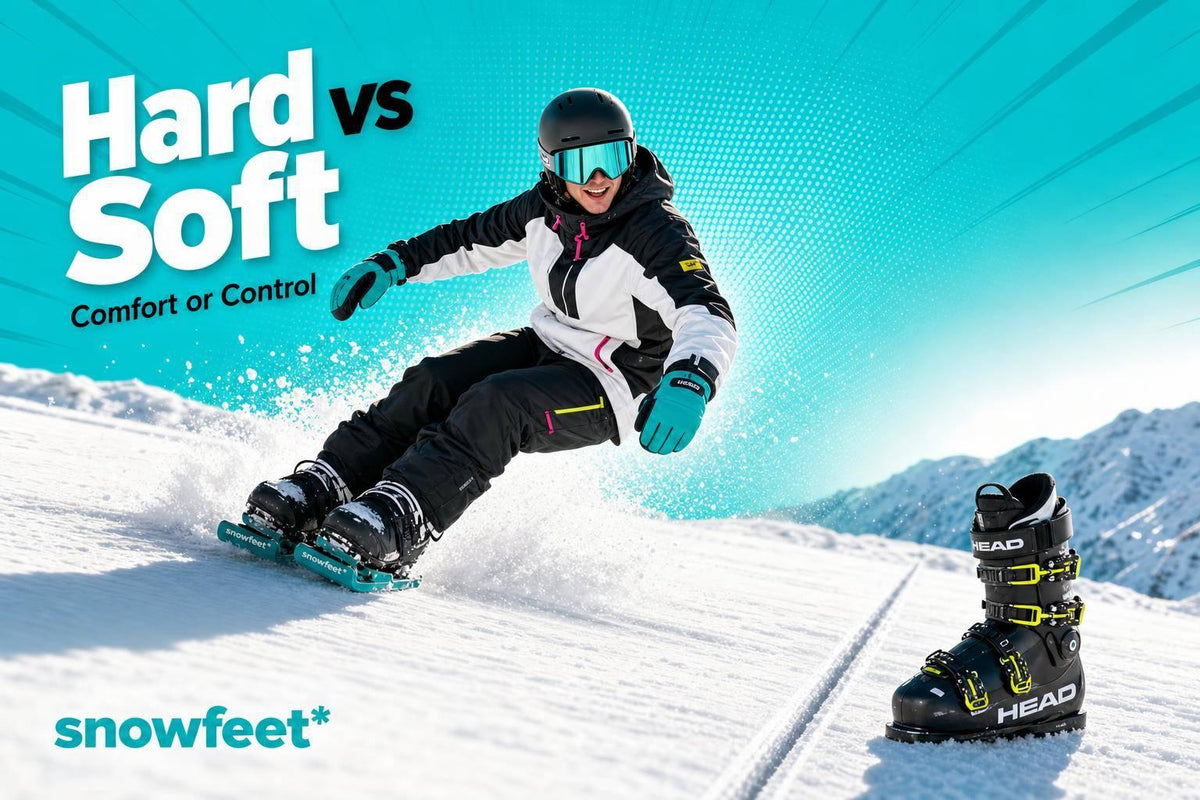
Snowboard boots are softer and more flexible than ski boots. Ski boots have a stiff shell and a tall cuff, which helps push power straight to the edges. Snowboard boots use softer materials and flexible soles, so they feel much more like winter shoes.
On short skis, you notice that fast. Snowboard boots are much nicer for walking, standing around in lift lines, and taking a lunch break. They also feel simpler to learn on, which is a big plus for beginners or casual riders who want a fun setup without going all-in on a full ski kit.
Control, Speed, and Edge Precision
Ski boots still win on edge precision. Since snowboard boots flex more, they send less power straight into the edge. But on short skis, that gap shrinks a bit. These skis are already quick, light, and easy to move around. So at low to mid speeds on groomed runs, snowboard boots do the job just fine for most casual riders.
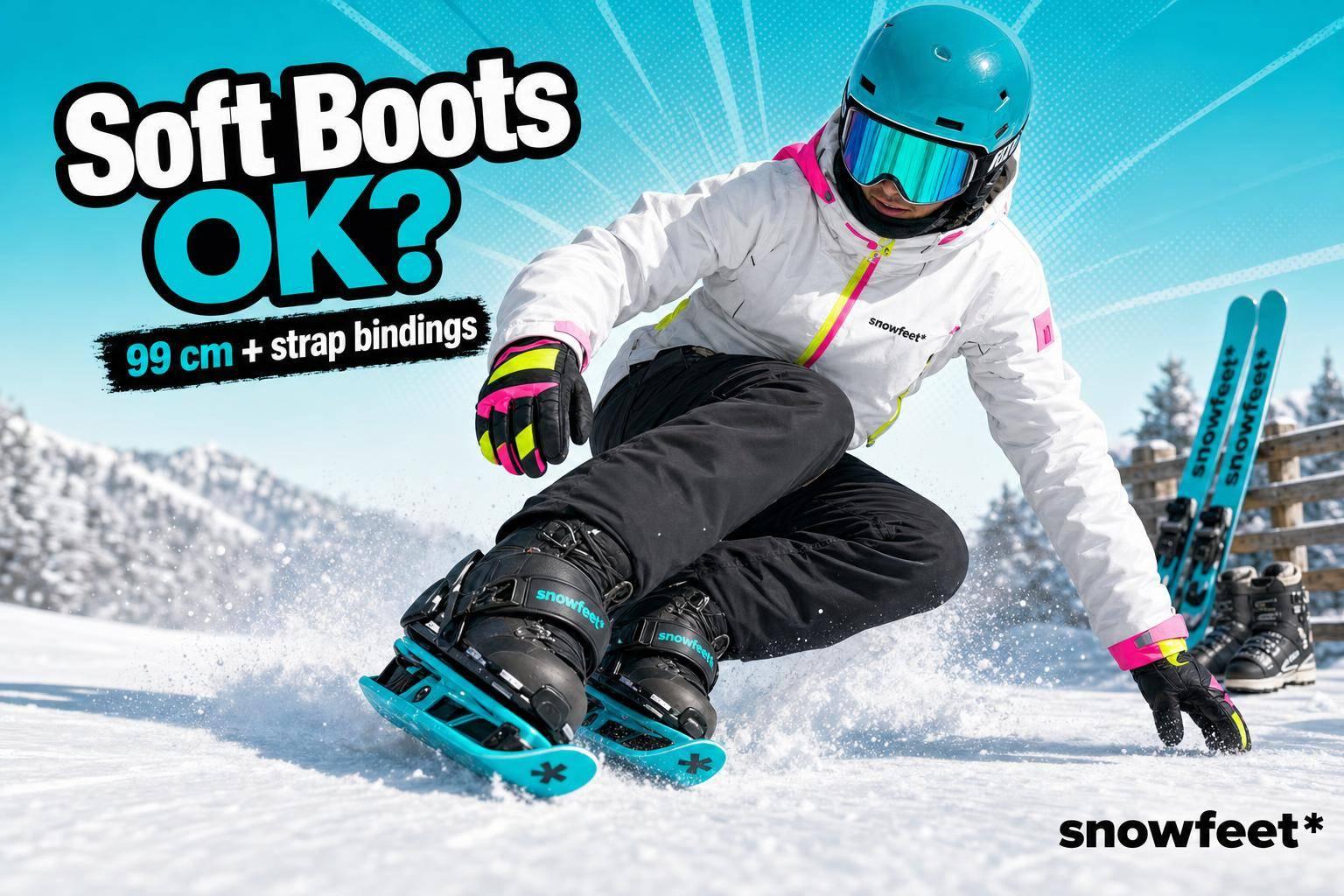
Snowboard boots pair best with the 44 cm, 50 cm, 65 cm, and 99 cm Snowfeet* setups. The 120 cm Skiblades lean more toward ski-boot use.
Here’s the day-to-day difference on the mountain.
| Category | Snowboard Boots | Ski Boots |
|---|---|---|
| Comfort | High - soft, warm, flexible | Moderate - stiff and restrictive |
| Walking ease | High - natural movement | Low - less comfortable off snow |
| Edge hold | Moderate - less direct power transfer | High - precise edge pressure |
| Stability at speed | Moderate - best at low to mid speeds | High - better for faster carving |
| Park feel | High - forgiving and playful | Moderate - stiffer and less forgiving |
| Learning curve | Very easy - approachable for beginners | Easy - best for skiers used to ski boots |
That trade-off shifts with ski length, which is why the best Snowfeet* setups for snowboard boots come next.
sbb-itb-17ade95
Best Snowfeet* Setups for Snowboard Boots
Snowfeet* keeps snowboard-boot setups pretty simple. A few models are made for them right out of the box. So the main choice isn’t can I use snowboard boots? It’s which length makes the most sense for how you ride: the tiny 44 cm and 50 cm options, or the longer 65 cm, 99 cm, and 120 cm versions.
Snowfeet* Skiskates 44 cm and Snowfeet PRO 50 cm
These two are the easy-travel picks. Both fit in a backpack, which makes them simple to pack, carry, and toss in the car without playing gear Tetris.
The Skiskates 44 cm use a wood core and a parabolic shape. They fit snowboard boots in sizes US 6–14.5 (EU 38–49). On groomed runs, they feel quick and snappy, and the learning curve is about five minutes. That’s pretty wild, honestly.
The Snowfeet PRO 50 cm bumps things up with a fiberglass-reinforced core and a built-in heel brake. That setup makes them more forgiving, which is nice if you’re new or just want a calmer ride. They fit snowboard boots in sizes US 6–13 (EU 38–47). One thing to watch: bulky US 12–13 boots can feel too tight.
If the shortest models sound fun but you want a bit more balance underfoot, the longer Skiblades are the next step.
Snowfeet* Skiblades 65 cm, 99 cm, and 120 cm
The Skiblades bring more stability and feel closer to skiing. Each length has its own lane.
The 65 cm is the most playful of the bunch. It works well in parks and on short runs. If you like quick turns and a loose feel, this one has that energy.
The 99 cm is the best all-around choice for most casual riders. It has about a 6-meter turning radius and works well on groomers, moguls, light powder, and park laps. It’s also sold with snowboard boot bindings, which is a big plus if you want more support underfoot without changing into ski boots.
The 120 cm is the longest option. It’s better for riders who want more ski-like stability, especially on groomers and while carving.
Here’s the lineup side by side:
| Model | Length | Boot Compatibility | Ideal Terrain | Skill Level | Portability | Main Trade-off |
|---|---|---|---|---|---|---|
| Skiskates | 44 cm | Snowboard or ski boots | Groomed slopes, parks | Beginner to pro | Fits in backpack | Poor in deep powder |
| Snowfeet PRO | 50 cm | Winter shoes or snowboard boots | Slopes, light powder | Beginner/casual | Fits in backpack | Not for high speed |
| Skiblades | 65 cm | Snowboard or ski boots | Parks, short runs | Intermediate | Very portable | Less stable than 99 cm |
| Skiblades | 99 cm | Snowboard or ski boots | All-mountain, groomers, moguls, light powder, park | All levels | Easy to carry | Less stable than long skis |
| Skiblades | 120 cm | Snowboard or ski boots | Groomers, carving | Intermediate–advanced | Moderate | Less portable than shorter models |
If you’re stuck between models, here’s the short version:
- 44 cm and 50 cm: best for travel, easy packing, and quick fun
- 99 cm: best all-around pick for control and stability
How Snowfeet* Compares to Long Skis and Other Short-Ski Brands
Long skis still come out ahead for top speed and deep powder. No surprise there.
But for a lot of casual resort riders, Snowfeet* is easier to learn, easier to carry, and much simpler if you want to ride in snowboard boots instead of buying a separate ski-boot setup. That’s a big deal. Fewer gear changes, less hassle, more time on snow.
That gap shows up most on groomers, in parks, and on short runs, where portability and easy handling matter the most.
Pros and Cons by Terrain and Use Case
Groomers and Everyday Resort Riding
This trade-off shows up most on groomers. On packed runs, snowboard boots on Snowfeet* feel easier, softer, and more forgiving than a full ski setup. That’s a big plus if you want a fun, low-stress day. The flip side? You get less edge hold and less stability as speed picks up and the snow gets firmer.
If you want the best middle ground for resort use, go with the 99 cm Skiblades. They hit a nice sweet spot. The 120 cm version gives you more stability at speed, which can feel a lot better when things get fast.
Parks, Short Runs, Trees, and Travel
The upside gets much bigger in tight terrain and anytime packing light matters. This is where snowboard boots on short skis make the most sense. The 44 cm Skiskates and 65 cm Skiblades are quick to turn, easy to slow down, and simple to move through tight spots without fighting the gear.
The Snowfeet PRO 50 cm works well on groomed runs, in snow parks, and in up to about 4 inches (10 cm) of powder.
Travel is another strong point. The 44 cm and 50 cm models are easy to pack, and you can use the snowboard boots you already own. That’s hard to beat if you don’t want to haul a full ski setup through airports, parking lots, or crowded lodges.
Still, there are limits. Big jumps, rough landings, icy snow, and deep powder are better handled by longer skis and stiffer boots. That gear gives you more support when the snow gets tricky or the stakes get higher.
Use the table below to match the terrain with the setup.
| Scenario | Snowboard Boots + Snowfeet* Short Skis | Ski Boots + Long Skis |
|---|---|---|
| Groomers (moderate speed) | Easy turns, comfortable all day, quick to learn | Better edge hold and more precision |
| Groomers (fast/icy) | Less stable, weaker edge grip | Stronger grip and more confidence |
| Terrain park (small features) | Great for spins, boxes, and low jumps | Works well, but less agile |
| Terrain park (big jumps) | Limited support and stability | Better for speed, takeoffs, and landings |
| Tight terrain (short runs, trees) | Quick direction changes, compact and maneuverable | More stable in deeper snow, but less nimble |
| Light powder | Manageable on shorter Snowfeet* setups | Better float and stability |
| Deep powder | Not recommended | Clear advantage |
| Travel and portability | Fits in a backpack or small bag, reuses existing boots | Requires more packing space and dedicated gear |
| Lift lines and walking | Comfortable and easy to move in | Heavy and awkward off the snow |
Conclusion: Which Setup Is Right for You
Once you stack comfort next to control, the call gets pretty simple: go with snowboard boots on short skis if you want comfort and easy handling. Go with ski boots and longer skis if you care more about speed and precise turns.
Snowfeet* gives you options across the whole range:
- 44/50 cm for easy packing and travel
- 65 cm for nimble handling
- 99/120 cm for a more ski-like feel and added stability
If you already have snowboard boots, Snowfeet* can cut your cost and make travel a lot easier. That’s one less piece of gear to buy, haul, and cram into a closet. Always nice :)
Here’s the quick way to think about it:
- Mostly groomed runs and parks? Short skis are the better fit.
- Moderate speeds or still learning? The shorter learning curve helps a lot.
- Already own snowboard boots? Use them and save some money.
- Travel often or short on storage? The compact Snowfeet* sizes are tough to beat.
If most of that sounds like you, snowboard boots on short skis are the right move. If you spend your days chasing speed, hard carving, or deep powder, ski boots and longer skis make more sense.
FAQs
Do I need special bindings for snowboard boots?
No. You don’t need separate gear. You just need a Snowfeet* model made for snowboard-boot bindings.
Here’s the simple part: old-school ski release bindings don’t work with soft snowboard boots. They’re built for a different kind of boot, so the fit just isn’t right.
Snowfeet* gets around that with custom, tool-free bindings that give you a secure, comfortable fit. So if you ride in snowboard boots, make sure you choose the snowboard-boot version. It fits US sizes 6–14.5.
Which short ski length is best for beginners?
For beginners, the best pick comes down to one thing: do you want the fastest learning curve, or do you want a bit more stability?
If your goal is to learn fast and get that nimble, skate-like feel, the 44 cm Skiskates are the best place to start. They feel playful and light on your feet, which helps a lot when you’re getting used to the movement.
If you’d rather have a more stable, planted feel that still stays forgiving, go with the 50 cm Snowfeet PRO. It’s the best all-around choice for many new riders.
A nice bonus with both options: they work with your existing snowboard boots. That matters more than people think. Snowboard boots often feel more comfortable and more forgiving than ski boots, which can make those first sessions a lot less awkward :)
Are snowboard boots on short skis safe at higher speeds?
Yes - if you use a setup made for snowboard boots, like Snowfeet models. That’s the key part. Standard alpine bindings don’t work with snowboard boots, and trying to mix the two can be unsafe.
On short skis under 100 cm, snowboard-friendly non-release bindings can hold your boots in place well. These setups work best for moderate, playful speeds - think fun laps, quick turns, and messing around on mellow terrain.
Push the speed up too much, though, and the trade-off shows up fast. Snowboard boots don’t give you the same precision and stability as stiff ski boots. A stiffer freeride boot can help a lot, but it still won’t feel the same as a ski boot setup.
And one more thing: always attach safety leashes. No shortcuts there.











Leave a comment
This site is protected by hCaptcha and the hCaptcha Privacy Policy and Terms of Service apply.